


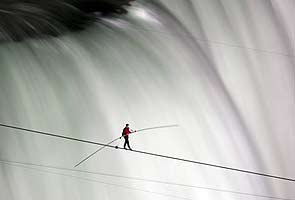
Nik Wallenda, first man to complete 1800-feet tightrope walk across Niagara Falls

June 16, 2012

niagara_falla_tightrope_walk.295

Ontario, Canada, June 16: Daredevil Nik Wallenda became the first person to walk on a tightrope across the Niagara Falls, taking steady, measured steps Friday night for 1,800 feet across the mist-fogged brink of the roaring falls separating the U.S. and Canada.

"I feel like I'm on cloud nine right now," an exuberant Wallenda told reporters after accomplishing what he said was his childhood dream before an estimated 112,000 people crowding the shores of both countries and millions more who watched a live television broadcast.

He described wind "coming from every which way," mist so powerful he had to blink it away to maintain his vision and a breathtaking view during the nighttime walk illuminated by spotlights that "compared to nothing."

"There was no way to focus on the movement of the cable," said Wallenda, 33. "If I looked down at the cable there was water moving everywhere. And if I looked up there was heavy mist blowing in front of my face. So it was a very unique, a weird sensation."

He said he accomplished the feat through "a lot of praying, that's for sure. But, you know, it's all about the concentration, the focus, and the training."

The seventh-generation member of the famed Flying Wallendas had long dreamed of pulling off the stunt, never before attempted. Other daredevils have wire-walked over the Niagara River but farther downstream and not since 1896.


"This is what dreams are made of, people," said Wallenda, who wore a microphone for the broadcast, shortly after he stepped off from a platform on the American shore.

Along the way, he calmly prayed aloud.

After passing the halfway mark, Wallenda expressed fatigue. "I'm strained, I'm drained," he said. "This is so physical, not only mental but physical."

Toward the end, as he neared the Canadian shore, Wallenda dropped to one knee and pumped his fist while the spectators cheered.


He broke into a playful run about 15 feet from the finish line, where his wife and three children waited.

"I am so blessed," he said later. "How blessed I am to have the life that I have."

ABC televised the walk and insisted Wallenda use a tether to keep him from falling in the river. Wallenda said he agreed because he wasn't willing to lose the chance to perform the walk it took him well over a year to win permission from two countries to do. Such stunts are normally illegal. ABC's sponsorship helped offset some of the $1.3 million cost of the spectacle.

Wallenda said he thought about the tether, which was secured at his waist and dragged behind him, at several points along the 30-minute walk but wasn't hindered by it as he'd feared.

"Awesome! The whole thing is awesome," 8-year-old William Clements of Dresden, Ontario, said after watching the walk with his family from the Canadian side, adding he wouldn't want to walk "even over something not high."

"He was meant to do it. The weather was perfect," said Glenda Rutherford of Ontario. "It was amazing."

For Wallenda, who has grown up on the high wire and holds six Guinness records for various stunts, the Niagara Falls walk was unlike anything he'd ever done. Because it was over water, the 2-inch wire didn't have the usual stabilizer cables to keep it from swinging. Pendulum anchors were designed to keep it from twisting under the elkskin-soled shoes designed by his mother.

The Wallendas trace their roots to 1780 Austria-Hungary, when ancestors traveled as a band of acrobats, aerialists, jugglers, animal trainers and trapeze artists. The clan has been touched by tragedy, notably in 1978 when patriarch Karl Wallenda, Nik's great-grandfather, fell to his death during a stunt in Puerto Rico.

Wallenda said that at one point in the middle of the walk, he thought about his great-grandfather and the walks he had taken:


"That's what this is all about, paying tribute to my ancestors, and my hero, Karl Wallenda."

About a dozen other tightrope artists have crossed the Niagara Gorge downstream, dating to Jean Francois Gravelet, aka The Great Blondin, in 1859. But no one had walked directly over the falls, and authorities hadn't allowed any tightrope acts in the area since 1896. It took Wallenda two years to persuade U.S. and Canadian authorities to allow it, and many civic leaders hoped to use the publicity to jumpstart the region's struggling economy, particularly on the U.S. side of the falls.



Comments

Add new comment

  • Coastaldigest.com reserves the right to delete or block any comments.
  • Coastaldigset.com is not responsible for its readers’ comments.
  • Comments that are abusive, incendiary or irrelevant are strictly prohibited.
  • Please use a genuine email ID and provide your name to avoid reject.
News Network
June 15,2020

Dubai, Jun 15: The global tally of Covid-19 coronavirus infections crossed the 8 million mark on Monday, with recoveries at 4.13 million, and deaths at nearly 436,000.

As of 11.40am UAE time, there were 3.43 active Covid-19 cases globally, of which 54,460 were serious or critical.

The United States still leads the charts with 2.16 million cases and 117,858 deaths. Behind US, at a distant No 2, is Brazil with 867,882 cases and 43,389 deaths.

Russia, India, the UK, Spain, Italy, Peru, Germany and Iran complete the top 10.

Comments

Add new comment

  • Coastaldigest.com reserves the right to delete or block any comments.
  • Coastaldigset.com is not responsible for its readers’ comments.
  • Comments that are abusive, incendiary or irrelevant are strictly prohibited.
  • Please use a genuine email ID and provide your name to avoid reject.
News Network
May 8,2020

New York, May 8: An Indian-American father and daughter, both doctors in New Jersey, have died due to the COVID-19, with Governor Phil Murphy describing their demise as “particularly tough" and hailed them for dedicating their lives for others.

Satyender Dev Khanna, 78, was a surgeon who served both on staff and as the head of the surgical departments for multiple hospitals across New Jersey for decades.

Priya Khanna, 43, was a double board-certified in both internal medicine and nephrology. She was Chief of Residents at Union Hospital, now part of RWJ Barnabas Health.

"Dr Satyender Dev Khanna and Dr Priya Khanna were father and daughter. They both dedicated their lives to helping others. This is a family dedicated to health and medicine. Our words cannot amply express our condolences," New Jersey Governor Murphy tweeted on Thursday.

“Both dedicated their lives to helping others and we lost both of them to COVID-19,” Murphy said during a press conference on Thursday, saying their demise is a "particularly tough one.”

Satyender passed away at the Clara Maass Medical Center where he had worked for more than 35 years.

Murphy described him as a "pioneering doctor” who was one of the first surgeons to perform laparoscopic surgery in the state. He is being remembered by colleagues as a “gentle and caring physician."

“And for a doctor, I'm not one, but I would bet, I don't think there could be a more fitting way to be remembered, or a nurse or a healthcare worker of any kind,” Murphy said, adding that the doctor had a passion for bicycling, and he often found peace from the hustle of the hospital in biking along the Jersey Shore.

Priya did all of her medical training in New Jersey and then did her fellowship in nephrology in South Jersey with the Cooper Health System. Like her father, she too worked at Clara Maass, where she died.

She was also Medical Director at two dialysis centres in Essex County and “took pride” in teaching the next generation of doctors, Murphy said, adding that the ICU physician who cared for Priya Khanna was trained and taught by her as well.

Follow live developments on the coronavirus pandemic here

“Priya will be remembered as a caring and selfless person who put others first. And even while in the hospital, fighting her own battle, she continued to check up on her mom and dad and her family,” Murphy said.

“This is a family, by the way, dedicated to health and medicine,” he said.

The governor spoke with Satyender's wife Komlish Khanna, who is a paediatrician. The couple has two more daughters - Sugandha Khanna, an emergency medicine physician and Anisha Khanna, a paediatrician.

“Unbelievable. Our words cannot amply express our condolences nor, I am sure, can they express the pain that the Khanna family is feeling. But I hope that the fact that our entire state mourns with them is some small comfort. And we mourn everyone we have lost. We commit in their memory to saving as many lives as we can,” Murphy said.

Comments

Add new comment

  • Coastaldigest.com reserves the right to delete or block any comments.
  • Coastaldigset.com is not responsible for its readers’ comments.
  • Comments that are abusive, incendiary or irrelevant are strictly prohibited.
  • Please use a genuine email ID and provide your name to avoid reject.
Agencies
March 15,2020

Houston, Mar 15: Researchers, studying the novel coronavirus, have found that the time between cases in a chain of transmission is less than a week, and over 10 per cent of patients are infected by someone who has the virus, but does not show symptoms yet, a finding that may help public health officials contain the pandemic.

The study, published in the journal Emerging Infectious Diseases, estimated what's called the serial interval of the coronavirus by measuring the time it takes for symptoms to appear in two people with the virus -- the person who infects another, and the infected second person.

According to the researchers, including those from the University of Texas at Austin, the average serial interval for the novel coronavirus in China was approximately four days.

They said the speed of an epidemic depends on two things -- how many people each case infects, and how long it takes cases to spread.

The first quantity, the scientists said, is called the reproduction number, and the second is the serial interval.

Due to the short serial interval of the disease caused by the coronavirus -- COVID-19 -- they said, emerging outbreaks will grow quickly, and could be difficult to stop.

“Ebola, with a serial interval of several weeks, is much easier to contain than influenza, with a serial interval of only a few days,” said Lauren Ancel Meyers, study co-author from UT Austin.

Meyers explained that public health responders to Ebola outbreaks have much more time to identify and isolate cases before they infect others.

“The data suggest that this coronavirus may spread like the flu. That means we need to move quickly and aggressively to curb the emerging threat,” Meyers added.

In the study, the scientists examined more than 450 infection case reports from 93 cities in China, and found the strongest evidence yet that people without symptoms must be transmitting the virus -- known as pre-symptomatic transmission.

More than one in ten infections were from people who had the virus but did not yet feel sick, the scientists said.

While researchers across the globe had some uncertainty until now about asymptomatic transmission with the coronavirus, the new evidence could provide guidance to public health officials on how to contain the spread of the disease.

“This provides evidence that extensive control measures including isolation, quarantine, school closures, travel restrictions and cancellation of mass gatherings may be warranted,” Meyers said.

The researchers cautioned that asymptomatic transmission makes containment more difficult.

With hundreds of new cases emerging around the world every day, the scientists said, the data may offer a different picture over time.

They said infection case reports are based on people's memories of where they went and whom they had contact with, and if health officials move quickly to isolate patients, that may also skew the data.

“Our findings are corroborated by instances of silent transmission and rising case counts in hundreds of cities worldwide. This tells us that COVID-19 outbreaks can be elusive and require extreme measures,” Meyers said.

Comments

Add new comment

  • Coastaldigest.com reserves the right to delete or block any comments.
  • Coastaldigset.com is not responsible for its readers’ comments.
  • Comments that are abusive, incendiary or irrelevant are strictly prohibited.
  • Please use a genuine email ID and provide your name to avoid reject.