


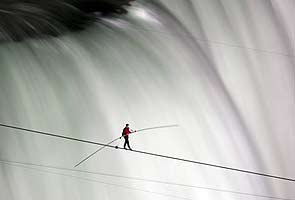
Nik Wallenda, first man to complete 1800-feet tightrope walk across Niagara Falls

June 16, 2012

niagara_falla_tightrope_walk.295

Ontario, Canada, June 16: Daredevil Nik Wallenda became the first person to walk on a tightrope across the Niagara Falls, taking steady, measured steps Friday night for 1,800 feet across the mist-fogged brink of the roaring falls separating the U.S. and Canada.

"I feel like I'm on cloud nine right now," an exuberant Wallenda told reporters after accomplishing what he said was his childhood dream before an estimated 112,000 people crowding the shores of both countries and millions more who watched a live television broadcast.

He described wind "coming from every which way," mist so powerful he had to blink it away to maintain his vision and a breathtaking view during the nighttime walk illuminated by spotlights that "compared to nothing."

"There was no way to focus on the movement of the cable," said Wallenda, 33. "If I looked down at the cable there was water moving everywhere. And if I looked up there was heavy mist blowing in front of my face. So it was a very unique, a weird sensation."

He said he accomplished the feat through "a lot of praying, that's for sure. But, you know, it's all about the concentration, the focus, and the training."

The seventh-generation member of the famed Flying Wallendas had long dreamed of pulling off the stunt, never before attempted. Other daredevils have wire-walked over the Niagara River but farther downstream and not since 1896.


"This is what dreams are made of, people," said Wallenda, who wore a microphone for the broadcast, shortly after he stepped off from a platform on the American shore.

Along the way, he calmly prayed aloud.

After passing the halfway mark, Wallenda expressed fatigue. "I'm strained, I'm drained," he said. "This is so physical, not only mental but physical."

Toward the end, as he neared the Canadian shore, Wallenda dropped to one knee and pumped his fist while the spectators cheered.


He broke into a playful run about 15 feet from the finish line, where his wife and three children waited.

"I am so blessed," he said later. "How blessed I am to have the life that I have."

ABC televised the walk and insisted Wallenda use a tether to keep him from falling in the river. Wallenda said he agreed because he wasn't willing to lose the chance to perform the walk it took him well over a year to win permission from two countries to do. Such stunts are normally illegal. ABC's sponsorship helped offset some of the $1.3 million cost of the spectacle.

Wallenda said he thought about the tether, which was secured at his waist and dragged behind him, at several points along the 30-minute walk but wasn't hindered by it as he'd feared.

"Awesome! The whole thing is awesome," 8-year-old William Clements of Dresden, Ontario, said after watching the walk with his family from the Canadian side, adding he wouldn't want to walk "even over something not high."

"He was meant to do it. The weather was perfect," said Glenda Rutherford of Ontario. "It was amazing."

For Wallenda, who has grown up on the high wire and holds six Guinness records for various stunts, the Niagara Falls walk was unlike anything he'd ever done. Because it was over water, the 2-inch wire didn't have the usual stabilizer cables to keep it from swinging. Pendulum anchors were designed to keep it from twisting under the elkskin-soled shoes designed by his mother.

The Wallendas trace their roots to 1780 Austria-Hungary, when ancestors traveled as a band of acrobats, aerialists, jugglers, animal trainers and trapeze artists. The clan has been touched by tragedy, notably in 1978 when patriarch Karl Wallenda, Nik's great-grandfather, fell to his death during a stunt in Puerto Rico.

Wallenda said that at one point in the middle of the walk, he thought about his great-grandfather and the walks he had taken:


"That's what this is all about, paying tribute to my ancestors, and my hero, Karl Wallenda."

About a dozen other tightrope artists have crossed the Niagara Gorge downstream, dating to Jean Francois Gravelet, aka The Great Blondin, in 1859. But no one had walked directly over the falls, and authorities hadn't allowed any tightrope acts in the area since 1896. It took Wallenda two years to persuade U.S. and Canadian authorities to allow it, and many civic leaders hoped to use the publicity to jumpstart the region's struggling economy, particularly on the U.S. side of the falls.



Comments

Add new comment

  • Coastaldigest.com reserves the right to delete or block any comments.
  • Coastaldigset.com is not responsible for its readers’ comments.
  • Comments that are abusive, incendiary or irrelevant are strictly prohibited.
  • Please use a genuine email ID and provide your name to avoid reject.
News Network
February 26,2020

Feb 26: China’s massive travel restrictions, house-to-house checks, huge isolation wards and lockdowns of entire cities bought the world valuable time to prepare for the global spread of the new virus.

But with troubling outbreaks now emerging in Italy, South Korea and Iran, and U.S. health officials warning Tuesday it’s inevitable it will spread more widely in America, the question is: Did the world use that time wisely and is it ready for a potential pandemic?

“It’s not so much a question of if this will happen anymore, but rather more a question of exactly when this will happen — and how many people in this country will have severe illness,” said Dr. Nancy Messonnier of the U.S. Centers for Disease Control and Prevention.

Some countries are putting price caps on face masks to combat price gouging, while others are using loudspeakers on trucks to keep residents informed. In the United States and many other nations, public health officials are turning to guidelines written for pandemic flu and discussing the possibility of school closures, telecommuting and canceling events.

Countries could be doing even more: training hundreds of workers to trace the virus’ spread from person to person and planning to commandeer entire hospital wards or even entire hospitals, said Dr. Bruce Aylward, the World Health Organization’s envoy to China, briefing reporters Tuesday about lessons learned by the recently returned team of international scientists he led.

“Time is everything in this disease,” Aylward said. “Days make a difference with a disease like this.”

The U.S. National Institutes of Health’s infectious disease chief, Dr. Anthony Fauci, said the world is “teetering very, very close” to a pandemic. He credits China’s response for giving other nations some breathing room.

China locked down tens of millions of its citizens and other nations imposed travel restrictions, reducing the number of people who needed health checks or quarantines outside the Asian country.

It “gave us time to really brush off our pandemic preparedness plans and get ready for the kinds of things we have to do,” Fauci said. “And we’ve actually been quite successful because the travel-related cases, we’ve been able to identify, to isolate” and to track down those they came in contact with.

With no vaccine or medicine available yet, preparations are focused on what’s called “social distancing” — limiting opportunities for people to gather and spread the virus.

That played out in Italy this week. With cases climbing, authorities cut short the popular Venice Carnival and closed down Milan’s La Scala opera house. In Japan, Prime Minister Shinzo Abe called on companies to allow employees to work from home, while the Tokyo Marathon has been restricted to elite runners and other public events have been canceled.

Is the rest of the world ready?

In Africa, three-quarters of countries have a flu pandemic plan, but most are outdated, according to authors of a modeling study published last week in The Lancet medical journal. The slightly better news is that the African nations most connected to China by air travel — Egypt, Algeria and South Africa — also have the most prepared health systems on the continent.

Elsewhere, Thailand said it would establish special clinics to examine people with flu-like symptoms to detect infections early. Sri Lanka and Laos imposed price ceilings for face masks, while India restricted the export of personal protective equipment.

India’s health ministry has been framing step-by-step instructions to deal with sustained transmissions that will be circulated to the 250,000 village councils that are the most basic unit of the country’s sprawling administration.

Vietnam is using music videos on social media to reach the public. In Malaysia, loudspeakers on trucks blare information through the streets.

In Europe, portable pods set up at United Kingdom hospitals will be used to assess people suspected of infection while keeping them apart from others. France developed a quick test for the virus and has shared it with poorer nations. German authorities are stressing “sneezing etiquette” and Russia is screening people at airports, railway stations and those riding public transportation.

In the U.S., hospitals and emergency workers for years have practiced for a possible deadly, fast-spreading flu. Those drills helped the first hospitals to treat U.S. patients suffering from COVID-19, the disease caused by the virus.

Other hospitals are paying attention. The CDC has been talking to the American Hospital Association, which in turn communicates coronavirus news daily to its nearly 5,000 member hospitals. Hospitals are reviewing infection control measures, considering using telemedicine to keep potentially infectious patients from making unnecessary trips to the hospital and conserving dwindling supplies of masks and gloves.

What’s more, the CDC has held 17 different calls reaching more than 11,000 companies and organizations, including stadiums, universities, faith leaders, retailers and large corporations. U.S. health authorities are talking to city, county and state health departments about being ready to cancel mass gathering events, close schools and take other steps.

The CDC’s Messonnier said Tuesday she had contacted her children’s school district to ask about plans for using internet-based education should schools need to close temporarily, as some did in 2009 during an outbreak of H1N1 flu. She encouraged American parents to do the same, and to ask their employers whether they’ll be able to work from home.

“We want to make sure the American public is prepared,” Messonnier said.

How prepared are U.S. hospitals?

“It depends on caseload and location. I would suspect most hospitals are prepared to handle one to two cases, but if there is ongoing local transmission with many cases, most are likely not prepared just yet for a surge of patients and the ‘worried well,’” Dr. Jennifer Lighter, a pediatric infectious diseases specialist at NYU Langone in New York, said in an email.

In the U.S., a vaccine candidate is inching closer to first-step safety studies in people, as Moderna Inc. has delivered test doses to Fauci’s NIH institute. Some other companies say they have candidates that could begin testing in a few months. Still, even if those first safety studies show no red flags, specialists believe it would take at least a year to have something ready for widespread use. That’s longer than it took in 2009, during the H1N1 flu pandemic — because that time around, scientists only had to adjust regular flu vaccines, not start from scratch.

The head of the World Health Organization, Tedros Adhanom Ghebreyesus, said the U.N. health agency’s team in China found the fatality rate between 2% and 4% in the hard-hit city of Wuhan, the virus’ epicenter, and 0.7% elsewhere.

The world is “simply not ready,” said the WHO’s Aylward. “It can get ready very fast, but the big shift has to be in the mindset.”

Aylward advised other countries to do “really practical things” now to get ready.

Among them: Do you have hundreds of workers lined up and trained to trace the contacts of infected patients, or will you be training them after a cluster pops up?

Can you take over entire hospital wards, or even entire hospitals, to isolate patients?

Are hospitals buying ventilators and checking oxygen supplies?

Countries must improve testing capacity — and instructions so health workers know which travelers should be tested as the number of affected countries rises, said Johns Hopkins University emergency response specialist Lauren Sauer. She pointed to how Canada diagnosed the first traveler from Iran arriving there with COVID-19, before many other countries even considered adding Iran to the at-risk list.

If the disease does spread globally, everyone is likely to feel it, said Nancy Foster, a vice president of the American Hospital Association. Even those who aren’t ill may need to help friends and family in isolation or have their own health appointments delayed.

“There will be a lot of people affected even if they never become ill themselves,” she said.

Comments

Add new comment

  • Coastaldigest.com reserves the right to delete or block any comments.
  • Coastaldigset.com is not responsible for its readers’ comments.
  • Comments that are abusive, incendiary or irrelevant are strictly prohibited.
  • Please use a genuine email ID and provide your name to avoid reject.
News Network
June 1,2020

Jun 1: The new coronavirus is losing its potency and has become much less lethal, a senior Italian doctor said on Sunday.

"In reality, the virus clinically no longer exists in Italy," said Alberto Zangrillo, the head of the San Raffaele Hospital in Milan in the northern region of Lombardy, which has borne the brunt of Italy's coronavirus contagion.

"The swabs that were performed over the last 10 days showed a viral load in quantitative terms that was absolutely infinitesimal compared to the ones carried out a month or two months ago," he told RAI television.

Italy has the third-highest death toll in the world from COVID-19, with 33,415 people dying since the outbreak came to light on Feb. 21. It has the sixth-highest global tally of cases at 233,019.

However new infections and fatalities have fallen steadily in May and the country is unwinding some of the most rigid lockdown restrictions introduced anywhere on the continent.

Zangrillo said some experts were too alarmist about the prospect of a second wave of infections and politicians needed to take into account the new reality.

"We've got to get back to being a normal country," he said. "Someone has to take responsibility for terrorizing the country."

The government urged caution, saying it was far too soon to claim victory.

"Pending scientific evidence to support the thesis that the virus has disappeared ... I would invite those who say they are sure of it not to confuse Italians," Sandra Zampa, an undersecretary at the health ministry, said in a statement.

"We should instead invite Italians to maintain the maximum caution, maintain physical distancing, avoid large groups, to frequently wash their hands and to wear masks."

A second doctor from northern Italy told the national ANSA news agency that he was also seeing the coronavirus weaken. "The strength the virus had two months ago is not the same strength it has today," said Matteo Bassetti, head of the infectious diseases clinic at the San Martino hospital in the city of Genoa.

"It is clear that today the COVID-19 disease is different."

Comments

Add new comment

  • Coastaldigest.com reserves the right to delete or block any comments.
  • Coastaldigset.com is not responsible for its readers’ comments.
  • Comments that are abusive, incendiary or irrelevant are strictly prohibited.
  • Please use a genuine email ID and provide your name to avoid reject.
News Network
May 30,2020

Washington, May 30: The United States will end its relationship with the World Health Organization over the body’s handling of the coronavirus pandemic, U.S. President Donald Trump said on Friday, accusing the U.N. agency of becoming a puppet of China.

The move to quit the Geneva-based body, which the United States formally joined in 1948, comes amid growing tensions between Washington and Beijing over the coronavirus outbreak. The virus first emerged in China’s Wuhan city late last year.

Speaking in the White House Rose Garden, Trump said Chinese officials “ignored their reporting obligations” to the WHO about the virus - that has killed hundreds of thousands of people globally - and pressured the agency to “mislead the world.”

“China has total control over the World Health Organization despite only paying $40 million per year compared to what the United States has been paying which is approximately $450 million a year,” he said.

Trump’s decision follows a pledge last week by Chinese President Xi Jinping to give $2 billion to the WHO over the next two years to help combat the coronavirus. The amount almost matches the WHO’s entire annual program budget for last year.

Trump last month halted funding for the 194-member organization, then in a May 18 letter gave the WHO 30 days to commit to reforms.

“Because they have failed to make the requested and greatly needed reforms, we will be today terminating our relationship with the World Health Organization and redirecting those funds to other worldwide and deserving urgent global public health needs,” Trump said on Friday.

It was not immediately clear when his decision would come into effect. A 1948 joint resolution of Congress on U.S. membership of the WHO said the country “reserves its right to withdraw from the organization on a one-year notice.”

The World Health Organization did not immediately respond to a request for comment on Trump’s announcement. It has previously denied Trump’s assertions that it promoted Chinese “disinformation” about the virus.

“It’s important to remember that the WHO is a platform for cooperation among countries,” said Donna McKay, executive director of Physicians for Human Rights. “Walking away from this critical institution in the midst of an historic pandemic will hurt people both in the United States and around the world.”

‘ABSOLUTELY CRITICAL’

The United States currently owes the WHO more than $200 million in assessed contributions, according to the WHO website. Washington also gives several hundred million dollars annually in voluntary funding tied to specific WHO programs such as polio eradication, HIV, hepatitis and tuberculosis.

Amesh A. Adalja, a senior scholar at Johns Hopkins Center for Health Security, said that in practice Trump’s decision was unlikely to change the operations of the WHO.

“From a symbolic or moral standpoint it’s the wrong type of action to be taking in the middle of a pandemic and seems to deflect responsibility for what we in the U.S. failed to do and blame the WHO,” said Adalja.

When Trump halted funding to the WHO last month, two Western diplomats said the U.S. suspension was more harmful politically to the WHO than to the agency’s current programs, which are funded for now.

The WHO is an independent international body that works with the United Nations. U.N. Secretary-General Antonio Guterres said last month that the WHO is “absolutely critical to the world’s efforts to win the war against COVID-19.”

When asked about Trump’s decision, a U.N. spokesman said: “We have consistently called for all states to support WHO.”

Trump has long scorned multilateralism as he focuses on an “America First” agenda. Since taking office, he has quit the U.N. Human Rights Council, the U.N. cultural agency, a global accord to tackle climate change and the Iran nuclear deal. He has also cut funding for the U.N. population fund and the U.N. agency that aids Palestinian refugees.

“The WHO is the world’s early warning system for infectious diseases,” said U.S. Representative Nita Lowey, a Democrat who chairs the House Committee on Appropriations. “Now, during a global pandemic that has cost over 100,000 American lives, is not the time to put the country further at risk.”

Comments

Add new comment

  • Coastaldigest.com reserves the right to delete or block any comments.
  • Coastaldigset.com is not responsible for its readers’ comments.
  • Comments that are abusive, incendiary or irrelevant are strictly prohibited.
  • Please use a genuine email ID and provide your name to avoid reject.