


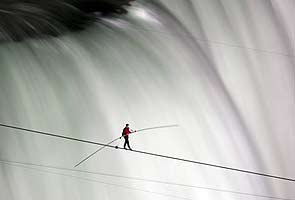
Nik Wallenda, first man to complete 1800-feet tightrope walk across Niagara Falls

June 16, 2012

niagara_falla_tightrope_walk.295

Ontario, Canada, June 16: Daredevil Nik Wallenda became the first person to walk on a tightrope across the Niagara Falls, taking steady, measured steps Friday night for 1,800 feet across the mist-fogged brink of the roaring falls separating the U.S. and Canada.

"I feel like I'm on cloud nine right now," an exuberant Wallenda told reporters after accomplishing what he said was his childhood dream before an estimated 112,000 people crowding the shores of both countries and millions more who watched a live television broadcast.

He described wind "coming from every which way," mist so powerful he had to blink it away to maintain his vision and a breathtaking view during the nighttime walk illuminated by spotlights that "compared to nothing."

"There was no way to focus on the movement of the cable," said Wallenda, 33. "If I looked down at the cable there was water moving everywhere. And if I looked up there was heavy mist blowing in front of my face. So it was a very unique, a weird sensation."

He said he accomplished the feat through "a lot of praying, that's for sure. But, you know, it's all about the concentration, the focus, and the training."

The seventh-generation member of the famed Flying Wallendas had long dreamed of pulling off the stunt, never before attempted. Other daredevils have wire-walked over the Niagara River but farther downstream and not since 1896.


"This is what dreams are made of, people," said Wallenda, who wore a microphone for the broadcast, shortly after he stepped off from a platform on the American shore.

Along the way, he calmly prayed aloud.

After passing the halfway mark, Wallenda expressed fatigue. "I'm strained, I'm drained," he said. "This is so physical, not only mental but physical."

Toward the end, as he neared the Canadian shore, Wallenda dropped to one knee and pumped his fist while the spectators cheered.


He broke into a playful run about 15 feet from the finish line, where his wife and three children waited.

"I am so blessed," he said later. "How blessed I am to have the life that I have."

ABC televised the walk and insisted Wallenda use a tether to keep him from falling in the river. Wallenda said he agreed because he wasn't willing to lose the chance to perform the walk it took him well over a year to win permission from two countries to do. Such stunts are normally illegal. ABC's sponsorship helped offset some of the $1.3 million cost of the spectacle.

Wallenda said he thought about the tether, which was secured at his waist and dragged behind him, at several points along the 30-minute walk but wasn't hindered by it as he'd feared.

"Awesome! The whole thing is awesome," 8-year-old William Clements of Dresden, Ontario, said after watching the walk with his family from the Canadian side, adding he wouldn't want to walk "even over something not high."

"He was meant to do it. The weather was perfect," said Glenda Rutherford of Ontario. "It was amazing."

For Wallenda, who has grown up on the high wire and holds six Guinness records for various stunts, the Niagara Falls walk was unlike anything he'd ever done. Because it was over water, the 2-inch wire didn't have the usual stabilizer cables to keep it from swinging. Pendulum anchors were designed to keep it from twisting under the elkskin-soled shoes designed by his mother.

The Wallendas trace their roots to 1780 Austria-Hungary, when ancestors traveled as a band of acrobats, aerialists, jugglers, animal trainers and trapeze artists. The clan has been touched by tragedy, notably in 1978 when patriarch Karl Wallenda, Nik's great-grandfather, fell to his death during a stunt in Puerto Rico.

Wallenda said that at one point in the middle of the walk, he thought about his great-grandfather and the walks he had taken:


"That's what this is all about, paying tribute to my ancestors, and my hero, Karl Wallenda."

About a dozen other tightrope artists have crossed the Niagara Gorge downstream, dating to Jean Francois Gravelet, aka The Great Blondin, in 1859. But no one had walked directly over the falls, and authorities hadn't allowed any tightrope acts in the area since 1896. It took Wallenda two years to persuade U.S. and Canadian authorities to allow it, and many civic leaders hoped to use the publicity to jumpstart the region's struggling economy, particularly on the U.S. side of the falls.



Comments

Add new comment

  • Coastaldigest.com reserves the right to delete or block any comments.
  • Coastaldigset.com is not responsible for its readers’ comments.
  • Comments that are abusive, incendiary or irrelevant are strictly prohibited.
  • Please use a genuine email ID and provide your name to avoid reject.
News Network
May 30,2020

Washington, May 30: The United States will end its relationship with the World Health Organization over the body’s handling of the coronavirus pandemic, U.S. President Donald Trump said on Friday, accusing the U.N. agency of becoming a puppet of China.

The move to quit the Geneva-based body, which the United States formally joined in 1948, comes amid growing tensions between Washington and Beijing over the coronavirus outbreak. The virus first emerged in China’s Wuhan city late last year.

Speaking in the White House Rose Garden, Trump said Chinese officials “ignored their reporting obligations” to the WHO about the virus - that has killed hundreds of thousands of people globally - and pressured the agency to “mislead the world.”

“China has total control over the World Health Organization despite only paying $40 million per year compared to what the United States has been paying which is approximately $450 million a year,” he said.

Trump’s decision follows a pledge last week by Chinese President Xi Jinping to give $2 billion to the WHO over the next two years to help combat the coronavirus. The amount almost matches the WHO’s entire annual program budget for last year.

Trump last month halted funding for the 194-member organization, then in a May 18 letter gave the WHO 30 days to commit to reforms.

“Because they have failed to make the requested and greatly needed reforms, we will be today terminating our relationship with the World Health Organization and redirecting those funds to other worldwide and deserving urgent global public health needs,” Trump said on Friday.

It was not immediately clear when his decision would come into effect. A 1948 joint resolution of Congress on U.S. membership of the WHO said the country “reserves its right to withdraw from the organization on a one-year notice.”

The World Health Organization did not immediately respond to a request for comment on Trump’s announcement. It has previously denied Trump’s assertions that it promoted Chinese “disinformation” about the virus.

“It’s important to remember that the WHO is a platform for cooperation among countries,” said Donna McKay, executive director of Physicians for Human Rights. “Walking away from this critical institution in the midst of an historic pandemic will hurt people both in the United States and around the world.”

‘ABSOLUTELY CRITICAL’

The United States currently owes the WHO more than $200 million in assessed contributions, according to the WHO website. Washington also gives several hundred million dollars annually in voluntary funding tied to specific WHO programs such as polio eradication, HIV, hepatitis and tuberculosis.

Amesh A. Adalja, a senior scholar at Johns Hopkins Center for Health Security, said that in practice Trump’s decision was unlikely to change the operations of the WHO.

“From a symbolic or moral standpoint it’s the wrong type of action to be taking in the middle of a pandemic and seems to deflect responsibility for what we in the U.S. failed to do and blame the WHO,” said Adalja.

When Trump halted funding to the WHO last month, two Western diplomats said the U.S. suspension was more harmful politically to the WHO than to the agency’s current programs, which are funded for now.

The WHO is an independent international body that works with the United Nations. U.N. Secretary-General Antonio Guterres said last month that the WHO is “absolutely critical to the world’s efforts to win the war against COVID-19.”

When asked about Trump’s decision, a U.N. spokesman said: “We have consistently called for all states to support WHO.”

Trump has long scorned multilateralism as he focuses on an “America First” agenda. Since taking office, he has quit the U.N. Human Rights Council, the U.N. cultural agency, a global accord to tackle climate change and the Iran nuclear deal. He has also cut funding for the U.N. population fund and the U.N. agency that aids Palestinian refugees.

“The WHO is the world’s early warning system for infectious diseases,” said U.S. Representative Nita Lowey, a Democrat who chairs the House Committee on Appropriations. “Now, during a global pandemic that has cost over 100,000 American lives, is not the time to put the country further at risk.”

Comments

Add new comment

  • Coastaldigest.com reserves the right to delete or block any comments.
  • Coastaldigset.com is not responsible for its readers’ comments.
  • Comments that are abusive, incendiary or irrelevant are strictly prohibited.
  • Please use a genuine email ID and provide your name to avoid reject.
News Network
February 9,2020

Beijing, Feb 9: After making sure everyone's face mask is on and sanitizer is to hand, the Qiao family heads out to Jingshan Park, a former royal sanctuary beside the Forbidden City in China's capital Beijing.

Snow has fallen for a second day, a rare event in the city of 21.5 million that would normally bring hundreds of thousands of people out to take photos and play. But the streets are empty and the parks are so quiet the only sound is of birds chirping.

It's not just Beijing. Shanghai, China's financial hub, and other cities in the world's most populous nation have turned into ghost towns after the government extended a holiday and asked residents not to go out because of the coronavirus.

"We know the situation of the coronavirus is severe. But the epicentre is far away, so we think it should be fine here ... It's a God-given chance to enjoy this family moment with snow and without work," said Mr Qiao, who has an 11-year-old daughter.

The epidemic has killed 722 people and infected nearly 32,000 in China as of February 8. More than three-quarters of the cases are in the central Hubei province where the virus originated - more than 1,000 km (620 miles) from Beijing.

Only a few people are brave enough to come out. A security guard at Jingshan Park said there were less than a third of the number of tourists than usual, even with the rare snowfall.

Even at one of the best spots for snapping photos of snowy Beijing just outside the Forbidden City, there's barely a crowd, while the usual tour buses and groups of people speaking different dialects are nowhere to be seen.

"Last year when it snowed, I took a few hours off work to come down here to take a picture and the crowd was several layers deep," said a man in his 30s who gave his surname as Yang. "But this year, I am not at all worried about finding a space to take a photo. The virus is keeping people indoors."

Security guards along Wangfujing street, a popular pedestrianised shopping area in downtown Beijing, said it was normally so crowded during the holiday period that it was hard to move around.

"Look at it now, there are more security guards and street cleaners than tourists!" said one of the guards.

Businesses, including shops, bars and restaurants, have been severely hit by the epidemic as the government has banned mass gatherings and even group meals in an effort to curb the spread of the coronavirus.

"You would have to wait outside for a table on a normal day," said a waitress at a restaurant with more than 50 tables. Just five were taken at the peak lunch hour.

Only a handful of the more than 100 restaurants along Beijing's famous food street, Guijie, were open, and the remaining outlets were wondering how long they can hold out.

Comments

Add new comment

  • Coastaldigest.com reserves the right to delete or block any comments.
  • Coastaldigset.com is not responsible for its readers’ comments.
  • Comments that are abusive, incendiary or irrelevant are strictly prohibited.
  • Please use a genuine email ID and provide your name to avoid reject.
News Network
May 21,2020

London, May 21: Working mothers in Europe and the United States are taking on most of the extra housework and childcare created by lockdown - and many are struggling to cope, a survey showed on Thursday.

Women with children now spend an average 65 hours a week on the unpaid chores - nearly a third more than fathers - according to the Boston Consulting Group, which questioned parents in five countries.

"Women have been doing too much household work for too long, and this crisis is pushing them to a point that's simply unsustainable," Rachel Thomas, of U.S.-based women's rights group LeanIn.Org, said in response to the data.

"We need a major culture shift in our homes and in our companies ... We should use this moment to build a better way to work and live – one that's fair for everybody."

Researchers say fallout from the pandemic weighs on women in a host of ways, be it in rising domestic violence or in lower wages, as some women cut paid work to take on the new duties.

With lockdowns shutting schools and keeping citizens at home, creating a mountain of domestic work, public campaigns from Georgia to Mexico have urged men to do their fair share.

But women, who on average already do more at home than men, are now shouldering most of the new coronavirus burden, too, said the survey of more than 3,000 working parents in the United States, Britain, Italy, Germany and France.

Women's unpaid hours at home have nearly doubled to 65 hours a week, said the survey, against 50 logged by an average father.

British women are more likely to support others in the COVID-19 pandemic and are finding it harder to stay positive, according to separate analysis released this week by polling firm Ipsos MORI and feminist organisation The Fawcett Society.

It is "no surprise" to see women do more childcare and housekeeping on top of their day jobs, Jacqui Hunt of women's rights group Equality Now, told the Thomson Reuters Foundation.

However, there are "hopeful signs" that men in West Africa are sharing more childcare during the pandemic in a shift in social norms, found a small rapid analysis by humanitarian organisation CARE International released on Wednesday.

Comments

Add new comment

  • Coastaldigest.com reserves the right to delete or block any comments.
  • Coastaldigset.com is not responsible for its readers’ comments.
  • Comments that are abusive, incendiary or irrelevant are strictly prohibited.
  • Please use a genuine email ID and provide your name to avoid reject.