


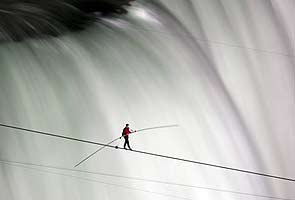
Nik Wallenda, first man to complete 1800-feet tightrope walk across Niagara Falls

June 16, 2012

niagara_falla_tightrope_walk.295

Ontario, Canada, June 16: Daredevil Nik Wallenda became the first person to walk on a tightrope across the Niagara Falls, taking steady, measured steps Friday night for 1,800 feet across the mist-fogged brink of the roaring falls separating the U.S. and Canada.

"I feel like I'm on cloud nine right now," an exuberant Wallenda told reporters after accomplishing what he said was his childhood dream before an estimated 112,000 people crowding the shores of both countries and millions more who watched a live television broadcast.

He described wind "coming from every which way," mist so powerful he had to blink it away to maintain his vision and a breathtaking view during the nighttime walk illuminated by spotlights that "compared to nothing."

"There was no way to focus on the movement of the cable," said Wallenda, 33. "If I looked down at the cable there was water moving everywhere. And if I looked up there was heavy mist blowing in front of my face. So it was a very unique, a weird sensation."

He said he accomplished the feat through "a lot of praying, that's for sure. But, you know, it's all about the concentration, the focus, and the training."

The seventh-generation member of the famed Flying Wallendas had long dreamed of pulling off the stunt, never before attempted. Other daredevils have wire-walked over the Niagara River but farther downstream and not since 1896.


"This is what dreams are made of, people," said Wallenda, who wore a microphone for the broadcast, shortly after he stepped off from a platform on the American shore.

Along the way, he calmly prayed aloud.

After passing the halfway mark, Wallenda expressed fatigue. "I'm strained, I'm drained," he said. "This is so physical, not only mental but physical."

Toward the end, as he neared the Canadian shore, Wallenda dropped to one knee and pumped his fist while the spectators cheered.


He broke into a playful run about 15 feet from the finish line, where his wife and three children waited.

"I am so blessed," he said later. "How blessed I am to have the life that I have."

ABC televised the walk and insisted Wallenda use a tether to keep him from falling in the river. Wallenda said he agreed because he wasn't willing to lose the chance to perform the walk it took him well over a year to win permission from two countries to do. Such stunts are normally illegal. ABC's sponsorship helped offset some of the $1.3 million cost of the spectacle.

Wallenda said he thought about the tether, which was secured at his waist and dragged behind him, at several points along the 30-minute walk but wasn't hindered by it as he'd feared.

"Awesome! The whole thing is awesome," 8-year-old William Clements of Dresden, Ontario, said after watching the walk with his family from the Canadian side, adding he wouldn't want to walk "even over something not high."

"He was meant to do it. The weather was perfect," said Glenda Rutherford of Ontario. "It was amazing."

For Wallenda, who has grown up on the high wire and holds six Guinness records for various stunts, the Niagara Falls walk was unlike anything he'd ever done. Because it was over water, the 2-inch wire didn't have the usual stabilizer cables to keep it from swinging. Pendulum anchors were designed to keep it from twisting under the elkskin-soled shoes designed by his mother.

The Wallendas trace their roots to 1780 Austria-Hungary, when ancestors traveled as a band of acrobats, aerialists, jugglers, animal trainers and trapeze artists. The clan has been touched by tragedy, notably in 1978 when patriarch Karl Wallenda, Nik's great-grandfather, fell to his death during a stunt in Puerto Rico.

Wallenda said that at one point in the middle of the walk, he thought about his great-grandfather and the walks he had taken:


"That's what this is all about, paying tribute to my ancestors, and my hero, Karl Wallenda."

About a dozen other tightrope artists have crossed the Niagara Gorge downstream, dating to Jean Francois Gravelet, aka The Great Blondin, in 1859. But no one had walked directly over the falls, and authorities hadn't allowed any tightrope acts in the area since 1896. It took Wallenda two years to persuade U.S. and Canadian authorities to allow it, and many civic leaders hoped to use the publicity to jumpstart the region's struggling economy, particularly on the U.S. side of the falls.



Comments

Add new comment

  • Coastaldigest.com reserves the right to delete or block any comments.
  • Coastaldigset.com is not responsible for its readers’ comments.
  • Comments that are abusive, incendiary or irrelevant are strictly prohibited.
  • Please use a genuine email ID and provide your name to avoid reject.
Agencies
July 3,2020

The dollar's dominance will slowly melt away over the coming year on weakening global demand and a sombre U.S. economic outlook, according to a Reuters poll of currency forecasters whose views depend on there being no second coronavirus shock.

Despite fears a surge in new Covid-19 cases would delay economies reopening and stymie a tentative recovery, world stocks have rallied - with the S&P 500 finishing higher in June, marking its biggest quarterly percentage gain since the height of the technology boom in 1998.

Caught between bets in favour of riskier investments, weak U.S. economic prospects as well as an easing in the thirst for dollars after the Federal Reserve flooded markets with liquidity, the greenback fell nearly 1.0 per cent last month. It was its worst monthly performance since December.

While there was a dire prognosis from the top U.S. medical expert on the coronavirus' spread, the June 25-July 1 poll of over 70 analysts showed weak dollar projections as Fed Chair Jerome Powell on Monday reiterated the economic outlook for the world's largest economy was uncertain.

"The dollar rises in two instances: when you see risk off or when there is a situation where the U.S. is leading the global recovery, and we don't think that's going to be the case anytime soon," said Gavin Friend, senior FX strategist at NAB Group in London.

"The U.S. is playing fast and loose with the virus, and chronologically they're behind the rest of the world."

Currency speculators, who had built up trades against the dollar to the highest in two years during May, increased their out-of-favour dollar bets further last week, the latest positioning data showed.

About 80 per cent of analysts, 53 of 66, said the likely path for the dollar over the next six months was to trade around current levels, alternating between slight gains and losses in a range. That suggests the greenback may be at a crucial crossroad as more currency strategists have turned bearish.

But more than 90 per cent, or 63 of 68, said a second shock from the pandemic would push the dollar higher. Five said it would push the U.S. currency lower.

Much will also depend on debt servicing and repayments by Asian, European and other international borrowers in U.S. dollars.

While an early shortage of dollars in March from the pandemic's first shock pushed the Fed to open currency swap lines with major central banks, international funding strains have eased significantly since. In recent weeks, usage of the facility has reduced dramatically.

That trend is expected to continue over the next six months with major central banks' usage of swap lines to "stay around current levels", according to 32 of 46 analysts. While 13 predicted a sharp drop, only one respondent said use of them would "rise sharply".

The dollar index, which measures the greenback's strength against six other major currencies, has slipped over 5 per cent since touching a more than three-year high in March.

When asked which currencies would perform better against the dollar by end-December, a touch over half of 49 respondents said major developed market ones, with the remaining almost split between commodity-linked and emerging market currencies.

"The dollar is so overvalued, and has been overvalued for a long time, it's time now for it to come back down again, as we head towards the (U.S.) election," added NAB's Friend.

Over the last quarter, the euro has staged a 1.8 per cent comeback after falling by a similar margin during the first three months of the year. For the month of June, the euro was up 1.2 per cent against the dollar.

The single currency was now expected to gain about 2.5 per cent to trade at $1.15 in a year from around $1.12 on Wednesday, slightly stronger than $1.14 predicted last month. While those findings are similar to what analysts have been predicting for nearly two years, there was a clear shift in their outlook for the euro, with the range of forecasts showing higher highs and higher lows from last month.

"In comparison to even a month or two ago, the outlook in Europe has improved significantly," said Lee Hardman, currency strategist at MUFG.

"I think that makes the euro look relatively more attractive and cheap against the likes of the dollar. We're not arguing strongly for the euro to surge higher, we're just saying, after the weakness we have seen in recent years, there is the potential for that weakness to start to reverse."

Comments

Add new comment

  • Coastaldigest.com reserves the right to delete or block any comments.
  • Coastaldigset.com is not responsible for its readers’ comments.
  • Comments that are abusive, incendiary or irrelevant are strictly prohibited.
  • Please use a genuine email ID and provide your name to avoid reject.
Agencies
May 31,2020

Minneapolis, May 31: The full Minnesota National Guard was activated for the first time since World War Two after four nights of civil unrest that has spread to other U.S. cities following the death of George Floyd, a black man shown on video gasping for breath as a white Minneapolis policeman knelt on his neck.

Minnesota Governor Tim Walz said the deployment was necessary because outside agitators were using protests over Monday’s death of George Floyd to sow chaos and that he expected Saturday night’s demonstrations to be the fiercest so far.

From Minneapolis to several other major cities including New York, Atlanta and Washington, protesters clashed with police late on Friday in a rising tide of anger over the treatment of minorities by law enforcement.

“We are under assault,” Walz, a first-term governor elected from Minnesota’s Democratic-Farmer-Labor Party, told a briefing on Saturday. “Order needs to be restored. ... We will use our full strength of goodness and righteousness to make sure this ends.”

He said he believed a “tightly controlled” group of outsiders, including white supremacists and drug cartel members, were instigating some of the violence in Minnesota’s largest city, but he did not give specific evidence of this when asked by reporters.

As many as 80% of those arrested were from outside the state, Walz said. But detention records show just eight non-Minnesota residents have been booked into the Hennepin County Jail since Tuesday, and it was unclear whether all of them were arrested in connection with the Minneapolis unrest.

The Republican Trump administration suggested civil disturbances were being orchestrated from the political left.

“In many places, it appears the violence is planned, organized and driven by anarchic and left extremist groups - far-left extremist groups ... many of whom travel from outside the state to promote violence,” U.S. Attorney William Barr said in a statement.

In an extraordinary move, the Pentagon said it put military units on a four-hour alert to be ready if requested by Walz to help keep the peace.

Activists staged another round of protests on Saturday in at least a dozen major U.S. cities coast to coast, including Seattle, Los Angeles, Chicago, Cleveland, Dallas, Atlanta, New York and Atlanta.

In the nation’s capital, hundreds of demonstrators assembled near the Justice Department headquarters, then marched toward the U.S. Capitol, chanting, “Black lives matter,” and “I can’t breathe,” a rallying cry echoing Floyd’s dying words.

Many later ended up near the White House, where they faced off with shield-carrying police, some mounted on horseback.

The streets of Minneapolis were largely quiet during daylight on Saturday, though several National Guard armoured personnel carriers were seen rolling through town.

On Friday, in defiance of a newly imposed curfew, Minneapolis protesters took to the streets for a fourth night - albeit in smaller numbers than before - despite the announcement hours earlier of murder charges filed against Derek Chauvin, the policeman seen in video footage kneeling on Floyd’s neck.

Three other officers fired from the police department with Chauvin on Tuesday are also under criminal investigation in the case, prosecutors said.

The video of Floyd’s arrest - captured by an onlooker’s cellphone as he repeatedly groaned, “please, I can’t breathe” before becoming motionless - triggered an outpouring of rage that civil rights activists said has long simmered in Minneapolis and cities across the country over persistent racial bias in the U.S. criminal justice system.

‘PAINS ME SO MUCH’

The mood was sombre on Saturday in the Minneapolis neighbourhood of Lyndale, where dozens of people surveyed the damage while sweeping up broken glass and debris.

“It pains me so much,” said Luke Kallstrom, 27, a financial analyst, standing in the threshold of a fire-gutted post office. “This does not honour the man who was wrongfully taken away from us.”

Some of Friday’s most chaotic scenes were in the New York City borough of Brooklyn, where police armed with batons and pepper spray made more than 200 arrests in sometimes violent clashes. Several officers were injured, police said.

In Washington, President Donald Trump said on Saturday that if protesters who gathered the night before in Lafayette Square, across from the White House, had breached the fence, “they would have been greeted with the most vicious dogs, and most ominous weapons, I have ever seen.”

CHAOS IN ATLANTA

In Atlanta, Bernice King, the youngest daughter of slain civil rights icon Martin Luther King Jr., urged people to go home on Friday night after more than 1,000 protesters marched to the state capitol and blocked traffic on an interstate highway.

The demonstration turned violent at points. Fires burned near the CNN Center, the network’s headquarters, and windows were smashed at its lobby. Several vehicles were torched, including at least one police car.

Rapper Killer Mike, in an impassioned speech flanked by the city’s mayor and police chief, also implored angry residents to stay indoors and to mobilize to win at the ballot box.

“But it is not time to burn down your own home.”

Floyd, a Houston native who had worked security for nightclubs, was arrested on suspicion of trying to pass counterfeit money at a store to buy cigarettes on Monday evening. Police said he was unarmed. An employee who called for help had told a police dispatcher that the suspect appeared to be intoxicated.

In a striking coincidence, Floyd and Chauvin had both worked security at the same Latin nightclub in Minneapolis, though it was unlikely they ever interacted, former owner Maya Santamaria, who sold the El Nuevo Rodeo club in January, told Reuters.

Santamaria said Floyd worked inside the club on certain nights, supporting other staff with security. She said Chauvin, who worked outside the club as an off-duty cop for 16 years, had a reputation for roughing up customers, but she considered him responsible and a friend.

Comments

Add new comment

  • Coastaldigest.com reserves the right to delete or block any comments.
  • Coastaldigset.com is not responsible for its readers’ comments.
  • Comments that are abusive, incendiary or irrelevant are strictly prohibited.
  • Please use a genuine email ID and provide your name to avoid reject.
News Network
May 25,2020

Karachi, May 25: The pilot of the Pakistan International Airlines (PIA)'s crashed plane ignored three warnings from the air traffic controllers about the aircraft's altitude and speed before the landing, saying he was satisfied and would handle the situation, according to a report on Monday.

The national flag carrier's PK-8303 tragedy on Friday, in which 97 people were killed and two miraculously survived, is one of the most catastrophic aviation disasters in the country's history.

The Airbus A-320 from Lahore to Karachi was 15 nautical miles from the Jinnah International Airport, flying at an altitude of 10,000 feet above the ground instead of 7,000 when the Air Traffic Control (ATC) issued its first warning to lower the plane's altitude, Geo News quoted an ATC report as saying.

Instead of lowering the altitude, the pilot responded by saying that he was satisfied. When only 10 nautical miles were left till the airport, the plane was at an altitude of 7,000 feet instead of 3,000 feet, it said.

The ATC issued a second warning to the pilot to lower the plane's altitude. However, the pilot responded again by stating that he was satisfied and would handle the situation, saying he was ready for landing, the report said.

The report said that the plane had enough fuel to fly for two hours and 34 minutes, while its total flying time was recorded at one hour and 33 minutes.

Pakistani investigators are trying to find out if the crash is attributable to a pilot error or a technical glitch.

According to a report prepared by the country's Civil Aviation Authority (CAA), the plane's engines had scraped the runway thrice on the pilot's first attempt to land, causing friction and sparks recorded by the experts.

When the aircraft scraped the ground on the first failed attempt at landing, the engine's oil tank and fuel pump may have been damaged and started to leak, preventing the pilot from achieving the required thrust and speed to raise the aircraft to safety, the report said.

The pilot made a decision "on his own" to undertake a "go-around" after he failed to land the first time. It was only during the go-around that the ATC was informed that landing gear was not deploying, it said.

"The pilot was directed by the air traffic controller to take the aircraft to 3,000 feet, but he managed only 1,800. When the cockpit was reminded to go for the 3,000 feet level, the first officer said 'we are trying'," the report said.

Experts said that the failure to achieve the directed height indicates that the engines were not responding. The aircraft, thereafter, tilted and crashed suddenly.

The flight crashed at the Jinnah Garden area near Model Colony in Malir on Friday afternoon, minutes before its landing in Karachi's Jinnah International Airport. Eleven people on the ground were injured.

The probe team, headed by Air Commodore Muhammad Usman Ghani, President of the Aircraft Accident and Investigation Board, is expected to submit a full report in about three months.

According to the PIA's engineering and maintenance department, the last check of the plane was done on March 21 this year and it had flown from Muscat to Lahore a day before the crash.

In the wake of the COVID-19 pandemic, the Pakistan government had allowed the limited domestic flight operations from five major airports - Islamabad, Karachi, Lahore, Peshawar and Quetta - from May 16.

After the plane tragedy, the PIA has called off its domestic operation.

Comments

Add new comment

  • Coastaldigest.com reserves the right to delete or block any comments.
  • Coastaldigset.com is not responsible for its readers’ comments.
  • Comments that are abusive, incendiary or irrelevant are strictly prohibited.
  • Please use a genuine email ID and provide your name to avoid reject.