


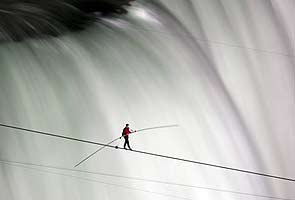
Nik Wallenda, first man to complete 1800-feet tightrope walk across Niagara Falls

June 16, 2012

niagara_falla_tightrope_walk.295

Ontario, Canada, June 16: Daredevil Nik Wallenda became the first person to walk on a tightrope across the Niagara Falls, taking steady, measured steps Friday night for 1,800 feet across the mist-fogged brink of the roaring falls separating the U.S. and Canada.

"I feel like I'm on cloud nine right now," an exuberant Wallenda told reporters after accomplishing what he said was his childhood dream before an estimated 112,000 people crowding the shores of both countries and millions more who watched a live television broadcast.

He described wind "coming from every which way," mist so powerful he had to blink it away to maintain his vision and a breathtaking view during the nighttime walk illuminated by spotlights that "compared to nothing."

"There was no way to focus on the movement of the cable," said Wallenda, 33. "If I looked down at the cable there was water moving everywhere. And if I looked up there was heavy mist blowing in front of my face. So it was a very unique, a weird sensation."

He said he accomplished the feat through "a lot of praying, that's for sure. But, you know, it's all about the concentration, the focus, and the training."

The seventh-generation member of the famed Flying Wallendas had long dreamed of pulling off the stunt, never before attempted. Other daredevils have wire-walked over the Niagara River but farther downstream and not since 1896.


"This is what dreams are made of, people," said Wallenda, who wore a microphone for the broadcast, shortly after he stepped off from a platform on the American shore.

Along the way, he calmly prayed aloud.

After passing the halfway mark, Wallenda expressed fatigue. "I'm strained, I'm drained," he said. "This is so physical, not only mental but physical."

Toward the end, as he neared the Canadian shore, Wallenda dropped to one knee and pumped his fist while the spectators cheered.


He broke into a playful run about 15 feet from the finish line, where his wife and three children waited.

"I am so blessed," he said later. "How blessed I am to have the life that I have."

ABC televised the walk and insisted Wallenda use a tether to keep him from falling in the river. Wallenda said he agreed because he wasn't willing to lose the chance to perform the walk it took him well over a year to win permission from two countries to do. Such stunts are normally illegal. ABC's sponsorship helped offset some of the $1.3 million cost of the spectacle.

Wallenda said he thought about the tether, which was secured at his waist and dragged behind him, at several points along the 30-minute walk but wasn't hindered by it as he'd feared.

"Awesome! The whole thing is awesome," 8-year-old William Clements of Dresden, Ontario, said after watching the walk with his family from the Canadian side, adding he wouldn't want to walk "even over something not high."

"He was meant to do it. The weather was perfect," said Glenda Rutherford of Ontario. "It was amazing."

For Wallenda, who has grown up on the high wire and holds six Guinness records for various stunts, the Niagara Falls walk was unlike anything he'd ever done. Because it was over water, the 2-inch wire didn't have the usual stabilizer cables to keep it from swinging. Pendulum anchors were designed to keep it from twisting under the elkskin-soled shoes designed by his mother.

The Wallendas trace their roots to 1780 Austria-Hungary, when ancestors traveled as a band of acrobats, aerialists, jugglers, animal trainers and trapeze artists. The clan has been touched by tragedy, notably in 1978 when patriarch Karl Wallenda, Nik's great-grandfather, fell to his death during a stunt in Puerto Rico.

Wallenda said that at one point in the middle of the walk, he thought about his great-grandfather and the walks he had taken:


"That's what this is all about, paying tribute to my ancestors, and my hero, Karl Wallenda."

About a dozen other tightrope artists have crossed the Niagara Gorge downstream, dating to Jean Francois Gravelet, aka The Great Blondin, in 1859. But no one had walked directly over the falls, and authorities hadn't allowed any tightrope acts in the area since 1896. It took Wallenda two years to persuade U.S. and Canadian authorities to allow it, and many civic leaders hoped to use the publicity to jumpstart the region's struggling economy, particularly on the U.S. side of the falls.



Comments

Add new comment

  • Coastaldigest.com reserves the right to delete or block any comments.
  • Coastaldigset.com is not responsible for its readers’ comments.
  • Comments that are abusive, incendiary or irrelevant are strictly prohibited.
  • Please use a genuine email ID and provide your name to avoid reject.
Agencies
June 16,2020

India continues to remain ranked 43rd on an annual World Competitiveness Index compiled by Institute for Management Development (IMD) with some traditional weaknesses like poor infrastructure and insufficient education investment keeping its ranking low, the international business school said on Tuesday.

Singapore has retained its top position on the 63-nation list.

Denmark has moved up to the second position (from 8th last year), Switzerland has gained one place to rank 3rd, the Netherlands has retained its 4th place and Hong Kong has slipped to the fifth place (from 2nd in 2019).

The US has moved down to 10th place (from 3rd last year), while China has also slipped from 14th to 20th place. Among the BRICS nations, India is ranked second after China, followed by Russia (50th), Brazil (56th) and South Africa (59th).

India was ranked 41st on the IMD World Competitiveness Ranking, being produced by the business school based in Switzerland and Singapore every year since 1989, but had slipped to 45th in 2017 before improving to 44th in 2018 and then to 43rd in 2019.

While its overall position has remained unchanged in the 2020 list, it has recorded improvements in areas like long-term employment growth, current account balance, high-tech exports, foreign currency reserves, public expenditure on education, political stability and overall productivity, the IMD said.

However, it has moved down in areas like exchange rate stability, real GDP growth, competition legislation and taxes.

Arturo Bris, Head of Competitiveness Center at IMD Business School, said India continues to struggle on the list and the recent country rating downgrade by Moody’s reflects the uncertainties regarding the economy’s future.

"In our ranking this year, we again emphasize the traditional weaknesses of India -- poor infrastructure, an important deficit in education investment, and a health system that does not reach everybody. For India to follow the path of China, it must stress its intangible infrastructure," Bris said.

"In a less global world, with China, USA, and Europe looking inwards, currencies like the rupee (and the Brazilian real for instance) are going to suffer and display high volatilities.

"Moody’s has threatened the country with a downgrade to junk and that would put India in a terrible position to attract foreign capital. So the urgency for the government should be to fix the short-term problems—and this requires to improve the credibility of the government itself," Bris added.

With the exception of Singapore, the Philippines, Taiwan and the Korean Republic, most Asian economies dropped in rankings this year, the IMD said.

The reason for the Asian economies’ less stellar performance as a region, this year is partly the result of the trade frictions between China and the US, particularly because these economies are highly dependent on trade with China.

About Singapore, which moved to the top rank last year, the IMD said its position is largely driven by the relative ease of setting up business, availability of skilled labour and its cutting-edge technological infrastructure.

The IMD said the impact of COVID-19 on the competitiveness ranking has partially been captured by executives’ opinions about the effectiveness of the different health systems.

In the ASEAN countries included in the survey, only Singapore and Thailand have a positive performance in the effectiveness of the health infrastructure.

Comments

Add new comment

  • Coastaldigest.com reserves the right to delete or block any comments.
  • Coastaldigset.com is not responsible for its readers’ comments.
  • Comments that are abusive, incendiary or irrelevant are strictly prohibited.
  • Please use a genuine email ID and provide your name to avoid reject.
News Network
June 17,2020

Beijing, Jun 17: Beijing's airports cancelled more than 1,200 flights and schools in the Chinese capital were closed again on Wednesday as authorities rushed to contain a new coronavirus outbreak linked to a wholesale food market.

The city reported 31 new cases on Wednesday while officials urged residents not to leave Beijing, with fears growing about a second wave of infections in China, which had largely brought its outbreak under control.

Tens of thousands of people linked to the new Beijing virus cluster -- believed to have started in the sprawling Xinfadi wholesale food market -- are being tested, with almost 30 residential compounds in the city now under lockdown.

At least 1,255 scheduled flights were cancelled Wednesday morning, state-run People's Daily reported, nearly 70 percent of all trips to and from Beijing's main airports.

The outbreak had already forced authorities to announce a travel ban for residents of "medium- or high-risk" areas of the city, while requiring other residents to take nucleic acid tests in order to leave Beijing.

Meanwhile, several provinces were quarantining travellers from Beijing, where all schools -- which had mostly reopened -- have been ordered to close again and return to online classes.

"The epidemic situation in the capital is extremely severe," Beijing city spokesman Xu Hejian warned Tuesday.

Mass testing under way

Officials have closed 11 markets and disinfected thousands of food and beverage businesses in Beijing after the outbreak was detected.

The city has now reported 137 infections over the last six days, with six new asymptomatic cases and three suspected cases on Wednesday, according to the municipal health commission.

An additional two domestic cases, one in neighbouring Hebei province and another in Zhejiang, were reported by national authorities on Wednesday, while there were 11 imported cases.

Authorities have so far banned group sports, ordered people to wear masks in crowded enclosed spaces, and suspended inter-provincial group tours in response to the outbreak.

Officials said that since May 30, more than 200,000 people had visited Xinfadi market, which supplies more than 70 percent of Beijing's fruit and vegetables.

More than 8,000 workers there were tested and quarantined.

Until the new outbreak, most of China's recent cases were nationals returning from abroad as COVID-19 spread globally, and the government had all but declared victory against the disease.

China's Center for Disease Control and Prevention said Monday that the virus type found in the Beijing outbreak was a "major epidemic strain" in Europe.

Comments

Add new comment

  • Coastaldigest.com reserves the right to delete or block any comments.
  • Coastaldigset.com is not responsible for its readers’ comments.
  • Comments that are abusive, incendiary or irrelevant are strictly prohibited.
  • Please use a genuine email ID and provide your name to avoid reject.
News Network
March 4,2020

Tokyo, Mar 4: Takeda Pharmaceutical Co said on Wednesday it was developing a drug to treat COVID-19, the flu-like illness that has struck more than 90,000 people worldwide and killed over 3,000.

The Japanese drugmaker is working on a plasma-derived therapy to treat high-risk individuals infected with the new coronavirus and will share its plans with members of the U.S. Congress on Wednesday, it said in a statement.

Takeda is also studying whether its currently marketed and pipeline products may be effective treatments for infected patients.

"We will do all that we can to address the novel coronavirus threat...(and) are hopeful that we can expand the treatment options," Rajeev Venkayya, president of Takeda's vaccine business, said in the statement.

Takeda said it was in talks with various health and regulatory agencies and healthcare partners in the United States, Asia and Europe to move forward its research into the drug.

Its research requires access to the blood of people who have recovered from the respiratory disease or who have been vaccinated, once a vaccine is developed, Takeda said.

Comments

Add new comment

  • Coastaldigest.com reserves the right to delete or block any comments.
  • Coastaldigset.com is not responsible for its readers’ comments.
  • Comments that are abusive, incendiary or irrelevant are strictly prohibited.
  • Please use a genuine email ID and provide your name to avoid reject.