


US probe calls for punishment of troops in Quran burning

June 20, 2012

quran

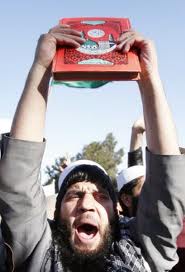
Washington, June 20: A US military investigation has recommended disciplinary action for up to seven troops over their role in the burning of Qurans at a base in Afghanistan, a US official said Tuesday.

No final decision has been made yet on the findings of a probe that examined the torching of Qurans at a US air base in February that sparked deadly riots, said the official, who spoke on condition of anonymity.

The investigation called for administrative punishment but no criminal charges of up to six Army troops and one member of the Navy, the official told AFP.

The US Army confirmed the probe of the incident had been wrapped up but offered no details on recommended disciplinary measures.

"The investigation is complete and is pending review," said spokesman George Wright.

The Koran burning ignited days of violent anti-US protests in which about 40 people died, plunging relations between foreign forces and their Afghan allies to an all-time low and forcing US President Barack Obama to apologize.

Taliban insurgents sought to exploit the incident and called on Afghans to kill foreign troops in revenge.

The Taliban claimed to have been behind the shooting deaths of two US advisers who were killed inside the Afghan interior ministry after the incident.

Top US commanders issued numerous apologies over the Quran and insisted it was an accident, but details of exactly how the incident occurred have remained unclear pending the outcome of the probe.

Of the troops who might be penalized, it was unclear how many were officers and how many were enlisted personnel.

After the incident, some US officials said privately the military had removed Quran from the US-run prison at Bagram because inmates were suspected of using the holy book to pass messages to each other.

But the account has yet to be officially confirmed.

US officials say relations with Kabul have been shored up since the incident and the two governments have signed a partnership agreement opening the door to a long-term American military presence after 2014, when the bulk of US and NATO combat forces are due to withdraw.

Afghanistan is a deeply religious country where slights against Islam have frequently provoked violent protests and Afghans were incensed that any Western troops could be so insensitive, 10 years after the 2001 US-led campaign that toppled the Taliban.

A radical Christian pastor in the US state of Florida sparked protests in Afghanistan and elsewhere in the Islamic world when he threatened in 2010 to burn a copy of the Koran on the anniversary of the September 11 attacks on New York and Washington.

The pastor, Terry Jones, went ahead and burned a copy of the sacred book in March 2011.

In May 2008, thousands protested in Afghanistan over the desecration of the Koran by an American soldier in Iraq who used a copy of the Muslim holy book as a shooting target.

Comments

Add new comment

  • Coastaldigest.com reserves the right to delete or block any comments.
  • Coastaldigset.com is not responsible for its readers’ comments.
  • Comments that are abusive, incendiary or irrelevant are strictly prohibited.
  • Please use a genuine email ID and provide your name to avoid reject.
News Network
January 23,2020

Jan 23: Pakistan's Prime Minister Imran Khan called on Wednesday for the United Nations to help mediate between nuclear armed India and Pakistan over the disputed territory of Kashmir.

"This is a potential flashpoint," Khan said during a media briefing at the annual meeting of the World Economic Forum in Davos, Switzerland, adding that it was time for the "international institutions ... specifically set up to stop this" to "come into action".

The Indian government in August revoked the constitutional autonomy of Indian-administered Kashmir, splitting the Muslim-majority region into two federal territories in a bid to integrate it fully with the rest of the country.

Kashmir is claimed in full by both India and Pakistan. The two countries have gone to war twice over it, and both rule parts of it. India's portion has been plagued by separatist violence since the late 1980s.

Khan said his biggest fear was how New Delhi would respond to ongoing protests in India over a citizenship law that many feel targets Muslims.

"We're not close to a conflict right now ... What if the protests get worse in India, and to distract attention from that, what if ..."

The prime minister said he had discussed the prospect of war between his country and India in a Tuesday meeting with US President Donald Trump. Trump later said he had offered to help mediate between the two countries.

Khan said Pakistan and the United States were closer in their approach to the Taliban armed rebellion in Afghanistan than they had been for many years. He said he had never seen a military solution to that conflict.

"Finally the position of the US is there should be negotiations and a peace plan."

In a separate on-stage conversation later on Wednesday, Khan said he had told Trump in their meeting that a war with Iran would be "a disaster for the world". Trump had not responded, Khan said.

Khan made some of his most straightforward comments when asked why Pakistan has been muted in defence of Uighurs in China.

China has been widely condemned for setting up complexes in remote Xinjiang province that Beijing describes as "vocational training centres" to stamp out ""extremism and give people new skills.

The United Nations says at least one million ethnic Uighurs and other Muslims have been detained.

When pressed on China's policies, Khan said Pakistan's relations with Beijing were too important for him to speak out publicly.

"China has helped us when we were at rock bottom. We are really grateful to the Chinese government, so we have decided that any issues we have had with China we will handle privately."

Comments

Add new comment

  • Coastaldigest.com reserves the right to delete or block any comments.
  • Coastaldigset.com is not responsible for its readers’ comments.
  • Comments that are abusive, incendiary or irrelevant are strictly prohibited.
  • Please use a genuine email ID and provide your name to avoid reject.
News Network
June 19,2020

United Nations, Jun 19: Half of the world's children -- one billion every year -- are affected by physical, sexual or psychological violence, suffering injuries and death because countries have failed to follow established strategies to protect them, the first report of its kind from the UN has said, with experts noting that the coronavirus-related lockdowns have left far too many youngsters stuck with their abusers.

While nearly all countries (88 per cent) have laws in place to protect minors, less than half (47 per cent) say they strongly enforce them, said the Global Status Report on Preventing Violence Against Children 2020 launched on Thursday.

Because countries have failed to follow established strategies to protect children, about one billion are affected each year by physical, sexual or psychological violence, it said.

"There is never any excuse for violence against children," WHO Director-General Tedros Adhanom Ghebreyesus said.

"We have evidence-based tools to prevent it, which we urge all countries to implement. Protecting the health and well-being of children is central to protecting our collective health and well-being, now and for the future," he said.

The report -- launched by the World Health Organisation, the UNICEF, the UNESCO, the Special Representative of the UN Secretary-General on Violence against Children and the End Violence Partnership -- charted progress in 155 countries against the "INSPIRE" framework, a set of seven strategies for preventing and responding to violence against children.

The report signaled a clear need in all countries to scale up efforts to implement them. It included the first ever global homicide estimates specifically for children under 18 years of age -- previous estimates were based on data that included 18 to 19-year olds.

According to the findings, in 2017, around 40,000 children were victims of homicide.

"Violence against children has always been pervasive, and now things could be getting much worse," UNICEF Executive Director Henrietta Fore said.

"Lockdowns, school closures and movement restrictions have left far too many children stuck with their abusers, without the safe space that school would normally offer. It is urgent to scale up efforts to protect children during these times and beyond, including by designating social service workers as essential and strengthening child helplines," she said.

UNESCO Director-General Audrey Azoulay said during the COVID-19 pandemic, and the related school closures, "we have seen a rise in violence and hate online – and this includes bullying".

"Now, as schools begin to re-open, children are expressing their fears about going back to school. It is our collective responsibility to ensure that schools are safe environments for all children. We need to think and act collectively to stop violence at school and in our societies at large," Azoulay said.

Stay-at-home measures including school closures have limited the usual sources of support for families and individuals such as friends, extended family or professionals.

This further erodes victims’ ability to successfully cope with crises and the new routines of daily life. Spikes in calls to helplines for child abuse and intimate partner violence have been observed, the report said.

While online communities have become central to maintain many children's learning, support and play, an increase in harmful online behaviors including cyberbullying, risky online behavior and sexual exploitation have been identified.

“Whilst this report was being finalised, confinement measures and the disrupted provision of already limited child protection services exacerbated the vulnerability of children to various forms of violence," said Najat Maalla M’jid, Special Representative of the UN Secretary-General on Violence against Children.

Of the INSPIRE strategies, only access to schools through enrolment showed the most progress with 54 per cent of the countries reporting that a sufficient number of children in need were being reached in this way.

Between 32 per cent and 37 per cent of the countries considered that victims of violence could access support services, while 26 per cent of the countries provided programmes on parent and caregiver support; 21 per cent of the countries had programmes to change harmful norms; and 15 per cent of the countries had modifications to provide safe physical environments for children, the report said.

Although a majority of countries (83 per cent) have national data on violence against children, only 21 per cent used these to set baselines and national targets to prevent and respond to violence against children, it added.

The report said about 80 per cent of countries have national plans of action and policies but only one-fifth have plans that are fully funded or have measurable targets. A lack of funding combined with inadequate professional capacity are likely contributing factors and a reason why implementation has been slow.

"Ending violence against children is the right thing to do, a smart investment to make - and it's possible. We can and must create a world where every child can thrive," Howard Taylor of the End Violence Partnership said.

Comments

Add new comment

  • Coastaldigest.com reserves the right to delete or block any comments.
  • Coastaldigset.com is not responsible for its readers’ comments.
  • Comments that are abusive, incendiary or irrelevant are strictly prohibited.
  • Please use a genuine email ID and provide your name to avoid reject.
Agencies
June 22,2020

The total number of global COVID-19 cases was nearing 9 million, while the deaths have increased to over 467,000, according to the Johns Hopkins University.

By Monday morning, the total number of cases stood at 8,927,195, while the fatalities increased to 467,636, the University's Center for Systems Science and Engineering (CSSE) revealed in its latest update.

With 2,279,306 cases and 119,967 deaths, the US continues with the world's highest number of COVID-19 infections and fatalities, according to the CSSE.

Brazil comes in the second place with 1,083,341 infections and 50,591 deaths.

In terms of cases, Russia ranks third (583,879), and was followed by India (410,461), the UK (305,803), Peru (251,338), Spain (246,272), Chile (242,355), Italy (238,499), Iran (204,952), France (197,008), Germany (191,272), Turkey (187,685), Mexico (180,545), Pakistan (176,617), Saudi Arabia (157,612), Bangladesh (112,306) and Canada (103,078), the CSSE figures showed.

The other countries with over 10,000 deaths are the UK (42,717), Italy (34,634), France (29,643), Spain (28,323), Mexico (21,825) and India (13,254).

Comments

Add new comment

  • Coastaldigest.com reserves the right to delete or block any comments.
  • Coastaldigset.com is not responsible for its readers’ comments.
  • Comments that are abusive, incendiary or irrelevant are strictly prohibited.
  • Please use a genuine email ID and provide your name to avoid reject.