


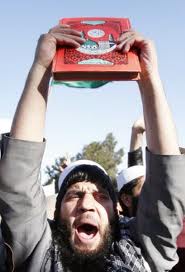
US probe calls for punishment of troops in Quran burning

June 20, 2012

quran

Washington, June 20: A US military investigation has recommended disciplinary action for up to seven troops over their role in the burning of Qurans at a base in Afghanistan, a US official said Tuesday.

No final decision has been made yet on the findings of a probe that examined the torching of Qurans at a US air base in February that sparked deadly riots, said the official, who spoke on condition of anonymity.

The investigation called for administrative punishment but no criminal charges of up to six Army troops and one member of the Navy, the official told AFP.

The US Army confirmed the probe of the incident had been wrapped up but offered no details on recommended disciplinary measures.

"The investigation is complete and is pending review," said spokesman George Wright.

The Koran burning ignited days of violent anti-US protests in which about 40 people died, plunging relations between foreign forces and their Afghan allies to an all-time low and forcing US President Barack Obama to apologize.

Taliban insurgents sought to exploit the incident and called on Afghans to kill foreign troops in revenge.

The Taliban claimed to have been behind the shooting deaths of two US advisers who were killed inside the Afghan interior ministry after the incident.

Top US commanders issued numerous apologies over the Quran and insisted it was an accident, but details of exactly how the incident occurred have remained unclear pending the outcome of the probe.

Of the troops who might be penalized, it was unclear how many were officers and how many were enlisted personnel.

After the incident, some US officials said privately the military had removed Quran from the US-run prison at Bagram because inmates were suspected of using the holy book to pass messages to each other.

But the account has yet to be officially confirmed.

US officials say relations with Kabul have been shored up since the incident and the two governments have signed a partnership agreement opening the door to a long-term American military presence after 2014, when the bulk of US and NATO combat forces are due to withdraw.

Afghanistan is a deeply religious country where slights against Islam have frequently provoked violent protests and Afghans were incensed that any Western troops could be so insensitive, 10 years after the 2001 US-led campaign that toppled the Taliban.

A radical Christian pastor in the US state of Florida sparked protests in Afghanistan and elsewhere in the Islamic world when he threatened in 2010 to burn a copy of the Koran on the anniversary of the September 11 attacks on New York and Washington.

The pastor, Terry Jones, went ahead and burned a copy of the sacred book in March 2011.

In May 2008, thousands protested in Afghanistan over the desecration of the Koran by an American soldier in Iraq who used a copy of the Muslim holy book as a shooting target.

Comments

Add new comment

  • Coastaldigest.com reserves the right to delete or block any comments.
  • Coastaldigset.com is not responsible for its readers’ comments.
  • Comments that are abusive, incendiary or irrelevant are strictly prohibited.
  • Please use a genuine email ID and provide your name to avoid reject.
News Network
May 20,2020

Kensington (United States), May 20: The world cut its daily carbon dioxide emissions by 17% at the peak of the pandemic shutdown last month, a new study found.

But with life and heat-trapping gas levels inching back toward normal, the brief pollution break will likely be “a drop in the ocean" when it comes to climate change, scientists said.

In their study of carbon dioxide emissions during the coronavirus pandemic, an international team of scientists calculated that pollution levels are heading back up — and for the year will end up between 4% and 7% lower than 2019 levels.

That's still the biggest annual drop in carbon emissions since World War II.

It'll be 7% if the strictest lockdown rules remain all year long across much of the globe, 4% if they are lifted soon.

For a week in April, the United States cut its carbon dioxide levels by about one-third.

China, the world's biggest emitter of heat-trapping gases, sliced its carbon pollution by nearly a quarter in February, according to a study Tuesday in the journal Nature Climate Change. India and Europe cut emissions by 26% and 27% respectively.

The biggest global drop was from April 4 through 9 when the world was spewing 18.7 million tons (17 million metric tons) of carbon pollution a day less than it was doing on New Year's Day.

Such low global emission levels haven't been recorded since 2006. But if the world returns to its slowly increasing pollution levels next year, the temporary reduction amounts to ''a drop in the ocean," said study lead author Corinne LeQuere, a climate scientist at the University of East Anglia.

“It's like you have a bath filled with water and you're turning off the tap for 10 seconds," she said.

By April 30, the world carbon pollution levels had grown by 3.3 million tons (3 million metric tons) a day from its low point earlier in the month. Carbon dioxide stays in the air for about a century.

Outside experts praised the study as the most comprehensive yet, saying it shows how much effort is needed to prevent dangerous levels of further global warming.

“That underscores a simple truth: Individual behavior alone ... won't get us there,” Pennsylvania State University climate scientist Michael Mann, who wasn't part of the study, said in an email.

“We need fundamental structural change.”

If the world could keep up annual emission cuts like this without a pandemic for a couple decades, there's a decent chance Earth can avoid warming another 1.8 degrees (1 degree Celsius) of warming from now, study authors said. But getting the type of yearly cuts to reach that international goal is unlikely, they said.

If next year returns to 2019 pollution levels, it means the world has only bought about a year's delay in hitting the extra 1.8 degrees (1 degree Celsius) of warming that leaders are trying to avoid, LeQuere said. That level could still occur anywhere from 2050 to 2070, the authors said.

The study was carried out by Global Carbon Project, a consortium of international scientists that produces the authoritative annual estimate of carbon dioxide emissions. They looked at 450 databases showing daily energy use and introduced a measurement scale for pandemic-related societal “confinement” in its estimates.

Nearly half the emission reductions came from less transportation pollution, mostly involving cars and trucks, the authors said. By contrast, the study found that drastic reductions in air travel only accounted for 10% of the overall pollution drop.

In the US, the biggest pollution declines were seen in California and Washington with plunges of more than 40%.

Comments

Add new comment

  • Coastaldigest.com reserves the right to delete or block any comments.
  • Coastaldigset.com is not responsible for its readers’ comments.
  • Comments that are abusive, incendiary or irrelevant are strictly prohibited.
  • Please use a genuine email ID and provide your name to avoid reject.
News Network
January 25,2020

Beijing, Jan 25: The death toll due to the novel coronavirus (2019-nCoV) outbreak in China has soared to 41, while the number of infected persons were 1,287, the National Health Commission said on Saturday.

The Commission said that 444 fresh cases were reported since Friday, with 237 patients in serious conditions, while 38 had been cured and discharged from hospitals, reports Efe news.

Health authorities have carried out check-ups on 15,197 people who have come into close contact with the infected persons. Nearly 14,000 of them continue to be monitored for symptoms.

The others cases outside of China were reported in France (two), Australia (one), Thailand (four including two cured), Japan (two including one cured), South Korea (two), the US (two), Vietnam (two), Singapore (three), Nepal (one), Hong Kong (five), Macao (two) and Taiwan (three).

The symptoms of the new coronavirus, provisionally designated by the World Health Organization as 2019-nCoV, are similar to those of cold but may be accompanied by fever and fatigue, dry cough and dyspnea (shortness of breath).

The WHO has so far to declared the outbreak as an international health emergency.

Strict measures were being carried out in China, which include complete suspension of transport in around a dozen cities in Hubei province and also cancelling Chinese New Year celebrations.

Traditional events at Lama Temple and Ditan Park in Beijing were cancelled due to the risk of spreading the virus, authorities reported Friday, while the famous Forbidden City has also been closed indefinitely.

Wuhan, the capital of Hubei, where the virus was first reported, has been on lockdown since Thursday to prevent further spread of the virus and the city's authorities have begun to build a "special hospital" with 1,000 beds for infected patients.

"Construction of the special hospital with a capacity of 1,000 beds for patients with #nCoV2019 has begun in Wuhan," official China Daily said on Twitter.

The hospital in Wuhan will be based on the model of a similar facility that was built in just seven days in Beijing to deal with SARS in 2003.

Comments

Add new comment

  • Coastaldigest.com reserves the right to delete or block any comments.
  • Coastaldigset.com is not responsible for its readers’ comments.
  • Comments that are abusive, incendiary or irrelevant are strictly prohibited.
  • Please use a genuine email ID and provide your name to avoid reject.
News Network
February 19,2020

Washington, Feb 19: Sri Srinivasan, a prominent Indian-American judge, has created history by becoming the first person of South Asian descent to lead a powerful federal circuit court considered next only to the US Supreme Court.

Srinivasan, 52, became the Chief Judge of the United States Court of Appeals for the DC Circuit.

An Obama appointee who has already been considered for a Supreme Court seat twice, donned the mantle of the chief judge of the DC federal court circuit on February 12.

Srinivasan succeeded Judge Merrick Garland, who has been a member of the DC Circuit since 1997 and Chief Judge since 2013. He will remain on the bench, a press release said.

Notably, Garland's nomination to the Supreme Court by the then president Barack Obama was blocked by Senate Republicans in 2016.

Srinivasan, was appointed to the US Court of Appeals for the District of Columbia Circuit in May 2013.

He was the first ever Indian-American to be appointed to the second most powerful court of the US.

Neomi Rao, nominated by President Donald Trump, is the second Indian American on this powerful judiciary bench.

History being made on the DC Court of Appeals. Congratulations, Judge Srinivasan! Senator Mark Warner said.

Congratulations to Judge Sri Srinivasan on becoming the Chief Judge of the U.S. Court of Appeals for the D.C. Circuit! A milestone for the Indian-American/Kansan community (and yet another piece of evidence my family can use that I'm underachieving), US Federal Communications Commission Chair Ajit Pai said.

According to The Washington Post, Srinivasan spoke recently about his path to the bench at an event celebrating women in the law, a field where men still dominate leadership positions.

"Everybody doubts their belonging and worthiness in some measure. I definitely did and still do. This is just going to be a part of the thing when you're looking out in the world in which everyone isn't like you. It's natural to doubt whether you belong and whether you're worthy, he said, "but you do belong and you are worthy.

Born in Chandigarh, and raised in Lawrence, Kansas, he received a B.A. from Stanford University, a J.D. from Stanford Law School, and an M.B.A. from the Stanford Graduate School of Business.

Following graduation, he served as a law clerk to Judge J. Harvie Wilkinson III of the US Court of Appeals for the Fourth Circuit, as a Bristow Fellow in the Office of the US Solicitor General, and as a law clerk to US Supreme Court Justice Sandra Day O'Connor.

From 2011 until his appointment to the US Court of Appeals, Judge Srinivasan served as the Principal Deputy Solicitor General of the United States.

He has argued 25 cases before the US Supreme Court. He has also taught appellate advocacy at Harvard Law School as well as a seminar on civil rights statutes and the Supreme Court at Georgetown University Law Center.

Comments

Add new comment

  • Coastaldigest.com reserves the right to delete or block any comments.
  • Coastaldigset.com is not responsible for its readers’ comments.
  • Comments that are abusive, incendiary or irrelevant are strictly prohibited.
  • Please use a genuine email ID and provide your name to avoid reject.