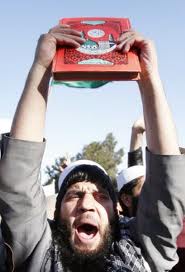
US probe calls for punishment of troops in Quran burning

June 20, 2012

quran

Washington, June 20: A US military investigation has recommended disciplinary action for up to seven troops over their role in the burning of Qurans at a base in Afghanistan, a US official said Tuesday.

No final decision has been made yet on the findings of a probe that examined the torching of Qurans at a US air base in February that sparked deadly riots, said the official, who spoke on condition of anonymity.

The investigation called for administrative punishment but no criminal charges of up to six Army troops and one member of the Navy, the official told AFP.

The US Army confirmed the probe of the incident had been wrapped up but offered no details on recommended disciplinary measures.

"The investigation is complete and is pending review," said spokesman George Wright.

The Koran burning ignited days of violent anti-US protests in which about 40 people died, plunging relations between foreign forces and their Afghan allies to an all-time low and forcing US President Barack Obama to apologize.

Taliban insurgents sought to exploit the incident and called on Afghans to kill foreign troops in revenge.

The Taliban claimed to have been behind the shooting deaths of two US advisers who were killed inside the Afghan interior ministry after the incident.

Top US commanders issued numerous apologies over the Quran and insisted it was an accident, but details of exactly how the incident occurred have remained unclear pending the outcome of the probe.

Of the troops who might be penalized, it was unclear how many were officers and how many were enlisted personnel.

After the incident, some US officials said privately the military had removed Quran from the US-run prison at Bagram because inmates were suspected of using the holy book to pass messages to each other.

But the account has yet to be officially confirmed.

US officials say relations with Kabul have been shored up since the incident and the two governments have signed a partnership agreement opening the door to a long-term American military presence after 2014, when the bulk of US and NATO combat forces are due to withdraw.

Afghanistan is a deeply religious country where slights against Islam have frequently provoked violent protests and Afghans were incensed that any Western troops could be so insensitive, 10 years after the 2001 US-led campaign that toppled the Taliban.

A radical Christian pastor in the US state of Florida sparked protests in Afghanistan and elsewhere in the Islamic world when he threatened in 2010 to burn a copy of the Koran on the anniversary of the September 11 attacks on New York and Washington.

The pastor, Terry Jones, went ahead and burned a copy of the sacred book in March 2011.

In May 2008, thousands protested in Afghanistan over the desecration of the Koran by an American soldier in Iraq who used a copy of the Muslim holy book as a shooting target.

Comments

Add new comment

  • Coastaldigest.com reserves the right to delete or block any comments.
  • Coastaldigset.com is not responsible for its readers’ comments.
  • Comments that are abusive, incendiary or irrelevant are strictly prohibited.
  • Please use a genuine email ID and provide your name to avoid reject.
News Network
February 9,2020

Wuhan, Feb 9: President Xi Jinping strode onstage before an adoring audience in the Great Hall of the People in Beijing less than three weeks ago, trumpeting his successes in steering China through a tumultuous year and promising "landmark" progress in 2020.

"Every single Chinese person, every member of the Chinese nation, should feel proud to live in this great era," he declared to applause on the day before the Lunar New Year holiday. "Our progress will not be halted by any storms and tempests."

Xi made no mention of a dangerous new coronavirus that had already taken tenacious hold in the country. As he spoke, the government was locking down Wuhan, a city of 11 million people, in a frantic attempt to stop the virus spreading from its epicenter.

The coronavirus epidemic, which has killed more than 800 people in China as of Sunday and sickened tens of thousands, comes as Xi has struggled with a host of other challenges: a slowing economy, huge protests in Hong Kong, an election in Taiwan that rebuffed Beijing and a protracted trade war with the United States.

Now Xi faces an accelerating health crisis that is also a political one: a profound test of the authoritarian system he has built around himself over the past seven years. As the Chinese government struggles to contain the virus amid rising public discontent with its performance, the changes that Xi has ushered in could make it difficult for him to escape blame.

"It’s a big shock to the legitimacy of the ruling party. I think it could be only second to the June 4 incident of 1989. It’s that big," said Rong Jian, a writer about politics in Beijing, referring to the armed crackdown on Tiananmen Square protesters that year.

"There’s no doubt about his control over power," he added, "but the manner of control and its consequences have hurt his legitimacy and reputation."

Xi himself has recognized what is at stake, calling the outbreak "a major test of China’s system and capacity for governance."

Yet as China’s battle with the coronavirus intensified, Xi put the country’s No. 2 leader, Li Keqiang, in charge of a leadership group handling the emergency, effectively turning him into the public face of the government’s response. It was Li Keqiang who traveled to Wuhan to visit doctors.

Xi, by contrast, receded from public view for several days. That was not without precedent, though it stood out in this crisis, after previous Chinese leaders had used times of disaster to try to show a more common touch. State television and newspapers almost always lead with fawning coverage of Xi’s every move.

That retreat from the spotlight, some analysts said, signaled an effort by Xi to insulate himself from a campaign that may falter and draw public ire. Yet Xi has consolidated power, sidelining or eliminating rivals, so there are few people left to blame when something goes wrong.

"Politically, I think he is discovering that having total dictatorial power has a downside, which is that when things go wrong or have a high risk of going wrong, then you also have to bear all the responsibility," said Victor Shih, an associate professor at the University of California San Diego who studies Chinese politics.

Much of the country’s population has been told to stay at home, factories remain closed, and airlines have cut service. Experts warn that the coronavirus could slam the economy if not swiftly contained.

The government is also having trouble controlling the narrative. Xi now faces unusually sharp public discontent that even China’s rigorous censorship apparatus has been unable to stifle entirely.

The death of an ophthalmologist in Wuhan, Dr. Li Wenliang, who was censured for warning his medical school classmates of the spread of a dangerous new disease in December, has unleashed a torrent of pent-up public grief and rage over the government’s handling of the crisis. Chinese academics have launched at least two petitions in the wake of Li’s death, each calling for freedom of speech.

State media still portray Xi as ultimately in control, and there’s no sign that he faces a serious challenge from within the party leadership. The crisis, though, has already tainted China’s image as an emerging superpower — efficient, stable and strong — that could eventually rival the United States.

How much the crisis might erode Xi’s political standing remains to be seen, but it could weaken his position in the long run as he prepares to take a likely third term as Communist Party general secretary in 2022.

In 2018, Xi won approval to remove the constitutional limits on his term as the country’s president, making his plan for another five-year term seem all but certain.

If Xi comes out of this crisis politically insecure, the consequences are unpredictable. He may become more open to compromise within the party elite. Or he may double down on the imperious ways that have made him China’s most powerful leader in generations.

"Xi’s grip on power is not light," said Jude Blanchette, the Freeman Chair in China Studies at the Center for Strategic and International Studies.

"While the ham-fisted response to this crisis undoubtedly adds a further blemish to Xi’s tenure in office," Blanchette added, "the logistics of organizing a leadership challenge against him remain formidable."

In recent days, despite a dearth of public appearances, state media have portrayed Xi as a tireless commander-in-chief. This week they began calling the government’s fight against the virus the "people’s war," a phrase used in the official readout of Xi’s telephone call with President Donald Trump on Friday.

There are increasing signs that the propaganda this time is proving less than persuasive.

The Lunar New Year reception in Beijing where Xi spoke became a source of popular anger, a symbol of a government slow to respond to the suffering in Wuhan. Xi and other leaders appear to have been caught off guard by the ferocity of the epidemic.

Senior officials would almost certainly have been informed of the emerging crisis by the time national health authorities told the World Health Organization on Dec. 31, but neither Xi nor other officials in Beijing informed the public.

Xi’s first acknowledgment of the epidemic came Jan. 20, when brief instructions were issued under his name. His first public appearance after the lockdown of Wuhan on Jan. 23 came two days later, when he presided over a meeting of the Communist Party’s top body, the Politburo Standing Committee, which was shown at length on Chinese television. "We’re sure to be able to win in this battle," he proclaimed.

Back then, the death toll was 106. As it rose, Xi allowed other officials to take on more visible roles. Xi’s only appearances have been meeting foreign visitors in the Great Hall of the People or presiding over Communist Party meetings.

On Jan. 28, Xi met with the executive director of the World Health Organization, Dr. Tedros Adhanom Ghebreyesus, and told Tedros that he "personally directed" the government’s response. Later reports in state media omitted the phrase, saying instead that Xi’s government was "collectively directing" the response.

Since nothing about how Xi is portrayed in state media happens by accident, the tweak suggested a deliberate effort to emphasize shared responsibility.

Xi did not appear on official broadcasts again for a week — until a highly scripted meeting Wednesday with the authoritarian leader of Cambodia, Hun Sen.

There is little evidence that Xi has given up power behind the scenes. Li Keqiang, the premier in formal charge of the leadership group for the crisis, and other officials have said that they take their orders from Xi. The group is filled with officials who work closely under Xi, and its directives emphasize his authority.

"The way the epidemic is being handled now from the top just doesn’t fit with the argument that there’s been a clear shift toward more collective, consultative leadership," said Holly Snape, a British Academy Fellow at the University of Glasgow who studies Chinese politics.

The scale of discontent and the potential challenges for Xi could be measured by repeated references online to the nuclear accident at Chernobyl. Many of them came under the guise of viewer reviews of the popular television miniseries of the same name, which is still available for streaming inside China.

"In any era, any country, it’s the same. Cover everything up," one reviewer wrote.

The Soviet Union of 1986, however, was a different country than China in 2020.

The Soviet state was foundering when Chernobyl happened, said Sergey Radchenko, a professor of international relations at Cardiff University in Wales who has written extensively on Soviet and Chinese politics.

"The Chinese authorities, by contrast, are demonstrating an ability to cope, a willingness to take unprecedented measures — logistical feats that may actually increase the regime’s legitimacy," he added.

Radchenko compared Xi’s actions to those of previous leaders in moments of crisis: Mao Zedong after the Cultural Revolution or Deng Xiaoping after the Tiananmen Square crackdown.

"He’s doing what Mao and Deng would have done in similar circumstances: stepping back into the shadows while remaining firmly in charge."


Comments

Add new comment

  • Coastaldigest.com reserves the right to delete or block any comments.
  • Coastaldigset.com is not responsible for its readers’ comments.
  • Comments that are abusive, incendiary or irrelevant are strictly prohibited.
  • Please use a genuine email ID and provide your name to avoid reject.
News Network
May 21,2020

Washington, May 21: US President Donald Trump China is on a "massive disinformation" campaign and is desperately trying to deflect the "pain and carnage" that it spread throughout the world, US President Donald Trump has said, upping the ante on Beijing over its handling of the coronavirus outbreak.

Trump, who has expressed disappointment over China's handling of the COVID-19 pandemic, claimed that it was the "incompetence" of Beijing that led to the mass killing across the globe. 

"China is on a massive disinformation campaign because they are desperate to have Sleepy Joe Biden win the presidential race so they can continue to rip-off the United States, as they have done for decades, until I came along!" Trump said in a tweet on Wednesday.

"Spokesman speaks stupidly on behalf of China, trying desperately to deflect the pain and carnage that their country spread throughout the world. Its disinformation and propaganda attack on the United States and Europe is a disgrace… It all comes from the top. They could have easily stopped the plague, but they didn't," he said in a series of tweets.

Trump blamed China for spreading the coronavirus globally and accused it of being incompetent.
"Some wacko in China just released a statement blaming everybody other than China for the Virus which has now killed hundreds of thousands of people. Please explain to this dope that it was the 'incompetence of China', and nothing else, that did this mass Worldwide killing!" Trump said.

China has denied covering up the extent of its coronavirus outbreak and accused the US of attempting to divert public attention by insinuating that the virus originated from a virology laboratory in Wuhan.

"China was the first country to report the COVID-19 to the World Health Organisation (WHO), (and) that doesn't mean the virus originated from Wuhan... There has never been any concealment, and we'll never allow any concealment," Chinese Foreign Ministry spokesman Zhao Lijian said last month.

"A discerning person will understand at a glance that the purpose is to create confusion, divert public attention, and shirk their responsibility," he said.

The novel coronavirus which first originated in Wuhan in December last year has claimed 328,120 lives and infected nearly 5 million people globally. The Us is the worst affected country with 93,439 deaths and over 1.5 million infections, according to Johns Hopkins University data.

Meanwhile, the US Senate passed a bill boosting oversight of companies based in China and other nations that could lead to their removal from American stock exchanges.

The Holding Foreign Companies Accountable Act, proposes to increase oversight of Chinese and other foreign companies listed on American exchanges and delist and ban over-the-counter trading for firms that are out of compliance with US regulators for a period of three years.

In a related development, a group of top Republican Senators led by Marco Rubio sent a letter to Secretary of the Treasury Steven Mnuchin following disturbing reports that China's state-owned and-directed enterprises were looking to exploit the economic crisis by buying US and foreign companies.

As companies backed by the Chinese Communist Party (CCP) approach banks to identify the purchase of companies in the US and in Europe affected by the pandemic, the senators urged Mnuchin to protect against the China's and the CCP's predatory economic behaviour during the COVID-19 crisis.

"We write to express our concerns related to the People's Republic of China's (PRC) efforts to exploit the economic crisis wrought by the COVID-19 pandemic to gain control of distressed companies or shirking its international responsibilities amidst a worldwide crisis.

"In both Chinese Communist Party (CCP) and PRC policy documents, Beijing has made no secret of its intentions to dominate strategic industrial and emerging technology sectors as well as influence standards at the expense of liberal, rules-based governance," wrote the senators.

As the crisis reverberates across the globe, the PRC's predatory lending practices — including the use of non-disclosure agreements for bilateral loans — not only damage the fiscal situation of recipient countries but also undermine the international community's ability to respond effectively to the crisis, they said.

"Without US and international pressure for accountability and transparency, those countries that are in debt to the PRC will not have the political cover or protection to open their financial books. Such countries will face the risk of default or a currency crisis, leaving the International Monetary Fund (IMF), World Bank, and Western countries to clean up the PRC's mess," the senators said.

During a campaign round table Katrina Pierson, Senior Advisor to the Trump 2020 Campaign, said that only the US President will defeat the coronavirus, hold China accountable for their negligence, and defend the American people from socialism. 

Comments

Add new comment

  • Coastaldigest.com reserves the right to delete or block any comments.
  • Coastaldigset.com is not responsible for its readers’ comments.
  • Comments that are abusive, incendiary or irrelevant are strictly prohibited.
  • Please use a genuine email ID and provide your name to avoid reject.
News Network
March 3,2020

Mar 3: Just hours after the ending of a week-long “reduction” in violence that was crucial for Donald Trump’s peace deal in Afghanistan, the Taliban struck again: On Monday, they killed three people and injured about a dozen at a football match in Khost province. This resumption of violence will not surprise anyone actually invested in peace for that troubled country. The point of the U.S.-Taliban deal was never peace. It was to try and cover up an ignominious exit for the U.S., driven by an election-bound president who feels no responsibility toward that country or to the broader region.

Seen from South Asia, every point we know about in the agreement is a concession by Trump to the Taliban. Most importantly, it completes a long-term effort by the U.S. to delegitimize the elected government in Kabul — and, by extension, Afghanistan’s constitution. Afghanistan’s president is already balking at releasing 5,000 Taliban prisoners before intra-Afghan talks can begin — a provision that his government did not approve.

One particularly cringe-worthy aspect: The agreement refers to the Taliban throughout  as “the Islamic Emirate of Afghanistan that is not recognized by the United States as a state and is known as the Taliban.” This unwieldy nomenclature validates the Taliban’s claim to be a government equivalent to the one in Kabul, just not the one recognised at the moment by the U.S. When read together with the second part of the agreement, which binds the U.S. to not “intervene in [Afghanistan’s] domestic affairs,” the point is obvious: The Taliban is not interested in peace, but in ensuring that support for its rivals is forbidden, and its path to Kabul is cleared.

All that the U.S. has effectively gotten in return is the Taliban’s assurance that it will not allow the soil of Afghanistan to be used against the “U.S. and its allies.” True, the U.S. under Trump has shown a disturbing willingness to trust solemn assurances from autocrats; but its apparent belief in promises made by a murderous theocratic movement is even more ridiculous. Especially as the Taliban made much the same promise to an Assistant Secretary of State about Osama bin Laden while he was in the country plotting 9/11.

Nobody in the region is pleased with this agreement except for the Taliban and their backers in the Pakistani military. India has consistently held that the legitimate government in Kabul must be the basic anchor of any peace plan. Ordinary Afghans, unsurprisingly, long for peace — but they are, by all accounts, deeply skeptical about how this deal will get them there. The brave activists of the Afghan Women’s Network are worried that intra-Afghan talks will take place without adequate representation of the country’s women — who have, after all, the most to lose from a return to Taliban rule.

But the Pakistani military establishment is not hiding its glee. One retired general tweeted: “Big victory for Afghan Taliban as historic accord signed… Forced Americans to negotiate an accord from the position of parity. Setback for India.” Pakistan’s army, the Taliban’s biggest backer, longs to re-install a friendly Islamist regime in Kabul — and it has correctly estimated that, after being abandoned by Trump, the Afghan government will have sharply reduced bargaining power in any intra-Afghan peace talks. A deal with the Taliban that fails also to include its backers in the Pakistani military is meaningless.

India, meanwhile, will not see this deal as a positive for regional peace or its relationship with the U.S. It comes barely a week after Trump’s India visit, which made it painfully clear that shared strategic concerns are the only thing keeping the countries together. New Delhi remembers that India is not, on paper, a U.S. “ally.” In that respect, an intensification of terrorism targeting India, as happened the last time the U.S. withdrew from the region, would not even be a violation of Trump’s agreement. One possible outcome: Over time the government in New Delhi, which has resolutely sought to keep its ties with Kabul primarily political, may have to step up security cooperation. Nobody knows where that would lead.

The irresponsible concessions made by the U.S. in this agreement will likely disrupt South Asia for years to come, and endanger its own relationship with India going forward. But worst of all, this deal abandons those in Afghanistan who, under the shadow of war, tried to develop, for the first time, institutions that work for all Afghans. No amount of sanctimony about “ending America’s longest war” should obscure the danger and immorality of this sort of exit.

Comments

Add new comment

  • Coastaldigest.com reserves the right to delete or block any comments.
  • Coastaldigset.com is not responsible for its readers’ comments.
  • Comments that are abusive, incendiary or irrelevant are strictly prohibited.
  • Please use a genuine email ID and provide your name to avoid reject.