Britons cash in as ATM pays out double

June 23, 2012

Briton

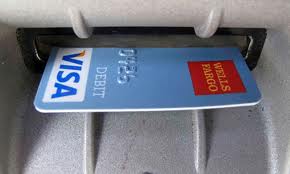
London, June 23: Any time double money! An ATM here started paying twice the amount asked for, due to a human error, and hordes of people benefited from the unexpected windfall till it lasted. There was a run on a cash machine in central London when it started paying out double money after an employee accidentally loaded the £10 tray with £20 notes.

Long queues formed outside the Sainsbury's ATM in Tottenham Court Road as word of the unexpected windfall spread like wildfire. Some customers walked away hundreds of pounds better off after withdrawing maximum of £300 on multiple cards and getting the same amount again each time for free. It's not the first time a "doubleyour-money" error has occurred at cash machines and on previous occasions some banks have chosen to write off the losses rather than pursue a large number of claims.

One office worker, who did not wish to be named, said he became aware of the blunder when he went to get cash out at lunchtime on Thursday.

"I realized the machine was paying double, so I queued up again and withdrew even more," he was quoted by the Daily Mail as saying, after benefiting £200 of free cash from the mistake.

"I checked my statement online and it was only showing the amount we had asked for, not what was paid out. It was the best thing in the world," he said.

The cash machine was finally closed down when a customer reported the problem to the supermarket. "We're only human, so on very rare occasions ATMs can be loaded with the incorrect cash which means a few get lucky customers get more than they bargained for," a spokeswoman for Sainsbury's said.

"We'd like to thank our customers for letting the store know and we have turned the machine off while we investigate the matter," she added.


Comments

Add new comment

  • Coastaldigest.com reserves the right to delete or block any comments.
  • Coastaldigset.com is not responsible for its readers’ comments.
  • Comments that are abusive, incendiary or irrelevant are strictly prohibited.
  • Please use a genuine email ID and provide your name to avoid reject.
News Network
April 28,2020

Washington, Apr 28: After nearly three weeks in an intensive care unit in Los Angeles, doctors treating 41-year-old Broadway actor Nick Cordero for COVID-19 were forced to amputate his right leg.

The flow of blood had been impeded by a blood clot: yet another dangerous complication of the disease that has been bubbling up in frontline reports from China, Europe and the United States.

To be sure, so-called "thrombotic events" occur for a variety of reasons among intensive care patients, but the rates among COVID-19 patients are far higher than would be otherwise expected.

"I have had 40-year-olds in my ICU who have clots in their fingers that look like they'll lose the finger, but there's no other reason to lose the finger than the virus," Shari Brosnahan, a critical care doctor at NYU Langone said.

One of these patients is suffering from a lack of blood flow to both feet and both hands, and she predicts an amputation may be necessary, or the blood vessels may get so damaged that an extremity could drop off by itself.

Blood clots aren't just dangerous for our limbs, but can make their way to the lungs, heart or brain, where they may cause lethal pulmonary embolisms, heart attacks, and strokes.

A recent paper from the Netherlands in the journal Thrombosis Research found that 31 percent of 184 patients suffered thrombotic complications, a figure that the researchers called "remarkably high" -- even if extreme consequences like amputation are rare.

Behnood Bikdeli, a doctor at New York-Presbyterian Hospital, assembled an international consortium of experts to study the issue. Their findings were published in the Journal of The American College of Cardiology.

The experts found the risks were so great that COVID-19 patients "may need to receive blood thinners, preventively, prophylactically," even before imaging tests are ordered, said Bikdeli.

What exactly is causing it? The reasons aren't fully understood, but he offered several possible explanations.

People with severe forms of COVID-19 often have underlying medical conditions like heart or lung disease -- which are themselves linked to higher rates of clotting.

Next, being in intensive care makes a person likelier to develop a clot because they are staying still for so long. That's why for example people are encouraged to stretch and move around on long haul flights.

It's also now clear the COVID-19 illness is associated with an abnormal immune reaction called "cytokine storm" -- and some research has indicated this too is linked to higher rates of clotting.

There could also be something about the virus itself that is causing coagulation, which has some precedent in other viral illnesses.

A paper in the journal The Lancet last week showed that the virus can infect the inner cell layer of organs and of blood vessels, called the endothelium. This, in theory, could interfere with the clotting process.

According to Brosnahan, while thinners like Heparin are effective in some patients, they don't work for all patients because the clots are at times too small.

"There are too many microclots," she said. "We're not sure exactly where they are."

Autopsies have in fact shown some people's lungs filled with hundreds of microclots.

The arrival of a new mystery however helps solve a slightly older one.

Cecilia Mirant-Borde, an intensive care doctor at a military veterans hospital in Manhattan, told AFP that lungs filled with microclots helped explain why ventilators work poorly for patients with low blood oxygen.

Earlier in the pandemic doctors were treating these patients according to protocols developed for acute respiratory distress syndrome, sometimes known as "wet lung."

But in some cases, "it's not because the lungs are occupied with water" -- rather, it's that the microclotting is blocking circulation and blood is leaving the lungs with less oxygen than it should.

It has just been a little under five months since the virus emerged in Wuhan, China, and researchers are learning more about its impact every day.

"While we react surprised, we shouldn't be as surprised as we were. Viruses tend to do weird things," said Brosnahan.

While the dizzying array of complications may seem daunting, "it's possible there'll be one or a couple of unifying mechanisms that describe how this damage happens," she said.

"It's possible it's all the same thing, and that there'll be the same solution."

Comments

Add new comment

  • Coastaldigest.com reserves the right to delete or block any comments.
  • Coastaldigset.com is not responsible for its readers’ comments.
  • Comments that are abusive, incendiary or irrelevant are strictly prohibited.
  • Please use a genuine email ID and provide your name to avoid reject.
News Network
May 22,2020

May 22: A Pakistan International Airlines (PIA) flight on its way from Lahore to Karachi, crashed in the area near Jinnah International Airport on Friday, according to Civil Aviation Authority officials.

Geo News reported that the plane crashed at the Jinnah Ground area near the airport as it was approaching for landing. There were more than 90 passengers on board the Airbus aircraft. Black smoke could be seen from afar at the crash site, say eye witnesses.

There were no immediate reports on the number of casualties. The aircraft arriving from the eastern city of Lahore was carrying 99 passengers and 8 crew members, news agency AP said, quoting Abdul Sattar Kokhar, spokesman for the country’s civil aviation authority.

Witnesses said the Airbus A320 appeared to attempt to land two or three times before crashing in a residential area near Jinnah International Airport.

Flight PK-303 from Lahore was about to land in Karachi when it crashed at the Jinnah Garden area near Model Colony in Malir, just a minute before its landing, Geo News reported.

Local television reports showed smoke coming from the direction of the airport. Ambulances were on their way to the airport.

News agency said Sindh’s Ministry of Health and Population Welfare has declared emergency in all major hospitals of Karachi due to the plane crash.

It’s the second plane crash for Pakistani carrier in less than four years. The airline’s chairman resigned in late 2016, less than a week after the crash of an ATR-42 aircraft killed 47 people. The incident comes as Pakistan was slowly resuming domestic flights in the wake of the coronavirus pandemic, Bloomberg reported.

Comments

Add new comment

  • Coastaldigest.com reserves the right to delete or block any comments.
  • Coastaldigset.com is not responsible for its readers’ comments.
  • Comments that are abusive, incendiary or irrelevant are strictly prohibited.
  • Please use a genuine email ID and provide your name to avoid reject.
News Network
May 29,2020

Karachi, May 29: Investigators and rescue officials have found around Rs 3 crore in cash in the wreckage of the Pakistan International Airlines' aircraft that crashed wth 99 people on board, killing 97 people, including nine children.

Flight PK-8303 from Lahore to Karachi crashed in a residential area near Karachi International Airport on Friday, with only two passengers miraculously surviving the crash.

Investigators and rescue officials have found currencies of different countries and denominations worth around Rs 30 million from the aircraft's wreckage, an official said on Thursday.

"An investigation has been ordered into how such a huge amount of cash got through airport security and baggage scanners and found its way into the ill-fated flight," the official said.

He said that the amount was recovered from two bags in the wreckage.

"The process of identifying the bodies and their luggage which will be handed over to their families and relatives is going on," he said.

A total of 97 people including the aircraft crew died in the crash, one of the most catastrophic aviation disasters in Pakistan's history.

A government official said on Thursday that the identification of 47 bodies had been completed, while 43 bodies were handed over for burial.

Friday's accident was the first major aircraft crash in Pakistan after December 7, 2016 when a PIA ATR-42 aircraft from Chitral to Islamabad crashed midway. The crash claimed the lives of all 48 passengers and crew, including singer-cum-evangelist Junaid Jamshed.

Comments

Add new comment

  • Coastaldigest.com reserves the right to delete or block any comments.
  • Coastaldigset.com is not responsible for its readers’ comments.
  • Comments that are abusive, incendiary or irrelevant are strictly prohibited.
  • Please use a genuine email ID and provide your name to avoid reject.