


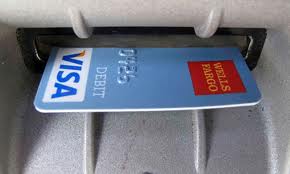
Britons cash in as ATM pays out double

June 23, 2012

Briton

London, June 23: Any time double money! An ATM here started paying twice the amount asked for, due to a human error, and hordes of people benefited from the unexpected windfall till it lasted. There was a run on a cash machine in central London when it started paying out double money after an employee accidentally loaded the £10 tray with £20 notes.

Long queues formed outside the Sainsbury's ATM in Tottenham Court Road as word of the unexpected windfall spread like wildfire. Some customers walked away hundreds of pounds better off after withdrawing maximum of £300 on multiple cards and getting the same amount again each time for free. It's not the first time a "doubleyour-money" error has occurred at cash machines and on previous occasions some banks have chosen to write off the losses rather than pursue a large number of claims.

One office worker, who did not wish to be named, said he became aware of the blunder when he went to get cash out at lunchtime on Thursday.

"I realized the machine was paying double, so I queued up again and withdrew even more," he was quoted by the Daily Mail as saying, after benefiting £200 of free cash from the mistake.

"I checked my statement online and it was only showing the amount we had asked for, not what was paid out. It was the best thing in the world," he said.

The cash machine was finally closed down when a customer reported the problem to the supermarket. "We're only human, so on very rare occasions ATMs can be loaded with the incorrect cash which means a few get lucky customers get more than they bargained for," a spokeswoman for Sainsbury's said.

"We'd like to thank our customers for letting the store know and we have turned the machine off while we investigate the matter," she added.



Comments

Add new comment

  • Coastaldigest.com reserves the right to delete or block any comments.
  • Coastaldigset.com is not responsible for its readers’ comments.
  • Comments that are abusive, incendiary or irrelevant are strictly prohibited.
  • Please use a genuine email ID and provide your name to avoid reject.
April 9,2020

Washington, Apr 9: At least 11 Indians have died of COVID-19 in the United States with another 16 testing positive for the infection which has claimed more than 14,000 lives and afflicted more than four lakh people in the US.

All Indian citizens who have succumbed to the deadly infection in the US are male, with ten of them from New York and New Jersey area. Four of the victims are said to be taxi drivers in New York City.

New York City has emerged as the US epicentre for COVID-19 spurt, accounting for more than 6,000 deaths and over 1,38,000 cases of infections. New Jersey accounts for 1,500 fatalities and nearly 48,000 infections.

One Indian national reportedly died in Florida because of coronavirus. Authorities are also ascertaining the nationality of some other Indian origin people in the States of California and Texas.

All 16 Indians, including four females, who have tested positive for coronavirus are in self-quarantine. Coming from diverse background, eight of them are from New York, three from New Jersey and rest from other states like Texas and California. They hail from Indian states like Uttarakhand, Maharashtra, Karnataka and Uttar Pradesh.

Indian Embassy and consulates across the United States are working closely with local authorities and Indian-American organizations to provide necessary assistance to Indian nationals and students affected with COVID-19.

Because of the strict travel restrictions and regulations to prevent the spread of the deadly virus, local city officials have been performing the last rites of the deceased and in many cases are not allowing even their immediate family members to attend their cremations, officials said.

Comments

Add new comment

  • Coastaldigest.com reserves the right to delete or block any comments.
  • Coastaldigset.com is not responsible for its readers’ comments.
  • Comments that are abusive, incendiary or irrelevant are strictly prohibited.
  • Please use a genuine email ID and provide your name to avoid reject.
Agencies
February 18,2020

British lawmaker Debbie Abrahams' e-Business visa was revoked as she was involved in anti-India activities and the cancellation was conveyed to her on February 14, government sources said on Tuesday.

Asserting that the grant, rejection or revocation of a visa or electronic travel authorisation is the sovereign right of a country, the sources said Abrahams was issued an e-Business visa on October 7 last year which was valid till October 5, 2020 for attending business meetings.

"Her e-Business visa was revoked on February 14, 2020 on account of her indulging in activities which went against India's national interest. The rejection of the e-Business visa was intimated to her on February 14," a source said.

Abrahams, who chairs a British parliamentary group on Kashmir, was denied entry into India upon her arrival at the New Delhi airport on Monday.

Government officials had said on Monday also that she was informed in advance that her e-visa had been cancelled.

Comments

Add new comment

  • Coastaldigest.com reserves the right to delete or block any comments.
  • Coastaldigset.com is not responsible for its readers’ comments.
  • Comments that are abusive, incendiary or irrelevant are strictly prohibited.
  • Please use a genuine email ID and provide your name to avoid reject.
News Network
February 22,2020

Feb 22: A 20-year-old Chinese woman from Wuhan, the epicentre of the coronavirus outbreak, travelled 400 miles(675 km) north to Anyang where she infected five relatives, without ever showing signs of infection, Chinese scientists reported on Friday, offering new evidence that the virus can be spread asymptomatically.

The case study, published in the Journal of the American Medical Association, offered clues about how the coronavirus is spreading, and suggested why it may be difficult to stop.

"Scientists have been asking if you can have this infection and not be ill? The answer is apparently, yes," said Dr. William Schaffner, an infectious disease expert at Vanderbilt University Medical Center, who was not involved in the study.

China has reported a total of 75,567 cases of the virus known as COVID-19 to the World Health Organization (WHO) including 2,239 deaths, and the virus has already spread to 26 countries and territories outside of mainland China.

Researchers have reported sporadic accounts of individuals without any symptoms spreading the virus. What's different in this study is that it offers a natural lab experiment of sorts, Schaffner said.

"You had this patient from Wuhan where the virus is, travelling to where the virus wasn't. She remained asymptomatic and infected a bunch of family members and you had a group of physicians who immediately seized on the moment and tested everyone."

According to the report by Dr Meiyun Wang of the People's Hospital of Zhengzhou University and colleagues, the woman travelled from Wuhan to Anyang on Jan. 10 and visited several relatives. When they started getting sick, doctors isolated the woman and tested her for coronavirus. Initially, the young woman tested negative for the virus, but a follow-up test was positive.

All five of her relatives developed COVID-19 pneumonia, but as of Feb. 11, the young woman still had not developed any symptoms, her chest CT remained normal and she had no fever, stomach or respiratory symptoms, such as cough or sore throat.

Scientists in the study said if the findings are replicated, "the prevention of COVID-19 infection could prove challenging."

Key questions now, Schaffner said, are how often does this kind of transmission occur and when during the asymptomatic period does a person test positive for the virus.

Comments

Add new comment

  • Coastaldigest.com reserves the right to delete or block any comments.
  • Coastaldigset.com is not responsible for its readers’ comments.
  • Comments that are abusive, incendiary or irrelevant are strictly prohibited.
  • Please use a genuine email ID and provide your name to avoid reject.