



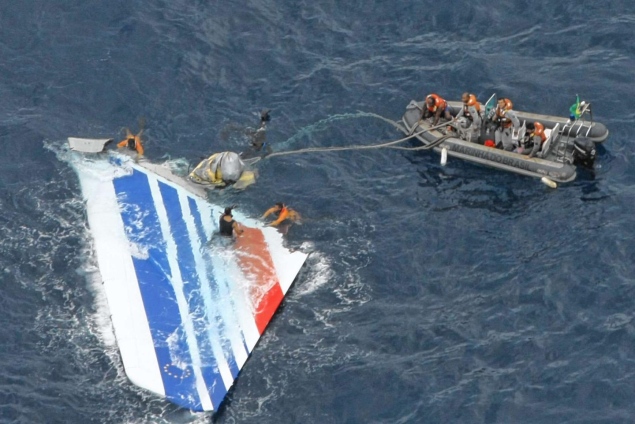
Faulty data misled pilot in 2009 Air France plane crash: Report

July 6, 2012

Pilot_error

Le Bourget (France), July 6: A combination of faulty sensors and mistakes by inadequately trained pilots caused an Air France jet to plunge into the Atlantic Ocean in 2009, killing all 228 people aboard in the airline's deadliest ever crash, French investigators said on Thursday.

Investigators are urging better instruction for pilots on flying manually at high altitudes and stricter plane certification rules as a result of a three-year investigation into what happened to Flight 447.

Airbus, manufacturer of the A330 plane, said in a statement that it is working to improve speed sensors known as pitot tubes and making other efforts to avoid future such accidents. Air France stressed the equipment troubles and insisted the pilots "acted in line with the information provided by the cockpit instruments and systems. .... The reading of the various data did not enable them to apply the appropriate action."


But the Bureau for Investigations and Analysis' findings raised broader concerns about training for pilots worldwide flying high-tech planes when confronted with a high-altitude crisis.

The report also could have legal implications: A separate French judicial investigation is still under way, and Air France and Airbus have been handed preliminary manslaughter charges.

The bureau's analysis lists a combination of "human and technical factors" behind the crash. The plane flying from Rio de Janeiro to Paris slammed into the sea during a nighttime thunderstorm on June 1, 2009.

Some families of victims felt investigators didn't focus hard enough on the equipment problems, saying the two pilots at the controls were doing what they could while faced with a barrage of inaccurate information.

Ice crystals that blocked the pitot tubes were the "unleashing event" that set off the plane's troubles, chief investigator Alain Bouillard said. The plane's autopilot shut off and the co-pilots had to fly manually, while a succession of alarms were going off. The captain was on a rest break.

In one fatal decision, the report says, one of the co-pilots nosed the Airbus A330 upward during a stall - instead of downward, as he should have - because of false data from sensors about the plane's position. Mr Bouillard said that was an "important element" of the cause of the crash.

He said the two pilots at the controls never understood that the plane was in a stall. He said only a well-experienced crew with a clear understanding of the situation could have stabilized the plane in those conditions.

"In this case, the crew was in a state of near-total loss of control," Mr Bouillard said.

Robert Soulas, who lost his daughter and son-in-law in the crash, says investigators said the flight director system indicated the "erroneous information" that the plane was diving downward, "and therefore to compensate, the pilot had a tendency to pull on the throttle to make it rise up."

However, the plane was in a stall instead. A basic maneuver for stall recovery, which pilots are taught at the outset of their flight training, is to push the yoke forward and apply full throttle to lower the nose of the plane and build up speed. But because the pilot thought the plane was diving, he nosed up.

Some families of people who died in the crash showed sympathy toward the pilots, saying they were dealing with bad equipment in an exceptionally challenging situation.

Mr Soulas noted that manufacturers had known for years about problems with the plane's speed sensors freezing over, but didn't order the faulty models systematically replaced until after the crash.

Pilot Gerard Arnoux said, "A normal pilot on a normal airliner follows" the signals on the flight director system, which tells them to go left, right, up or down.

Central to this accident is the fact that when the automation failed, the pilots were presented with conflicting information which was obviously incorrect, said William Voss, president of the Flight Safety Foundation in Alexandria, Virginia. But they were unable to look through this and understand what the aircraft was actually doing.

"Pilots a generation ago would have done that and understand what was going on, but (the AF447 pilots) were so conditioned to rely on the automation that they were unable to do this," he said.

"This is a problem not just limited to Air France or Airbus," Mr Voss said. "It's a problem we're seeing around the world because pilots are being conditioned to treat automated processed data as truth, and not compare it with the raw information that lies underneath."

The final report included a study of the plane's black box flight recorders, uncovered in a costly and extraordinarily complex search in the ocean depths.

Lais Seba, the mother of 31-year-old victim Luciana Clarkson Seba, said "it's going to be forever difficult" for survivors to deal with the loss of their loved-ones.

"We are surviving," she said. "We live one day at a time, with lots of pain, and always missing her."



Comments

Add new comment

  • Coastaldigest.com reserves the right to delete or block any comments.
  • Coastaldigset.com is not responsible for its readers’ comments.
  • Comments that are abusive, incendiary or irrelevant are strictly prohibited.
  • Please use a genuine email ID and provide your name to avoid reject.
News Network
April 18,2020

Washington, Apr 18: The United States on Friday passed 700,000 confirmed coronavirus cases, according to a tally maintained by Johns Hopkins University.

With the highest number of cases and deaths of any country in the world, the US had recorded 700,282 cases of COVID-19 and 36,773 deaths as of 8:30 pm (0030 GMT Friday), according to the Baltimore-based university.

That marked an increase of 3,856 deaths in the past 24 hours, but that figure likely includes "probable" virus-linked deaths, which had not previously been counted.

This week, New York City said it would add 3,778 "probable" virus deaths to its official count.

The US Centers for Disease Control and Prevention gave a toll Friday night of 33,049 dead, including 4,226 probable virus-linked deaths.

The United States has seen the highest death toll in the world in the coronavirus pandemic, ahead of Italy (22,745 deaths) although its population is just a fifth of that of the US.

Spain has recorded 19,478 deaths, followed by France with 18,681.

Trump announces $19 billion relief for farmers amid COVID-19 epidemic

President Donald Trump on Friday announced a $19 billion financial rescue package to help the agriculture industry weather the staggering economic downturn sparked by measures to defeat the coronavirus.

Trump told a press conference the government "will be implementing a $19 billion relief program for our great farmers and ranchers as they cope with the fallout of the global pandemic."

The program will include direct payments to farmers, ranchers and producers who Trump said have experienced "unprecedented losses during this pandemic."

Agriculture Secretary Sonny Perdue said US farmers have been hit hard by a sharp shift in demand, as schools and restaurants close and more Americans eat at home.

That has disrupted the food supply chain, forcing farmers in many places to destroy dairy output and plow under crops that no longer have buyers.

"Having to dump milk and plow under vegetables ready to market is not only financially distressing, but it's heartbreaking as well to those who produce them," Perdue said.

Perdue said some $3 billion of the money would go to buying produce and milk from such farmers, and redistribute it to community food banks.

Millions of Americans have recently turned to food pantries for meals and groceries after losing their jobs.

Comments

Add new comment

  • Coastaldigest.com reserves the right to delete or block any comments.
  • Coastaldigset.com is not responsible for its readers’ comments.
  • Comments that are abusive, incendiary or irrelevant are strictly prohibited.
  • Please use a genuine email ID and provide your name to avoid reject.
News Network
February 2,2020

Feb 2: The Philippines on Sunday reported the first death from a new virus outside of China, where authorities delayed the opening of schools in the worst-hit province and tightened quarantine measures in a city that allow only one family member to venture out to buy supplies.

The Philippine Department of Health said a 44-year-old Chinese man from Wuhan was admitted on Jan. 25 after experiencing a fever, cough, and sore throat. He developed severe pneumonia, and in his last few days, “the patient was stable and showed signs of improvement, however, the condition of the patient deteriorated within his last 24 hours resulting in his demise.”

The man’s 38-year-old female companion, also from Wuhan, also tested positive for the virus and remains in hospital isolation in Manila.

President Rodrigo Duterte approved a temporary ban on all travelers, except Filipinos, from China and its autonomous regions. The U.S., Japan, Singapore and Australia have imposed similar restrictions despite criticism from China and an assessment from the World Health Organization that they were unnecessarily hurting trade and travel.

The death toll in China climbed by 45 to 304 and the number of cases by 2,590 to 14,380, according to the National Health Commission, well above the number of those infected in in the 2002-03 outbreak of SARS, or severe acute respiratory syndrome, which broke out in southern China and spread worldwide.

Meanwhile, six officials in the city of Huanggang, neighboring the epicenter of Wuhan in Hubei province, have been fired over “poor performance” in handling the outbreak, the official Xinhua News Agency reported.

It cited the mayor as saying the city’s “capabilities to treat the patients remained inadequate and there is a severe shortage in medical supplies such as protective suits and medical masks.”

After Huanggang, the trading center of Wenzhou in coastal Zhejiang province also confined people to homes, allowing only one family member to venture out every other day to buy necessary supplies.

With the outbreak showing little sign of abating, authorities in Hubei and elsewhere have extended the Lunar New Year holiday, due to end this week, well into February. The annual travel crunch of millions of people returning from their hometowns to the cities is thought to pose a major threat of secondary infection at a time when authorities are encouraging people to avoid public gatherings.

All Hubei schools will postpone the opening of the new semester until further notice and students from elsewhere who visited over the holiday will also be excused from classes.

Far away on China’s southeast coast, the manufacturing hub of Wenzhou put off the opening of government offices until Feb. 9, private businesses until Feb. 17 and schools until March 1.

With nearly 10 million people, Wenzhou has reported 241 confirmed cases of the virus, one of the highest levels outside Hubei. Similar measures have been announced in the provinces and cities of Heilongjiang, Shandong, Guizhou, Hebei and Hunan, while the major cities of Shanghai and Beijing were on indefinite leave pending developments.

Despite imposing drastic travel restrictions at home, China has chafed at those imposed by foreign governments, criticizing Washington’s order barring entry to most non-citizens who visited China in the past two weeks. Apart from dinging China’s international reputation, such steps could worsen a domestic economy already growing at its lowest rate in decades.

The crisis is the latest to confront Chinese leader Xi Jinping, who has been beset by months of anti-government protests in the semi-autonomous Chinese city of Hong Kong, the reelection of Taiwan’s pro-independence president and criticism over human rights violations in the traditionally Muslim northwestern territory of Xinjiang. Economically, Xi faces lagging demand and dramatically slower growth at home while the tariff war with the U.S. remains largely unresolved.

Among a growing number of airlines suspending flights to mainland China was Qatar Airways. The Doha-based carrier said on its website that its flights would stop Monday. It blamed “significant operational challenges caused by entry restrictions imposed by a number of countries” for the suspension of flights.

Oman also halted flights to China, as did Saudi Arabia’s flagship national carrier, Saudia.

Saudi Arabia’s state-run TV reported that 10 Saudi students were evacuated from Wuhan on a special flight. It said the students would be screened upon arrival, but did not say whether they would be quarantined for 14 days.

This weekend, South Korea and India flew hundreds of their citizens out of Wuhan. They went into a two-week quarantine.

On Sunday, South Korea reported three more cases for a total of 15. They include an evacuee, a Chinese relative of a man who tested positive and a man who returned from Wuhan. India reported a second case, also in southern Kerala state.

South Korea also barred foreigners who have stayed or traveled to Hubei province within the last 14 days from entering the country.

Indonesia flew back 241 nationals from Wuhan on Sunday and quarantined them on the remote Natuna Islands for two weeks. Several hundred residents protested the move, with one saying, “This is not because we do not have a sense of solidarity with fellow nationals. But because we fear they could infect us with the deadly virus from China.”

A Turkish military transport plane carrying 42 people arrived in Ankara from Wutan Saturday night. The 32 Turkish, six Azerbaijani, three Georgian nationals and an Albanian will remain under observation for 14 days, together with 20 personnel who participated in the evacuation, Health Minister Fahrettin Koca said.

Vietnam counted its seventh case, a Vietnamese-American man who had a two-hour layover in Wuhan on his way from the U.S. to Ho Chi Minh City.

The virus’ rapid spread in two months prompted the WHO on Thursday to declare it a global emergency.

That declaration “flipped the switch” from a cautious attitude to recommending governments prepare for the possibility the virus might spread, said the WHO representative in Beijing, Gauden Galea. Most cases reported so far have been people who visited China or their family members.

WHO said it was especially concerned that some cases abroad involved human-to-human transmission.

“Countries need to get ready for possible importation in order to identify cases as early as possible and in order to be ready for a domestic outbreak control, if that happens,” Galea told The Associated Press.

Both the new virus and SARS are from the coronavirus family, which also includes those that cause the common cold.

The death rate in China is falling, but the number of confirmed cases will keep growing because thousands of specimens from suspected cases have yet to be tested, Galea said.

“The case fatality ratio is settling out at a much lower level than we were reporting three, now four, weeks ago,” he said.

Although scientists expect to see limited transmission of the virus between people with family or other close contact, they are concerned about cases of infection spreading to people who might have less exposure.

Comments

Add new comment

  • Coastaldigest.com reserves the right to delete or block any comments.
  • Coastaldigset.com is not responsible for its readers’ comments.
  • Comments that are abusive, incendiary or irrelevant are strictly prohibited.
  • Please use a genuine email ID and provide your name to avoid reject.
News Network
February 27,2020

Washington, Feb 27: President Donald Trump has said that the US' relationship with India is "extraordinary" right now and a lot of progress was made in bilateral ties during his maiden official visit to the country where America will be doing a lot of business.

Talking to reporters, after his return from India on Wednesday, Trump said, "He (Prime Minister Narendra Modi) is a great gentleman, a great leader. It's an incredible country."

President Trump visited India from February 24 to 25. He was accompanied by first lady Melania Trump, daughter Ivanka Trump, son-in-law Jared Kushner and the top brass of his administration, including national security advisor Robert O'Brien.

They visited Ahmedabad, Agra and New Delhi before leaving for Washington on Tuesday.

During his stay, he addressed a massive rally in Ahmedabad, visited Agra and held official meetings in New Delhi.

The US President was feted at the world's largest cricket stadium in the "Namaste Trump" event in Ahmedabad and was cheered by tens of thousands of people.

"We were treated very, very well and we really enjoyed it. A lot of tremendous progress was made in terms of relationship - our relationship with India is extraordinary right now," he said.

"We are going to be doing a lot of business with India, they are sending billions and billions of dollars now to the United States," Trump said in response to a question.

In a tweet, his daughter Ivanka said that, Trump announced that US international development finance corporation "will establish a permanent presence in India to strengthen our economic ties, improve development plus further women's economic empowerment through WGDP (Women's Global Development and Prosperity Initiative)!"

On her arrival from India, she thanked PM Modi for "your warm hospitality as we visited your beautiful country and celebrated the strength, spirit and unity of the US and India!"

"Throughout our visit we saw monumental achievements of human creativity and proof of the infinite capacity of the human heart!" she said.

The first lady tweeted two pictures of her with Trump facing the Taj Mahal in Agra.

"One of the Seven Wonders of the World, the breathtaking Taj Mahal!" she said.

President Trump "reaffirmed the strong strategic partnership, vibrant economic ties and expanding security relationship between our two countries. Wonderful trip, but glad to be home! Thank you India!" said White House press secretary Stephanie Grisham.

During the visit, India and the US on Tuesday finalised defence deals worth $3 billion under which 30 military helicopters will be procured from two American defence majors for Indian armed forces.

The deals will include procurement of 24 MH-60 Romeo helicopters by India from the US at a cost of $2.6 billion. Another contract to acquire six AH-64E Apache helicopters for $800 million from the US is also on the table.

Comments

Add new comment

  • Coastaldigest.com reserves the right to delete or block any comments.
  • Coastaldigset.com is not responsible for its readers’ comments.
  • Comments that are abusive, incendiary or irrelevant are strictly prohibited.
  • Please use a genuine email ID and provide your name to avoid reject.