



'Super volcano' that could kill millions lurks near Italy

August 5, 2012

volcano

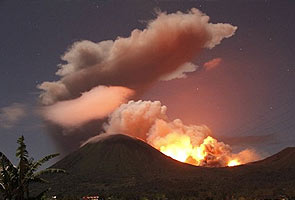
Pozzuoli, August 5: Across the bay of Naples from Pompeii, where thousands were incinerated by Mount Vesuvius in 79 AD, lies a hidden "super volcano" that could kill millions in a catastrophe many times worse, scientists say.

The boiling mud and sulphurous steam holes of the area west of Naples known as the Campi Flegrei or Phlegraean Fields, from the Greek word for burning, are a major tourist attraction.

But the zone of intense seismic activity, which the ancients thought was the entrance to hell, also could pose a danger of global proportions with millions of people literally living on top of a potential future volcanic eruption.


"These areas can give rise to the only eruptions that can have global catastrophic effects comparable to major meteorite impacts," said Giuseppe De Natale, head of a project to drill deep under the earth to monitor the molten "caldera".

One such meteorite impact is thought to have caused the extinction of the dinosaurs 65 million years ago when debris thrown into the atmosphere from the huge explosion plunged the earth into darkness.

Scientists plan to drill 3.5 km (2.2 miles) below the surface to monitor the huge chamber of molten rock near Pompeii and give early warning of any eruption from a 13-km-wide collapsed volcanic caldera.

The Campi Flegrei are similar to the Yellowstone caldera in the U.S. state of Wyoming but of more concern because they are in an area populated by around 3 million people in the Naples hinterland.

"Fortunately, it is extremely rare for these areas to erupt at their full capacity, as it is extremely rare for large meteorites to hit the earth," Mr De Natale told Reuters.

"But some of these areas, in particular the Campi Flegrei, are densely populated and therefore even small eruptions, which are the most probable, fortunately, can pose risks for the population," said Mr De Natale, from the Vesuvius observatory at Italy's National Institute for Geophysics and Volcanology.

"That is why the Campi Flegrei absolutely must be studied and monitored. I wouldn't say like others, but much more than the others exactly because of the danger given that millions of people live in the volcano."

However, the project, funded by the multi-national International Continental Scientific Drilling Programme, has run into major opposition from some local scientists who say the drilling itself could cause a dangerous eruption or earthquake.

EXPLOSION

Benedetto De Vivo, a geochemist at Naples University, has said the drilling could cause an explosion.

The Naples city council blocked the project in 2010 but it resumed on the site of an abandoned steel mill at Bagnoli, west of Naples, late last month after the recently elected new mayor, Luigi De Magistris, gave the go-ahead.

Mr De Natale scoffed at the objections, saying that the drilling was perfectly safe and that similar probes had been sent down by mining projects looking for sources of thermal energy in the 1980s and earlier.

"There were dozens of drillings in the past, with much less secure instruments for industrial motives and nobody said anything," he said.

He added that those raising objections were not experts on drilling and that their suggestions of potential earthquakes or escapes of magma or liquid molten rock, had been exaggerated by the local press.

"Some of the things they suggested are laughable," he said, adding that the project's priority will be scientific knowledge and safety of the local population rather than industrial exploitation as in the past.

"We believe the security of millions of people deserves the most powerful methods of inquiry without thinking too much about the economic aspect," he said.

He added that drilling is the only way to discover the geological history of the area because successive eruptions buried previous evidence. The probe has already found volcanic rock from a major eruption 15,000 years ago.

De Natale's team has begun drilling a pilot hole at the Bagnoli site, where a long jetty built to load steel is used by joggers and courting couples enjoying the spectacular Neapolitan sunsets.

The pilot hole is aimed not only at studying the stratification of the area but to establish a deep geological observatory with new instruments which De Natale says are many times more sensitive than those in the past.

"This will increase by a thousand or 10,000 times our ability to detect small episodes that are precursors of future eruptions," he said.

MOVEMENT OF EARTH'S SURFACE

The project also aims to study the cause of a phenomenon known as bradyseism which is a gradual raising and lowering of the earth's surface because of deep volcanic activity. This is episodic but in the latest phase the ground has risen by 3.5 m (yards) in 15 years, the most since medieval times.

This movement forced the evacuation of 30,000 people temporarily from Pozzuoli in the 1980s and a fishing harbour in the old part of the town was completely abandoned.

Once work is complete on the pilot hole, scientists plan to drill much deeper, to around 3.5 km where temperatures are at around 500 degrees C (930 F). But De Natale said this could take another 18 months and the area for the second phase has not yet been decided.

His team has developed new fibre optic sensors able to withstand the extreme heat that would have destroyed earlier electronic equipment.

"We will be able to identify the smallest signs of a future eruption...this is an enormous mitigation of the volcanic risk," he said.

De Natale says there will be no risk of an escape of magma because the molten chamber is at 7-km depth or lower and sensors will give ample warning of temperatures that reach 1,000 degrees C at the molten core.

"We will stop everything if we detect temperatures at 500 degrees...we can close the top of the drilling hole hermetically in a fraction of a second," he said.

Local people are divided on whether the drilling could be dangerous.

"There is a risk that the drilling can lead to a shift of the earth's surface and if that happened, rather than helping to predict future problems, they will be creating them," Pozzuoli student Marco Laporta said.

Many are more sanguine. "Back in the 1980s they said we would all be blown up and we weren't," pensioner Luigi Bruni said.



Comments

Add new comment

  • Coastaldigest.com reserves the right to delete or block any comments.
  • Coastaldigset.com is not responsible for its readers’ comments.
  • Comments that are abusive, incendiary or irrelevant are strictly prohibited.
  • Please use a genuine email ID and provide your name to avoid reject.
News Network
February 5,2020

Feb 5: Pakistan will buy more palm oil from Malaysia, Prime Minister Imran Khan said on Tuesday, aiming to help offset lost sales after top buyer India put curbs on Malaysian imports last month amid a diplomatic row.

India imposed restrictions on refined palm oil imports and informally asked traders to stop buying from Malaysia, the world's biggest producer of the edible oil. Sources said the move was in retaliation for Malaysia's criticism of India's policy on Kashmir.

Malaysian Prime Minister Mahathir Mohamad said on Tuesday that he discussed palm oil with Khan who was on a visit to Malaysia and that Pakistan had indicated it would import more from Malaysia.

"That's right, especially since we noticed India threatened Malaysia for supporting the Kashmir cause, threatened to cut palm oil imports," Khan told a joint news conference, referring to India's Muslim-majority region of Kashmir.

"Pakistan will do its best to compensate for that."

India is a Hindu-majority country while Malaysia and Pakistan are mainly Muslim. India and Pakistan have been mostly hostile to each other since the partition of British India in 1947, and have fought two of their three wars over competing territorial claims in Kashmir.

Pakistan may have bought around 135,000 tonnes of Malaysian palm oil last month, a record high, India-based dealers who track such shipments told Reuters on condition of anonymity.

The figure is close to estimates of 141,500 tonnes from Refinitiv, which show sales to India in January may have plunged 80% from a year earlier to 40,400 tonnes.

Malaysia will release official export data on Monday.

Pakistan bought 1.1 million tonnes of palm oil from Malaysia last year, while India bought 4.4 million tonnes, according to the Malaysian Palm Oil Council.

Malaysian palm oil futures rose on Tuesday after Khan's comments and on expectations of a steep drop in production in January.

STRONG TIES

India has repeatedly objected to Mahathir speaking out against its move last year to strip Kashmir's autonomy and make it easier for non-Muslims from neighbouring Muslim-majority Bangladesh, Pakistan and Afghanistan to gain citizenship.

At the news conference, Mahathir did not refer to Kashmir but Khan did.

"The way you, PM, have stood with us and spoken about this injustice going on, on behalf of Pakistan I really want to thank you," Khan said.

He also said he was sad he had been unable to attend a summit of Muslim leaders in Malaysia in December. Saudi Arabia did not attend the summit, saying it was the wrong forum to discuss matters affecting the world's Muslims and Khan belatedly pulled out.

Some Pakistani officials, unnamed because they were not authorised to speak to the media, said at the time that Khan pulled out under pressure from Saudi Arabia, a close ally, although local media reported his officials denied that was the reason for his absence.

"Unfortunately our friends, who are very close to Pakistan as well, felt that somehow the conference was going to divide the ummah," Khan said, using the Arabic word for the Muslim community but not mentioning Saudi Arabia by name.

"It is clearly a misconception, as that was not the purpose of the conference."

Comments

Add new comment

  • Coastaldigest.com reserves the right to delete or block any comments.
  • Coastaldigset.com is not responsible for its readers’ comments.
  • Comments that are abusive, incendiary or irrelevant are strictly prohibited.
  • Please use a genuine email ID and provide your name to avoid reject.
News Network
May 7,2020

Islamabad, May 7: Pakistan's COVID-19 cases have crossed 24,000 after 1,523 new infections were detected, while the death toll has jumped to 564 with 38 more people succumbing to the coronavirus, health officials said on Thursday.

Even as the country is seeing an increase in the number of coronavirus cases and fatalities, Prime Minister Imran Khan will discuss the easing of lockdown restrictions with his top aides on Thursday.

The Ministry of National Health Services said that out of the 24,073 total cases, Punjab reported 9,077, Sindh 8,640, Khyber-Pakhtunkhwa 3,712, Balochistan 1,495, Islamabad 521, Gilgit-Baltistan 388 and Pakistan-occupied Kashmir 76 cases.

After 38 more deaths on Wednesday, the total coronavirus patient death toll jumped to 564. Another 6,464 have recovered. A total of 1,523 new patients were added in a single day, the ministry.

So far, 244,778 tests have been conducted, including 12,196 in the last 24 hours, it said.

Prime Minister Khan will chair the National Coordination Committee (NCC) meeting on easing the lockdown restrictions in the country. The meeting will be attended by all chief ministers.

The issue was debated in the National Command and Operation Centre (NCOC) on Wednesday and in the Cabinet on Tuesday.

Planning Minister Asad Umar said that different proposals to allow certain businesses to open were prepared and will be presented before the Prime Minister for a final decision.

Earlier, Khan, undeterred by the mounting number of deaths and the new cases, announced that he was against a lockdown as it hits the poor people badly.

Comments

Add new comment

  • Coastaldigest.com reserves the right to delete or block any comments.
  • Coastaldigset.com is not responsible for its readers’ comments.
  • Comments that are abusive, incendiary or irrelevant are strictly prohibited.
  • Please use a genuine email ID and provide your name to avoid reject.
News Network
July 20,2020

Islamabad, Jul 20: Six advisors of Pakistan Prime Minister Imran Khan posses dual citizenships and several of top 20 aides have admitted of owning movable and immovable assets worth millions of dollars abroad.

The list was published on the official website of Pakistan government's cabinet division.
All the dual nationals were working as special assistants to the prime minister (SAPM). 

These people include SAPM on Overseas Pakistanis Syed Zulfiqar Abbas Bukhari (UK), SAPM on Power Division Shahzad Qasim (US), SAPM on Petroleum Nadeem Babar (US), SAPM on Political Affairs Shahbaz Gill (US), SAPM on Parliamentary Coordination Nadeem Afzal Gondal (Canada) and SAPM on Digital Pakistan Tania Aidrus (Canadian citizenship by birth).

According to Gulf News report, the wealthiest SAPM is Power Division and Mineral Resources Assistant Shahzad Syed Qasim who has assets worth over Rs 4 billion followed by SAPM on Petroleum Nadeem Babar with assets worth Rs 2.75 billion. Meanwhile, Adviser for Overseas Pakistanis Syed Zulfiqar Abbas Bukhari's net assets is estimated over Rs 2 billion.

Giving further details of the wealthiest SAPM, the official website stated that the PM's aide on Power Division and Coordination of Marketing and Development of Mineral Resources owns assets in Pakistan, UAE and US. His three properties in UAE include two villas in Jumeirah Golf Estates and Sienna Lakes, Jumeirah Golf Estates and an apartment at Park Towers, DIFC - all worth Dh20,688,000. He has three cars in the UAE worth Dh400,000 and in the US, he has property worth US$865,000 while he has Rs 4 billion in various local and foreign bank accounts and retirement funds including $2.1 million in US.

Meanwhile, Nadeem Babbar, who is Special Assistant on Petroleum Division, owns assets worth over Rs 2.7 billion, including several properties in Pakistan and abroad and stakes in more than 30 local and foreign companies.

The Gulf News further reported that in the list Dr Moeed Yusuf's, Special Assistant to the Prime Minister on National Security Division and Strategic Policy Planning, the name was also included but was later withdrawn as it was clarified that he had the US residency and only holds the citizenship of Pakistan as per the affidavit submitted to the government. "I have not returned to the US since I took up my current responsibility, have no employment or income in the US nor do I have any millions worth properties abroad" Dr Yusuf was quoted as saying.

The latest list on PM Imran Khan's advisors possessing dual nationalities has sparked strong criticisms by the Opposition leaders.

Comments

Add new comment

  • Coastaldigest.com reserves the right to delete or block any comments.
  • Coastaldigset.com is not responsible for its readers’ comments.
  • Comments that are abusive, incendiary or irrelevant are strictly prohibited.
  • Please use a genuine email ID and provide your name to avoid reject.