


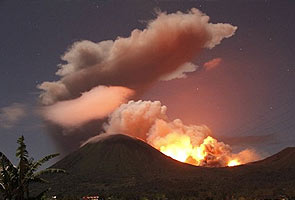
'Super volcano' that could kill millions lurks near Italy

August 5, 2012

volcano

Pozzuoli, August 5: Across the bay of Naples from Pompeii, where thousands were incinerated by Mount Vesuvius in 79 AD, lies a hidden "super volcano" that could kill millions in a catastrophe many times worse, scientists say.

The boiling mud and sulphurous steam holes of the area west of Naples known as the Campi Flegrei or Phlegraean Fields, from the Greek word for burning, are a major tourist attraction.

But the zone of intense seismic activity, which the ancients thought was the entrance to hell, also could pose a danger of global proportions with millions of people literally living on top of a potential future volcanic eruption.


"These areas can give rise to the only eruptions that can have global catastrophic effects comparable to major meteorite impacts," said Giuseppe De Natale, head of a project to drill deep under the earth to monitor the molten "caldera".

One such meteorite impact is thought to have caused the extinction of the dinosaurs 65 million years ago when debris thrown into the atmosphere from the huge explosion plunged the earth into darkness.

Scientists plan to drill 3.5 km (2.2 miles) below the surface to monitor the huge chamber of molten rock near Pompeii and give early warning of any eruption from a 13-km-wide collapsed volcanic caldera.

The Campi Flegrei are similar to the Yellowstone caldera in the U.S. state of Wyoming but of more concern because they are in an area populated by around 3 million people in the Naples hinterland.

"Fortunately, it is extremely rare for these areas to erupt at their full capacity, as it is extremely rare for large meteorites to hit the earth," Mr De Natale told Reuters.

"But some of these areas, in particular the Campi Flegrei, are densely populated and therefore even small eruptions, which are the most probable, fortunately, can pose risks for the population," said Mr De Natale, from the Vesuvius observatory at Italy's National Institute for Geophysics and Volcanology.

"That is why the Campi Flegrei absolutely must be studied and monitored. I wouldn't say like others, but much more than the others exactly because of the danger given that millions of people live in the volcano."

However, the project, funded by the multi-national International Continental Scientific Drilling Programme, has run into major opposition from some local scientists who say the drilling itself could cause a dangerous eruption or earthquake.

EXPLOSION

Benedetto De Vivo, a geochemist at Naples University, has said the drilling could cause an explosion.

The Naples city council blocked the project in 2010 but it resumed on the site of an abandoned steel mill at Bagnoli, west of Naples, late last month after the recently elected new mayor, Luigi De Magistris, gave the go-ahead.

Mr De Natale scoffed at the objections, saying that the drilling was perfectly safe and that similar probes had been sent down by mining projects looking for sources of thermal energy in the 1980s and earlier.

"There were dozens of drillings in the past, with much less secure instruments for industrial motives and nobody said anything," he said.

He added that those raising objections were not experts on drilling and that their suggestions of potential earthquakes or escapes of magma or liquid molten rock, had been exaggerated by the local press.

"Some of the things they suggested are laughable," he said, adding that the project's priority will be scientific knowledge and safety of the local population rather than industrial exploitation as in the past.

"We believe the security of millions of people deserves the most powerful methods of inquiry without thinking too much about the economic aspect," he said.

He added that drilling is the only way to discover the geological history of the area because successive eruptions buried previous evidence. The probe has already found volcanic rock from a major eruption 15,000 years ago.

De Natale's team has begun drilling a pilot hole at the Bagnoli site, where a long jetty built to load steel is used by joggers and courting couples enjoying the spectacular Neapolitan sunsets.

The pilot hole is aimed not only at studying the stratification of the area but to establish a deep geological observatory with new instruments which De Natale says are many times more sensitive than those in the past.

"This will increase by a thousand or 10,000 times our ability to detect small episodes that are precursors of future eruptions," he said.

MOVEMENT OF EARTH'S SURFACE

The project also aims to study the cause of a phenomenon known as bradyseism which is a gradual raising and lowering of the earth's surface because of deep volcanic activity. This is episodic but in the latest phase the ground has risen by 3.5 m (yards) in 15 years, the most since medieval times.

This movement forced the evacuation of 30,000 people temporarily from Pozzuoli in the 1980s and a fishing harbour in the old part of the town was completely abandoned.

Once work is complete on the pilot hole, scientists plan to drill much deeper, to around 3.5 km where temperatures are at around 500 degrees C (930 F). But De Natale said this could take another 18 months and the area for the second phase has not yet been decided.

His team has developed new fibre optic sensors able to withstand the extreme heat that would have destroyed earlier electronic equipment.

"We will be able to identify the smallest signs of a future eruption...this is an enormous mitigation of the volcanic risk," he said.

De Natale says there will be no risk of an escape of magma because the molten chamber is at 7-km depth or lower and sensors will give ample warning of temperatures that reach 1,000 degrees C at the molten core.

"We will stop everything if we detect temperatures at 500 degrees...we can close the top of the drilling hole hermetically in a fraction of a second," he said.

Local people are divided on whether the drilling could be dangerous.

"There is a risk that the drilling can lead to a shift of the earth's surface and if that happened, rather than helping to predict future problems, they will be creating them," Pozzuoli student Marco Laporta said.

Many are more sanguine. "Back in the 1980s they said we would all be blown up and we weren't," pensioner Luigi Bruni said.



Comments

Add new comment

  • Coastaldigest.com reserves the right to delete or block any comments.
  • Coastaldigset.com is not responsible for its readers’ comments.
  • Comments that are abusive, incendiary or irrelevant are strictly prohibited.
  • Please use a genuine email ID and provide your name to avoid reject.
News Network
April 8,2020

Washington, Apr 8: President Donald Trump has threatened to put a "very powerful" hold on US' funding to the World Health Organization, accusing the UN agency of being "very China centric" and criticising it for having "missed the call" in its response to the coronavirus pandemic.

Trump slammed the global health agency for its early guidance aimed at countering the international spread of the coronavirus.

"We're going to put a hold on money spent to the WHO. We're going to put a very powerful hold on it and we're going to see. It's a great thing if it works. But when they call every shot wrong, that's no good," Trump told reporters at his daily White House news conference on Tuesday.

The Geneva-headquartered World Health Organization (WHO), receives vast amounts of money from the United States.

"We pay for a majority or the biggest portion of their money. They actually criticized and disagreed with my travel ban at the time I did it. They were wrong. They've been wrong about a lot of things. They had a lot of information early and they didn't want to - they're very - they seem to be very China centric," Trump said.

The president said his administration was going to look into the US funding to the WHO.

"We give a majority of the money that they get, and it's much more than the USD 58 million. USD 58 million is a small portion of what they've got over the years. Sometimes they get much more than that. Sometimes it's for programs that they're doing, and-it's much bigger numbers. If the programmes are good, that's great as far as we're concerned," he said.

"But we want to look into it, WHO, because they called it wrong. They (WHO) called it wrong. They missed the call. They could've called it months earlier. They would have known and they should have known and they probably did know. So, we'll be looking into that very carefully, and we're going to put a hold on money spent to the WHO," Trump said.

Meanwhile, Senator Jim Risch, chairman of Senate Foreign Relations Committee, called for an independent investigation into the WHO's handling of the COVID-19 response.

"The WHO has failed not only the American people, it has failed the world with its flagrant mishandling of the response to COVID-19," said Risch.

WHO Director general Tedros Adhanom Ghebreyesus' apparent unwillingness to hold the Chinese Communist Party to even the minimum standard of global health and transparency hindered the world's ability to blunt the spread of this pandemic, he said.

"It is completely unacceptable that the world's global health organization has become a political puppet of the Chinese government," he alleged, adding that "an independent investigation into the WHO's handling of the COVID-19 response is imperative."

The United States is the largest contributor to the WHO.

"Our valuable tax payer dollars should go towards investments to prevent the spread of disease, not to aid and abet cover-ups that cost lives and isolate portions of the world's population on political grounds, as has been the case with Taiwan," Senator Risch said.

A bipartisan group of nearly two dozen lawmakers announced Tuesday to introduce a resolution to defund the WHO until Ghebreyesus resigns and an international commission investigates the organisation's role in covering up the Chinese Communist Party's failed COVID-19 response.

"The WHO helped the Chinese Communist Party hide the threat of COVID-19 from the world and now more than 10,000 Americans are dead, a number that is expected to rise dramatically in the coming weeks," Congressman Guy Reschenthaler alleged.

"The United States is the largest contributor to WHO. It is not right that Americans' hard-earned tax dollars are being used to propagate China's lies and hide information that could have saved lives. This bill will hold the WHO accountable for their negligence and deceit," he asserted.

The United States' intelligence community has reported that the Chinese government hid the threat of COVID-19 and, as a result, made it difficult for the rest of the world to respond early, appropriately and aggressively, said Congressman Fred Keller.

"For reasons beyond understanding, the WHO acted as a silent partner in this effort instead of protecting the lives of millions across the world, including hundreds of thousands of American citizens. Our hard-earned tax dollars should not go to a global organization more concerned with not offending the Chinese government than providing accurate information and protecting innocent lives," Keller said.

Senator Marco Rubio accused the Chinese Communist Party of using WHO "to mislead the world."

"The organisation's leadership is either complicit or dangerously incompetent. I will work with the Trump Administration to ensure that WHO is independent and has not been compromised by the CCP before we continue our current funding, he added.

According to Johns Hopkins University, there are over 1.43 million confirmed coronavirus cases across the world and over 82,000 people have died due to the disease. The US has nearly 400,000 infections, the highest in the world.

Comments

Add new comment

  • Coastaldigest.com reserves the right to delete or block any comments.
  • Coastaldigset.com is not responsible for its readers’ comments.
  • Comments that are abusive, incendiary or irrelevant are strictly prohibited.
  • Please use a genuine email ID and provide your name to avoid reject.
Agencies
May 26,2020

UN, May 26: Countries could see a "second peak" of coronavirus cases during the first wave of the pandemic if lockdown restrictions were lifted too soon, the World Health Organization (WHO) has warned.

Mike Ryan, the WHO's head of emergencies, told a briefing on Monday that the world was "right in the middle of the first wave", the BBC reported.

He said because the disease was "still on the way up", countries need to be aware that "the disease can jump up at any time".

"We cannot make assumptions that just because the disease is on the way down now that it's going to keep going down," Ryan said.

There would be a number of months to prepare for a second peak, he added.

The stark warning comes as countries around the world start to gradually ease lockdown restrictions, allowing shops to reopen and larger groups of people to gather.

Experts have said that without a vaccine to give people immunity, infections could increase again when social-distancing measures are relaxed.

Ryan said countries where cases are declining should be using this time to develop effective trace-and-test regimes to "ensure that we continue on a downwards trajectory and we don't have an immediate second peak".

Also on Monday, Tedros Adhanom Ghebreyesus, WHO Director-General, said that a clinical trial of hydroxychloroquine (HCQ) on COVID-19 patients has come to "a temporary pause", while the safety data of the the anti-malaria drug was being reviewed.

According to the WHO chief, The Lancet medical journal on May 22 had published an observational study on HCQ and chloroquine and its effects on COVID-19 patients that have been hospitalized, reports Xinhua news agency.

The authors of the study reported that among patients receiving the drug, when used alone or with a macrolide, they estimated a higher mortality rate.

"The Executive Group of the Solidarity Trial, representing 10 of the participating countries, met on Saturday (May 23) and has agreed to review a comprehensive analysis and critical appraisal of all evidence available globally," Tedros said in a virtual press conference.

The developments come as the total number of global COVID-19 cases has increased to 5,508,904, with 346,508 deaths, according to the Johns Hopkins University.

Comments

Add new comment

  • Coastaldigest.com reserves the right to delete or block any comments.
  • Coastaldigset.com is not responsible for its readers’ comments.
  • Comments that are abusive, incendiary or irrelevant are strictly prohibited.
  • Please use a genuine email ID and provide your name to avoid reject.
News Network
January 7,2020

Dubai/Washington, Jan 7: Iran's Supreme Leader Ayatollah Ali Khamenei wept in grief with hundreds of thousands of mourners thronging Tehran's streets on Monday for the funeral of military commander Qassem Soleimani, killed by a U.S. drone on U.S. President Donald Trump's orders.

The coffins of General Qassem Soleimani and Iraqi militia leader Abu Mahdi al-Muhandis, who also died in Friday's attack in Baghdad, were draped in their national flags and passed from hand to hand over the heads of mourners in central Tehran.

Responding to Trump's threats to hit 52 Iranian sites if Tehran retaliates for the drone strike, Iran's President Hassan Rouhani pointedly wrote on Twitter: "Never threaten the Iranian nation." And Soleimani's successor vowed to expel U.S. forces from the Middle East in revenge.

Khamenei, 80, led prayers at the funeral, pausing as his voice cracked with emotion. Soleimani, 62, was a national hero in Iran, even to many who do not consider themselves supporters of Iran's clerical rulers.

Aerial footage showed people, many clad in black, packing thoroughfares and side streets in the Iranian capital, chanting "Death to America!" - a show of national unity after anti-government protests in November in which many demonstrators were killed.

The crowd, which state media said numbered in the millions, recalled the masses of people that gathered in 1989 for the funeral of the Islamic Republic's founder, Ayatollah Ruhollah Khomeini. Soleimani, architect of Iran's drive to extend its influence across the Middle East, was widely seen as Iran's second most powerful figure behind Khamenei.

His killing of Soleimani has prompted concern around the world that a broader regional conflict could flare.

Trump on Saturday vowed to strike 52 Iranian targets, including cultural sites, if Iran retaliates with attacks on Americans or U.S. assets, and stood by his threat on Sunday, though American officials sought to downplay his reference to cultural targets. The 52 figure, Trump noted, matched the number of U.S. Embassy hostages held for 444 days after the 1979 Iranian Revolution.

Rouhani, regarded as a moderate, responded to Trump on Twitter.

"Those who refer to the number 52 should also remember the number 290. #IR655," Rouhani wrote, referring to the 1988 shooting down of an Iranian airline by a U.S. warship in which 290 were killed.

Trump also took to Twitter to reiterate the White House stance that "Iran will never have a nuclear weapon" but gave no other details.

'ACTIONS WILL BE TAKEN'

General Esmail Ghaani, Soleimani's successor as commander of the Quds Force, the elite unit of Iran's Revolutionary Guards charged with overseas operations, promised to "continue martyr Soleimani's cause as firmly as before with the help of God, and in return for his martyrdom we aim to rid the region of America."

"God the Almighty has promised to take martyr Soleimani's revenge," he told state television. "Certainly, actions will be taken."

Other political and military leaders have made similar, unspecific threats. Iran, which lies at the mouth of the key Gulf oil shipping route, has a range of proxy forces in the region through which it could act.

Iran's demand for U.S. forces to withdraw from the region gained traction on Sunday when Iraq's parliament passed a resolution calling for all foreign troops to leave the country.

Iraqi caretaker Prime Minister Abdel Abdul Mahdi told the U.S. ambassador to Baghdad on Monday that both nations needed to implement the resolution, the premier's office said in a statement. It did not give a timeline.

The United States has about 5,000 troops in Iraq.

Soleimani built a network of proxy militia that formed a crescent of influence - and a direct challenge to the United States and its regional allies led by Saudi Arabia - stretching from Lebanon through Syria and Iraq to Iran. Outside the crescent, Iran nurtured allied Palestinian and Yemeni groups.

He notably mobilised Shi'ite Muslim militia forces in Iraq that helped to crush ISIS, the Sunni militant group that had seized control of swathes of Syria and Iraq in 2014.

Washington, however, blames Soleimani for attacks on U.S. forces and their allies.

The funeral moves to Soleimani's southern home city of Kerman on Tuesday. Zeinab Soleimani, his daughter, told mourners in Tehran that the United States would face a "dark day" for her father's death, adding, "Crazy Trump, don't think that everything is over with my father's martyrdom."

NUCLEAR DEAL

Iran stoked tensions on Sunday by dropping all limitations on its uranium enrichment, another step back from commitments under a landmark deal with major powers in 2015 to curtail its nuclear programme that Trump abandoned in 2018.

In response, European signatories may launch a dispute resolution process against Iran this week that could lead to a renewal of the United Nations sanctions that were lifted as part of the deal, European diplomats said on Monday.

Diplomats said France, Britain and Germany could make a decision ahead of an EU foreign ministers' meeting on Friday that would assess whether there were any ways to salvage the deal.

After quitting the deal, the United States imposed new sanctions on Iran, saying it wanted to halt Iranian oil exports, the main source of government revenues. Iran's economy has been in freefall as the currency has plunged.

Trump adviser Kellyanne Conway said on Monday that he was still confident he could renegotiate a new nuclear agreement "if Iran wants to start behaving like a normal country."

Tehran has said Washington must return to the existing nuclear pact and lift sanctions before any talks can take place.

The United States advised American citizens in Israel and the Palestinian territories to be vigilant, citing the risk of rocket fire amid heightened tensions. As a U.S. ally against Iran, Israel is concerned about possible rocket attacks from Gaza, ruled by Iranian-backed Palestinian Islamists, or major Iran proxy Hezbollah in Lebanon.

Democratic critics of Trump have said the Republican president was reckless in authorising the strike, with some saying his threat to hit cultural sites amounted to a vow to commit war crimes. Trump also threatened sanctions against Iraq and said Baghdad would have to pay Washington for an air base in Iraq if U.S. troops were required to leave.

Comments

Add new comment

  • Coastaldigest.com reserves the right to delete or block any comments.
  • Coastaldigset.com is not responsible for its readers’ comments.
  • Comments that are abusive, incendiary or irrelevant are strictly prohibited.
  • Please use a genuine email ID and provide your name to avoid reject.