CNN and Time magazine's Fareed Zakaria suspended for plagiarism

August 11, 2012

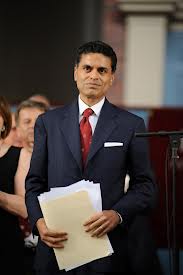
Fareed_ZakariaNew York, August 11: Time editor-at-large and CNN host Fareed Zakaria has been suspended by both the magazine and the network for lifting several paragraphs by another writer for his use in a recent Time column.


Zakaria apologized Friday, declaring in a statement he made "a terrible mistake," adding, "It is a serious lapse and one that is entirely my fault."


In a separate statement, Time spokesman Ali Zelenko said the magazine accepts Zakaria's apology, but would suspend his column for one month, "pending further review."


"What he did violates our own standards for our columnists, which is that their work must not only be factual but original; their views must not only be their own but their words as well," Zelenko said.

Shortly afterward, CNN said it had removed from the network's website a blog post that "included similar unattributed excerpts," and taken Zakaria off the air indefinitely.


"CNN has suspended Fareed Zakaria while this matter is under review," said CNN spokeswoman Jennifer Dargan. She said Zakaria's Sunday foreign-affairs program, "GPS," will have its time slots filled in the interim by "Your Money with Ali Veshi" and "The Situation Room with Wolf Blitzer."


Earlier Friday, media reporters had called attention to similarities between passages in Zakaria's column about gun control that appeared in Time's Aug. 20 issue, and paragraphs from an article on the same subject by Harvard University history professor Jill Lepore published in April in The New Yorker magazine.


In Zakaria's column, titled "The Case for Gun Control," he began one paragraph with the sentences: "Adam Winkler, a professor of constitutional law at UCLA, documents the actual history in 'Gunfight: The Battle Over the Right to Bear Arms in America.' Guns were regulated in the U.S. from the earliest years of the Republic."


A corresponding passage in Lenore's New Yorker essay, titled "Battleground America," begins: "As Adam Winkler, a constitutional-law scholar at U.C.L.A., demonstrates in a remarkably nuanced new book, 'Gunfight: The Battle Over the Right to Bear Arms in America,' firearms have been regulated in the United States from the start."


In Zakaria's statement, he apologized "unreservedly" to Lepore, as well as to his editors and readers.


Comments

Add new comment

  • Coastaldigest.com reserves the right to delete or block any comments.
  • Coastaldigset.com is not responsible for its readers’ comments.
  • Comments that are abusive, incendiary or irrelevant are strictly prohibited.
  • Please use a genuine email ID and provide your name to avoid reject.
News Network
May 30,2020

Washington, May 30: President Donald Trump said Friday he would strip several of Hong Kong's special privileges with the United States and bar some Chinese students from US universities in anger over Beijing's bid to exert control in the financial hub.

In a day of concerted action, the United States and Britain also raised alarm at the UN Security Council over a controversial new security law for Hong Kong, angering Beijing which said the issue had no place at the world body.

In a White House appearance that Trump had teased for a day, the US president attacked China over its treatment of the former British colony, saying it was "diminishing the city's longstanding and proud status."

"This is a tragedy for the people of Hong Kong, the people of China and indeed the people of the world," Trump said.

Trump also said he was terminating the US relationship with the World Health Organization, which he has accused of pro-China bias in its management of the coronavirus crisis.

But Trump was light on specifics and notably avoided personal criticism of President Xi Jinping, with whom he has boasted of having a friendship even as the two powers feud over a rising range of issues.

"I am directing my administration to begin the process of eliminating policy that gives Hong Kong different and special treatment," Trump said.

"This will affect the full range of agreements, from our extradition treaty to our export controls on dual-use technologies and more, with few exceptions," he said.

Secretary of State Mike Pompeo on Wednesday informed Congress that the Trump administration would no longer consider Hong Kong to be separate under US law, but it was up to Trump to spell out the consequences.

China this week pressed ahead on a law that would ban subversion and other perceived offenses against its rule in Hong Kong, which was rocked by months of massive pro-democracy protests last year.

US restricts students

In one move that could have long-reaching consequences, Trump issued an order to ban graduate students from US universities who are connected to China's military.

"For years, the government of China has conducted elicit espionage to steal our industrial secrets, of which there are many," Trump said.

Hawkish Republicans have been clamoring to kick out Chinese students enrolled in sensitive fields. The FBI in February said it was investigating 1,000 cases of Chinese economic espionage and technological theft.

But any move to deter students is unwelcome for US universities, which rely increasingly on tuition from foreigners and have already been hit hard by the COVID-19 shutdown.

China has been the top source of foreign students to the United States for the past decade with nearly 370,000 Chinese at US universities, although Trump's order will not directly affect undergraduates.

Critics say Trump has been eager to fan outrage about China to deflect attention from his own handling of the coronavirus pandemic that has killed more than 100,000 people in the United States, the highest number of deaths of any country.

Chuck Schumer, the top Democrat in the Senate, called Trump's announcement "just pathetic."

Eliot Engel, a Democrat who heads the House Foreign Affairs Committee, noted that Trump treaded lightly on Hong Kong during last year's protests as he sought a trade deal with Xi.

"Now, the president wants to shift the blame for his failures onto China, so he's doing the right thing for the wrong reason," Engel said.

Trump's order could also trigger retaliation. China in March expelled US journalists after the Trump administration tightened visa rules for staff at Chinese state media.

Clash at UN

The United States and Britain earlier in the day urged China to reconsider the Hong Kong law during talks at the UN Security Council, where China wields a veto -- making any formal session, let alone action against Beijing, impossible.

The Western allies raised Hong Kong in an informal, closed-door videoconference where China cannot block the agenda.

They said China was violating an international commitment as the 1984 handover agreement with Britain, in which Beijing promised to maintain the financial hub's separate system until at least 2047, was registered with the United Nations.

"The United States is resolute, and calls upon all UN members states to join us in demanding that the PRC immediately reverse course and honor its international legal commitments to this institution and to the Hong Kong people," said US Ambassador Kelly Craft, referring to the People's Republic of China.  

China demanded that the United States and Britain "immediately stop interfering in Hong Kong affairs," saying the law did not fall under the Security Council's mandate.

"Any attempt to use Hong Kong to interfere in China's internal matters is doomed to fail," warned a statement from China's UN mission.

"There was no consensus, no formal discussion in the Security Council, and the US and the UK's move came to nothing," it said.

Comments

Add new comment

  • Coastaldigest.com reserves the right to delete or block any comments.
  • Coastaldigset.com is not responsible for its readers’ comments.
  • Comments that are abusive, incendiary or irrelevant are strictly prohibited.
  • Please use a genuine email ID and provide your name to avoid reject.
Agencies
July 2,2020

Ramallah, Jul 2: Several world countries renew a call for Israel to halt contentious plans to annex parts of the occupied Palestinian territory after the regime delayed the implementation of the land garb bid in the face of a series of stumbling blocks, including internal rifts, global criticisms and the US’s failure to give Tel Aviv the go-ahead for the move.

Israel's ruling coalition, led by Prime Minister Benjamin Netanyahu, had announced July 1 as the date to begin moving forward with the plan to impose Tel Aviv’s “sovereignty” over about a third of the West Bank, including settlements and the fertile Jordan Valley.

Without clarifications, the regime, however, failed to launch the scheme on the set date amid widening differences between Netanyahu and his coalition partner, minister of military affairs Benny Gantz.

Meanwhile, there are signs that the administration of US President Donald Trump, a staunch Israel supporter, has cooled its backing for the Israeli move amid what is believed to be troubles at home and fears that it might hurt the president’s chances of re-election besides international pressure.

On Wednesday, Netanyahu's office said in a statement that he would continue to discuss a possible West bank annexation with the US administration.

“In the coming days there will be additional discussions,” the statement said.

Labor, Social Affairs and Social Services Minister Ofir Akunis said the Israel would annex portions of the West Bank in July but only after the US president issued a declaration on the matter.

The annexation “will only happen after a declaration by Trump,” he told Israeli Army Radio.

Trump had already given Tel Aviv the green light for the land grab in his self-proclaimed “deal of the century,” which was unveiled in January with the aim of re-drawing the Middle East map.

However, the Trump administration has so far refrained from offering official support for the annexation sought by Netanyahu and his right-wing allies.

Unlike the US, several countries, including some of Israel’s allies, have expressed their opposition to Israel’s planned push to consolidate its occupation of Palestine.

Germany passes anti-annexation resolution

On Wednesday, the German parliament approved a resolution calling on the government to dissuade Israel from annexing the West Bank.

The motion, which was brought in the German legislature by the three parties in Chancellor Angela Merkel's coalition, was approved without opposing votes. 

Berlin should use its “special relations and contacts [with Tel Aviv] to express to the Israeli government our concerns and our urgent demand to refrain from an annexation of parts of the West Bank and from the continued expansion of settlements, both of which contradict international law,” read the resolution.

Speaking at the parliamentary debate before the vote, German Foreign Minister Heiko Maas said, “We reject unilateral changes of borders, and we won’t recognize them.”

He also stressed that peace “cannot be achieved through unilateral steps but only through serious negotiations.”

France warns of consequences

Similarly, French Foreign Minister, Jean-Yves Le Drian warned that any Israeli annexation would be a violation of international law and would bring about consequences.

“Annexation of Palestinian territories, whatever the perimeters, would seriously throw into question the parameters to resolve the conflict,” he told a parliamentary hearing. 

The top diplomat added, “An annexation decision could not be left without consequences and we are examining different options at a national level and also in coordination with our main European partners.”

Australia raises concerns

Additionally, Australian Foreign Minister Marise Payne voiced worries about the Israeli scheme, saying she had directly expressed this view to Israeli Foreign Minister Gabi Ashkenazi.

“We are following with concern possible moves towards the unilateral annexation or change in status of territory on the West Bank,” she said in a statement.

“The focus needs to be on a return to direct and genuine negotiations between Israel and the Palestinians for a durable and resilient peace arrangement, as soon as possible,” Payne added.

Vatican summons US, Israeli envoys

Meanwhile, the Vatican announced on Wednesday that it had summoned the American and Israeli ambassadors to protest Israel’s annexation bid.

In separate meetings, Vatican Secretary of State Cardinal Pietro Parolin told Israeli Ambassador Oren David and US Ambassador Callista Gingrich of concerns “regarding possible unilateral actions that may further jeopardize the search for peace between Israelis and Palestinians, as well as the delicate situation in the Middle East,”

“As already declared … the Holy See reiterates that ... Israel and the State of Palestine have the right to exist and to live in peace and security, within internationally recognized borders,” the Vatican said in a statement.

“It thus appeals to the parties to do everything possible to reopen the process of direct negotiation, on the basis of the relevant Resolutions of the United Nations,” it added.

Amnesty urges firm action

Amnesty International called on the international community to take firm action against Israel’s annexation plan and its “law of the jungle” mentality.

“Members of the international community must enforce international law and restate that annexation of any part of the occupied West Bank is null and void,” said Saleh Higazi, deputy regional director for Amnesty Middle East and North Africa.

“They must also work to immediately stop the construction or expansion of illegal Israeli settlements and related infrastructure in the Occupied Palestinian Territories as a first step towards removing Israeli civilians living in such settlements,” he added.

Palestinians mark ‘Day of Rage'

Also on Wednesday, Palestinians held “Day of Rage” rallies both in the West Bank and the Gaza Strip against the Israeli expansionism.

In Gaza city, several thousand protesters gathered, some brandishing Palestinian national flags and placards condemning Trump.

Some demonstrators carried signs in English reading, “We Can’t Breathe Since 1948” and “Palestinian Lives Matter,” in reference to the American Black Lives Matter movement.

“The occupation has killed us and killed our children and deprived us of a good life. May God grant the Resistance victory,” a protester told the al-Aqsa TV.

“The resistance must be revived,” Gaza protester Rafeeq Inaiah told media persons. “Israel is afraid of force.”

Similar demonstrations also took place in the West Bank cities of Ramallah and Jericho.

Comments

Add new comment

  • Coastaldigest.com reserves the right to delete or block any comments.
  • Coastaldigset.com is not responsible for its readers’ comments.
  • Comments that are abusive, incendiary or irrelevant are strictly prohibited.
  • Please use a genuine email ID and provide your name to avoid reject.
News Network
May 30,2020

May 30: Warning of the tightrope walk ahead as governments battle the coronavirus crisis, Nobel laureate Peter Charles Doherty has expressed concern about densely populated countries such as India relaxing lockdown norms while also describing a complete shutdown as “an economic and social impossibility”.

The Australian immunologist, who cautioned that the number of COVID-19 cases will rise in the coming days, said the earliest time frame for an effective vaccine “going into large numbers of people” is nine to 12 months.

"If all goes well with testing, we could know if some of the candidate vaccines are both safe and effective as early as September/October. Then, rolling a vaccine out will depend on the type of product and how quickly it can be made, put in vials and so forth," Doherty told PTI in an email interview from Melbourne.

The novel coronavirus, he added, does not change fast like influenza and, from what is known so far, “the same vaccine should work everywhere”.

Doherty, who is with the Department of Microbiology and Immunology at the Doherty Institute, University of Melbourne, won the Nobel Prize for Medicine in 1996 for his discovery of how the body’s immune system distinguishes virus-infected cells from normal ones.

Discussing the lockdown, he said, "If it was purely a matter of hard science, everywhere should stay locked down. But that’s pretty much an economic and social impossibility.”

The expectation, he said, is the numbers will rise and limiting spread will depend on people acting responsibly and the capacity for rapid response and extensive contact testing.

“And in a densely populated country like India I think that it will be very difficult," the scientist said.

Several countries, including India, began relaxing lockdown norms in mid-May despite the WHO’s warning about a second wave. India’s lockdown began on March 25 and has since been extended. The fourth phase ends on Sunday.

Asked whether there are any alternatives to a lockdown, the 79-year-old said, "There is no other option other than closing borders. South Korea, for example, conducted massive, intensive testing and contact tracing in a wealthy country with a very disciplined population. Otherwise, not till we have effective vaccines."

He added that he personally doesn’t see the point of closing borders for people coming in if there’s already a high incidence of disease in the community, “unless it’s to avoid the need to care for them and use scarce hospital beds".

According to Doherty, the coronavirus "is a new virus which has come straight out of nature".

“It (the virus) has moved so rapidly across the world because of people travelling on international planes as well as tourist ships," he added.

The immunologist also warned against the use of hydroxychloroquine to treat COVID-19, and said current and planned trials of the anti-malaria drug should be stopped.

“My understanding is that the use of the drug in severe disease is definitely contra-indicated, but it’s not yet clear whether, if taken under medical supervision, it could have some useful effect if taken early on, or as a preventive. Those trials just haven’t been done properly," Doherty noted.

The Indian Council of Medical Research (ICMR) has backed the use of hydroxychloroquine as a preventive against COVID-19 even after the WHO suspended clinical trials of the drug citing safety concerns.

Asked whether plasma therapy can be an effective treatment for COVID-19, Doherty said, "We lack good properly controlled trials but, especially if the plasma has been tested for antibody levels and there’s evidence of good activity, it could be helpful. If I had the disease and was offered plasma therapy I would certainly accept, but I would not take hydroxychloroquine."

Doherty is also very optimistic about herd immunity developing against the SARS-CoV-2 infection.

"We think that (herd immunity) will cut in and have an obvious effect when, say, 60 per cent of people have been infected. Best hope is to boost herd immunity with a vaccine," he stated.

Herd immunity is a form of indirect protection from infectious disease that occurs when a large percentage of a population has become immune to an infection, whether through vaccination or previous infections.

The number of COVID-19 cases have crossed 5.9 million and the fatalities 3,65,000, according to the Johns Hopkins University on Saturday. 

In India, the death toll has risen to 4,971 and the number of cases to 1,73,763, according to the Union Health Ministry on Saturday.

Several states, including Bihar, Uttar Pradesh, Madhya Pradesh, Jharkhand and Chhattisgarh, have reported a rise in number since lockdown norms were relaxed in early May and migrant workers reached home.

In Uttar Pradesh, for instance, the number of infections rose from around 3,000 on May 4 to 6,532 on May 26. Similarly, Bihar’s numbers increased from around 500 to over 2,700 in the period.

Comments

Add new comment

  • Coastaldigest.com reserves the right to delete or block any comments.
  • Coastaldigset.com is not responsible for its readers’ comments.
  • Comments that are abusive, incendiary or irrelevant are strictly prohibited.
  • Please use a genuine email ID and provide your name to avoid reject.