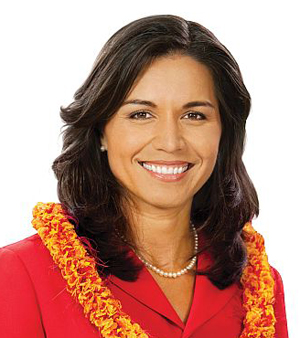
Tulsi Gabbard set to become first Hindu in US Congress

August 13, 2012

tulsi

Washington, August 13: Honolulu City Councilwoman Tulsi Gabbard has a great chance to become the first Hindu member of the US House of Representatives in 2013 with her primary victory in a safe Democratic seat.


Though a practicing Hindu and a strict vegetarian, Gabbard is not of Indian origin. Her father Mike Gabbard, who is a state senator, is from American Samoa. Her mother Carol Porter Gabbard, a white American, is a practicing Hindu. Her father is a Catholic.


Gabbard, 31, won the Democratic Party nomination in Hawaii's 2nd Congressional District Sunday with a decisive 55 percent vote in the primary with closest rival former Honolulu Mayor Mufi Hannemann getting 34 percent.


Four other candidates divided the remainder of the vote. Democratic Representative Mazie Hirono left the seat open when she decided to run for the Senate.


Born in 1981 in Leloaloa, American Samoa, she the fourth of five Gabbard children. When she was two, the family moved to Hawai'i, also the birthplace of President Barack Obama.


Dalip Singh Saund, the first Indian-American to be elected to the US in 1956, was a Sikh. Current Louisiana governor Bobby Jindal who became the second in 2004 had converted to Christianity while in high school.


Though not of Indian origin, Gabbard promises to be a representative for all the Indians in the US.


"Based on my strong affinity for India and Indian culture, as well as my warm love for the country and its people, I will always make myself available to hear the concerns of the Indian Diaspora and do my best to be of assistance," she said.


Comments

Add new comment

  • Coastaldigest.com reserves the right to delete or block any comments.
  • Coastaldigset.com is not responsible for its readers’ comments.
  • Comments that are abusive, incendiary or irrelevant are strictly prohibited.
  • Please use a genuine email ID and provide your name to avoid reject.
Agencies
February 4,2020

As the deadly coronavirus has spread worldwide, it has carried with it xenophobia -- and Asian communities around the world are finding themselves subject to suspicion and fear.

When a patient on Australia's Gold Coast refused to shake the hand of her surgeon Rhea Liang, citing the virus that has killed hundreds, the medic's first response was shock.

But after tweeting about the incident and receiving a flood of responses, the respected doctor learned her experience was all too common.

There has been a spike in reports of anti-Chinese rhetoric directed at people of Asian origin, regardless of whether they have ever visited the centre of the epidemic or been in contact with the virus.

Chinese tourists have reportedly been spat at in the Italian city of Venice, a family in Turin was accused of carrying the disease, and mothers in Milan have used social media to call for children to be kept away from Chinese classmates.

In Canada, a white man was filmed telling a Chinese-Canadian woman "you dropped your coronavirus" in the parking lot of a local mall.

In Malaysia, a petition to "bar Chinese people from entering our beloved country" received almost 500,000 signatures in one week.

The incidents are part of what the Australasian College for Emergency Medicine has described as "misinformation" which it says is fuelling "racial profiling" where "deeply distressing assumptions are being made about 'Chinese' or 'Asian-looking' people." Disease has long been accompanied by suspicions of foreigners -- from Irish immigrants being targeted in the Typhoid Mary panic of 1900s America to Nepali peacekeepers being accused of bringing cholera to earthquake-struck Haiti in the last decade.

"It's a common phenomenon," said Rob Grenfell, director of health and biosecurity for Australia's science and research agency CSIRO.

"With outbreaks and epidemics along human history, we've always tried to vilify certain subsets of the population," he said, comparing the behaviour to 1300s plague-ridden medieval Europe, where foreigners and religious groups were often blamed.

"Sure it emerged in China," he said of the coronavirus, "but that's no reason to actually vilify Chinese people." In a commentary for the British Medical Journal, doctor Abraar Karan warned this behaviour could discourage people with symptoms from coming forward.

Claire Hooker, a health lecturer at the University of Sydney, said the responses from governments may have compounded prejudice.

The World Health Organisation has warned against "measures that unnecessarily interfere with international travel and trade", but this has not stopped scores of countries from introducing travel bans.

The tiny Pacific nation of Micronesia has banned its citizens from visiting mainland China altogether.

"Travel bans respond largely to people's fears," said Hooker, and while sometimes warranted, they often "have the effect of cementing an association between Chinese people and scary viruses".

Abbey Shi, a Shanghai-born student in Sydney, said the attitude shown by some of her peers has "become almost an attack on students who are Chinese".

While Australia's conservative government has banished its citizens returning from Wuhan -- the central Chinese city at the epicentre of the virus -- to a remote island for quarantine, thousands of students still stuck in China risk their studies being torpedoed.

"Right now it looks like they have to miss the semester's start and potentially the whole year, because of the way the courses are set up," Shi said.

According to Hooker, studies in Toronto on the impact of Severe Acute Respiratory Syndrome, or SARS -- another global coronavirus outbreak in 2002 -- showed the impact of xenophobic sentiment often lasted much longer than the public health scare.

"While there may be a cessation of direct forms of racism as news about the disease dies down, it takes quite a bit of time for economic recovery and people continue to feel unsafe," she said.

People may not rush back to Chinese businesses or restaurants, and may even heed some of the more outlandish viral social media disinformation -- such as one popular post imploring people to avoid eating noodles for their own safety.

"In one sense you might think the effects lasted from the last coronavirus to this one because the representation as China being a place where diseases come from has been persistent," Hooker said.


Comments

Add new comment

  • Coastaldigest.com reserves the right to delete or block any comments.
  • Coastaldigset.com is not responsible for its readers’ comments.
  • Comments that are abusive, incendiary or irrelevant are strictly prohibited.
  • Please use a genuine email ID and provide your name to avoid reject.
News Network
April 12,2020

Apr 12: India and other South Asian countries are likely to record their worst growth performance in four decades this year due to the coronavirus outbreak, the World Bank said on Sunday.

The South Asian region, comprising eight countries, is likely to show economic growth of 1.8 per cent to 2.8 per cent this year, the World Bank said in its South Asia Economic Focus report, well down from the 6.3 per cent it projected six months ago.

India's economy, the region's biggest, is expected to grow 1.5 per cent to 2.8 per cent in the fiscal year that started on April 1. The World Bank has estimated it will grow 4.8 per cent to 5 per cent in the fiscal year that ended on March 31.

"The green shoots of a rebound that were observable at the end of 2019 have been overtaken by the negative impacts of the global crisis," the World Bank report said.

Other than India, the World Bank forecast that Sri Lanka, Nepal, Bhutan and Bangladesh will also see sharp falls in economic growth.

Three other countries - Pakistan, Afghanistan and the Maldives - are expected to fall into recession, the World Bank said in the report, which was based on country-level data available as of April 7.

Measures taken to counter the coronavirus have disrupted supply chains across South Asia, which has recorded more than 13,000 cases so far - still lower than many parts of the world.

India's lockdown of 1.3 billion people has also left millions out of work, disrupted big and small businesses and forced an exodus of migrant workers from the cities to their homes in villages.

In the event of prolonged and broad national lockdowns, the report warned of a worst-case scenario in which the entire region would experience an economic contraction this year.

To minimize short-term economic pain, the Bank called for countries in the region to announce more fiscal and monetary steps to support unemployed migrant workers, as well as debt relief for businesses and individuals.

India has so far unveiled a $23 billion economic plan to offer direct cash transfers to millions of poor people hit by its lockdown. In neighbouring Pakistan, the government has announced a $6 billion plan to support the economy.

"The priority for all South Asian governments is to contain the virus spread and protect their people, especially the poorest who face considerable worse health and economic outcomes," said senior World Bank official Hartwig Schafer.

Comments

Add new comment

  • Coastaldigest.com reserves the right to delete or block any comments.
  • Coastaldigset.com is not responsible for its readers’ comments.
  • Comments that are abusive, incendiary or irrelevant are strictly prohibited.
  • Please use a genuine email ID and provide your name to avoid reject.
News Network
May 21,2020

London, May 21: Working mothers in Europe and the United States are taking on most of the extra housework and childcare created by lockdown - and many are struggling to cope, a survey showed on Thursday.

Women with children now spend an average 65 hours a week on the unpaid chores - nearly a third more than fathers - according to the Boston Consulting Group, which questioned parents in five countries.

"Women have been doing too much household work for too long, and this crisis is pushing them to a point that's simply unsustainable," Rachel Thomas, of U.S.-based women's rights group LeanIn.Org, said in response to the data.

"We need a major culture shift in our homes and in our companies ... We should use this moment to build a better way to work and live – one that's fair for everybody."

Researchers say fallout from the pandemic weighs on women in a host of ways, be it in rising domestic violence or in lower wages, as some women cut paid work to take on the new duties.

With lockdowns shutting schools and keeping citizens at home, creating a mountain of domestic work, public campaigns from Georgia to Mexico have urged men to do their fair share.

But women, who on average already do more at home than men, are now shouldering most of the new coronavirus burden, too, said the survey of more than 3,000 working parents in the United States, Britain, Italy, Germany and France.

Women's unpaid hours at home have nearly doubled to 65 hours a week, said the survey, against 50 logged by an average father.

British women are more likely to support others in the COVID-19 pandemic and are finding it harder to stay positive, according to separate analysis released this week by polling firm Ipsos MORI and feminist organisation The Fawcett Society.

It is "no surprise" to see women do more childcare and housekeeping on top of their day jobs, Jacqui Hunt of women's rights group Equality Now, told the Thomson Reuters Foundation.

However, there are "hopeful signs" that men in West Africa are sharing more childcare during the pandemic in a shift in social norms, found a small rapid analysis by humanitarian organisation CARE International released on Wednesday.

Comments

Add new comment

  • Coastaldigest.com reserves the right to delete or block any comments.
  • Coastaldigset.com is not responsible for its readers’ comments.
  • Comments that are abusive, incendiary or irrelevant are strictly prohibited.
  • Please use a genuine email ID and provide your name to avoid reject.