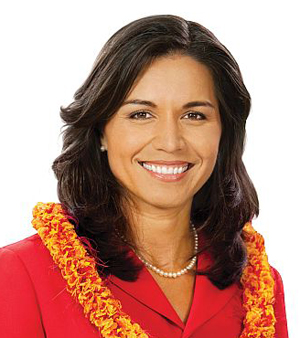
Tulsi Gabbard set to become first Hindu in US Congress

August 13, 2012

tulsi

Washington, August 13: Honolulu City Councilwoman Tulsi Gabbard has a great chance to become the first Hindu member of the US House of Representatives in 2013 with her primary victory in a safe Democratic seat.


Though a practicing Hindu and a strict vegetarian, Gabbard is not of Indian origin. Her father Mike Gabbard, who is a state senator, is from American Samoa. Her mother Carol Porter Gabbard, a white American, is a practicing Hindu. Her father is a Catholic.


Gabbard, 31, won the Democratic Party nomination in Hawaii's 2nd Congressional District Sunday with a decisive 55 percent vote in the primary with closest rival former Honolulu Mayor Mufi Hannemann getting 34 percent.


Four other candidates divided the remainder of the vote. Democratic Representative Mazie Hirono left the seat open when she decided to run for the Senate.


Born in 1981 in Leloaloa, American Samoa, she the fourth of five Gabbard children. When she was two, the family moved to Hawai'i, also the birthplace of President Barack Obama.


Dalip Singh Saund, the first Indian-American to be elected to the US in 1956, was a Sikh. Current Louisiana governor Bobby Jindal who became the second in 2004 had converted to Christianity while in high school.


Though not of Indian origin, Gabbard promises to be a representative for all the Indians in the US.


"Based on my strong affinity for India and Indian culture, as well as my warm love for the country and its people, I will always make myself available to hear the concerns of the Indian Diaspora and do my best to be of assistance," she said.


Comments

Add new comment

  • Coastaldigest.com reserves the right to delete or block any comments.
  • Coastaldigset.com is not responsible for its readers’ comments.
  • Comments that are abusive, incendiary or irrelevant are strictly prohibited.
  • Please use a genuine email ID and provide your name to avoid reject.
Agencies
February 4,2020

The Seattle City Council, one of the most powerful city councils in the U.S., on Monday unanimously passed a resolution condemning India’s recently-enacted Citizenship Amendment Act (CAA) and the National Register of Citizens (NRC).

Reaffirming Seattle as a welcoming city and expressing solidarity with the city’s South Asian community regardless of religion and caste, the resolution “resolves that the Seattle City Council opposes the National Register of Citizens and the Citizenship Amendment Act in India, and finds these policies to be discriminatory to Muslims, oppressed castes, women, indigenous, and LGBT people“.

Introduced by Indian American City Council member Kshama Sawant, the resolution urges the Parliament of India to uphold the Indian Constitution by repealing the CAA, and to stop the National Register of Citizens, and take steps towards helping refugees by ratifying various UN treaties on refugees.

“Seattle City’s decision to condemn CAA should be a message to all who wish to undermine pluralism and religious freedom. They cannot peddle in hate and bigotry, and expect to have international acceptability at the same time,” said Ahsan Khan, president of Indian American Muslim Council.

Thenmozhi Soundararajan of Equality Labs, which organised the community in support of the resolution, welcomed its passage. “We are proud of the Seattle City Council for standing on the right side of history today. Seattle is leading the moral consensus in the global outcry against the CAA, she said.

Soundararajan said that thousands of organizers across the country have called, e-mailed, and visited Seattle City Council members to amplify this resolution, and it sets an example to cities across the United States.

“At a time when members of the Indian ruling party sided Trump, the Muslim ban, and his war on immigrants as justification for targeting hundreds of millions of Indian minorities, Americans have a unique responsibility to stand up and speak about this human rights crisis. We are glad that Seattle is leading the way on this,” she said.

Comments

Add new comment

  • Coastaldigest.com reserves the right to delete or block any comments.
  • Coastaldigset.com is not responsible for its readers’ comments.
  • Comments that are abusive, incendiary or irrelevant are strictly prohibited.
  • Please use a genuine email ID and provide your name to avoid reject.
News Network
June 12,2020

Jun 12: The global number of COVID-19 cases has increased to over 7.5 million, while the death toll was nearing 421,000, according to the Johns Hopkins University.

As of Friday morning, the overall number of cases stood at 7,500,777, while the deaths increased to 420,993, the University's Center for Systems Science and Engineering (CSSE) revealed in its latest update.

The US continues with the world's highest number of confirmed cases and deaths at 2,022,488 and 113,803, respectively, according to the CSSE.

In terms of cases, Brazil comes in the second place with 802,828 infections.

This was followed by Russia (501,800), the UK (292,860), India (286,605), Spain (242,707), Italy (236,142), Peru (214,788), France (192,493), Germany (186,691), Iran (180,156), Turkey (174,023), Chile (154,092), Mexico (133,974), Pakistan (125,933) and Saudi Arabia (116,021), the CSSE figures showed.

Regarding fatalities, the UK continues in the second position after the US with 41,364 COVID-19 deaths, which also accounts for the highest number of fatalities in Europe.

The other countries with over 10,000 deaths are Brazil (40,919), Italy (34,167), France (29,349), Spain (27,136) and Mexico (15,944).

Comments

Add new comment

  • Coastaldigest.com reserves the right to delete or block any comments.
  • Coastaldigset.com is not responsible for its readers’ comments.
  • Comments that are abusive, incendiary or irrelevant are strictly prohibited.
  • Please use a genuine email ID and provide your name to avoid reject.
News Network
April 26,2020

Islamabad, Apr 26: Pakistan Prime Minister Imran Khan has been trumped by the country's powerful military yet again, this time over his government's inadequate steps and its poor response in curbing the coronavirus outbreak in the country, even as cases soared over 12,500.

In his address to the nation on March 22, Khan explained the reasons for not imposing a countrywide lockdown, asserting that millions would lose their jobs and affect families, who are below the poverty line, struggling to find enough food to eat. However, less than 24 hours later, Pakistan Army spokesperson Major General Babar Iftikhar announced the implementation of lockdown in the country having a population of over 200 million, contradicting the statements made by Imran Khan.

As lockdown was imposed, the military has deployed troops across Pakistan and is orchestrating the COVID-19 response through the National Core Committee, a body set up to coordinate policy between the national and provincial governments.

"The government left a big gap in its handling of the coronavirus. The army has tried to fill that gap, there was no choice," an unnamed retired general was quoted by Financial Times as saying.

The virus crisis in Pakistan has once again made things crystal clear about who is calling the shots -- the military, widely believed to bring Imran Khan to power in 2018.

The armymen have taken over the COVID-19 crisis as an opportunity to prove their competency in contrast to Imran Khan, who was mocked after urging youth to come forward and join Corona Relief Tigers Force, a volunteer body to wage "jihad" against the virus.

According to analysts, the military's seizure of the coronavirus response marks yet another policy failure for Imran Khan in the eyes of the generals, as per the Financial Times report.

The 67-year-old cricketer-turned-politician has repeatedly failed to gain international traction over the Kashmir issue and has struggled to convince the Financial Action Task Force (FATF) in getting his country removed from 'grey list' for terror funding.

In times of emergency, one has to take clear decisions and take them through. You can't dither. The whole world is advising strong lockdown. If the prime minister does not show that he is decisive, somebody else will," said Nafisa Shah, a Member of Parliament from the opposition Pakistan Peoples Party (PPP).

Even after the lockdown was imposed, Imran Khan continued to question the need for its implementation, raising eyebrows over the country's response in tackling the virus, as cases continue to rise. This comes even as such drastic measures are in place in many countries across the world, including neighbouring India.

According to The Dawn, the country has 12,657 confirmed cases of COVID-19, which includes 2,755 recoveries and 265 deaths. Punjab has the highest number of cases -- 5,326 --, followed by 4,232 in Sindh.

However, experts suggest that the actual numbers could be more given the low testing rates and inadequate supply of testing kits.

Doctors and nurses across the country have staged protests over the lack of personal protective equipment, as increasing numbers of health workers contract COVID-19.

"Because of the lack of resources, there is chaos among the doctors and healthcare workers. They know people are dying, they know the severity of the illness and they have to work without PPE," Shoaib Hasan Tarar, a doctor working in Rawalpindi, was quoted as saying.

As the coronavirus crisis continues to ravage Pakistan, the country's overwhelming health infrastructure has put a toll on its already floundering economy. The IMF said that the GDP will shrink 1.5 per cent in 2020. The cash-strapped nation is set to be the first major emerging economy to apply to a G-20 initiative to request debt repayment relief, according to Financial Times.

In early March, Pakistan saw a surge in coronavirus cases, when infected pilgrims and workers crossed the border from Qom, a religious city in Iran, which is a hotspot.

Pakistan's limited resources were exposed when quarantined pilgrims agitated against unhealthy conditions at Taftan camp on Pakistan-Iran border, where five people were living in a tent with no access to toilets.

While the lockdown is in place, authorities have been confronted by hardline clerics who have defied social distancing terms and downplayed the threat of the virus. During Friday prayers every week, worshippers violate the restrictions by gathering at various mosques.

Last week, Islamabad inked an agreement allowing mosques to stay open for Ramzan. It stipulated that people should follow 20 rules, including maintaining a six feet distance from each other.

"There is little consistency in terms of how the lockdown is being approached. Coronavirus has shown the disconnect between the national government, regional governments and the military. Imran Khan has been left behind as the cheerleader for keeping Pakistan's morale high. I think people are starting to ask, 'How long is he going to last?'", said Sajjan Gohel, South Asia expert and guest teacher at the London School of Economics.


Comments

Add new comment

  • Coastaldigest.com reserves the right to delete or block any comments.
  • Coastaldigset.com is not responsible for its readers’ comments.
  • Comments that are abusive, incendiary or irrelevant are strictly prohibited.
  • Please use a genuine email ID and provide your name to avoid reject.