


Google Earth discovers 'lost pyramid complexes' in Egypt

August 13, 2012

pyramaid

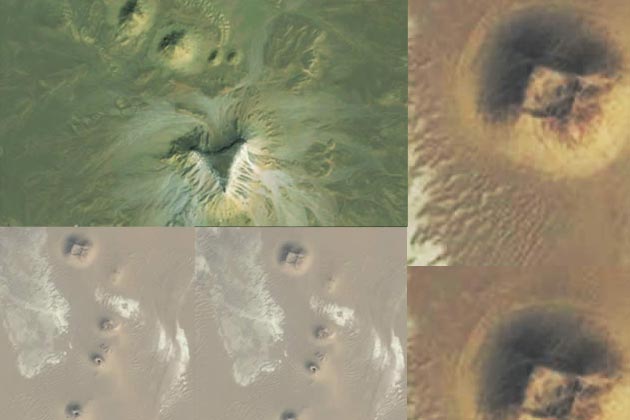
Washington, August 13: An archaeologist claimed to have discovered two new possible pyramid complexes in Egypt with a large mound almost three times the size of the Great Pyramid of Giza.


Archaeology researcher Angela Micol from Maiden, North Carolina has been conducting satellite archaeology research for over ten years, searching for ancient sites from space using Google earth satellite imagery programme and she found two pyramid complexes in Egypt.


The sites have been verified as 'undiscovered' by Egyptologist and pyramid expert Nabil Selim, the Discovery News reported.


"Located about 90 miles (144 kilometres) apart, the sites contain unusual grouping of mounds with intriguing features and orientations," Angela Micol said.


One site in Upper Egypt, just 19 kilometres from the city of Abu Sidhum along the Nile, features four mounds each with a larger, triangular-shaped plateau.


The two larger mounds at this site are approximately 76.2 metres in width, with two smaller mounds approximately 30.48 metres in width.


The site complex is arranged in a very clear formation with the large mound extending a width of approximately 188 metres almost three times the size of the Great Pyramid.


The Great Pyramid of Giza is the oldest and largest of the three pyramids in the Giza Necropolis bordering what is now El Giza, Egypt. It is the oldest of the Seven Wonders of the Ancient World.


"Upon closer examination of the formation, this mound appears to have a very flat top and a curiously symmetrical triangular shape that has been heavily eroded with time,"


Micol wrote in the website Google Earth Anomalies.


The second possible pyramid complex some 144 kilometres north near the Fayoum oasis, contains a four-sided, truncated mound that is approximately 45 metres wide.


"Located just 1.5 miles (2.4 kilometres) south east of the ancient town of Dimai, the site also contains three smaller mounds in a very clear formation, similar to the diagonal alignment of the Giza Plateau pyramids," Micol said.


"The images speak for themselves. It's very obvious what the sites may contain but field research is needed to verify they are, in fact, pyramids," Micol said.


The Egyptian sites have been sent to Egyptologists and researchers for further investigation.



Comments

Add new comment

  • Coastaldigest.com reserves the right to delete or block any comments.
  • Coastaldigset.com is not responsible for its readers’ comments.
  • Comments that are abusive, incendiary or irrelevant are strictly prohibited.
  • Please use a genuine email ID and provide your name to avoid reject.
Agencies
July 3,2020

The dollar's dominance will slowly melt away over the coming year on weakening global demand and a sombre U.S. economic outlook, according to a Reuters poll of currency forecasters whose views depend on there being no second coronavirus shock.

Despite fears a surge in new Covid-19 cases would delay economies reopening and stymie a tentative recovery, world stocks have rallied - with the S&P 500 finishing higher in June, marking its biggest quarterly percentage gain since the height of the technology boom in 1998.

Caught between bets in favour of riskier investments, weak U.S. economic prospects as well as an easing in the thirst for dollars after the Federal Reserve flooded markets with liquidity, the greenback fell nearly 1.0 per cent last month. It was its worst monthly performance since December.

While there was a dire prognosis from the top U.S. medical expert on the coronavirus' spread, the June 25-July 1 poll of over 70 analysts showed weak dollar projections as Fed Chair Jerome Powell on Monday reiterated the economic outlook for the world's largest economy was uncertain.

"The dollar rises in two instances: when you see risk off or when there is a situation where the U.S. is leading the global recovery, and we don't think that's going to be the case anytime soon," said Gavin Friend, senior FX strategist at NAB Group in London.

"The U.S. is playing fast and loose with the virus, and chronologically they're behind the rest of the world."

Currency speculators, who had built up trades against the dollar to the highest in two years during May, increased their out-of-favour dollar bets further last week, the latest positioning data showed.

About 80 per cent of analysts, 53 of 66, said the likely path for the dollar over the next six months was to trade around current levels, alternating between slight gains and losses in a range. That suggests the greenback may be at a crucial crossroad as more currency strategists have turned bearish.

But more than 90 per cent, or 63 of 68, said a second shock from the pandemic would push the dollar higher. Five said it would push the U.S. currency lower.

Much will also depend on debt servicing and repayments by Asian, European and other international borrowers in U.S. dollars.

While an early shortage of dollars in March from the pandemic's first shock pushed the Fed to open currency swap lines with major central banks, international funding strains have eased significantly since. In recent weeks, usage of the facility has reduced dramatically.

That trend is expected to continue over the next six months with major central banks' usage of swap lines to "stay around current levels", according to 32 of 46 analysts. While 13 predicted a sharp drop, only one respondent said use of them would "rise sharply".

The dollar index, which measures the greenback's strength against six other major currencies, has slipped over 5 per cent since touching a more than three-year high in March.

When asked which currencies would perform better against the dollar by end-December, a touch over half of 49 respondents said major developed market ones, with the remaining almost split between commodity-linked and emerging market currencies.

"The dollar is so overvalued, and has been overvalued for a long time, it's time now for it to come back down again, as we head towards the (U.S.) election," added NAB's Friend.

Over the last quarter, the euro has staged a 1.8 per cent comeback after falling by a similar margin during the first three months of the year. For the month of June, the euro was up 1.2 per cent against the dollar.

The single currency was now expected to gain about 2.5 per cent to trade at $1.15 in a year from around $1.12 on Wednesday, slightly stronger than $1.14 predicted last month. While those findings are similar to what analysts have been predicting for nearly two years, there was a clear shift in their outlook for the euro, with the range of forecasts showing higher highs and higher lows from last month.

"In comparison to even a month or two ago, the outlook in Europe has improved significantly," said Lee Hardman, currency strategist at MUFG.

"I think that makes the euro look relatively more attractive and cheap against the likes of the dollar. We're not arguing strongly for the euro to surge higher, we're just saying, after the weakness we have seen in recent years, there is the potential for that weakness to start to reverse."

Comments

Add new comment

  • Coastaldigest.com reserves the right to delete or block any comments.
  • Coastaldigset.com is not responsible for its readers’ comments.
  • Comments that are abusive, incendiary or irrelevant are strictly prohibited.
  • Please use a genuine email ID and provide your name to avoid reject.
News Network
January 23,2020

Beijing, Jan 23: China is putting on lockdown a city of 11 million people considered the epicenter of the new coronavirus outbreak that has killed 17 and infected nearly 600 people, as health authorities around the world work to prevent a global pandemic.

The previously unknown coronavirus strain is believed to have emerged late last year from illegally traded wildlife at an animal market in the central Chinese city of Wuhan. Cases have been detected as far away as the United States, stoking fears the virus is already spreading worldwide.

Wuhan's local government said it would shut down all urban transport networks and suspend outgoing flights from the city as of 10 a.m. (0200 GMT) Thursday, state media reported, adding that the government is urging citizens to not leave the city in the absence of special circumstances.

Contrasting with its secrecy over the 2002-03 Severe Acute Respiratory Syndrome (SARS), which killed nearly 800 people, China's communist government has this time given regular updates to try to avoid panic as millions of people travel for the Chinese Lunar New Year holiday.

Chinese authorities have confirmed 571 cases and 17 deaths as of end-Wednesday, state television reported on Thursday. There are eight other known cases around the world - Thailand has confirmed four cases, while the United States, Taiwan, South Korea and Japan have each reported one.

Vice Premier Sun Chunlan said during a visit to Wuhan that authorities needed to be open about the spread of the virus and their efforts to contain it, the official Xinhua news agency reported on Thursday, comments likely to reassure global health experts.

After a meeting at its Geneva headquarters on Wednesday, the World Health Organization (WHO) said it would decide on Thursday whether to declare the outbreak a global health emergency, which would step up the international response.

If it does so, it will be the sixth international public health emergency to be declared in the last decade.

WHO Director-General Tedros Adhanom Ghebreyesus told reporters in Geneva that China's actions so far were "very strong" but called in Beijing to take "more and significant measures to limit or minimise the international spread".

"We stressed to them that by having a strong action not only they will control the outbreak in their country but they will also minimise the chances of this outbreak spreading internationally. So they recognise that," he said.

A senior U.S. State Department official also called on China to "play a bigger role in global health so they taking more and significant measures to limit or minimise the international spread".

"The lack of transparency in the past, especially with SARS ... gives us concern that that may be the case here," the official said, adding however that there were "positive signs that they have taken action in Wuhan".

Fears of a pandemic initially spooked markets but they regained their footing on Wednesday, with investors citing the robust response from authorities as reassuring.

VIRUS SPREADING

The outbreak began in Wuhan, a major transportation hub as well as central China's main industrial and commercial centre, and has now spread to other major population centers including Beijing, Shanghai and Hong Kong.

There is no known cure for the virus. Symptoms include fever, difficulty in breathing and cough, similar to many other respiratory illnesses, and can cause pneumonia.

Chinese authorities are still investigating the origins of the virus, though they confirmed the outbreak began at a market in Wuhan with illegal wildlife transactions and that it can spread from one person to another via respiratory transmission. Among confirmed patients are 15 medical workers, further adding to worries about a possible global pandemic.

Many Chinese were canceling trips, buying face masks, avoiding public places such as cinemas and shopping centers, and even turning to an online plague simulation game as a way to cope.

Airports globally stepped up screening passengers from China and the European Centre for Disease Control and Prevention (ECDC) said in a risk assessment that further global spread of the virus was likely.

Britain joined other countries including Australia in advising citizens against all but essential travel to Wuhan.

Comments

Add new comment

  • Coastaldigest.com reserves the right to delete or block any comments.
  • Coastaldigset.com is not responsible for its readers’ comments.
  • Comments that are abusive, incendiary or irrelevant are strictly prohibited.
  • Please use a genuine email ID and provide your name to avoid reject.
Agencies
June 16,2020

India continues to remain ranked 43rd on an annual World Competitiveness Index compiled by Institute for Management Development (IMD) with some traditional weaknesses like poor infrastructure and insufficient education investment keeping its ranking low, the international business school said on Tuesday.

Singapore has retained its top position on the 63-nation list.

Denmark has moved up to the second position (from 8th last year), Switzerland has gained one place to rank 3rd, the Netherlands has retained its 4th place and Hong Kong has slipped to the fifth place (from 2nd in 2019).

The US has moved down to 10th place (from 3rd last year), while China has also slipped from 14th to 20th place. Among the BRICS nations, India is ranked second after China, followed by Russia (50th), Brazil (56th) and South Africa (59th).

India was ranked 41st on the IMD World Competitiveness Ranking, being produced by the business school based in Switzerland and Singapore every year since 1989, but had slipped to 45th in 2017 before improving to 44th in 2018 and then to 43rd in 2019.

While its overall position has remained unchanged in the 2020 list, it has recorded improvements in areas like long-term employment growth, current account balance, high-tech exports, foreign currency reserves, public expenditure on education, political stability and overall productivity, the IMD said.

However, it has moved down in areas like exchange rate stability, real GDP growth, competition legislation and taxes.

Arturo Bris, Head of Competitiveness Center at IMD Business School, said India continues to struggle on the list and the recent country rating downgrade by Moody’s reflects the uncertainties regarding the economy’s future.

"In our ranking this year, we again emphasize the traditional weaknesses of India -- poor infrastructure, an important deficit in education investment, and a health system that does not reach everybody. For India to follow the path of China, it must stress its intangible infrastructure," Bris said.

"In a less global world, with China, USA, and Europe looking inwards, currencies like the rupee (and the Brazilian real for instance) are going to suffer and display high volatilities.

"Moody’s has threatened the country with a downgrade to junk and that would put India in a terrible position to attract foreign capital. So the urgency for the government should be to fix the short-term problems—and this requires to improve the credibility of the government itself," Bris added.

With the exception of Singapore, the Philippines, Taiwan and the Korean Republic, most Asian economies dropped in rankings this year, the IMD said.

The reason for the Asian economies’ less stellar performance as a region, this year is partly the result of the trade frictions between China and the US, particularly because these economies are highly dependent on trade with China.

About Singapore, which moved to the top rank last year, the IMD said its position is largely driven by the relative ease of setting up business, availability of skilled labour and its cutting-edge technological infrastructure.

The IMD said the impact of COVID-19 on the competitiveness ranking has partially been captured by executives’ opinions about the effectiveness of the different health systems.

In the ASEAN countries included in the survey, only Singapore and Thailand have a positive performance in the effectiveness of the health infrastructure.

Comments

Add new comment

  • Coastaldigest.com reserves the right to delete or block any comments.
  • Coastaldigset.com is not responsible for its readers’ comments.
  • Comments that are abusive, incendiary or irrelevant are strictly prohibited.
  • Please use a genuine email ID and provide your name to avoid reject.