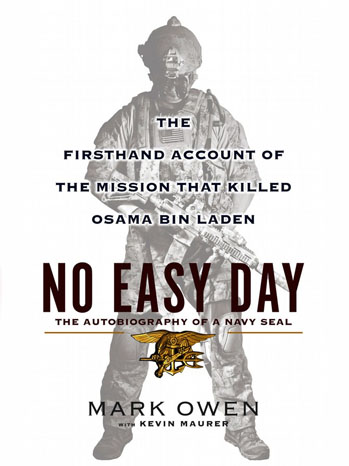
Navy Seal pens book on Osama bin Laden raid

August 24, 2012

No_Easy_Day

Washington, August 24: The US government was surprised by the news that a navy Seal who participated in the raid on Osama bin Laden's compound in Pakistan has written a book about the operation in which the al-Qaida leader was killed, US officials said on Wednesday.


'No Easy Day: The Firsthand Account of the Mission that Killed Osama bin Laden' was written by a navy Seal under the pseudonym Mark Owen with co-author Kevin Maurer and is to be released next month on the anniversary of the September 11 attacks. It was not vetted by government agencies to ensure that no secrets were revealed.


However, Christine Ball, a spokeswoman for the publisher , Dutton, said, "The book was vetted by a former special operations attorney. He vetted it for tactical, technical, and procedural information as well as information that could be considered classified by compilation and found it to be without risk to national security."

The book will be published at a time when Washington has been roiled by controversy over national security leaks ahead of the November 6 presidential election. Republicans have charged that President Barack Obama's administration has engaged in selective leaks to bolster the Democrat's national security credentials. The White House denies those accusations. 0But the book on the bin Laden raid appeared to catch officials off guard.

"We learned about this book on Thursday from press reports. We haven't reviewed it and don't know what it says," White House spokesman Tommy Vietor said. The Pentagon said it hadn't vetted the book or helped provide information to the authors. There are at least two Pentagon regulations requiring the defence department review writings by retired troops that contain sensitive material.


Comments

Add new comment

  • Coastaldigest.com reserves the right to delete or block any comments.
  • Coastaldigset.com is not responsible for its readers’ comments.
  • Comments that are abusive, incendiary or irrelevant are strictly prohibited.
  • Please use a genuine email ID and provide your name to avoid reject.
News Network
March 29,2020

Beijing, Mar 29: In a rare display of public anger in China, dozens of people in central Hubei province, the epicentre of the coronavirus outbreak till recently, attacked official vehicles after they were stopped from crossing a bridge and travel to neighbouring Jiangxi after the lifting of the lockdown.
Hubei province with over 56 million people was kept under lockdown from January 23 as part of aggressive measures to bring down COVID-19 cases which rapidly spread in the area.

Videos on Chinese social media on Friday showed unprecedented scenes of police from Hubei and Jiangxi clashing on the bridge connecting the two provinces over barricades erected from stopping Hubei people from moving out over fears of coronavirus spreading.

Policemen from both sides argued over how to verify if people were allowed to enter Jiangxi, according to local media reports.

It was a major relief for millions of people in Hubei province, when the Chinese government which kept it under lockdown lifted the restrictions on travel.

The government will permit people from the province to travel if they hold a green health code, meaning no contact with any infected or suspected COVID-19 cases.

But people of Hubei to their shock on Friday found roadblocks on the 1st Yangtze River Bridge that separates Huangmei county in Hubei erected by Huangmei county of Jiangxi province.

In local media reports, witnesses were quoted as saying that Huangmei police in Jiujiang erected roadblocks on the bridge to stop people from Hubei from crossing it, a move they alleged stigmatised them.

Video footage shared online showed rows of police armed with riot shields holding back the crowds, while members of the public could be seen damaging and even overturning police vehicles.

In a clip published by the Huanggang city government, which administers Huangmei, the county's Communist Party chief Ma Yanzhou could be heard speaking to the people through a loud hailer, warning them that by gathering in a large group they were increasing their chances of contracting the virus, Hong Kong-based South China Morning Post reported.

While it is unclear exactly how the clash started, police from the two sides published separate official statements online, which were quickly deleted, it said.

The incident underlines the problems China faces as it seeks a return to normalcy after months of lockdown, the Post said.

After the incident, the governments of Huangmei and Jiujiang on Friday issued a joint statement saying they had agreed to remove the barriers set up to restrict travel during the lockdown, and also to recognise each other's health screening codes to make it easier for people in good health to get to where they needed to be, the Post report said.

An article by the ruling Communist Party of China (CPC) mouthpiece, People''s Daily acknowledged the problems in getting the country back on its feet.

"In the past few days, all walks of life have called for governments to accept workers from Hubei," it said.

"However, it is undeniable that some places, intentionally or not, have set up obstacles for Hubei migrant workers to return to their posts and hold prejudices against them."

Comments

Add new comment

  • Coastaldigest.com reserves the right to delete or block any comments.
  • Coastaldigset.com is not responsible for its readers’ comments.
  • Comments that are abusive, incendiary or irrelevant are strictly prohibited.
  • Please use a genuine email ID and provide your name to avoid reject.
Agencies
July 3,2020

The dollar's dominance will slowly melt away over the coming year on weakening global demand and a sombre U.S. economic outlook, according to a Reuters poll of currency forecasters whose views depend on there being no second coronavirus shock.

Despite fears a surge in new Covid-19 cases would delay economies reopening and stymie a tentative recovery, world stocks have rallied - with the S&P 500 finishing higher in June, marking its biggest quarterly percentage gain since the height of the technology boom in 1998.

Caught between bets in favour of riskier investments, weak U.S. economic prospects as well as an easing in the thirst for dollars after the Federal Reserve flooded markets with liquidity, the greenback fell nearly 1.0 per cent last month. It was its worst monthly performance since December.

While there was a dire prognosis from the top U.S. medical expert on the coronavirus' spread, the June 25-July 1 poll of over 70 analysts showed weak dollar projections as Fed Chair Jerome Powell on Monday reiterated the economic outlook for the world's largest economy was uncertain.

"The dollar rises in two instances: when you see risk off or when there is a situation where the U.S. is leading the global recovery, and we don't think that's going to be the case anytime soon," said Gavin Friend, senior FX strategist at NAB Group in London.

"The U.S. is playing fast and loose with the virus, and chronologically they're behind the rest of the world."

Currency speculators, who had built up trades against the dollar to the highest in two years during May, increased their out-of-favour dollar bets further last week, the latest positioning data showed.

About 80 per cent of analysts, 53 of 66, said the likely path for the dollar over the next six months was to trade around current levels, alternating between slight gains and losses in a range. That suggests the greenback may be at a crucial crossroad as more currency strategists have turned bearish.

But more than 90 per cent, or 63 of 68, said a second shock from the pandemic would push the dollar higher. Five said it would push the U.S. currency lower.

Much will also depend on debt servicing and repayments by Asian, European and other international borrowers in U.S. dollars.

While an early shortage of dollars in March from the pandemic's first shock pushed the Fed to open currency swap lines with major central banks, international funding strains have eased significantly since. In recent weeks, usage of the facility has reduced dramatically.

That trend is expected to continue over the next six months with major central banks' usage of swap lines to "stay around current levels", according to 32 of 46 analysts. While 13 predicted a sharp drop, only one respondent said use of them would "rise sharply".

The dollar index, which measures the greenback's strength against six other major currencies, has slipped over 5 per cent since touching a more than three-year high in March.

When asked which currencies would perform better against the dollar by end-December, a touch over half of 49 respondents said major developed market ones, with the remaining almost split between commodity-linked and emerging market currencies.

"The dollar is so overvalued, and has been overvalued for a long time, it's time now for it to come back down again, as we head towards the (U.S.) election," added NAB's Friend.

Over the last quarter, the euro has staged a 1.8 per cent comeback after falling by a similar margin during the first three months of the year. For the month of June, the euro was up 1.2 per cent against the dollar.

The single currency was now expected to gain about 2.5 per cent to trade at $1.15 in a year from around $1.12 on Wednesday, slightly stronger than $1.14 predicted last month. While those findings are similar to what analysts have been predicting for nearly two years, there was a clear shift in their outlook for the euro, with the range of forecasts showing higher highs and higher lows from last month.

"In comparison to even a month or two ago, the outlook in Europe has improved significantly," said Lee Hardman, currency strategist at MUFG.

"I think that makes the euro look relatively more attractive and cheap against the likes of the dollar. We're not arguing strongly for the euro to surge higher, we're just saying, after the weakness we have seen in recent years, there is the potential for that weakness to start to reverse."


Comments

Add new comment

  • Coastaldigest.com reserves the right to delete or block any comments.
  • Coastaldigset.com is not responsible for its readers’ comments.
  • Comments that are abusive, incendiary or irrelevant are strictly prohibited.
  • Please use a genuine email ID and provide your name to avoid reject.
News Network
May 8,2020

New York, May 8: An Indian-American father and daughter, both doctors in New Jersey, have died due to the COVID-19, with Governor Phil Murphy describing their demise as “particularly tough" and hailed them for dedicating their lives for others.

Satyender Dev Khanna, 78, was a surgeon who served both on staff and as the head of the surgical departments for multiple hospitals across New Jersey for decades.

Priya Khanna, 43, was a double board-certified in both internal medicine and nephrology. She was Chief of Residents at Union Hospital, now part of RWJ Barnabas Health.

"Dr Satyender Dev Khanna and Dr Priya Khanna were father and daughter. They both dedicated their lives to helping others. This is a family dedicated to health and medicine. Our words cannot amply express our condolences," New Jersey Governor Murphy tweeted on Thursday.

“Both dedicated their lives to helping others and we lost both of them to COVID-19,” Murphy said during a press conference on Thursday, saying their demise is a "particularly tough one.”

Satyender passed away at the Clara Maass Medical Center where he had worked for more than 35 years.

Murphy described him as a "pioneering doctor” who was one of the first surgeons to perform laparoscopic surgery in the state. He is being remembered by colleagues as a “gentle and caring physician."

“And for a doctor, I'm not one, but I would bet, I don't think there could be a more fitting way to be remembered, or a nurse or a healthcare worker of any kind,” Murphy said, adding that the doctor had a passion for bicycling, and he often found peace from the hustle of the hospital in biking along the Jersey Shore.

Priya did all of her medical training in New Jersey and then did her fellowship in nephrology in South Jersey with the Cooper Health System. Like her father, she too worked at Clara Maass, where she died.

She was also Medical Director at two dialysis centres in Essex County and “took pride” in teaching the next generation of doctors, Murphy said, adding that the ICU physician who cared for Priya Khanna was trained and taught by her as well.

Follow live developments on the coronavirus pandemic here

“Priya will be remembered as a caring and selfless person who put others first. And even while in the hospital, fighting her own battle, she continued to check up on her mom and dad and her family,” Murphy said.

“This is a family, by the way, dedicated to health and medicine,” he said.

The governor spoke with Satyender's wife Komlish Khanna, who is a paediatrician. The couple has two more daughters - Sugandha Khanna, an emergency medicine physician and Anisha Khanna, a paediatrician.

“Unbelievable. Our words cannot amply express our condolences nor, I am sure, can they express the pain that the Khanna family is feeling. But I hope that the fact that our entire state mourns with them is some small comfort. And we mourn everyone we have lost. We commit in their memory to saving as many lives as we can,” Murphy said.

Comments

Add new comment

  • Coastaldigest.com reserves the right to delete or block any comments.
  • Coastaldigset.com is not responsible for its readers’ comments.
  • Comments that are abusive, incendiary or irrelevant are strictly prohibited.
  • Please use a genuine email ID and provide your name to avoid reject.