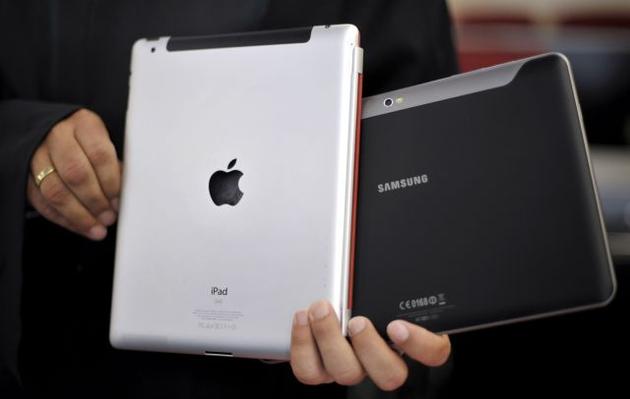
Apple wins $1 billion in Samsung patent case

August 25, 2012

apple

San Jose (California), August 25: A California jury awarded Apple Inc more than $1.05 billion on Friday in its patent infringement claim that Samsung Electronics Co copied technology used in its iPad and iPhone.

The nine-member jury in a federal court in San Jose, California, found overwhelmingly in Apple's favour, saying Samsung had infringed on six of seven smartphone patents in question.

The US lawsuit was one of several cases around the world between California-based Apple and South Korean Samsung over technology rights and innovation in the fast-growing mobile computing sector.

Apple sued Samsung in April 2011, and Samsung countersued. The companies have also sued each other in Britain, Australia and South Korea. The California case was the first to go to a US jury.

Apple sought $2.75 billion for its claims that Samsung infringed four design patents and three software patents. Samsung demanded as much as $421.8 million in royalties for claims that Apple infringed five patents.

The complexity of the case was compounded by Apple's contention that nearly two dozen of Samsung's devices violated its patents.

The disputes date to 2010 when Samsung released its Galaxy smartphones. Apple immediately suspected that Galaxy phones copied the iPhone, which had been on the market for three years.

Apple and Samsung are the world's largest makers of handheld devices that blend phone and a computer functionality.

Sales of the iPhone totalled 47 billion dollars in 2011, while iPad sales totaled 20.4 billion dollars, according to data compiled by Bloomberg. Together they comprised 62 per cent of Apple's sales in fiscal 2011.

In smartphone sales, Samsung has a lead over Apple with about 32 per cent of the market to Apple's 17 per cent, according to technology market researcher IDC.

In a related decision, the US International Trade Commission ruled Friday that Apple did not infringe two patents owned by Google Inc's Motorola Mobility unit for wireless technologies.

The commission stopped short of resolving their dispute, ordering a trade judge to reconsider Motorola Mobility's claim that Apple had violated another patent.

Comments

Add new comment

  • Coastaldigest.com reserves the right to delete or block any comments.
  • Coastaldigset.com is not responsible for its readers’ comments.
  • Comments that are abusive, incendiary or irrelevant are strictly prohibited.
  • Please use a genuine email ID and provide your name to avoid reject.
News Network
February 6,2020

Washington, Feb 6: U.S. president Donald Trump drew on staunch Republican support to defeat the gravest threat yet to his three-year-old presidency on Wednesday, winning acquittal in the Senate on impeachment charges of abuse of power and obstruction of Congress.

Only the third U.S. leader ever placed on trial, Trump readily defeated the Democratic-led effort to expel him from office for having illicitly sought help from Ukraine to bolster his 2020 re-election effort.

Trump immediately claimed "victory" while the White House declared it a full "exoneration" for the president -- even as Democrats rejected the acquittal as the "valueless" outcome of an unfair trial.

Despite being confronted with strong evidence, Republicans stayed loyal and mustered a majority of votes to clear the president of both charges -- by 52 to 48 on abuse of power and 53 to 47 on obstruction of Congress -- falling far short of the two-thirds supermajority required for conviction.

"Two thirds of the senators present not having found him guilty of the charges contained therein, it is therefore ordered and adjudged that the said Donald John Trump be, and he is hereby, acquitted," said Supreme Court chief justice John Roberts, who presided over the trial.

The months-long impeachment of the 45th US leader shone a harsh light on America's political divide, with Trump's core support base united behind him in rejecting it as a "hoax."

One Republican, senator Mitt Romney, a longtime Trump foe, risked White House wrath to vote alongside Democrats on the first count, saying Trump was "guilty of an appalling abuse of public trust." He voted not guilty on the second charge.

But the verdict was never truly in question since the House of Representatives formally impeached Trump in December, and has now cleared out a major hurdle for the president to fully plunge into his campaign for re-election in November.

Trump to speak Thursday

Responding to the verdict, Trump announced he would deliver a formal statement Thursday from the White House "to discuss our Country's VICTORY on the Impeachment Hoax!"

Shortly before, the president tweeted a montage depicting a fake cover of Time magazine declaring him president for all eternity.

The White House declared that Trump had obtained "full vindication and exoneration."

But Nancy Pelosi, the House Speaker and top Democrat in Congress, said that by clearing Trump, the Republicans had "normalized lawlessness."

"There can be no acquittal without a trial, and there is no trial without witnesses, documents and evidence," she said.

"Sadly, because of the Republican Senate's betrayal of the Constitution, the president remains an ongoing threat to American democracy, with his insistence that he is above the law and that he can corrupt the elections if he wants to."

Senate minority leader Chuck Schumer said the acquittal was "virtually valueless" since Republicans refused witnesses at his trial.

'Forever impeached'

The Democrats' intense 78-day House investigation faced public doubts and high-pressure stonewalling from the White House.

Concerned about the political risk for the party, Pelosi rejected a call early last year to impeach Trump on evidence compiled by then-special counsel Robert Mueller that he had obstructed the Russia election meddling investigation.

But her concerns melted after new allegations surfaced in August that Trump had pressured Ukraine for help for his 2020 campaign.

Though doubtful from the outset that they would win support from Republicans, an investigation amassed with surprising speed strong evidence to support the allegations.

The evidence showed that from early in 2019, Trump's private lawyer Rudy Giuliani and a close political ally, Ambassador to the European Union Gordon Sondland, were scheming to pressure Kiev to help smear Democrats, including Trump's potential 2020 rival Joe Biden, by opening investigations into them.

"We must say enough -- enough! He has betrayed our national security, and he will do so again," Adam Schiff, who led the House investigation, argued on the Senate floor this week.

"He has compromised our elections, and he will do so again," Schiff said.

'Colossal' mistake

In the trial, Trump's defence was not seen as having undermined the facts compiled by Schiff's probe, and several Republican senators acknowledged he did wrong.

But his lawyers and Senate defenders argued, essentially, that Trump's behaviour was not egregious enough for impeachment and removal.

And, pointing to the December House impeachment vote, starkly along party lines, they painted it as a political effort to "destroy the president" in an election year and insisted voters should be allowed to decide Trump's fate.

Senate majority leader Mitch McConnell said impeachment will benefit Republicans.

"Right now this is a political loser for them. They initiated it. They thought this was a great idea. At least for the short term, it has been a colossal political mistake."


Comments

Add new comment

  • Coastaldigest.com reserves the right to delete or block any comments.
  • Coastaldigset.com is not responsible for its readers’ comments.
  • Comments that are abusive, incendiary or irrelevant are strictly prohibited.
  • Please use a genuine email ID and provide your name to avoid reject.
News Network
May 19,2020

May 19: A Chinese laboratory has been developing a drug it believes has the power to bring the coronavirus pandemic to a halt.

The outbreak first emerged in China late last year before spreading across the world, prompting an international race to find treatments and vaccines.

A drug being tested by scientists at China's prestigious Peking University could not only shorten the recovery time for those infected, but even offer short-term immunity from the virus, researchers say.

Sunney Xie, director of the university's Beijing Advanced Innovation Center for Genomics, told AFP that the drug has been successful at the animal testing stage.

"When we injected neutralising antibodies into infected mice, after five days the viral load was reduced by a factor of 2,500," said Xie.

"That means this potential drug has (a) therapeutic effect."

The drug uses neutralising antibodies -- produced by the human immune system to prevent the virus infecting cells -- which Xie's team isolated from the blood of 60 recovered patients.

A study on the team's research, published Sunday in the scientific journal Cell, suggests that using the antibodies provides a potential "cure" for the disease and shortens recovery time.

Xie said his team had been working "day and night" searching for the antibody.

"Our expertise is single-cell genomics rather than immunology or virology. When we realised that the single-cell genomic approach can effectively find the neutralising antibody we were thrilled."

He added that the drug should be ready for use later this year and in time for any potential winter outbreak of the virus, which has infected 4.8 million people around the world and killed more than 315,000.

"Planning for the clinical trial is underway," said Xie, adding it will be carried out in Australia and other countries since cases have dwindled in China, offering fewer human guinea pigs for testing.

"The hope is these neutralised antibodies can become a specialised drug that would stop the pandemic," he said.

China already has five potential coronavirus vaccines at the human trial stage, a health official said last week.

But the World Health Organization has warned that developing a vaccine could take 12 to 18 months.

Scientists have also pointed to the potential benefits of plasma -- a blood fluid -- from recovered individuals who have developed antibodies to the virus enabling the body's defences to attack it.

More than 700 patients have received plasma therapy in China, a process which authorities said showed "very good therapeutic effects".

"However, it (plasma) is limited in supply," Xie said, noting that the 14 neutralising antibodies used in their drug could be put into mass production quickly.

Using antibodies in drug treatments is not a new approach, and it has been successful in treating several other viruses such as HIV, Ebola and Middle East Respiratory Syndrome (MERS).

Xie said his researchers had "an early start" since the outbreak started in China before spreading to other countries.

Ebola drug Remdesivir was considered a hopeful early treatment for COVID-19 -- clinical trials in the US showed it shortened the recovery time in some patients by a third -- but the difference in mortality rate was not significant.

The new drug could even offer short-term protection against the virus.

The study showed that if the neutralising antibody was injected before the mice were infected with the virus, the mice stayed free of infection and no virus was detected.

This may offer temporary protection for medical workers for a few weeks, which Xie said they are hoping to "extend to a few months".

More than 100 vaccines for COVID-19 are in the works globally, but as the process of vaccine development is more demanding, Xie is hoping that the new drug could be a faster and more efficient way to stop the global march of the coronavirus.

"We would be able to stop the pandemic with an effective drug, even without a vaccine," he said.

Comments

Add new comment

  • Coastaldigest.com reserves the right to delete or block any comments.
  • Coastaldigset.com is not responsible for its readers’ comments.
  • Comments that are abusive, incendiary or irrelevant are strictly prohibited.
  • Please use a genuine email ID and provide your name to avoid reject.
News Network
April 6,2020

Tokyo, April 6: Japan Prime Minister Shinzo Abe is planning to declare a state of emergency in view of the surging cases of coronavirus in the country, especially in Tokyo and other large cities, government sources said on Monday.

Pressure had been mounting on Abe to make the declaration amid a spurt in COVID-19 cases recently, with calls for the move from Tokyo Governor Yuriko Koike and the Japan Medical Association intensifying, Xinhua news agency reported.

The Tokyo metropolitan government, along with healthcare specialists, said that the number of hospital beds available for coronavirus patients will soon reach capacity, with the health ministry rapidly trying to secure more beds.

Adding to pressure on the government to demonstrably bolster its preventive and countermeasures to the spread of the virus, a panel of government experts warned recently that the country's healthcare system could collapse if coronavirus cases continue to spike.

The healthcare system in Tokyo and four other prefectures are under increased strain and "drastic countermeasures need to be taken as quickly as possible," the experts said.

As of Sunday, 143 new cases of COVID-19 were recorded in Tokyo, a record daily high for the capital, bringing the total to 1,034, with Japan's health ministry and local governments adding that nationwide cases rose to 3,531 as of Sunday afternoon.

Comments

Add new comment

  • Coastaldigest.com reserves the right to delete or block any comments.
  • Coastaldigset.com is not responsible for its readers’ comments.
  • Comments that are abusive, incendiary or irrelevant are strictly prohibited.
  • Please use a genuine email ID and provide your name to avoid reject.