


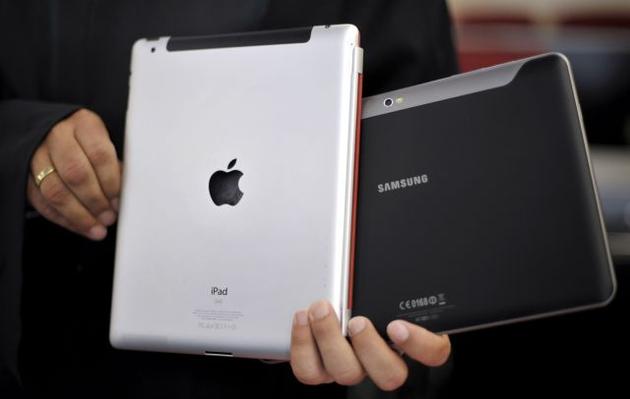
Apple wins $1 billion in Samsung patent case

August 25, 2012

apple

San Jose (California), August 25: A California jury awarded Apple Inc more than $1.05 billion on Friday in its patent infringement claim that Samsung Electronics Co copied technology used in its iPad and iPhone.

The nine-member jury in a federal court in San Jose, California, found overwhelmingly in Apple's favour, saying Samsung had infringed on six of seven smartphone patents in question.

The US lawsuit was one of several cases around the world between California-based Apple and South Korean Samsung over technology rights and innovation in the fast-growing mobile computing sector.

Apple sued Samsung in April 2011, and Samsung countersued. The companies have also sued each other in Britain, Australia and South Korea. The California case was the first to go to a US jury.

Apple sought $2.75 billion for its claims that Samsung infringed four design patents and three software patents. Samsung demanded as much as $421.8 million in royalties for claims that Apple infringed five patents.

The complexity of the case was compounded by Apple's contention that nearly two dozen of Samsung's devices violated its patents.

The disputes date to 2010 when Samsung released its Galaxy smartphones. Apple immediately suspected that Galaxy phones copied the iPhone, which had been on the market for three years.

Apple and Samsung are the world's largest makers of handheld devices that blend phone and a computer functionality.

Sales of the iPhone totalled 47 billion dollars in 2011, while iPad sales totaled 20.4 billion dollars, according to data compiled by Bloomberg. Together they comprised 62 per cent of Apple's sales in fiscal 2011.

In smartphone sales, Samsung has a lead over Apple with about 32 per cent of the market to Apple's 17 per cent, according to technology market researcher IDC.

In a related decision, the US International Trade Commission ruled Friday that Apple did not infringe two patents owned by Google Inc's Motorola Mobility unit for wireless technologies.

The commission stopped short of resolving their dispute, ordering a trade judge to reconsider Motorola Mobility's claim that Apple had violated another patent.

Comments

Add new comment

  • Coastaldigest.com reserves the right to delete or block any comments.
  • Coastaldigset.com is not responsible for its readers’ comments.
  • Comments that are abusive, incendiary or irrelevant are strictly prohibited.
  • Please use a genuine email ID and provide your name to avoid reject.
News Network
January 23,2020

Jan 23: Pakistan's Prime Minister Imran Khan called on Wednesday for the United Nations to help mediate between nuclear armed India and Pakistan over the disputed territory of Kashmir.

"This is a potential flashpoint," Khan said during a media briefing at the annual meeting of the World Economic Forum in Davos, Switzerland, adding that it was time for the "international institutions ... specifically set up to stop this" to "come into action".

The Indian government in August revoked the constitutional autonomy of Indian-administered Kashmir, splitting the Muslim-majority region into two federal territories in a bid to integrate it fully with the rest of the country.

Kashmir is claimed in full by both India and Pakistan. The two countries have gone to war twice over it, and both rule parts of it. India's portion has been plagued by separatist violence since the late 1980s.

Khan said his biggest fear was how New Delhi would respond to ongoing protests in India over a citizenship law that many feel targets Muslims.

"We're not close to a conflict right now ... What if the protests get worse in India, and to distract attention from that, what if ..."

The prime minister said he had discussed the prospect of war between his country and India in a Tuesday meeting with US President Donald Trump. Trump later said he had offered to help mediate between the two countries.

Khan said Pakistan and the United States were closer in their approach to the Taliban armed rebellion in Afghanistan than they had been for many years. He said he had never seen a military solution to that conflict.

"Finally the position of the US is there should be negotiations and a peace plan."

In a separate on-stage conversation later on Wednesday, Khan said he had told Trump in their meeting that a war with Iran would be "a disaster for the world". Trump had not responded, Khan said.

Khan made some of his most straightforward comments when asked why Pakistan has been muted in defence of Uighurs in China.

China has been widely condemned for setting up complexes in remote Xinjiang province that Beijing describes as "vocational training centres" to stamp out ""extremism and give people new skills.

The United Nations says at least one million ethnic Uighurs and other Muslims have been detained.

When pressed on China's policies, Khan said Pakistan's relations with Beijing were too important for him to speak out publicly.

"China has helped us when we were at rock bottom. We are really grateful to the Chinese government, so we have decided that any issues we have had with China we will handle privately."

Comments

Add new comment

  • Coastaldigest.com reserves the right to delete or block any comments.
  • Coastaldigset.com is not responsible for its readers’ comments.
  • Comments that are abusive, incendiary or irrelevant are strictly prohibited.
  • Please use a genuine email ID and provide your name to avoid reject.
Agencies
May 25,2020

The Japan government on Monday decided to lift the state of emergency for COVID-19 in Tokyo and four other prefectures of the country, the only places where the measure implemented to curb the pandemic had remained in force.

The lifting of the alert was backed by the coronavirus advisory panel and will be formally approved by the government later day, the economic revitalization minister and head of the working group to coordinate Japan's fight against COVID-19, Yasutoshi Nishimura, said.

The Japanese authorities made the decision after taking into account the number of infections and the situation of the health system in Tokyo, the three neighbouring prefectures of Chiba, Kanagawa and Saitama and the northern Hokkaido, the only ones where the state of emergency declared more than a month ago to control the pandemic remained in effect, reports Efe news.

The health alert was initially declared in Tokyo and six other prefectures on April 17 and subsequently extended across the country.

It allowed local authorities to ban large-scale public events and close bars and restaurants at night, among other measures, while the government has launched a campaign to encourage teleworking and staying at home.

The government resorted to this measure for the first time in the country's recent history to contain the spread of the virus and is now withdrawing it after a sustained slowdown in infections throughout the archipelago, where around 16,600 confirmed COVID-19 cases and 839 deaths have been recorded, according to the latest data.

The group of experts advising the government appreciated the efforts made by citizens to comply with the recommendations to achieve the target of reducing interpersonal contact by 80 percent, top government spokesperson Yoshihide Suga said at a press conference on Monday.

The recommendation for citizens to avoid unnecessary trips outside and the request for non-essential businesses to close were not mandatory nor accompanied by fines or other penalties for non-compliance, unlike the stricter containment measures implemented in other countries.

The government plans to formally approve the lifting of the state of emergency on Monday after consulting with other political parties in parliament and another meeting with the advisory panel, following which Japanese Prime Minister Shinzo Abe will hold a press conference.

The government had already decided to lift the emergency in 39 prefectures on May 14 after they reported a marked decrease in the number of infections, leaving out the more populated regions such as Tokyo and Osaka.

To avoid new outbreaks of the virus, Abe has urged people to become accustomed to a "new lifestyle" that includes maintaining social distancing, the use of masks outside as well as a series of guidelines for the reopening of shops, restaurants and public facilities.

Comments

Add new comment

  • Coastaldigest.com reserves the right to delete or block any comments.
  • Coastaldigset.com is not responsible for its readers’ comments.
  • Comments that are abusive, incendiary or irrelevant are strictly prohibited.
  • Please use a genuine email ID and provide your name to avoid reject.
News Network
June 10,2020

Hong Kong, Jun 10: The Hong Kong police on Wednesday said they had arrested 53 people during demonstrations on Tuesday evening which were called to mark the one-year anniversary of the protest against a bill proposing extraditions to mainland China. That protest grew into a pro-democracy movement and sparked seven months of protests against Beijing's rule.

Hundreds of activists took to the streets in Hong Kong yesterday, at times blocking roads in the heart of the city, before police fired pepper spray to disperse crowds, Al Jazeera reported.

The police informed that 36 males and 17 females were arrested for offenses including unlawful assembly and disorderly conduct.

Protesters had defied a ban on gatherings of more than eight people introduced by the Hong Kong government to prevent the spread of the coronavirus.

"Lawful protests are always respected, but unlawful acts are to be rejected. Please stop breaking the law," police said in a tweet.

More protests are being planned in the coming days, with pro-democracy supporters fearing the proposed national security legislation will stifle freedoms in the city.

While details of the security law or how it will operate have yet to be revealed, authorities in Beijing and Hong Kong have said there is no cause for concern and the legislation will target a minority of "troublemakers".

But critics say the law would destroy the civil liberties Hong Kong residents enjoy under the "one country, two systems" agreement put in place when the United Kingdom handed the territory back to China in 1997. The agreement is set to end in 2047.

Japan had already issued a statement independently expressing serious concern about Beijing's move on May 28, the day China approved the decision and called in the Chinese ambassador to convey its view.

The United States, Britain, Australia, and Canada also condemned the move, with Washington saying it would revoke Hong Kong's special trading status granted under a 1992 law on the condition that the city retains key freedoms and autonomy.

China blames the protests in part on foreign intervention and is rushing to enact the national security law aimed at curbing secessionist and subversive activities in Hong Kong.

Comments

Add new comment

  • Coastaldigest.com reserves the right to delete or block any comments.
  • Coastaldigset.com is not responsible for its readers’ comments.
  • Comments that are abusive, incendiary or irrelevant are strictly prohibited.
  • Please use a genuine email ID and provide your name to avoid reject.