



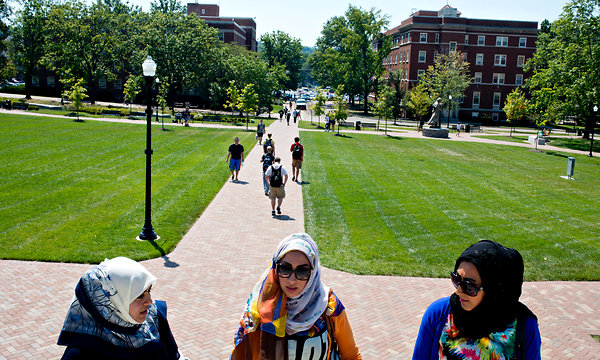
Muslims are thriving in American Catholic colleges

[email protected] (Richard Perez Pena, New York Times |)
September 4, 2012

h

Dayton (Ohio), September 4: Arriving from Kuwait to attend college here, Mai Alhamad wondered how Americans would receive a Muslim, especially one whose head scarf broadcasts her religious identity.

At any of the countless secular universities she might have chosen, religion - at least in theory - would be beside the point. But she picked one that would seem to underline her status as a member of a religious minority. She enrolled at the University of Dayton, a Roman Catholic school, and she says it suits her well.

"Here, people are more religious, even if they're not Muslim, and I am comfortable with that," said Ms. Alhamad, an undergraduate in civil engineering, as several other Muslim women gathered in the student center nodded in agreement. "I'm more comfortable talking to a Christian than an atheist."

A decade ago, the University of Dayton, with 11,000 undergraduate and graduate students, had just 12 from predominantly Muslim countries, all of them men, said Amy Anderson, the director of the school's center for international programs. Last year, she said, there were 78, and about one-third of them were women.

The flow of students from the Muslim world into American colleges and universities has grown sharply in recent years, and women, though still far outnumbered by men, account for a rising share.

No definitive figures are available, but interviews with students and administrators at several Catholic institutions indicate an even faster rate of growth there, with the Muslim student population generally doubling over the past decade, and the number of Muslim women tripling or more.

At those schools, Muslim students, from the United States or abroad, say they prefer a place where talk of religious beliefs and adherence to a religious code are accepted and even encouraged, socially and academically. Correctly or not, many of them say they believe that they are more accepted than they would be at secular schools.

"I like the fact that there's faith, even if it's not my faith, and I feel my faith is respected," said Maha Haroon, a pre-med undergraduate at Creighton University in Omaha, who was born in Pakistan and grew up in the United States. "I don't have to leave my faith at home when I come to school."

She and her twin sister, Zoha, said they chose Creighton based in part on features rooted in its religious identity, like community service requirements and theology classes that shed light on how different faiths approach ethical issues.

Many Muslim students, particularly women, say they based their college choices partly on the idea that Catholic schools would be less permissive than others in the United States, though the behavior they say they witness later can call that into question.

They like the prevalence of single-sex floors in dorms, and even single-sex dorms at some schools. "I thought it would be a better fit for me, more traditional, a little more conservative," said Shameela Idrees, a Pakistani undergraduate in business at Marymount University in Arlington, Va., who at first lived in an all-women dorm.

Some of the women land at Catholic schools more or less accidentally - some are married and simply enroll where their husbands are going, while others are steered toward particular schools by their home countries' governments.

But for others it is a conscious choice, based on recommendations from friends or relatives, or impressions gained from growing up in places, like Lebanon, with strong traditions of church schools.

Most of the schools say they do not specifically recruit Muslim students.

"There's no conscious effort," said the Rev Kail Ellis, a priest and vice president for academic affairs at Villanova University, near Philadelphia. "It's basically something that happened through word of mouth and reputation."

Muslim students here cite the accommodations Dayton has made, like setting aside spaces for them to pray - a small room for daily use, and two larger ones for Fridays - and installing an ablution room for the traditional preprayer washing of hands and feet.

The university also helps students arrange celebrations of major religious holidays, and it contracts with a halal meat supplier for special events.

Manal Alsharekh, a Saudi Arabian graduate student in engineering at Dayton, said, "I was in another university before that did not respect us so much."

Even so, the adjustment to an American school can be jarring, especially for women. They are a minority even within the minority of Muslim students. Many of them follow restrictions on interaction with nonrelatives, and the head coverings most of them wear make it impossible to blend in.

The degree of culture shock students experience varies as widely as the traditions they grew up in. Some eat the nonhalal meat served daily in school cafeterias, some eat it only after saying a blessing over it and others do not eat it at all.

In a gathering of foreign-born Muslim women here, traditional attire varied widely, from Ayse Cayli, a graduate student from Turkey who does not cover her head and wore shorts and a T-shirt, to Alsharekh, who while in public wears a floor-length cloak over her clothes and a veil across most of her face. Most wear a hijab, or head covering, and stylish but fairly conservative Western clothes extending to the ankles and wrists, even in warm weather.

The prospect of walking into an identifiably Christian institution, often for the first time in their lives, can be intimidating.

"I was afraid they will not like me because I am Muslim, or they will want me to go to church," said Falah Nasser Garoot, a male Saudi graduate student in business at Xavier University in Cincinnati. "At first, when I saw the crosses on the classroom walls, it was very strange for me."

Fatema Albalooshi, a graduate student from Bahrain who is studying engineering at Dayton, said that when she first looked into the school, "I thought it was going to be compulsory to take Catholic courses."

And for the women, especially, identifiable by their head scarves, there are always questions. "People stop and ask me questions, total strangers, about my head covering, they're curious about how I dress," said Hadil Issa, an undergraduate here who grew up in the Palestinian territories and the United States. The more covering they wear, the more women are asked if they get hot in the summer. Muslims are consulted on etiquette by students planning to visit the Middle East. And often, they are asked why they attend a Catholic school.

"I tell people the atmosphere is very warm and supportive," Ms. Issa said. "I feel accepted here, and that's what matters."

Comments

Add new comment

  • Coastaldigest.com reserves the right to delete or block any comments.
  • Coastaldigset.com is not responsible for its readers’ comments.
  • Comments that are abusive, incendiary or irrelevant are strictly prohibited.
  • Please use a genuine email ID and provide your name to avoid reject.
Agencies
March 24,2020

Beijing, Mar 24:  China reported 78 new confirmed cases, including 74 imported infections, while the death toll from the novel coronavirus increased to 3,277 after seven more fatalities were confirmed from the COVID-19, health officials said on Tuesday.

The overall confirmed cases on the Chinese mainland have reached 81,171 by the end of Monday. This included 3,277 people who died of the disease, 4,735 patients who were still being treated and 73,159 patients discharged after recovery, the National Health Commission (NHC) said on Tuesday.

The NHC said, 78 new confirmed COVID-19 cases were reported on the Chinese mainland on Monday, of which 74 were imported from abroad taking the number of overseas cases to 427.

Also on Monday, seven deaths and 35 new suspected cases were reported on the mainland with all the deaths in Hubei Province.

The total COVID-19 cases in Beijing climbed to 522 with eight deaths prompting local governments of Beijing as well as Shanghai to announce that all overseas arrivals will be subjected to nucleic acid tests to ensure proper detection.

Of the 74 newly imported cases, 31 were reported in Beijing, 14 in Guangdong, nine in Shanghai, five in Fujian, four in Tianjin, three in Jiangsu, two in Zhejiang and Sichuan respectively, and one in Shanxi, Liaoning, Shandong and Chongqing respectively, the NHC said.

Beijing is already diverting all international flights to different cities where the passengers will be quarantined for 14 days before arriving in the city.

The NHC said 132 people were still suspected of being infected with the virus.

Coronavirus epicentre Wuhan has reported one confirmed case after a gap of five days prompting officials to begin to ease restrictions.

Wuhan also reported seven new deaths, bringing the total number of deaths in the city and Hubei province for which Wuhan is the capital to 3,160.

The province also saw 444 patients discharged from hospital after recovery on Monday. Among the 4,200 patients being treated in hospital, 1,203 were still in severe condition and another 336 in critical condition, the local health commission said.

By the end of Monday, 356 confirmed cases, including four deaths have been reported in Hong Kong, which has restricted the entry of foreigners into the city. Also a total of 25 confirmed cases were reported in Macao and 195 in Taiwan including two deaths, state-run Xinhua news agency reporrted.

After days of decline in coronavirus cases, China on Monday said that COVID-19 has effectively been "stemmed" in the country and it started easing severe restrictions imposed on Wuhan's 11 million people who were under lockdown since January 23.

The authorities began relaxing restrictions in Wuhan as it reported no new case for the fifth consecutive day on Monday.

Significantly, the Central Leading Group (CLP), headed by Premier Li Keqiang which is coordinating efforts to contain the virus since January 23, said the virus has been curtailed in the country as well as in Wuhan.

"The meeting noted that the spread of the virus nationwide, particularly in the epicentre of Wuhan, has been effectively stemmed," an official statement said on Monday.

The meeting, however, warned that the risks for sporadic infections and localised outbreaks have not gone away. With the pandemic rampaging across the world, the situation remains complex and challenging.

"Wuhan city and Hubei province should stay focused on medical treatment and community-level containment as the two key priorities. They should continue to treat the severe cases, promptly admit new cases, and advance epidemiological investigations," the meeting said.

In Wuhan, officials said people are allowed to go back to work while restrictions on the public transport are gradually being eased.

The Hubei province and its capital Wuhan with over 56 million people were under lockdown since January 23. The vicious virus broke out in city, reportedly at a live animal market in December last year and became virulent inflicting thousands of people in the city and province catching the government off guard.

As the country saw a surge in imported infections, the Chinese government announced that all international flights scheduled to arrive in Beijing will be redirected to airports in 12 other Chinese cities from Monday.

International passengers flying to Beijing will instead land at airports in 12 cities including Shanghai, Tianjin, Nanjing and Shenyang as their first points of entry, the Civil Aviation Administration of China (CAAC) said in a statement.

On Monday, China said international travellers should "think twice" about choosing Beijing for flight transfer in view of the restrictions.

Starting from Monday, all international flights scheduled to arrive in Beijing will be redirected to airports in 12 other Chinese cities, Liu Haitao, an official with China's National Immigration Administration said.

Passengers would go through entry procedures and quarantine measures at the designated cities' airports before they continue their flights to Beijing, Liu said, urging travellers to reserve enough time for their next flights to make sure that they do not miss their outbound flights.

Comments

Add new comment

  • Coastaldigest.com reserves the right to delete or block any comments.
  • Coastaldigset.com is not responsible for its readers’ comments.
  • Comments that are abusive, incendiary or irrelevant are strictly prohibited.
  • Please use a genuine email ID and provide your name to avoid reject.
Agencies
April 28,2020

Washington, Apr 28: US President while addressing a news conference on coronavirus pandemic said his administration has launched "very serious investigations" into China's response to the novel coronavirus.

"And we are not happy with China, we are not happy with that whole situation, because we believe it could have been stopped at the source," he said. "It could have been stopped quickly and it wouldn't have spread all over the world," the BBC reported.

Trump has been critical of China as the pandemic has progressed and has frequently touted his decision to close the US borders to China in an effort to curb the outbreak. Some health experts have said the effort bought time for the US to prepare, but the Trump administration has been accused of squandering the opportunity.

"Nobody except one country can be held accountable for what happened," Trump said.

"Nobody's blaming anybody here, we're looking at a group of people that should've stopped it at the source."

The US will never forget those who were "sacrificed for a reason of incompetence or something else other than incompetence," he added.

"They" - referring to China - "could've protected the whole world - not just us - the whole world," he said.

At the starting of the conference Trump said COVID-19 cases are declining or stablising across the country.

"In all cases getting better," he said. "Really a horrible situation that we've been confronted with, but they're moving along."

He added there's a "hunger" to get back to work.

"Ensuring the health of our economy is vital to ensuring the health of our nation - these goals work in tandem."

The president has suggested an unnamed individual "a long time ago" could have stopped the "unnecessary death[s]" due to COVID-19.

"There has been so much unnecessary death in this country," he said.

"It could've been stopped and it could've been stopped short, but somebody a long time ago, it seems, decided not to do it that way and the whole world is suffering because of it."

He did not say who he was referencing and gave no other details.

Trump was asked if he has considered delaying the November presidential election.

"I never even thought of changing the date of the election," he answered. "Why would I do that? November 3rd. That's a good number."

Trump called the suggestion "made up propaganda" and said that "sleepy Joe" Biden - his presumptive Democratic rival - was likely unaware his campaign had put the statement out.

Former Vice-President Joe Biden said at a virtual fundraiser last week that he thought Trump would "try to kick back the election somehow".

The president has frequently levelled insults at his Democratic opponent by questioning the former vice-president's mental fortitude.

"I look forward to that election," Trump said.

The president responded to a question criticising Health Secretary Alex Azar's early downplaying of the disease by saying it was "unfair". He claimed Democrats did the same, including Speaker of the House of Representatives Nancy Pelosi.

"I was very fortunate through luck or whatever that we closed the border, we put a ban on China," he said.

"But I could tell you that Nancy Pelosi was dancing in the streets in Chinatown. She wanted to go, let's go out and party. That was late in February."

Back in February, Pelosi had encouraged people to visit San Francisco's Chinatown to help struggling businesses. She did not propose any parties, as the president suggested.

The city issued a stay-at-home order in March.

A reporter asked: If an American president loses more Americans over the course of six weeks than died during the entirety of the Vietnam war, does he deserve to be reelected?

Trump took the question in stride.

"So, yeah, we've lost a lot of people but if you look at what original projections were, 2.2 million, we're probably heading to 60,000 - 70,000," he said.

"It's far too many - one person is too many for this. I think we've made a lot of really good decisions," he added. "The big decision was closing the border, doing the ban on people coming in from China."

He also brings up the "unbelievable" job his administration did with ventilators.

"I think we've done a great job. And I will say this - one person is too many."

Comments

Add new comment

  • Coastaldigest.com reserves the right to delete or block any comments.
  • Coastaldigset.com is not responsible for its readers’ comments.
  • Comments that are abusive, incendiary or irrelevant are strictly prohibited.
  • Please use a genuine email ID and provide your name to avoid reject.
Agencies
August 3,2020

Manila, Aug 2: The number of COVID-19 cases in the Philippines has exceeded the 100,000 marks with a record 5,032 new infections registered on Sunday, the Health Ministry's data showed.

With the total cases now reaching 103,185, the spread of COVID-19 in the Southeast Asian nation is steeply rising. The daily growth rate just this Thursday set a record at over 3,800 cases, the next day there were nearly 4,000 new infections detected and on Saturday, over 4,800 cases were detected.

More than 65,000 people have recovered from the ailment, while 2,059 people have died.

The Philippines' epidemiological dynamic mirrors that of many Southeast Asian nations, where COVID-19 infections have only recently begun to climb. 

Most other nations in Europe and the Americas experienced an initial spread of the virus which later tailed off only to begin climbing again after easing of restrictions.

Comments

Add new comment

  • Coastaldigest.com reserves the right to delete or block any comments.
  • Coastaldigset.com is not responsible for its readers’ comments.
  • Comments that are abusive, incendiary or irrelevant are strictly prohibited.
  • Please use a genuine email ID and provide your name to avoid reject.