


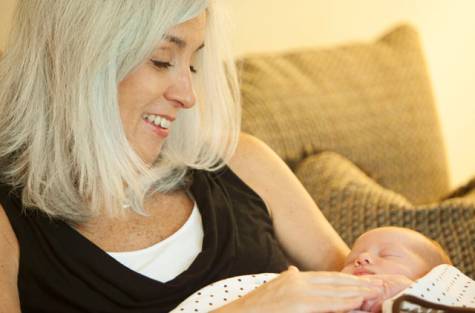
Grandma gives birth to her own grandchild

September 8, 2012

Cindy

Chicago, September 8: ?Setting foot in a hospital again, Emily and Mike Jordan couldn't help but feel anxious.

More than two years before, at age 29, Emily had been diagnosed with cervical cancer. But just before she was to undergo a radical hysterectomy, she was told that she was pregnant.

Faced with saving her own life or their unborn child's, the young couple made the excruciating decision to go forward with her surgery. It meant losing the baby, and forfeiting any chance at having their own children.

Or so they thought.

“I can't describe what that was like after finding out you have cancer, after finding out your chance of ever carrying a baby is gone,” Emily says, still stammering at times as she recounts that painful day in 2010.

Simply put, her body no longer had a place where a baby could grow.

But now, more than two years later, she and Mike had come from their suburban Chicago home to the labour and delivery department of a downtown hospital to realise the dream they thought was lost — to become parents, though not the way they, or most people, would have imagined.

Alongside them that day was Emily's mother, Cindy Reutzel — a fit, silver-haired 53-year-old grandmother whose profile revealed a round belly, a pregnant belly.

Reutzel was about to give birth to her own grandchild.

Just 34 years ago, Louise Brown, the first “test tube” baby, was born in Great Britain. The result? A veritable in-vitro baby boom.

It started with would-be mothers in their 20s and 30s. “Then people started pushing the envelope,” says Dr Helen Kim, director of the in vitro

fertilisation programme at the University of Chicago. “If you could help a menopausal woman in her 30s, could you help a menopausal woman in her 40s? And then it became, ‘Can you help a menopausal woman in her 50s?'

“And the answer is yes.”

Some older women were having their own babies. But more often, they were using egg donors to have their own children, or serving as surrogates or “gestational carriers”.

There was the 51-year-old grandmother in Brazil who gave birth to her twin grandchildren in 2007. There've been others, grandmothers in their 40s or 50s and even 60s.

Cindy Reutzel, Emily's mom, had a vague recollection of those stories. So when doctors shared the good news that they had been able to keep Emily's ovaries intact, Reutzel immediately made the offer.

“What if I carried your baby for you?” she asked.

Emily and Mike didn't take it too seriously at first. “We didn't really think that was a realistic option,” says Emily, who works in hospital administration.

It turned out, though, that it wasn't really that far-fetched after all, particularly for a young grandmother who's in good health, like Reutzel.

After a process that included psychological evaluation and hormonal manipulation to prepare their bodies, Kim eventually implanted Reutzel's uterus with an embryo created with an egg from Emily and Mike's sperm.

It was no easy process, with a regimen of hormonal shots. Work schedules were interrupted and vacations postponed. But Reutzel was committed.

“The thought of Emily and Mike not being able to have children and share that piece of their lives with someone just broke my heart,” says Reutzel, who lives in Chicago and is executive director at medical foundation. “I want Emily to have that connection with another human being like I had with her.”

As her belly grew, people started asking about “her baby”. But she was quick to tell them the story. This was not her baby, she was Grandma.

Admittedly, she says, she worried about the physical toll pregnancy might take, though her body handled it better than she expected. She also wondered how well she'd bounce back from a Caesarean section. That's how she had delivered Emily and her older brother, but that had been three decades ago.

Still, she reassured Emily and Mike throughout the pregnancy that the baby was fine, she was fine, everything would be fine.

Humour helped. Mike often teased his mother-in-law each time they'd take her to dinner or do something nice for her.

“Are we even yet?” he'd ask.

“Not yet,” she'd reply, laughing.

In truth, Mike and Emily knew there'd really be no way to repay this kind of gesture.

“This is a continuation of everything that she has done her entire life for me, which is to make sure that I have the best life possible,” Emily says.

All they could do, they said, was to promise to raise their baby as best they could. And that was enough for Reutzel.

“I know I gave a gift,” she says. “But I'm also getting so much in return.”

Last week, a few days after Emily's 32nd birthday, daughter sat next to mother, holding hands in the delivery room.

And Elle Cynthia Jordan was born.

“She looks just like you! She looks just like you!” Emily shouted, running from the delivery room to introduce their newborn to Mike.

Reutzel is recovering well. She even says she'd consider doing it again.

“When I watch both of them hold that baby and look into her face, it's like everything I could have imagined wanting for them — better than I could have imagined,” she says, her eyes filling with tears.

“This is what it was all about for me.”

Comments

Add new comment

  • Coastaldigest.com reserves the right to delete or block any comments.
  • Coastaldigset.com is not responsible for its readers’ comments.
  • Comments that are abusive, incendiary or irrelevant are strictly prohibited.
  • Please use a genuine email ID and provide your name to avoid reject.
Agencies
June 7,2020

Boston, Jun 7: Dozens of scientists doing research funded by Mark Zuckerberg say Facebook should not be letting President Donald Trump use of the social media platform to spread both misinformation and incendiary statements.

The researchers, including 60 professors at leading US research institutions, wrote a letter to the Facebook CEO on Saturday asking that he consider stricter policies on misinformation and incendiary language that harms people," especially during the current turmoil over racial injustice.

The letter calls the spread of deliberate misinformation and divisive language the researchers' goal of using technology to prevent and eradicate disease, improving childhood education and reform the criminal justice system.

The researchers' mission "is antithetical to some of the stances that Facebook has been taking, so we're encouraging them to be more on the side of truth and on the right side of history as we've said in the letter, said Debora Marks of Harvard Medical School, one of three professors who organized the letter.

The other organisers are Martin Kampmann of the University of California-San Francisco and Jason Shepherd of the University of Utah.

All have grants from a Chan Zuckerberg Initiative program working to prevent, cure and treat neurodegenerative disorders including Alzheimer's and Parkinson's disease. The initiative is run by Zuckerberg and his wife, Priscilla Chan.

They said the letter had more than 160 signatories. Shepherd said about 10% are employees of Chan Zuckerberg foundations.

The letter objects specifically to Zuckerberg's decision not to at least flag as a violation of Facebook's community standards Trump's post that stated when the looting starts, the shooting starts after unrest in Minneapolis over the videotaped killing of George Floyd, a black man, by a white police officer.

The letter's authors called the post a clear statement of inciting violence.

Twitter had both flagged and demoted a Trump tweet using the same language.

The Associated Press emailed the Chan Zuckerberg Initiative press office for comment. It did not immediately respond.

Some Facebook employees have publicly objected to Zuckerberg's refusal to take down or label misleading or incendiary posts by Trump or other politicians. But Zuckerberg who controls a majority of voting shares in the company has so far refused.

On Friday, Zuckerberg said in a post that he would review potential options for handling violating or partially-violating content aside from the binary leave-it-up or take-it-down decisions I know many of you think we should have labeled the President's posts in some way last week, he wrote.

"Our current policy is that if content is actually inciting violence, then the right mitigation is to take that content down not let people continue seeing it behind a flag. There is no exception to this policy for politicians or newsworthiness.

Comments

Add new comment

  • Coastaldigest.com reserves the right to delete or block any comments.
  • Coastaldigset.com is not responsible for its readers’ comments.
  • Comments that are abusive, incendiary or irrelevant are strictly prohibited.
  • Please use a genuine email ID and provide your name to avoid reject.
Agencies
May 28,2020

More than one in six youths were jobless since the onset of the COVID-19 pandemic while those who remain employed have seen their working hours cut by 23 per cent, according to a report by the International Labour Organisation (ILO).

According to the 'ILO Monitor: COVID-19 and the world of work: 4th edition' published on Wednesday, youths are being disproportionately affected by the pandemic, and the substantial and rapid increase in youth unemployment seen since February is affecting young women more than young men, reports Xinhua news agency.

The pandemic is inflicting a triple shock on young people.

Not only is it destroying their employment, but it is also disrupting education and training, and placing major obstacles in the way of those seeking to enter the labour market or to move between jobs, said the report.

At 13.6 per cent, the youth unemployment rate in 2019 was already higher than any other group.

There were around 267 million young people not in employment, education or training worldwide.

"If we do not take significant and immediate action to improve their situation, the legacy of the virus could be with us for decades," said ILO Director-General Guy Ryder.

"If their talent and energy is sidelined by a lack of opportunity or skills, it will damage all our futures and make it much more difficult to re-build a better, post-COVID economy."

The report called for urgent, large-scale and targeted policy responses to support youth, including broad-based employment/training guarantee programs in developed countries, and employment-intensive programs and guarantees in low- and middle-income economies.

Comments

Add new comment

  • Coastaldigest.com reserves the right to delete or block any comments.
  • Coastaldigset.com is not responsible for its readers’ comments.
  • Comments that are abusive, incendiary or irrelevant are strictly prohibited.
  • Please use a genuine email ID and provide your name to avoid reject.
News Network
February 28,2020

Tehran, Feb 28: The coronavirus epidemic in Iran has cost 26 lives, the health ministry announced Thursday, with a vice president becoming the latest top official to be infected as the spread appeared to accelerate.

Health ministry spokesman Kianoush Jahanpour told a news conference that the tally of infections had risen to 245 with 106 more cases confirmed -- the highest number for a single day since Iran announced its first infections on February 19.

The Islamic republic has the highest death toll from the virus outside China, where COVID-19 first emerged.

Among the latest coronavirus sufferers is one of Iran's seven vice presidents, Massoumeh Ebtekar, who oversees women's affairs.

Ebtekar, a former spokeswoman for students who took 52 Americans hostage at the US embassy in Tehran in 1979, is being treated at home and members of her team have been tested, state news agency IRNA reported.

Mojtaba Zolnour, head of parliament's national security and foreign affairs committee, also contracted the virus, appearing in a video posted by Fars news agency saying he was in self-quarantine.

The cleric is a deputy for the Shiite holy city of Qom in central Iran where the country's first cases were detected.

According to media reports, among the deceased in Qom on Thursday was theologian Hadi Khroroshahi, who in 1981 was named Iran's first ambassador to the Vatican.

The announcement by Zolnour comes two days after another top official, deputy health minister Iraj Harirchi, head of the government's coronavirus task force, said he too had contracted the virus.

On Wednesday, Iranian authorities announced domestic travel restrictions for people with confirmed or suspected infections.

They also placed curbs on access to major Shiite pilgrimage sites, including the Imam Reza shrine in second city Mashhad and the Fatima Masumeh shrine in Qom.

Visitors to the shrines will be allowed to visit on condition they are provided "with hand-washing liquids, proper (health) information, masks", Health Minister Saeed Namaki said.

They must "not gather together in groups but just pray and leave", he said.

In a rare move, authorities announced the cancellation of the main Friday weekly prayers in Tehran, Qom and Mashhad as well as in the capitals of 22 of Iran's 31 provinces and other infected areas.

"All of these decisions are temporary and if the situation changes, we might intensify or ease them," Namaki said.

Comments

Add new comment

  • Coastaldigest.com reserves the right to delete or block any comments.
  • Coastaldigset.com is not responsible for its readers’ comments.
  • Comments that are abusive, incendiary or irrelevant are strictly prohibited.
  • Please use a genuine email ID and provide your name to avoid reject.