


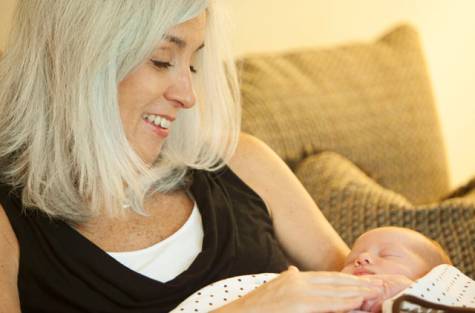
Grandma gives birth to her own grandchild

September 8, 2012

Cindy

Chicago, September 8: ?Setting foot in a hospital again, Emily and Mike Jordan couldn't help but feel anxious.

More than two years before, at age 29, Emily had been diagnosed with cervical cancer. But just before she was to undergo a radical hysterectomy, she was told that she was pregnant.

Faced with saving her own life or their unborn child's, the young couple made the excruciating decision to go forward with her surgery. It meant losing the baby, and forfeiting any chance at having their own children.

Or so they thought.

“I can't describe what that was like after finding out you have cancer, after finding out your chance of ever carrying a baby is gone,” Emily says, still stammering at times as she recounts that painful day in 2010.

Simply put, her body no longer had a place where a baby could grow.

But now, more than two years later, she and Mike had come from their suburban Chicago home to the labour and delivery department of a downtown hospital to realise the dream they thought was lost — to become parents, though not the way they, or most people, would have imagined.

Alongside them that day was Emily's mother, Cindy Reutzel — a fit, silver-haired 53-year-old grandmother whose profile revealed a round belly, a pregnant belly.

Reutzel was about to give birth to her own grandchild.

Just 34 years ago, Louise Brown, the first “test tube” baby, was born in Great Britain. The result? A veritable in-vitro baby boom.

It started with would-be mothers in their 20s and 30s. “Then people started pushing the envelope,” says Dr Helen Kim, director of the in vitro

fertilisation programme at the University of Chicago. “If you could help a menopausal woman in her 30s, could you help a menopausal woman in her 40s? And then it became, ‘Can you help a menopausal woman in her 50s?'

“And the answer is yes.”

Some older women were having their own babies. But more often, they were using egg donors to have their own children, or serving as surrogates or “gestational carriers”.

There was the 51-year-old grandmother in Brazil who gave birth to her twin grandchildren in 2007. There've been others, grandmothers in their 40s or 50s and even 60s.

Cindy Reutzel, Emily's mom, had a vague recollection of those stories. So when doctors shared the good news that they had been able to keep Emily's ovaries intact, Reutzel immediately made the offer.

“What if I carried your baby for you?” she asked.

Emily and Mike didn't take it too seriously at first. “We didn't really think that was a realistic option,” says Emily, who works in hospital administration.

It turned out, though, that it wasn't really that far-fetched after all, particularly for a young grandmother who's in good health, like Reutzel.

After a process that included psychological evaluation and hormonal manipulation to prepare their bodies, Kim eventually implanted Reutzel's uterus with an embryo created with an egg from Emily and Mike's sperm.

It was no easy process, with a regimen of hormonal shots. Work schedules were interrupted and vacations postponed. But Reutzel was committed.

“The thought of Emily and Mike not being able to have children and share that piece of their lives with someone just broke my heart,” says Reutzel, who lives in Chicago and is executive director at medical foundation. “I want Emily to have that connection with another human being like I had with her.”

As her belly grew, people started asking about “her baby”. But she was quick to tell them the story. This was not her baby, she was Grandma.

Admittedly, she says, she worried about the physical toll pregnancy might take, though her body handled it better than she expected. She also wondered how well she'd bounce back from a Caesarean section. That's how she had delivered Emily and her older brother, but that had been three decades ago.

Still, she reassured Emily and Mike throughout the pregnancy that the baby was fine, she was fine, everything would be fine.

Humour helped. Mike often teased his mother-in-law each time they'd take her to dinner or do something nice for her.

“Are we even yet?” he'd ask.

“Not yet,” she'd reply, laughing.

In truth, Mike and Emily knew there'd really be no way to repay this kind of gesture.

“This is a continuation of everything that she has done her entire life for me, which is to make sure that I have the best life possible,” Emily says.

All they could do, they said, was to promise to raise their baby as best they could. And that was enough for Reutzel.

“I know I gave a gift,” she says. “But I'm also getting so much in return.”

Last week, a few days after Emily's 32nd birthday, daughter sat next to mother, holding hands in the delivery room.

And Elle Cynthia Jordan was born.

“She looks just like you! She looks just like you!” Emily shouted, running from the delivery room to introduce their newborn to Mike.

Reutzel is recovering well. She even says she'd consider doing it again.

“When I watch both of them hold that baby and look into her face, it's like everything I could have imagined wanting for them — better than I could have imagined,” she says, her eyes filling with tears.

“This is what it was all about for me.”

Comments

Add new comment

  • Coastaldigest.com reserves the right to delete or block any comments.
  • Coastaldigset.com is not responsible for its readers’ comments.
  • Comments that are abusive, incendiary or irrelevant are strictly prohibited.
  • Please use a genuine email ID and provide your name to avoid reject.
News Network
June 24,2020

Washington, Jun 24: An Indian restaurant in the Sante Fe City of New Mexico, owned by a Sikh, was broken into and vandalised with hate messages scrawled on its walls, a media report said Tuesday.

The damage caused to India Palace restaurant is estimated to be worth USD 100,000, local Santa Fe Reporter said adding that the vandalisation is being investigated by local police and the FBI.

Sikh American Legal Defense and Education Fund (SALDEF) has condemned the incident.

"This kind of hate and violence is unacceptable and swift action must be taken to ensure the safety and security of all Americans," said Kiran Kaur Gill SALDEF executive director.

According to the local daily, tables were overturned, glassware was smashed into piles on the floor, wine racks were emptied, a statue of a goddess was beheaded and computers were stolen.

The vandals also turned over and destroyed food warmers while the front desk area was devastated, plates smashed and the kitchen rendered completely unusable, it said.

"I walked into the kitchen, I saw everything and I was like, hold on, what? What is going on here?" owner Baljit Singh told Santa Fe Reporter. "White power," "Trump 2020," "go home," and far worse were spray-painted on walls, doors, counters and any other available surface.

"Some phrases contained threats of violence and derogatory racial slurs," the daily said.

"Santa Fe is a peaceful town, and the Sikh community has lived here, beautifully integrated, since the 60s," said SALDEF board member Simran Singh, who lives minutes away from the restaurant.

"Tensions have flared recently with the reinvigoration of the Black Lives Matter movement and the removal of statues associated with Spanish colonisers of this area, who committed a number of atrocities," he said.

"Nevertheless, we are seeing an outpouring of love and support around the city and in my experience, our neighbors love and appreciate us, as we love and appreciate them," he added.

SALDEF said that it has seen an unprecedented rise in hate crimes including the April 29 incident wherein a Sikh American Lakhwant Singh was brutally attacked by a man identified as Eric Breeman in Lakewood, Colorado.

Lakhwant Singh was told to "go back to your country," while being attacked. No formal hate crime charges have been brought against the attacker.

Comments

Add new comment

  • Coastaldigest.com reserves the right to delete or block any comments.
  • Coastaldigset.com is not responsible for its readers’ comments.
  • Comments that are abusive, incendiary or irrelevant are strictly prohibited.
  • Please use a genuine email ID and provide your name to avoid reject.
Agencies
January 9,2020

Washington, Jan 9: The U.S. and Iran stepped back from the brink of possible war Wednesday as President Donald Trump signaled he would not retaliate militarily for Iran's missile strikes on Iraqi bases housing U.S. troops. No one was harmed in the strikes, but U.S. forces in the region remained on high alert.

Speaking from the White House, Trump seemed intent on deescalating the crisis, which spiralled after he authorized the assassination of Iran's top general, Qassem Soleimani. Iran responded overnight by firing more than a dozen missiles at two installations in Iraq, its most direct assault on America since the 1979 seizure of the U.S. Embassy in Tehran.

Trump's takeaway was that “Iran appears to be standing down, which is a good thing for all parties concerned and a very good thing for the world.”

The region remained on edge, however, and American troops including a quick-reaction force dispatched over the weekend were on high alert. Hours after Trump spoke, an ‘incoming’ siren went off in Baghdad's Green Zone after what seemed to be small rockets “impacted” the diplomatic area, a Western official said. There were no reports of casualties.

Iran's Supreme Leader Ayatollah Ali Khamenei said the overnight strike was not necessarily the totality of Iran's response. “Last night they received a slap,” Khamenei said. “These military actions are not sufficient (for revenge). What is important is that the corrupt presence of America in this region comes to an end.”

The strikes had pushed Tehran and Washington perilously close to all-out conflict and left the world waiting to see whether the American president would respond with more military force. Trump, in his nine-minute, televised address, spoke of a robust U.S. military with missiles that are “big, powerful, accurate, lethal and fast.'' But then he added: “We do not want to use it."

Iran for days had been promising to respond forcefully to Soleimani's killing, but its limited strike on two bases--one in the northern Iraqi city of Irbil and the other at Ain al-Asad in western Iraq--appeared to signal that it too was uninterested in a wider clash with the U.S. Foreign minister Mohammad Javad Zarif tweeted that the country had “concluded proportionate measures in self-defence.”

Trump said the U.S. was “ready to embrace peace with all who seek it.” That marked a sharp change in tone from his warning a day earlier that “if Iran does anything that they shouldn't be doing, they're going to be suffering the consequences, and very strongly.”

Trump opened his remarks at the White House by reiterating his promise that “Iran will never be allowed to have a nuclear weapon.” Iran had announced in the wake of Soleimani's killing that it would no longer comply with any of the limits on uranium enrichment in the 2015 nuclear deal crafted to keep it from building a nuclear device.

The president, who had earlier pulled the U.S. out of the deal, seized on the moment of calm to call for negotiations toward a new agreement that would do more to limit Iran's ballistic missile programmes and constrain regional proxy campaigns like those led by Soleimani.

Trump spoke of new sanctions on Iran, but it was not immediately clear what those would be.

Comments

Add new comment

  • Coastaldigest.com reserves the right to delete or block any comments.
  • Coastaldigset.com is not responsible for its readers’ comments.
  • Comments that are abusive, incendiary or irrelevant are strictly prohibited.
  • Please use a genuine email ID and provide your name to avoid reject.
News Network
June 26,2020

Washington, Jun 26: The United States reported more than 39,000 new coronavirus cases on Thursday, its highest-ever single-day count as the government relaxed restrictions and is downplaying the threat of the deadly virus.

According to the Washington Post, experts believe there is a troubling lack of consistent, unified messaging from President Donald Trump and Vice President Mike Pence. They have downplayed the danger and denigrated effective disease defences such as mask-wearing, testing, and social distancing.

Churches, beaches, and bars are filling up with people and so are hospital beds, the report said.

The counties home to Dallas, Phoenix, and Tampa all reported record-high averages on at least 15 straight days in June.

The hardest-hit states are California, Texas, Florida and those that thought they had the virus under control, like Utah and Oregon.

"I think the politicians are in denial," said Kami Kim, director of the Division of Infectious Disease and International Medicine at the University of South Florida.

The chief of the Division of Pediatric Infectious Diseases at the University of Utah Health, Andrew T. Pavia, is of the view that the push to reopen quickly even as cases climb sends a dangerous and inaccurate message.

"On the one hand, you get messages from politicians and the business community that we have to go, go, go and open up," he said. "On the other hand, you're seeing epidemiological indicators that we still have to be very careful."

"It's cognitive dissonance," he added.

The Trump administration has tried to downplay the rising number. Pence called concerns about another surge of infections "overblown," the product of media "fearmongering."

Some governors have followed the administration's lead, blaming rising caseloads on more testing.

Testifying before a congressional committee this week, Anthony S. Fauci, the nation's top infectious-diseases expert, said the new cases were "a disturbing surge" spurred by community transmission rather than testing.

"That's something I'm really quite concerned about," Fauci said. "A couple of days ago, there were 30,000 new infections. That's very disturbing to me."

Several states like Arizona, Arkansas, the Carolinas, Mississippi, Tennessee, Texas and Utah have recently reported new highs in the number of coronavirus patients hospitalized.

"We're seeing a 40 per cent increase in the last two weeks in hospitalizations," said Dallas County Judge Clay Jenkins (D), the jurisdiction's top elected official. "We're by far at our record numbers, and we're at record numbers in north Texas. Houston is at a record, the state is at a record." The Texas Medical Center in Houston, a massive medical complex, reported Thursday that 100 per cent of the beds in its intensive care unit are occupied.

Comments

Add new comment

  • Coastaldigest.com reserves the right to delete or block any comments.
  • Coastaldigset.com is not responsible for its readers’ comments.
  • Comments that are abusive, incendiary or irrelevant are strictly prohibited.
  • Please use a genuine email ID and provide your name to avoid reject.