


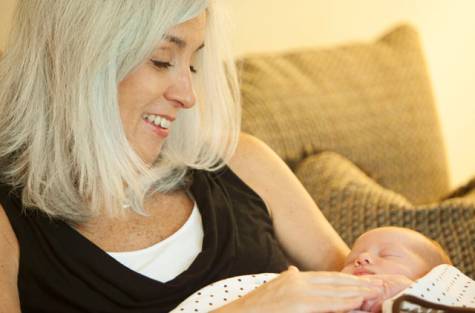
Grandma gives birth to her own grandchild

September 8, 2012

Cindy

Chicago, September 8: ?Setting foot in a hospital again, Emily and Mike Jordan couldn't help but feel anxious.

More than two years before, at age 29, Emily had been diagnosed with cervical cancer. But just before she was to undergo a radical hysterectomy, she was told that she was pregnant.

Faced with saving her own life or their unborn child's, the young couple made the excruciating decision to go forward with her surgery. It meant losing the baby, and forfeiting any chance at having their own children.

Or so they thought.

“I can't describe what that was like after finding out you have cancer, after finding out your chance of ever carrying a baby is gone,” Emily says, still stammering at times as she recounts that painful day in 2010.

Simply put, her body no longer had a place where a baby could grow.

But now, more than two years later, she and Mike had come from their suburban Chicago home to the labour and delivery department of a downtown hospital to realise the dream they thought was lost — to become parents, though not the way they, or most people, would have imagined.

Alongside them that day was Emily's mother, Cindy Reutzel — a fit, silver-haired 53-year-old grandmother whose profile revealed a round belly, a pregnant belly.

Reutzel was about to give birth to her own grandchild.

Just 34 years ago, Louise Brown, the first “test tube” baby, was born in Great Britain. The result? A veritable in-vitro baby boom.

It started with would-be mothers in their 20s and 30s. “Then people started pushing the envelope,” says Dr Helen Kim, director of the in vitro

fertilisation programme at the University of Chicago. “If you could help a menopausal woman in her 30s, could you help a menopausal woman in her 40s? And then it became, ‘Can you help a menopausal woman in her 50s?'

“And the answer is yes.”

Some older women were having their own babies. But more often, they were using egg donors to have their own children, or serving as surrogates or “gestational carriers”.

There was the 51-year-old grandmother in Brazil who gave birth to her twin grandchildren in 2007. There've been others, grandmothers in their 40s or 50s and even 60s.

Cindy Reutzel, Emily's mom, had a vague recollection of those stories. So when doctors shared the good news that they had been able to keep Emily's ovaries intact, Reutzel immediately made the offer.

“What if I carried your baby for you?” she asked.

Emily and Mike didn't take it too seriously at first. “We didn't really think that was a realistic option,” says Emily, who works in hospital administration.

It turned out, though, that it wasn't really that far-fetched after all, particularly for a young grandmother who's in good health, like Reutzel.

After a process that included psychological evaluation and hormonal manipulation to prepare their bodies, Kim eventually implanted Reutzel's uterus with an embryo created with an egg from Emily and Mike's sperm.

It was no easy process, with a regimen of hormonal shots. Work schedules were interrupted and vacations postponed. But Reutzel was committed.

“The thought of Emily and Mike not being able to have children and share that piece of their lives with someone just broke my heart,” says Reutzel, who lives in Chicago and is executive director at medical foundation. “I want Emily to have that connection with another human being like I had with her.”

As her belly grew, people started asking about “her baby”. But she was quick to tell them the story. This was not her baby, she was Grandma.

Admittedly, she says, she worried about the physical toll pregnancy might take, though her body handled it better than she expected. She also wondered how well she'd bounce back from a Caesarean section. That's how she had delivered Emily and her older brother, but that had been three decades ago.

Still, she reassured Emily and Mike throughout the pregnancy that the baby was fine, she was fine, everything would be fine.

Humour helped. Mike often teased his mother-in-law each time they'd take her to dinner or do something nice for her.

“Are we even yet?” he'd ask.

“Not yet,” she'd reply, laughing.

In truth, Mike and Emily knew there'd really be no way to repay this kind of gesture.

“This is a continuation of everything that she has done her entire life for me, which is to make sure that I have the best life possible,” Emily says.

All they could do, they said, was to promise to raise their baby as best they could. And that was enough for Reutzel.

“I know I gave a gift,” she says. “But I'm also getting so much in return.”

Last week, a few days after Emily's 32nd birthday, daughter sat next to mother, holding hands in the delivery room.

And Elle Cynthia Jordan was born.

“She looks just like you! She looks just like you!” Emily shouted, running from the delivery room to introduce their newborn to Mike.

Reutzel is recovering well. She even says she'd consider doing it again.

“When I watch both of them hold that baby and look into her face, it's like everything I could have imagined wanting for them — better than I could have imagined,” she says, her eyes filling with tears.

“This is what it was all about for me.”

Comments

Add new comment

  • Coastaldigest.com reserves the right to delete or block any comments.
  • Coastaldigset.com is not responsible for its readers’ comments.
  • Comments that are abusive, incendiary or irrelevant are strictly prohibited.
  • Please use a genuine email ID and provide your name to avoid reject.
Agencies
February 25,2020

Washington, Feb 25: Democratic presidential front-runner Senator Bernie Sanders on Monday slammed President Donald Trump for selling weapons to India, saying that the US should instead partner with New Delhi to fight climate change to save the planet.

Sanders, who has won the Nevada and New Hampshire primaries and tied in Iowa, made the comments after Trump, who is on a two-day visit to India, on Monday announced that the US will sign defence trade deals worth USD 3 billion with India.

In an address at a massive "Namaste Trump" rally at Motera stadium in Ahmedabad, Trump announced that deals to sell state-of-the-art military helicopters and other equipment worth over USD 3 billion will be sealed with India on Tuesday.

“Instead of selling USD 3 billion in weapons to enrich Raytheon, Boeing and Lockheed, the United States should be partnering with India to fight climate change,” Sanders said in a tweet, the first by a Democratic presidential candidate on Trump's India visit.

“We can work together to cut air pollution, create good renewable energy jobs, and save our planet,” he said.

However, a former White House official defended the US' decision to sell arms and weapons to India.

“I'm proud of my service in the White House, in which we poured enormous energy into deepening climate and green tech cooperation w/ India... and also advancing security cooperation and defense sales. I'd like to think both can be part of a strong, values-based partnership,” Joshua White said.

According to the US State Department, India plays a vital role in the US vision for a free and open Indo-Pacific.

In 2016, the US designated India as a Major Defence Partner. Commensurate with this designation, India in 2018 was granted Strategic Trade Authorization tier 1 status, which allows New Delhi to receive license-free access to a wide range of military and dual-use technologies that are regulated by the Department of Commerce.

Bilateral defence trade with India in a little over a decade has increased from near zero in 2008 to USD20 billion.

Among some of the key foreign military sales notified to Congress include MH-60R Seahawk helicopters (USD2.6 billion), Apache helicopters (USD2.3 billion), P-8I maritime patrol aircraft (USD3 billion), and M777 howitzers (USD737 million).

India was the first non-treaty partner to be offered a Missile Technology Control Regime Category-1 Unmanned Aerial System – the Sea Guardian UAS manufactured by General Atomics.

The State Department is also advocating for the Lockheed Martin F-21 and Boeing F/A-18 – two state of the art fighter aircraft that India is currently evaluating.

These platforms provide critical opportunities to enhance India's military capabilities and protect shared security interests in the Indo-Pacific region, it argued.

The top categories of DCS to India include aircraft, electronics and gas turbine engines.

Comments

Add new comment

  • Coastaldigest.com reserves the right to delete or block any comments.
  • Coastaldigset.com is not responsible for its readers’ comments.
  • Comments that are abusive, incendiary or irrelevant are strictly prohibited.
  • Please use a genuine email ID and provide your name to avoid reject.
News Network
June 24,2020

Geneva, Jun 24: The global cumulative count of confirmed coronavirus cases is approaching nine million, with 133,326 cases recorded over the past day, the World Health Organisation (WHO) said in its daily situation report on Tuesday.

Over the past 24 hours, 3,847 people died from COVID-19 worldwide, taking the cumulative death toll to 469,587 fatalities, according to the report.

The global case total has now reached 8,993,659.

The Americas still account for the majority of cases and deaths -- 4.4 million and 224,207, respectively.

The United States remains the country with the highest count of cases and fatalities -- 2.3 million and 119,761, respectively.

Comments

Add new comment

  • Coastaldigest.com reserves the right to delete or block any comments.
  • Coastaldigset.com is not responsible for its readers’ comments.
  • Comments that are abusive, incendiary or irrelevant are strictly prohibited.
  • Please use a genuine email ID and provide your name to avoid reject.
News Network
June 18,2020

Washington, Jun 18: US Defence officials are concerned over China's use of COVID-19 situation to gain stakes in strategically important companies of United States as the impact of novel coronavirus has left several companies in dire need of capital.

Amid the pandemic, it getting hard for the defence department to keep an eye on national security and help protect smaller companies down the chain, CNN reported.

"We are paying close attention to any indicators that China is leveraging Covid-19 to take advantage of a situation where defence companies need capital more than ever," a defence official told CNN.

In April, Ellen Lord, undersecretary of defence for acquisition and sustainment said it is paying close attention to 'adversaries' against the 'economic warfare' with the United States.

"We have to be very, very careful about the focused efforts some of our adversaries have to really undergo sort of economic warfare with us, which has been going on for some time," Ellen Lord, undersecretary of defence for acquisition and sustainment was quoted as saying by CNN.

US Committee on Foreign Investment protects its interest against hostile countries gaining ownership in strategically important companies. But the pandemic is changing the definition of national security concerns to include drugs, protective gear and medical supplies.

"These are now national security needs and we probably should have been thinking about it a long time ago in terms of biowarfare that we should have a trusted industrial base or a set of trusted allies -- the UK, or NATO allies or Japan or Korea -- who are trusted in that regard," Bill Greenwalt, a former Pentagon official.

Give the threat posed by foreign acquisition, Pentagon has been offering tools to help small US businesses defend themselves against adversarial investment and conducting background checks with other government agencies to ensure transparency.

US President Donald Trump's trade adviser Peter Navarro recently told CNN if Trump wins reelection, Washington DC will likely take offshore supply chains as national security priorities.

"If we fail to do that in the face of this crisis, we will have failed this country and all future generations of Americans," Navarro said.

The US State Department has also warned US allies to "avoid economic overreliance on China" and "guard their critical infrastructure" from China's influence.

Chad P Bown, a senior fellow at the Peterson Institute for International Economics, pointed to recent China's economic coercion of Australia on the political matter saying, "this is how China operates and everybody knows it."

Comments

Add new comment

  • Coastaldigest.com reserves the right to delete or block any comments.
  • Coastaldigset.com is not responsible for its readers’ comments.
  • Comments that are abusive, incendiary or irrelevant are strictly prohibited.
  • Please use a genuine email ID and provide your name to avoid reject.