


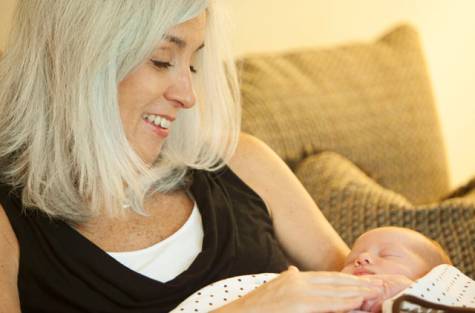
Grandma gives birth to her own grandchild

September 8, 2012

Cindy

Chicago, September 8: ?Setting foot in a hospital again, Emily and Mike Jordan couldn't help but feel anxious.

More than two years before, at age 29, Emily had been diagnosed with cervical cancer. But just before she was to undergo a radical hysterectomy, she was told that she was pregnant.

Faced with saving her own life or their unborn child's, the young couple made the excruciating decision to go forward with her surgery. It meant losing the baby, and forfeiting any chance at having their own children.

Or so they thought.

“I can't describe what that was like after finding out you have cancer, after finding out your chance of ever carrying a baby is gone,” Emily says, still stammering at times as she recounts that painful day in 2010.

Simply put, her body no longer had a place where a baby could grow.

But now, more than two years later, she and Mike had come from their suburban Chicago home to the labour and delivery department of a downtown hospital to realise the dream they thought was lost — to become parents, though not the way they, or most people, would have imagined.

Alongside them that day was Emily's mother, Cindy Reutzel — a fit, silver-haired 53-year-old grandmother whose profile revealed a round belly, a pregnant belly.

Reutzel was about to give birth to her own grandchild.

Just 34 years ago, Louise Brown, the first “test tube” baby, was born in Great Britain. The result? A veritable in-vitro baby boom.

It started with would-be mothers in their 20s and 30s. “Then people started pushing the envelope,” says Dr Helen Kim, director of the in vitro

fertilisation programme at the University of Chicago. “If you could help a menopausal woman in her 30s, could you help a menopausal woman in her 40s? And then it became, ‘Can you help a menopausal woman in her 50s?'

“And the answer is yes.”

Some older women were having their own babies. But more often, they were using egg donors to have their own children, or serving as surrogates or “gestational carriers”.

There was the 51-year-old grandmother in Brazil who gave birth to her twin grandchildren in 2007. There've been others, grandmothers in their 40s or 50s and even 60s.

Cindy Reutzel, Emily's mom, had a vague recollection of those stories. So when doctors shared the good news that they had been able to keep Emily's ovaries intact, Reutzel immediately made the offer.

“What if I carried your baby for you?” she asked.

Emily and Mike didn't take it too seriously at first. “We didn't really think that was a realistic option,” says Emily, who works in hospital administration.

It turned out, though, that it wasn't really that far-fetched after all, particularly for a young grandmother who's in good health, like Reutzel.

After a process that included psychological evaluation and hormonal manipulation to prepare their bodies, Kim eventually implanted Reutzel's uterus with an embryo created with an egg from Emily and Mike's sperm.

It was no easy process, with a regimen of hormonal shots. Work schedules were interrupted and vacations postponed. But Reutzel was committed.

“The thought of Emily and Mike not being able to have children and share that piece of their lives with someone just broke my heart,” says Reutzel, who lives in Chicago and is executive director at medical foundation. “I want Emily to have that connection with another human being like I had with her.”

As her belly grew, people started asking about “her baby”. But she was quick to tell them the story. This was not her baby, she was Grandma.

Admittedly, she says, she worried about the physical toll pregnancy might take, though her body handled it better than she expected. She also wondered how well she'd bounce back from a Caesarean section. That's how she had delivered Emily and her older brother, but that had been three decades ago.

Still, she reassured Emily and Mike throughout the pregnancy that the baby was fine, she was fine, everything would be fine.

Humour helped. Mike often teased his mother-in-law each time they'd take her to dinner or do something nice for her.

“Are we even yet?” he'd ask.

“Not yet,” she'd reply, laughing.

In truth, Mike and Emily knew there'd really be no way to repay this kind of gesture.

“This is a continuation of everything that she has done her entire life for me, which is to make sure that I have the best life possible,” Emily says.

All they could do, they said, was to promise to raise their baby as best they could. And that was enough for Reutzel.

“I know I gave a gift,” she says. “But I'm also getting so much in return.”

Last week, a few days after Emily's 32nd birthday, daughter sat next to mother, holding hands in the delivery room.

And Elle Cynthia Jordan was born.

“She looks just like you! She looks just like you!” Emily shouted, running from the delivery room to introduce their newborn to Mike.

Reutzel is recovering well. She even says she'd consider doing it again.

“When I watch both of them hold that baby and look into her face, it's like everything I could have imagined wanting for them — better than I could have imagined,” she says, her eyes filling with tears.

“This is what it was all about for me.”

Comments

Add new comment

  • Coastaldigest.com reserves the right to delete or block any comments.
  • Coastaldigset.com is not responsible for its readers’ comments.
  • Comments that are abusive, incendiary or irrelevant are strictly prohibited.
  • Please use a genuine email ID and provide your name to avoid reject.
News Network
June 13,2020

Mexico City, Jun 13: The number of people, who have died of COVID-19 in Mexico, has risen by 544 to 16,448 within the past 24 hours, Jose Luis Alomia, the director of epidemiology at the Health Ministry, said.

He also said on late Friday that the number of confirmed coronavirus cases had increased by 5,222 to 139,196 within the same period of time.

A day earlier, the Latin American nation has recorded 4,790 new confirmed cases of the coronavirus, with 587 fatalities.

The World Health Organization declared the COVID-19 outbreak a pandemic on March 11. To date, more than 7.6 million people have been infected with the coronavirus worldwide, with over 425,000 fatalities, according to Johns Hopkins University.

Comments

Add new comment

  • Coastaldigest.com reserves the right to delete or block any comments.
  • Coastaldigset.com is not responsible for its readers’ comments.
  • Comments that are abusive, incendiary or irrelevant are strictly prohibited.
  • Please use a genuine email ID and provide your name to avoid reject.
News Network
May 30,2020

Washington, May 30: The United States will end its relationship with the World Health Organization over the body’s handling of the coronavirus pandemic, U.S. President Donald Trump said on Friday, accusing the U.N. agency of becoming a puppet of China.

The move to quit the Geneva-based body, which the United States formally joined in 1948, comes amid growing tensions between Washington and Beijing over the coronavirus outbreak. The virus first emerged in China’s Wuhan city late last year.

Speaking in the White House Rose Garden, Trump said Chinese officials “ignored their reporting obligations” to the WHO about the virus - that has killed hundreds of thousands of people globally - and pressured the agency to “mislead the world.”

“China has total control over the World Health Organization despite only paying $40 million per year compared to what the United States has been paying which is approximately $450 million a year,” he said.

Trump’s decision follows a pledge last week by Chinese President Xi Jinping to give $2 billion to the WHO over the next two years to help combat the coronavirus. The amount almost matches the WHO’s entire annual program budget for last year.

Trump last month halted funding for the 194-member organization, then in a May 18 letter gave the WHO 30 days to commit to reforms.

“Because they have failed to make the requested and greatly needed reforms, we will be today terminating our relationship with the World Health Organization and redirecting those funds to other worldwide and deserving urgent global public health needs,” Trump said on Friday.

It was not immediately clear when his decision would come into effect. A 1948 joint resolution of Congress on U.S. membership of the WHO said the country “reserves its right to withdraw from the organization on a one-year notice.”

The World Health Organization did not immediately respond to a request for comment on Trump’s announcement. It has previously denied Trump’s assertions that it promoted Chinese “disinformation” about the virus.

“It’s important to remember that the WHO is a platform for cooperation among countries,” said Donna McKay, executive director of Physicians for Human Rights. “Walking away from this critical institution in the midst of an historic pandemic will hurt people both in the United States and around the world.”

‘ABSOLUTELY CRITICAL’

The United States currently owes the WHO more than $200 million in assessed contributions, according to the WHO website. Washington also gives several hundred million dollars annually in voluntary funding tied to specific WHO programs such as polio eradication, HIV, hepatitis and tuberculosis.

Amesh A. Adalja, a senior scholar at Johns Hopkins Center for Health Security, said that in practice Trump’s decision was unlikely to change the operations of the WHO.

“From a symbolic or moral standpoint it’s the wrong type of action to be taking in the middle of a pandemic and seems to deflect responsibility for what we in the U.S. failed to do and blame the WHO,” said Adalja.

When Trump halted funding to the WHO last month, two Western diplomats said the U.S. suspension was more harmful politically to the WHO than to the agency’s current programs, which are funded for now.

The WHO is an independent international body that works with the United Nations. U.N. Secretary-General Antonio Guterres said last month that the WHO is “absolutely critical to the world’s efforts to win the war against COVID-19.”

When asked about Trump’s decision, a U.N. spokesman said: “We have consistently called for all states to support WHO.”

Trump has long scorned multilateralism as he focuses on an “America First” agenda. Since taking office, he has quit the U.N. Human Rights Council, the U.N. cultural agency, a global accord to tackle climate change and the Iran nuclear deal. He has also cut funding for the U.N. population fund and the U.N. agency that aids Palestinian refugees.

“The WHO is the world’s early warning system for infectious diseases,” said U.S. Representative Nita Lowey, a Democrat who chairs the House Committee on Appropriations. “Now, during a global pandemic that has cost over 100,000 American lives, is not the time to put the country further at risk.”

Comments

Add new comment

  • Coastaldigest.com reserves the right to delete or block any comments.
  • Coastaldigset.com is not responsible for its readers’ comments.
  • Comments that are abusive, incendiary or irrelevant are strictly prohibited.
  • Please use a genuine email ID and provide your name to avoid reject.
Agencies
May 23,2020

Washington, May 23: President Donald Trump has labeled churches and other houses of worship as “essential" and called on governors nationwide to let them reopen this weekend even though some areas remain under coronavirus lockdown.

The president threatened Friday to “override” governors who defy him, but it was unclear what authority he has to do so.

“Governors need to do the right thing and allow these very important essential places of faith to open right now — for this weekend," Trump said at a hastily arranged press conference at the White House. Asked what authority Trump might have to supersede governors, White House press secretary Kayleigh McEnany said she wouldn't answer a theoretical question.

Trump has been pushing for the country to reopen as he tries to reverse an economic free fall playing out months before he faces reelection. White evangelical Christians have been among the president's most loyal supporters, and the White House has been careful to attend to their concerns throughout the crisis.

Following Trump's announcement, the Centers for Disease Control and Prevention released new guidelines for communities of faith on how to safely reopen, including recommendations to limit the size of gatherings and consider holding services outdoors or in large, well-ventilated areas.

Public health agencies have generally advised people to avoid gatherings of more than 10 people and encouraged Americans to remain 6 feet (1.8 meters) away from others when possible. Some parts of the country remain under some version of remain-at-home orders.

In-person religious services have been vectors for transmission of the virus. A person who attended a Mother's Day service at a church in Northern California that defied the governor's closure orders later tested positive, exposing more than 180 churchgoers. And a choir practice at a church in Washington state was labeled by the CDC as an early “superspreading" event.

But Trump on Friday stressed the importance of churches in many communities and said he was “identifying houses of worship — churches, synagogues and mosques — as essential places that provide essential services.”

“Some governors have deemed liquor stores and abortion clinics as essential” but not churches, he said. “It's not right. So I'm correcting this injustice and calling houses of worship essential." “These are places that hold our society together and keep our people united,” he added.

Dr. Deborah Birx, coordinator of the White House coronavirus task force, said faith leaders should be in touch with local health departments and can take steps to mitigate risks, including making sure those who are at high risk of severe complications remain protected.

“There's a way for us to work together to have social distancing and safety for people so we decrease the amount of exposure that anyone would have to an asymptomatic," she said.

A person familiar with the White House's thinking who spoke on condition of anonymity to discuss internal deliberations said Trump had called the news conference, which had not been on his public schedule, because he wanted to be the face of church reopenings, knowing how well it would play with his political base.

Churches around the country have filed legal challenges opposing virus closures.

In Minnesota, after Democratic Gov. Tim Walz this week declined to lift restrictions on churches, Roman Catholic and some Lutheran leaders said they would defy his ban and resume worship services. They called the restrictions unconstitutional and unfair since restaurants, malls and bars were allowed limited reopening.

Some hailed the president's move, including Kelly Shackelford, president of the conservative First Liberty Institute.

“The discrimination that has been occurring against churches and houses of worship has been shocking," he said in a statement. "Americans are going to malls and restaurants. They need to be able to go to their houses of worship.” But Rabbi Jack Moline, president of Interfaith Alliance, said it was “completely irresponsible” for Trump to call for a mass reopening of houses of worship.

“Faith is essential and community is necessary; however, neither requires endangering the people who seek to participate in them,” he said.

“The virus does not discriminate between types of gatherings, and neither should the president." Rhode Island Gov. Gina Raimondo, a Democrat, made clear that churches and other houses of worship will not resume in-person services in her state until at least next weekend and said she was skeptical Trump had the authority to impose such a requirement.

“It's reckless to force them to reopen this weekend. They're not ready,” she said. “We've got a good plan. I'm going to stick with it.” New Hampshire Gov. Chris Sununu, a Republican, said he would review the federal guidance, while maintaining a decision rests with him.

"Obviously we'd love to get to the point where we can get those open, but we'll look at the guidance documents and try to make some decisions rather quickly, depending on what it might say,” he said. “It's the governor's decision, of course.”

The CDC more than a month ago sent the Trump administration documents the agency had drafted outlining specific steps various kinds of organizations, including houses of worship, could follow as they worked to reopen safely.

But the White House dragged its feet, concerned that the recommendations were too specific and could give the impression the administration was interfering in church operations.

The guidance posted Friday contains most of the same advice as the draft guidance. It calls for the use of face coverings and recommends keeping worshippers 6 feet from one another and cutting down on singing, which can spread aerosolized drops that carry the virus.

Comments

Add new comment

  • Coastaldigest.com reserves the right to delete or block any comments.
  • Coastaldigset.com is not responsible for its readers’ comments.
  • Comments that are abusive, incendiary or irrelevant are strictly prohibited.
  • Please use a genuine email ID and provide your name to avoid reject.