


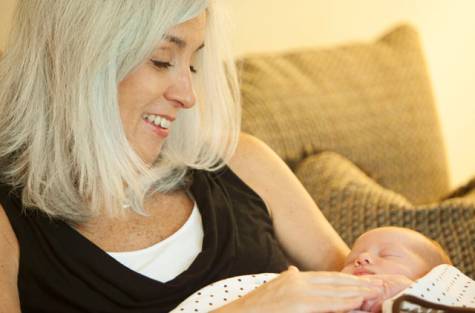
Grandma gives birth to her own grandchild

September 8, 2012

Cindy

Chicago, September 8: ?Setting foot in a hospital again, Emily and Mike Jordan couldn't help but feel anxious.

More than two years before, at age 29, Emily had been diagnosed with cervical cancer. But just before she was to undergo a radical hysterectomy, she was told that she was pregnant.

Faced with saving her own life or their unborn child's, the young couple made the excruciating decision to go forward with her surgery. It meant losing the baby, and forfeiting any chance at having their own children.

Or so they thought.

“I can't describe what that was like after finding out you have cancer, after finding out your chance of ever carrying a baby is gone,” Emily says, still stammering at times as she recounts that painful day in 2010.

Simply put, her body no longer had a place where a baby could grow.

But now, more than two years later, she and Mike had come from their suburban Chicago home to the labour and delivery department of a downtown hospital to realise the dream they thought was lost — to become parents, though not the way they, or most people, would have imagined.

Alongside them that day was Emily's mother, Cindy Reutzel — a fit, silver-haired 53-year-old grandmother whose profile revealed a round belly, a pregnant belly.

Reutzel was about to give birth to her own grandchild.

Just 34 years ago, Louise Brown, the first “test tube” baby, was born in Great Britain. The result? A veritable in-vitro baby boom.

It started with would-be mothers in their 20s and 30s. “Then people started pushing the envelope,” says Dr Helen Kim, director of the in vitro

fertilisation programme at the University of Chicago. “If you could help a menopausal woman in her 30s, could you help a menopausal woman in her 40s? And then it became, ‘Can you help a menopausal woman in her 50s?'

“And the answer is yes.”

Some older women were having their own babies. But more often, they were using egg donors to have their own children, or serving as surrogates or “gestational carriers”.

There was the 51-year-old grandmother in Brazil who gave birth to her twin grandchildren in 2007. There've been others, grandmothers in their 40s or 50s and even 60s.

Cindy Reutzel, Emily's mom, had a vague recollection of those stories. So when doctors shared the good news that they had been able to keep Emily's ovaries intact, Reutzel immediately made the offer.

“What if I carried your baby for you?” she asked.

Emily and Mike didn't take it too seriously at first. “We didn't really think that was a realistic option,” says Emily, who works in hospital administration.

It turned out, though, that it wasn't really that far-fetched after all, particularly for a young grandmother who's in good health, like Reutzel.

After a process that included psychological evaluation and hormonal manipulation to prepare their bodies, Kim eventually implanted Reutzel's uterus with an embryo created with an egg from Emily and Mike's sperm.

It was no easy process, with a regimen of hormonal shots. Work schedules were interrupted and vacations postponed. But Reutzel was committed.

“The thought of Emily and Mike not being able to have children and share that piece of their lives with someone just broke my heart,” says Reutzel, who lives in Chicago and is executive director at medical foundation. “I want Emily to have that connection with another human being like I had with her.”

As her belly grew, people started asking about “her baby”. But she was quick to tell them the story. This was not her baby, she was Grandma.

Admittedly, she says, she worried about the physical toll pregnancy might take, though her body handled it better than she expected. She also wondered how well she'd bounce back from a Caesarean section. That's how she had delivered Emily and her older brother, but that had been three decades ago.

Still, she reassured Emily and Mike throughout the pregnancy that the baby was fine, she was fine, everything would be fine.

Humour helped. Mike often teased his mother-in-law each time they'd take her to dinner or do something nice for her.

“Are we even yet?” he'd ask.

“Not yet,” she'd reply, laughing.

In truth, Mike and Emily knew there'd really be no way to repay this kind of gesture.

“This is a continuation of everything that she has done her entire life for me, which is to make sure that I have the best life possible,” Emily says.

All they could do, they said, was to promise to raise their baby as best they could. And that was enough for Reutzel.

“I know I gave a gift,” she says. “But I'm also getting so much in return.”

Last week, a few days after Emily's 32nd birthday, daughter sat next to mother, holding hands in the delivery room.

And Elle Cynthia Jordan was born.

“She looks just like you! She looks just like you!” Emily shouted, running from the delivery room to introduce their newborn to Mike.

Reutzel is recovering well. She even says she'd consider doing it again.

“When I watch both of them hold that baby and look into her face, it's like everything I could have imagined wanting for them — better than I could have imagined,” she says, her eyes filling with tears.

“This is what it was all about for me.”

Comments

Add new comment

  • Coastaldigest.com reserves the right to delete or block any comments.
  • Coastaldigset.com is not responsible for its readers’ comments.
  • Comments that are abusive, incendiary or irrelevant are strictly prohibited.
  • Please use a genuine email ID and provide your name to avoid reject.
News Network
May 22,2020

Washington, May 22: The deadly coronavirus came from China and the US is not going to take it lightly, American President Donald Trump said on Thursday.

"It came from China. We are not happy about it. We just signed a trade deal, the ink wasn't dry and all of the sudden this floated in. We are not going to take it lightly,” Trump said participating in a Listening Session with African-American Leaders in Michigan.

Trump in the last several weeks has been very critical of China's inability to control the spread of the novel coronavirus within its territory. By Thursday more than 94,000 Americans have died due to the coronavirus and over 1.6 million have tested positive.

He has so far not given any indication of the steps that he is contemplating taking against China.

Meanwhile, pressure is building on his administration, mainly from the Republican lawmakers on this.

On Thursday, Senators Ted Cruz and Rick Scott, along Mike Braun, Marsha Blackburn, Joni Ernst, Martha McSally and Tom Cotton, introduced the COVID-19 Vaccine Protection Act to prevent the Chinese Communist Party from stealing or sabotaging American COVID-19 vaccine research.

The bill requires a thorough national security evaluation and clearance by the Department of Homeland Security, the Department of State, and the Federal Bureau of Investigation of all Chinese student visa holders taking part in activities related to COVID-19 vaccine research.

"The same Chinese Communist Party that covered up the coronavirus outbreak also routinely engages in state sponsored theft of intellectual property," Cruz said. "We cannot allow China to steal or interfere with American research and development of a vaccine,” he added.

"Communist China is responsible for the coronavirus pandemic, and their lies and misinformation cost American lives," Scott said.

"We cannot let Communist China off the hook for this, and we absolutely cannot allow Communist China to steal or sabotage any American research efforts related to the Coronavirus vaccine. The COVID-19 Vaccine Protection Act protects American efforts to create a vaccine as we work to end this pandemic," he added.

The COVID-19 Vaccine Protection Act, among others requires an enhanced vetting of nationals of the Chinese nationals in the US as nonimmigrants under F, J, or M student visas to determine if any student visa holders are a national security threat.

Once the review is complete, authorizes Department of Homeland Secretary, in consultation with other agencies, to continuously monitor all nonimmigrant student visa holders (F, M, J) who are Chinese nationals while in the US and are engaged in, or have access to, the research of any potential COVID-19 vaccine or COVID-19 related material.

Republican Whip and Ranking Member of the Select Subcommittee on the Coronavirus Crisis Steve Scalise alleged that China lied to the world on coronavirus.

"During a critical period in December and January, China withheld evidence of the virus: evidence that confirmed human to human transmission of the virus, evidence of the extent of the spread. China refused entry of American and other medical experts from around the world for weeks,” he said.

“And during this time, China hoarded medical supplies like masks, gowns, and other life-saving PPE. Chinese exports of surgical masks, gowns, and gloves were stifled by the Chinese Communist Party during this period. China knew the danger posed by the virus and while they hid the truth, they used the time to stock up on vital medical supplies,” Scalise said.

“While Chinese authorities limited domestic flights from Wuhan to other Chinese cities like Beijing and Shanghai, China's government urged international carriers to maintain their flight schedules — seeding the virus throughout the rest of the world,” he alleged.

Comments

Add new comment

  • Coastaldigest.com reserves the right to delete or block any comments.
  • Coastaldigset.com is not responsible for its readers’ comments.
  • Comments that are abusive, incendiary or irrelevant are strictly prohibited.
  • Please use a genuine email ID and provide your name to avoid reject.
News Network
July 26,2020

Seoul, Jul 26: North Korean authorities have imposed a lockdown on the border city of Kaesong after discovering what they called the country's first suspected case of the novel coronavirus, state media reported Sunday.

Leader Kim Jong Un convened an emergency politburo meeting on Saturday to implement a "maximum emergency system and issue a top-class alert" to contain the virus, official news agency KCNA said.

If confirmed, it would be the first officially recognised COVID-19 case in the North where medical infrastructure is seen as woefully inadequate for dealing with any epidemic.

KCNA said a defector who had left for the South three years ago returned on July 19 after "illegally crossing" the heavily fortified border dividing the countries.

But there have been no reports in the South of anyone leaving through what is one of the world's most secure borders, replete with minefields and guard posts.

Pyongyang has previously insisted not a single case of the coronavirus had been seen in the North despite the illness having swept the globe, and the country's borders remain closed.

The patient was found in Kaesong City, which borders the South, and "was put under strict quarantine", as would anybody who had come in close contact, state media said.

It was a "dangerous situation... that may lead to a deadly and destructive disaster", the media outlet added.

Kim was quoted as saying "the vicious virus could be said to have entered the country", and officials on Friday took the "preemptive measure of totally blocking Kaesong City".

The nuclear-armed North closed its borders in late January as the virus spread in neighbouring China and imposed tough restrictions that put thousands of its people into isolation, but analysts say the North is unlikely to have avoided the contagion.

South Korea is currently recording around 40 to 60 cases a day.

Earlier this month Kim warned against any "hasty" relaxation of anti-coronavirus measures, indicating the country will keep its borders closed for the foreseeable future.

Comments

Add new comment

  • Coastaldigest.com reserves the right to delete or block any comments.
  • Coastaldigset.com is not responsible for its readers’ comments.
  • Comments that are abusive, incendiary or irrelevant are strictly prohibited.
  • Please use a genuine email ID and provide your name to avoid reject.
Agencies
May 26,2020

UN, May 26: Countries could see a "second peak" of coronavirus cases during the first wave of the pandemic if lockdown restrictions were lifted too soon, the World Health Organization (WHO) has warned.

Mike Ryan, the WHO's head of emergencies, told a briefing on Monday that the world was "right in the middle of the first wave", the BBC reported.

He said because the disease was "still on the way up", countries need to be aware that "the disease can jump up at any time".

"We cannot make assumptions that just because the disease is on the way down now that it's going to keep going down," Ryan said.

There would be a number of months to prepare for a second peak, he added.

The stark warning comes as countries around the world start to gradually ease lockdown restrictions, allowing shops to reopen and larger groups of people to gather.

Experts have said that without a vaccine to give people immunity, infections could increase again when social-distancing measures are relaxed.

Ryan said countries where cases are declining should be using this time to develop effective trace-and-test regimes to "ensure that we continue on a downwards trajectory and we don't have an immediate second peak".

Also on Monday, Tedros Adhanom Ghebreyesus, WHO Director-General, said that a clinical trial of hydroxychloroquine (HCQ) on COVID-19 patients has come to "a temporary pause", while the safety data of the the anti-malaria drug was being reviewed.

According to the WHO chief, The Lancet medical journal on May 22 had published an observational study on HCQ and chloroquine and its effects on COVID-19 patients that have been hospitalized, reports Xinhua news agency.

The authors of the study reported that among patients receiving the drug, when used alone or with a macrolide, they estimated a higher mortality rate.

"The Executive Group of the Solidarity Trial, representing 10 of the participating countries, met on Saturday (May 23) and has agreed to review a comprehensive analysis and critical appraisal of all evidence available globally," Tedros said in a virtual press conference.

The developments come as the total number of global COVID-19 cases has increased to 5,508,904, with 346,508 deaths, according to the Johns Hopkins University.

Comments

Add new comment

  • Coastaldigest.com reserves the right to delete or block any comments.
  • Coastaldigset.com is not responsible for its readers’ comments.
  • Comments that are abusive, incendiary or irrelevant are strictly prohibited.
  • Please use a genuine email ID and provide your name to avoid reject.