



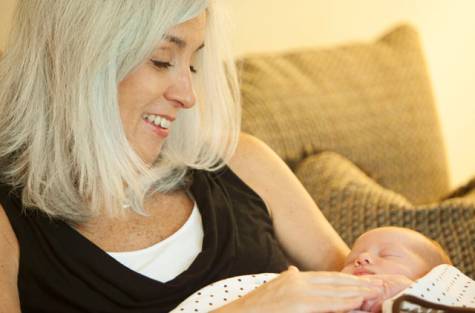
Grandma gives birth to her own grandchild

September 8, 2012

Cindy

Chicago, September 8: ?Setting foot in a hospital again, Emily and Mike Jordan couldn't help but feel anxious.

More than two years before, at age 29, Emily had been diagnosed with cervical cancer. But just before she was to undergo a radical hysterectomy, she was told that she was pregnant.

Faced with saving her own life or their unborn child's, the young couple made the excruciating decision to go forward with her surgery. It meant losing the baby, and forfeiting any chance at having their own children.

Or so they thought.

“I can't describe what that was like after finding out you have cancer, after finding out your chance of ever carrying a baby is gone,” Emily says, still stammering at times as she recounts that painful day in 2010.

Simply put, her body no longer had a place where a baby could grow.

But now, more than two years later, she and Mike had come from their suburban Chicago home to the labour and delivery department of a downtown hospital to realise the dream they thought was lost — to become parents, though not the way they, or most people, would have imagined.

Alongside them that day was Emily's mother, Cindy Reutzel — a fit, silver-haired 53-year-old grandmother whose profile revealed a round belly, a pregnant belly.

Reutzel was about to give birth to her own grandchild.

Just 34 years ago, Louise Brown, the first “test tube” baby, was born in Great Britain. The result? A veritable in-vitro baby boom.

It started with would-be mothers in their 20s and 30s. “Then people started pushing the envelope,” says Dr Helen Kim, director of the in vitro

fertilisation programme at the University of Chicago. “If you could help a menopausal woman in her 30s, could you help a menopausal woman in her 40s? And then it became, ‘Can you help a menopausal woman in her 50s?'

“And the answer is yes.”

Some older women were having their own babies. But more often, they were using egg donors to have their own children, or serving as surrogates or “gestational carriers”.

There was the 51-year-old grandmother in Brazil who gave birth to her twin grandchildren in 2007. There've been others, grandmothers in their 40s or 50s and even 60s.

Cindy Reutzel, Emily's mom, had a vague recollection of those stories. So when doctors shared the good news that they had been able to keep Emily's ovaries intact, Reutzel immediately made the offer.

“What if I carried your baby for you?” she asked.

Emily and Mike didn't take it too seriously at first. “We didn't really think that was a realistic option,” says Emily, who works in hospital administration.

It turned out, though, that it wasn't really that far-fetched after all, particularly for a young grandmother who's in good health, like Reutzel.

After a process that included psychological evaluation and hormonal manipulation to prepare their bodies, Kim eventually implanted Reutzel's uterus with an embryo created with an egg from Emily and Mike's sperm.

It was no easy process, with a regimen of hormonal shots. Work schedules were interrupted and vacations postponed. But Reutzel was committed.

“The thought of Emily and Mike not being able to have children and share that piece of their lives with someone just broke my heart,” says Reutzel, who lives in Chicago and is executive director at medical foundation. “I want Emily to have that connection with another human being like I had with her.”

As her belly grew, people started asking about “her baby”. But she was quick to tell them the story. This was not her baby, she was Grandma.

Admittedly, she says, she worried about the physical toll pregnancy might take, though her body handled it better than she expected. She also wondered how well she'd bounce back from a Caesarean section. That's how she had delivered Emily and her older brother, but that had been three decades ago.

Still, she reassured Emily and Mike throughout the pregnancy that the baby was fine, she was fine, everything would be fine.

Humour helped. Mike often teased his mother-in-law each time they'd take her to dinner or do something nice for her.

“Are we even yet?” he'd ask.

“Not yet,” she'd reply, laughing.

In truth, Mike and Emily knew there'd really be no way to repay this kind of gesture.

“This is a continuation of everything that she has done her entire life for me, which is to make sure that I have the best life possible,” Emily says.

All they could do, they said, was to promise to raise their baby as best they could. And that was enough for Reutzel.

“I know I gave a gift,” she says. “But I'm also getting so much in return.”

Last week, a few days after Emily's 32nd birthday, daughter sat next to mother, holding hands in the delivery room.

And Elle Cynthia Jordan was born.

“She looks just like you! She looks just like you!” Emily shouted, running from the delivery room to introduce their newborn to Mike.

Reutzel is recovering well. She even says she'd consider doing it again.

“When I watch both of them hold that baby and look into her face, it's like everything I could have imagined wanting for them — better than I could have imagined,” she says, her eyes filling with tears.

“This is what it was all about for me.”

Comments

Add new comment

  • Coastaldigest.com reserves the right to delete or block any comments.
  • Coastaldigset.com is not responsible for its readers’ comments.
  • Comments that are abusive, incendiary or irrelevant are strictly prohibited.
  • Please use a genuine email ID and provide your name to avoid reject.
News Network
June 4,2020

Beijing, Jun 4: Around 40 students and staff members of a primary school in China were stabbed by a security guard, official media reported today.

The incident happened at a school in China's Guangxi province, state-run China Daily said in a brief report.

Further details about the attack are awaited.

Knife attacks by disgruntled people have been taking place in different parts of China in the past few years, reported news agency Press Trust of India.

The attackers targeted mainly kindergarten and primary schools besides public transport, the news agency reported.

Comments

Add new comment

  • Coastaldigest.com reserves the right to delete or block any comments.
  • Coastaldigset.com is not responsible for its readers’ comments.
  • Comments that are abusive, incendiary or irrelevant are strictly prohibited.
  • Please use a genuine email ID and provide your name to avoid reject.
News Network
July 1,2020

Melbourne, July 1: Authorities will lock down around 300,000 people in suburbs north of Melbourne for a month from late on Wednesday to contain the risk of infection after two weeks of double-digit rises in new coronavirus cases in Australia's second-most populous state.

Australia has fared better than many countries in the pandemic, with around 7,830 cases and 104 deaths, but the recent surge has stoked fears of a second wave of COVID-19, echoing concerns expressed in other countries.

Globally, coronavirus cases exceeded 10 million on Sunday, a major milestone in the spread of a disease that has killed more than half a million people in seven months.

From midnight, more than 30 suburbs in Australia's second-biggest city will return to stage three restrictions, the third-strictest level in curbs to control the pandemic. That means residents will be confined to home except for grocery shopping, health appointments, work or caregiving, and exercise.

The restrictions will be accompanied by a testing blitz that authorities hope will extend to half the population of the area affected, and for which borders will be patrolled, authorities said. The measures come as curbs ease across the rest of the state of Victoria, with restaurants, gyms and cinemas reopening in recent weeks.

Victoria recorded 73 fresh cases on Tuesday from 20,682 tests, following an increase of 75 cases on Monday. State premier Daniel Andrews warned on Wednesday that the return of broader restrictions across city remained a possibility.

"If we all stick together these next four weeks, we can regain control of that community transmission ... across metropolitan Melbourne," Andrews said at a briefing. "Ultimately if I didn't shut down those postcodes I'd be shutting down all postcodes. We want to avoid that."

Victoria's spike in cases has been linked to staff members at hotels housing returned travellers for which quarantine protocols were not strictly followed. Victorian state authorities have announced an investigation into the matter.

Some other Australian states and territories are preparing to open borders, but applying limits and quarantine measures to citizens of Victoria as the school holiday season gets under way.

South Australia, the country's fifth most populous state, has had just three new cases in the past month. But citing the spike in coronavirus infections, on Tuesday it cancelled its scheduled reopening to other parts of the nation.

New South Wales (NSW), Australia's most populous state, has stopped short of closing its borders to all Victorians, but those holidaying from hotspot areas - not permitted under NSW rules - can be handed a fine of A$11,000 ($7,596) or jailed if they are detected, state authorities said.

The delays reopening internal borders cast doubts over a federal plan to set up "travel bubble" with neighbouring New Zealand that would allow movement between the two countries.

Comments

Add new comment

  • Coastaldigest.com reserves the right to delete or block any comments.
  • Coastaldigset.com is not responsible for its readers’ comments.
  • Comments that are abusive, incendiary or irrelevant are strictly prohibited.
  • Please use a genuine email ID and provide your name to avoid reject.
News Network
May 20,2020

Washington, May 20: Once dubbed as historic by him, US President Donald Trump on Tuesday said he now feels ‘differently’ about the trade deal he signed with China earlier this year.

He said this while once again venting out his frustration with the Beijing leadership, accusing it of letting coronavirus spread.

Till Tuesday, over 92,000 Americans have died and 1.5 million tested positive for coronavirus that has globally killed around 320,000 people.

The US and China had signed a deal in January to end their 22-month-long trade war during which the two countries slapped tit-for-tat tariff hikes on products worth nearly half a trillion USD.

Under it, Beijing agreed to increase its purchase of US goods by USD 200 billion in 2020-2021.

“I feel differently now about that deal than I did three months ago,” Trump told reporters during a Cabinet meeting at the White House.

“We will see what all happens, but it's been a very disappointing situation. A very disappointing thing happened with China because the plague flowed in and that wasn't supposed to happen and it could have been stopped," he said.

Trump said he was very excited when the trade deal with China was signed.

“But once the virus came in, once the plague, as I called it, came in, I said how did they let that happen? And how come it didn't go into other sections of China? Why did they block it from leaving Wuhan? But they didn't block it from going to the rest of the world, including the United States. Why is that? Beijing doesn't have it. Other places don't have it,” he said.

Trump did not respond to questions on retaliation against China.

Meanwhile, top American senators continued to press the administration that rules of engagement with China needs to change post-coronavirus.

“As we know, they unleashed this virus on America and the world with their classic communist cover-up, deception, continued propaganda campaign, costing now over 90,000 American lives, 35 million Americans losing their jobs so far,” Senator Martha McSally said during a Congressional hearing.

“We don’t know who patient zero is, they destroyed samples, they silenced doctors, they kicked out journalists, they impacted international travel to seed this and their reckless behaviour continues to be the root of all this,” she said.

As a result of coronavirus, the American economy has been thrown into recession; more than 36 million people have lost their job – the worst ever after last century’s great depression.

Many of the US states have now started opening up, after taking necessary precautions.

By conservative estimates, it will take several quarters for the economy to be back on track.

Trump in the last a few weeks has exuded confidence that the economy will be back on track next year.

Comments

Add new comment

  • Coastaldigest.com reserves the right to delete or block any comments.
  • Coastaldigset.com is not responsible for its readers’ comments.
  • Comments that are abusive, incendiary or irrelevant are strictly prohibited.
  • Please use a genuine email ID and provide your name to avoid reject.