


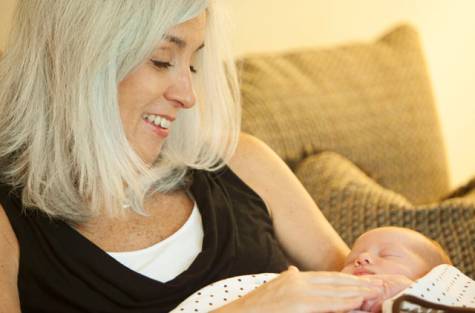
Grandma gives birth to her own grandchild

September 8, 2012

Cindy

Chicago, September 8: ?Setting foot in a hospital again, Emily and Mike Jordan couldn't help but feel anxious.

More than two years before, at age 29, Emily had been diagnosed with cervical cancer. But just before she was to undergo a radical hysterectomy, she was told that she was pregnant.

Faced with saving her own life or their unborn child's, the young couple made the excruciating decision to go forward with her surgery. It meant losing the baby, and forfeiting any chance at having their own children.

Or so they thought.

“I can't describe what that was like after finding out you have cancer, after finding out your chance of ever carrying a baby is gone,” Emily says, still stammering at times as she recounts that painful day in 2010.

Simply put, her body no longer had a place where a baby could grow.

But now, more than two years later, she and Mike had come from their suburban Chicago home to the labour and delivery department of a downtown hospital to realise the dream they thought was lost — to become parents, though not the way they, or most people, would have imagined.

Alongside them that day was Emily's mother, Cindy Reutzel — a fit, silver-haired 53-year-old grandmother whose profile revealed a round belly, a pregnant belly.

Reutzel was about to give birth to her own grandchild.

Just 34 years ago, Louise Brown, the first “test tube” baby, was born in Great Britain. The result? A veritable in-vitro baby boom.

It started with would-be mothers in their 20s and 30s. “Then people started pushing the envelope,” says Dr Helen Kim, director of the in vitro

fertilisation programme at the University of Chicago. “If you could help a menopausal woman in her 30s, could you help a menopausal woman in her 40s? And then it became, ‘Can you help a menopausal woman in her 50s?'

“And the answer is yes.”

Some older women were having their own babies. But more often, they were using egg donors to have their own children, or serving as surrogates or “gestational carriers”.

There was the 51-year-old grandmother in Brazil who gave birth to her twin grandchildren in 2007. There've been others, grandmothers in their 40s or 50s and even 60s.

Cindy Reutzel, Emily's mom, had a vague recollection of those stories. So when doctors shared the good news that they had been able to keep Emily's ovaries intact, Reutzel immediately made the offer.

“What if I carried your baby for you?” she asked.

Emily and Mike didn't take it too seriously at first. “We didn't really think that was a realistic option,” says Emily, who works in hospital administration.

It turned out, though, that it wasn't really that far-fetched after all, particularly for a young grandmother who's in good health, like Reutzel.

After a process that included psychological evaluation and hormonal manipulation to prepare their bodies, Kim eventually implanted Reutzel's uterus with an embryo created with an egg from Emily and Mike's sperm.

It was no easy process, with a regimen of hormonal shots. Work schedules were interrupted and vacations postponed. But Reutzel was committed.

“The thought of Emily and Mike not being able to have children and share that piece of their lives with someone just broke my heart,” says Reutzel, who lives in Chicago and is executive director at medical foundation. “I want Emily to have that connection with another human being like I had with her.”

As her belly grew, people started asking about “her baby”. But she was quick to tell them the story. This was not her baby, she was Grandma.

Admittedly, she says, she worried about the physical toll pregnancy might take, though her body handled it better than she expected. She also wondered how well she'd bounce back from a Caesarean section. That's how she had delivered Emily and her older brother, but that had been three decades ago.

Still, she reassured Emily and Mike throughout the pregnancy that the baby was fine, she was fine, everything would be fine.

Humour helped. Mike often teased his mother-in-law each time they'd take her to dinner or do something nice for her.

“Are we even yet?” he'd ask.

“Not yet,” she'd reply, laughing.

In truth, Mike and Emily knew there'd really be no way to repay this kind of gesture.

“This is a continuation of everything that she has done her entire life for me, which is to make sure that I have the best life possible,” Emily says.

All they could do, they said, was to promise to raise their baby as best they could. And that was enough for Reutzel.

“I know I gave a gift,” she says. “But I'm also getting so much in return.”

Last week, a few days after Emily's 32nd birthday, daughter sat next to mother, holding hands in the delivery room.

And Elle Cynthia Jordan was born.

“She looks just like you! She looks just like you!” Emily shouted, running from the delivery room to introduce their newborn to Mike.

Reutzel is recovering well. She even says she'd consider doing it again.

“When I watch both of them hold that baby and look into her face, it's like everything I could have imagined wanting for them — better than I could have imagined,” she says, her eyes filling with tears.

“This is what it was all about for me.”

Comments

Add new comment

  • Coastaldigest.com reserves the right to delete or block any comments.
  • Coastaldigset.com is not responsible for its readers’ comments.
  • Comments that are abusive, incendiary or irrelevant are strictly prohibited.
  • Please use a genuine email ID and provide your name to avoid reject.
News Network
April 14,2020

New Delhi, Apr 14: The World Health Organization on Tuesday lauded "India's tough and timely actions" against the coronavirus spread as Prime Minister Narendra Modi announced the extension of current lockdown till May 3.

"It may be early to talk about results in numbers, but a six-week nationwide lockdown to facilitate effective physical distancing, coupled with the expansion of core public health measures such as detection, isolation and tracing contact of coronavirus positive people, would go a long way in arresting the virus spread," said WHO's South-East Asia Regional Director, Dr Poonam Khetrapal Singh.

"Despite huge and multiple challenges, India has been demonstrating unwavering commitment in its fight against the pandemic," she said.

"In these testing times, the action lies as much with the communities as with the authorities and the health workforce," she added.

"It is indeed time for each and every one to contribute their best and together to beat the virus," Dr Singh said.

Modi on Tuesday said the implementation of the lockdown will be strictly ensured in coming days to ensure that the virus does not spread to new areas

The prime minister said a detailed guideline on the implementation of the new lockdown will be announced on Wednesday.

According the Union Health Ministry figures, a total of 339 people have died of COVIOD-19 till date in the country, while the number of infected cases has soared to 10,363 on Tuesday.

A PTI tally of figures reported by various states as on Monday evening, however, showed at least 346 deaths.

There has been a lag in the Union Health Ministry figures, compared to the number of deaths announced by different states, which officials attribute to procedural delays in assigning the cases to individual states.

Comments

Add new comment

  • Coastaldigest.com reserves the right to delete or block any comments.
  • Coastaldigset.com is not responsible for its readers’ comments.
  • Comments that are abusive, incendiary or irrelevant are strictly prohibited.
  • Please use a genuine email ID and provide your name to avoid reject.
News Network
June 24,2020

Islamabad, Jun 24: A plane crash which killed 97 people in Pakistan last month was because of human error by the pilot and air traffic control, according to an initial report into the disaster released Wednesday.

The Pakistan International Airlines (PIA) plane came down among houses on May 22 after both engines failed as it approached Karachi airport, killing all but two people on board.

"The pilot as well as the controller didn't follow the standard rules," the country's aviation minister Ghulam Sarwar Khan said, announcing the findings in parliament.

He said the pilots had been discussing the coronavirus pandemic as they attempted to land the Airbus A320.

"The pilot and co-pilot were not focused and throughout the conversation was about coronavirus," Khan said.

The Pakistani investigation team, which included officials from the French government and the aviation industry, analysed data and voice recorders.

The minister said the plane was "100 percent fit for flying, there was no technical fault".

The county's deadliest aviation accident in eight years came days after domestic commercial flights resumed following a two-month coronavirus lockdown.

Many passengers were on their way to spend the Muslim holiday of Eid al-Fitr with loved ones.

Comments

Add new comment

  • Coastaldigest.com reserves the right to delete or block any comments.
  • Coastaldigset.com is not responsible for its readers’ comments.
  • Comments that are abusive, incendiary or irrelevant are strictly prohibited.
  • Please use a genuine email ID and provide your name to avoid reject.
News Network
February 22,2020

Feb 22: A 20-year-old Chinese woman from Wuhan, the epicentre of the coronavirus outbreak, travelled 400 miles(675 km) north to Anyang where she infected five relatives, without ever showing signs of infection, Chinese scientists reported on Friday, offering new evidence that the virus can be spread asymptomatically.

The case study, published in the Journal of the American Medical Association, offered clues about how the coronavirus is spreading, and suggested why it may be difficult to stop.

"Scientists have been asking if you can have this infection and not be ill? The answer is apparently, yes," said Dr. William Schaffner, an infectious disease expert at Vanderbilt University Medical Center, who was not involved in the study.

China has reported a total of 75,567 cases of the virus known as COVID-19 to the World Health Organization (WHO) including 2,239 deaths, and the virus has already spread to 26 countries and territories outside of mainland China.

Researchers have reported sporadic accounts of individuals without any symptoms spreading the virus. What's different in this study is that it offers a natural lab experiment of sorts, Schaffner said.

"You had this patient from Wuhan where the virus is, travelling to where the virus wasn't. She remained asymptomatic and infected a bunch of family members and you had a group of physicians who immediately seized on the moment and tested everyone."

According to the report by Dr Meiyun Wang of the People's Hospital of Zhengzhou University and colleagues, the woman travelled from Wuhan to Anyang on Jan. 10 and visited several relatives. When they started getting sick, doctors isolated the woman and tested her for coronavirus. Initially, the young woman tested negative for the virus, but a follow-up test was positive.

All five of her relatives developed COVID-19 pneumonia, but as of Feb. 11, the young woman still had not developed any symptoms, her chest CT remained normal and she had no fever, stomach or respiratory symptoms, such as cough or sore throat.

Scientists in the study said if the findings are replicated, "the prevention of COVID-19 infection could prove challenging."

Key questions now, Schaffner said, are how often does this kind of transmission occur and when during the asymptomatic period does a person test positive for the virus.

Comments

Add new comment

  • Coastaldigest.com reserves the right to delete or block any comments.
  • Coastaldigset.com is not responsible for its readers’ comments.
  • Comments that are abusive, incendiary or irrelevant are strictly prohibited.
  • Please use a genuine email ID and provide your name to avoid reject.