



20 killed across Pakistan in violence over ‘anti-Islam' film

September 22, 2012

20killed

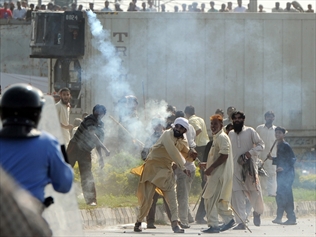
Islamabad/Karachi, September 22: Nearly 20 people were killed and hundreds injured on Friday when thousands of angry demonstrators during government-sanctioned protests over an anti-Islam film turned violent in several cities across Pakistan on a day being observed as ‘Love the Prophet Day'.

The worst affected was Pakistan's financial hub Karachi, where 14 people were killed including two policemen who were shot dead. Around 110 others injured when anti-film rallies turned violent and anarchy prevailed for many hours in some parts of the coastal city. Officials said nearly 200 people were injured in Islamabad, Karachi and Peshawar before the protests tapered off at nightfall.

Rampaging mobs destroyed private and government property worth crores of rupees across the country. Protestors vandalised and torched three cinema halls and the chamber of commerce in Peshawar in the northwest. Five persons, including an employee of a TV news channel, were killed in violence in Peshawar city, officials said.

ARY News said its employee Mohammad Amir died after being hit by a bullet in police firing. Others were killed in police firing or clashes between protestors and police. Footage on television showed several armed protestors firing during demonstrations. In Karachi, mobs torched three cinema halls, three government offices, three banks and several police vans near the CM's residence.


At many places, crowds of protestors looted shops and private buildings. A toll plaza and several vehicles were burnt by protestors on the outskirts of Rawalpindi. Protestors also vandalised a CNG pump, blocked roads by burning tyres and lobbed stones at passing cars.


Hundreds of protestors gathered near the gates of the US Consulate in Lahore before they were driven back by security forces at 7.30 pm. Paramilitary Pakistan Rangers personnel were deployed after a police post was torched near the mission.

Lahore Police spokesman Niyab Haider said 11 people, mostly policemen, were injured in the clashes.

Thousands of students and members of hardline groups tried to get past police barriers in Islamabad and march to the diplomatic enclave, home to the embassies of the US and most Western countries. Police used rubber bullets and teargas to push back demonstrators, who continued making efforts to enter the enclave till darkness fell.

No need to take down clip: US court

A Los Angeles judge has refused to order YouTube to take down a controversial film clip, “The Innocence of Muslims”, agencies report from Los Angeles. Los Angeles County Superior Court Judge Luis Lanvin ruled that Cindy Lee Garcia failed to show that she would likely prevail on the merits of her request, despite the actress's claim that she was tricked into appearing in the inflammatory film, reported Xinhua citing the Courthouse News.

The YouTube clip has triggered violent anti-American riots and protests in more than 20 countries, and has led to at least 28 deaths, including the killing of US ambassador to Libya Christopher Stevens.



Comments

Add new comment

  • Coastaldigest.com reserves the right to delete or block any comments.
  • Coastaldigset.com is not responsible for its readers’ comments.
  • Comments that are abusive, incendiary or irrelevant are strictly prohibited.
  • Please use a genuine email ID and provide your name to avoid reject.
News Network
May 30,2020

May 30: Warning of the tightrope walk ahead as governments battle the coronavirus crisis, Nobel laureate Peter Charles Doherty has expressed concern about densely populated countries such as India relaxing lockdown norms while also describing a complete shutdown as “an economic and social impossibility”.

The Australian immunologist, who cautioned that the number of COVID-19 cases will rise in the coming days, said the earliest time frame for an effective vaccine “going into large numbers of people” is nine to 12 months.

"If all goes well with testing, we could know if some of the candidate vaccines are both safe and effective as early as September/October. Then, rolling a vaccine out will depend on the type of product and how quickly it can be made, put in vials and so forth," Doherty told PTI in an email interview from Melbourne.

The novel coronavirus, he added, does not change fast like influenza and, from what is known so far, “the same vaccine should work everywhere”.

Doherty, who is with the Department of Microbiology and Immunology at the Doherty Institute, University of Melbourne, won the Nobel Prize for Medicine in 1996 for his discovery of how the body’s immune system distinguishes virus-infected cells from normal ones.

Discussing the lockdown, he said, "If it was purely a matter of hard science, everywhere should stay locked down. But that’s pretty much an economic and social impossibility.”

The expectation, he said, is the numbers will rise and limiting spread will depend on people acting responsibly and the capacity for rapid response and extensive contact testing.

“And in a densely populated country like India I think that it will be very difficult," the scientist said.

Several countries, including India, began relaxing lockdown norms in mid-May despite the WHO’s warning about a second wave. India’s lockdown began on March 25 and has since been extended. The fourth phase ends on Sunday.

Asked whether there are any alternatives to a lockdown, the 79-year-old said, "There is no other option other than closing borders. South Korea, for example, conducted massive, intensive testing and contact tracing in a wealthy country with a very disciplined population. Otherwise, not till we have effective vaccines."

He added that he personally doesn’t see the point of closing borders for people coming in if there’s already a high incidence of disease in the community, “unless it’s to avoid the need to care for them and use scarce hospital beds".

According to Doherty, the coronavirus "is a new virus which has come straight out of nature".

“It (the virus) has moved so rapidly across the world because of people travelling on international planes as well as tourist ships," he added.

The immunologist also warned against the use of hydroxychloroquine to treat COVID-19, and said current and planned trials of the anti-malaria drug should be stopped.

“My understanding is that the use of the drug in severe disease is definitely contra-indicated, but it’s not yet clear whether, if taken under medical supervision, it could have some useful effect if taken early on, or as a preventive. Those trials just haven’t been done properly," Doherty noted.

The Indian Council of Medical Research (ICMR) has backed the use of hydroxychloroquine as a preventive against COVID-19 even after the WHO suspended clinical trials of the drug citing safety concerns.

Asked whether plasma therapy can be an effective treatment for COVID-19, Doherty said, "We lack good properly controlled trials but, especially if the plasma has been tested for antibody levels and there’s evidence of good activity, it could be helpful. If I had the disease and was offered plasma therapy I would certainly accept, but I would not take hydroxychloroquine."

Doherty is also very optimistic about herd immunity developing against the SARS-CoV-2 infection.

"We think that (herd immunity) will cut in and have an obvious effect when, say, 60 per cent of people have been infected. Best hope is to boost herd immunity with a vaccine," he stated.

Herd immunity is a form of indirect protection from infectious disease that occurs when a large percentage of a population has become immune to an infection, whether through vaccination or previous infections.

The number of COVID-19 cases have crossed 5.9 million and the fatalities 3,65,000, according to the Johns Hopkins University on Saturday. 

In India, the death toll has risen to 4,971 and the number of cases to 1,73,763, according to the Union Health Ministry on Saturday.

Several states, including Bihar, Uttar Pradesh, Madhya Pradesh, Jharkhand and Chhattisgarh, have reported a rise in number since lockdown norms were relaxed in early May and migrant workers reached home.

In Uttar Pradesh, for instance, the number of infections rose from around 3,000 on May 4 to 6,532 on May 26. Similarly, Bihar’s numbers increased from around 500 to over 2,700 in the period.

Comments

Add new comment

  • Coastaldigest.com reserves the right to delete or block any comments.
  • Coastaldigset.com is not responsible for its readers’ comments.
  • Comments that are abusive, incendiary or irrelevant are strictly prohibited.
  • Please use a genuine email ID and provide your name to avoid reject.
News Network
June 17,2020

Washington, Jun 17: The United States is closely monitoring the situation following a fierce clash between Indian and Chinese forces in eastern Ladakh and hopes that the differences will be resolved peacefully, officials said here.

Twenty Indian Army personnel including a colonel were killed in the clash with Chinese troops in the Galwan Valley in eastern Ladakh on Monday night, the biggest military confrontation in over five decades that has significantly escalated the already volatile border standoff in the region.

"We are closely monitoring the situation between Indian and Chinese forces along the Line of Actual Control," a State Department spokesperson said.

"We note the Indian military has announced that 20 soldiers have died, and we offer our condolences to their families," the official said.

Both India and China have expressed their desires to de-escalate and the US supports a peaceful resolution of the current situation, the spokesperson said.

"During their phone call on June 2, 2020, President Donald Trump and Prime Minister Narendra Modi had discussed the situation along the India-China border," the official added.

Comments

Add new comment

  • Coastaldigest.com reserves the right to delete or block any comments.
  • Coastaldigset.com is not responsible for its readers’ comments.
  • Comments that are abusive, incendiary or irrelevant are strictly prohibited.
  • Please use a genuine email ID and provide your name to avoid reject.
News Network
June 24,2020

Islamabad, Jun 24: A plane crash which killed 97 people in Pakistan last month was because of human error by the pilot and air traffic control, according to an initial report into the disaster released Wednesday.

The Pakistan International Airlines (PIA) plane came down among houses on May 22 after both engines failed as it approached Karachi airport, killing all but two people on board.

"The pilot as well as the controller didn't follow the standard rules," the country's aviation minister Ghulam Sarwar Khan said, announcing the findings in parliament.

He said the pilots had been discussing the coronavirus pandemic as they attempted to land the Airbus A320.

"The pilot and co-pilot were not focused and throughout the conversation was about coronavirus," Khan said.

The Pakistani investigation team, which included officials from the French government and the aviation industry, analysed data and voice recorders.

The minister said the plane was "100 percent fit for flying, there was no technical fault".

The county's deadliest aviation accident in eight years came days after domestic commercial flights resumed following a two-month coronavirus lockdown.

Many passengers were on their way to spend the Muslim holiday of Eid al-Fitr with loved ones.

Comments

Add new comment

  • Coastaldigest.com reserves the right to delete or block any comments.
  • Coastaldigset.com is not responsible for its readers’ comments.
  • Comments that are abusive, incendiary or irrelevant are strictly prohibited.
  • Please use a genuine email ID and provide your name to avoid reject.