


Russia helps U.S., Syria establish contact, Turkey in shock

[email protected] (The Hindu)
September 30, 2012

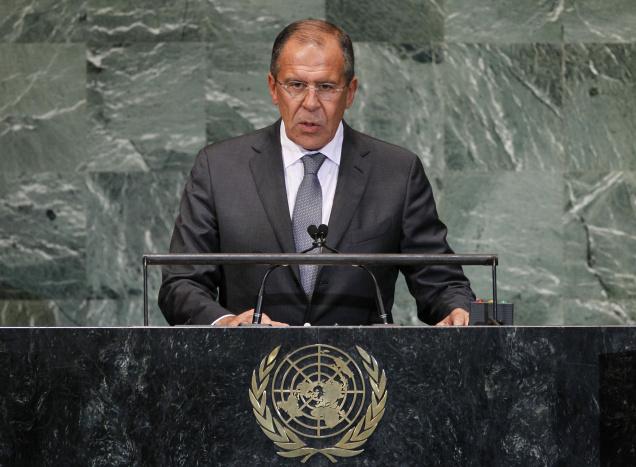
Lavrov

Dubai, September 30: With a little bit of help from Russia, the Americans and the Syrians have established contact with each other, sending shockwaves in Turkey, which has blamed Moscow and Beijing for the continuation of strife in Syria.

Addressing the American media on Thursday, Russian Foreign Minister, Sergei Lavrov dropped a bombshell. He said that Moscow had helped the American experts to establish contact with the Syrians on the subject of chemical weapons. “I hope I won't disclose any big secret, but we have helped American experts establish contact with the Syrians on this issue, and we have received explanations and assurances that the Syrian government is guarding these facilities in the best possible way,” said Mr. Lavrov, as reported by Russia Today.

He also added that Russia was not considering granting asylum to Syrian President Bashar Al Assad, in case he decided to quit office.

“No, we won't grant him asylum,” Mr. Lavrov said, pointing out that the Syrian President “was a friend of other countries northwest of Syria.”

Lebanon's Al Manar television website quoted its Arab sources in France as confirming that the U.S. delegation at the U.N. General Assembly annual session wanted to discuss with Syria, the issue of chemical weapons. The Syrian side pledged “with a Russian guarantee” that it would not use these weapons “inside Syria during the conflict between the government and the militant opposition”. However, the Syrian delegation was emphatic in stating that in case Syria was subjected to a foreign attack, in that case countries involved in inciting and participating in that attack would be legitimate targets “for the Syrian rockets… loaded with chemical warheads, including countries neighbouring Syria”.

Coinciding with the Mr. Lavrov's announcement of opening a U.S.-Syria dialogue track on chemical weapons, Turkish Prime Minister, Recep Tayyip Erdogan went uncharacteristically ballistic—blaming both Russia and China of siding with Syria. His outburst against Moscow and Beijing was aired live on NTV, a leading Turkish television station.

“The main source of disappointment is Russia. Let alone raising its voice against Syria, it stands by the massacre,” said Mr. Erdogan as reported by Reuters.

“China stands by Russia, and although [Chinese President] Hu Jintao had told me they wouldn't veto the plan [for a safe zone] for a third time, they did at the U.N. vote.” Mr. Erdogan described the position of Iran, a staunch Syria ally, as “impossible to understand”.

Turkey has emerged as a frontline state against the Assad government, with Saudi Arabia, Qatar and the United States as allies.

The bitter acrimony that this has caused between one time allies — Turkey and Syria — is climbing to new heights. Syria is now seriously considering arming Kurdish fighters for combat against


Turkey, Al Manar said. Citing its “Kurdish sources,” close to the Kurdistan Workers' Party (PKK) and the Kurdish Democratic Union Party in Syria, the website said that the Assad government “had sent a letter to Turkey saying that the Turkish interference in Syria would prompt Damascus to arm every Kurdish man in both Turkey and Syria”.

The Syrian government is apparently considering supplying the Kurds advanced weaponry including the anti-tank Kornet rockets, as it considers playing its “Kurdish card”.

Adding psychological warfare to its arsenal, the Syrian army has been sending cellphone text messages nationwide to the armed opposition stating: “Game Over”. These messages have also said that the countdown to evict the foreign fighters from Syria had begun, Associated Press reported.



Comments

Add new comment

  • Coastaldigest.com reserves the right to delete or block any comments.
  • Coastaldigset.com is not responsible for its readers’ comments.
  • Comments that are abusive, incendiary or irrelevant are strictly prohibited.
  • Please use a genuine email ID and provide your name to avoid reject.
News Network
March 25,2020

Beijing, Mar 25: Around 5,000 people have signed up for the phase I clinical trial of recombinant novel coronavirus vaccine in Chinese city Wuhan where the virus first emerged late last year.

The recruitment for participants ended this week with nearly 5,000 volunteers signing up for the trial, state-run Beijing News reported on Wednesday.

A single-centre, open and dose-escalation phase I clinical trial for recombinant novel coronavirus vaccine (adenoviral vector) will be tested in healthy adults aged between 18 and 60 years, according to the ChiCTR (China Clinical Trial Register).

The trial, led by experts from the Academy of Military Medical Sciences, gained its approval on March 16 and the research is expected to last half a year.

Requiring at least 108 participants, the trial will be conducted in Wuhan, capital of Hubei province, the region worst-affected by the virus in the country, state-run China Daily reported.

Participants will experience 14-day quarantine restrictions after being vaccinated and their health condition will be recorded every day.

Chinese scientists are hastening the development of COVID-19 vaccines through five approaches --- inactivated vaccines, genetic engineering subunit vaccines, adenovirus vector vaccines, nucleic acid vaccines and vaccines using attenuated influenza virus as vectors.

So far, most teams are expected to complete preclinical research in April and some are moving forward faster, Wang Junzhi, an academician with the Chinese Academy of Engineering said.

Wang noted that research and development of COVID-19 vaccines in China is not slower than foreign counterparts and has been carried out in a scientific, standardised and orderly way.

China has stepped up the process to finalise vaccines to counter COVID-19 after Kaiser Permanente research facility in Seattle and Washington stole the march and began human trials.

China lifted tough restrictions on the Hubei province on Wednesday after a months-long lockdown as the country reported no new domestic cases.

But there were another 47 imported infections from overseas, the National Health Commission said. In total, 474 imported infections have been diagnosed in China -- mostly Chinese nationals returning home.

Comments

Y UDAYA CHANDAR
 - 
Monday, 13 Apr 2020

Dear Sir,


I am 77 but a very healthy person with remarkable immunity. I contracted Malaria fever in 1994 because of mosquito biting and I have not been sick anytime there after, not even for ordinary fever in the last 26 years.


I am sure you would like to conduct the trials on persons of varying criteria. I am sure you don't want to carry out the trials on perfectly healthy young individuals only. 


I am certain that  you want to try the vaccine on a 'common man' from 'general public.' I am ready for the trial and you can take me. I will be delighted. 


If you are not handling this matter kindly forward this mail to the correct agency.


I look forward to hearing from you.


Best regards.


If you are not moving forward, you are really moving backward.

Y Udaya Chandar


Add new comment

  • Coastaldigest.com reserves the right to delete or block any comments.
  • Coastaldigset.com is not responsible for its readers’ comments.
  • Comments that are abusive, incendiary or irrelevant are strictly prohibited.
  • Please use a genuine email ID and provide your name to avoid reject.
News Network
April 2,2020

Washington, Apr 2: The total US death toll from the coronavirus pandemic topped 4,000 early Wednesday, more than double the number from three days earlier, according to a tally by Johns Hopkins University.

The number of deaths was 4,076 -- more than twice the 2,010 recorded late Saturday.

More than 40 percent of recorded deaths nationally were in New York state, the Johns Hopkins data showed.

On Tuesday the United States exceeded the number of deaths in China, where the pandemic emerged in December before spreading worldwide.

The number of confirmed US cases has reached 189,510, the most in the world, though Italy and Spain have recorded more fatalities.

After initially downplaying the threat from new coronavirus in the early stages of the US outbreak, President Donald Trump warned of "a very, very painful two weeks" to come for the country on Tuesday.

Comments

Add new comment

  • Coastaldigest.com reserves the right to delete or block any comments.
  • Coastaldigset.com is not responsible for its readers’ comments.
  • Comments that are abusive, incendiary or irrelevant are strictly prohibited.
  • Please use a genuine email ID and provide your name to avoid reject.
News Network
March 3,2020

Mar 3: Just hours after the ending of a week-long “reduction” in violence that was crucial for Donald Trump’s peace deal in Afghanistan, the Taliban struck again: On Monday, they killed three people and injured about a dozen at a football match in Khost province. This resumption of violence will not surprise anyone actually invested in peace for that troubled country. The point of the U.S.-Taliban deal was never peace. It was to try and cover up an ignominious exit for the U.S., driven by an election-bound president who feels no responsibility toward that country or to the broader region.

Seen from South Asia, every point we know about in the agreement is a concession by Trump to the Taliban. Most importantly, it completes a long-term effort by the U.S. to delegitimize the elected government in Kabul — and, by extension, Afghanistan’s constitution. Afghanistan’s president is already balking at releasing 5,000 Taliban prisoners before intra-Afghan talks can begin — a provision that his government did not approve.

One particularly cringe-worthy aspect: The agreement refers to the Taliban throughout  as “the Islamic Emirate of Afghanistan that is not recognized by the United States as a state and is known as the Taliban.” This unwieldy nomenclature validates the Taliban’s claim to be a government equivalent to the one in Kabul, just not the one recognised at the moment by the U.S. When read together with the second part of the agreement, which binds the U.S. to not “intervene in [Afghanistan’s] domestic affairs,” the point is obvious: The Taliban is not interested in peace, but in ensuring that support for its rivals is forbidden, and its path to Kabul is cleared.

All that the U.S. has effectively gotten in return is the Taliban’s assurance that it will not allow the soil of Afghanistan to be used against the “U.S. and its allies.” True, the U.S. under Trump has shown a disturbing willingness to trust solemn assurances from autocrats; but its apparent belief in promises made by a murderous theocratic movement is even more ridiculous. Especially as the Taliban made much the same promise to an Assistant Secretary of State about Osama bin Laden while he was in the country plotting 9/11.

Nobody in the region is pleased with this agreement except for the Taliban and their backers in the Pakistani military. India has consistently held that the legitimate government in Kabul must be the basic anchor of any peace plan. Ordinary Afghans, unsurprisingly, long for peace — but they are, by all accounts, deeply skeptical about how this deal will get them there. The brave activists of the Afghan Women’s Network are worried that intra-Afghan talks will take place without adequate representation of the country’s women — who have, after all, the most to lose from a return to Taliban rule.

But the Pakistani military establishment is not hiding its glee. One retired general tweeted: “Big victory for Afghan Taliban as historic accord signed… Forced Americans to negotiate an accord from the position of parity. Setback for India.” Pakistan’s army, the Taliban’s biggest backer, longs to re-install a friendly Islamist regime in Kabul — and it has correctly estimated that, after being abandoned by Trump, the Afghan government will have sharply reduced bargaining power in any intra-Afghan peace talks. A deal with the Taliban that fails also to include its backers in the Pakistani military is meaningless.

India, meanwhile, will not see this deal as a positive for regional peace or its relationship with the U.S. It comes barely a week after Trump’s India visit, which made it painfully clear that shared strategic concerns are the only thing keeping the countries together. New Delhi remembers that India is not, on paper, a U.S. “ally.” In that respect, an intensification of terrorism targeting India, as happened the last time the U.S. withdrew from the region, would not even be a violation of Trump’s agreement. One possible outcome: Over time the government in New Delhi, which has resolutely sought to keep its ties with Kabul primarily political, may have to step up security cooperation. Nobody knows where that would lead.

The irresponsible concessions made by the U.S. in this agreement will likely disrupt South Asia for years to come, and endanger its own relationship with India going forward. But worst of all, this deal abandons those in Afghanistan who, under the shadow of war, tried to develop, for the first time, institutions that work for all Afghans. No amount of sanctimony about “ending America’s longest war” should obscure the danger and immorality of this sort of exit.

Comments

Add new comment

  • Coastaldigest.com reserves the right to delete or block any comments.
  • Coastaldigset.com is not responsible for its readers’ comments.
  • Comments that are abusive, incendiary or irrelevant are strictly prohibited.
  • Please use a genuine email ID and provide your name to avoid reject.