


Russia helps U.S., Syria establish contact, Turkey in shock

[email protected] (The Hindu)
September 30, 2012

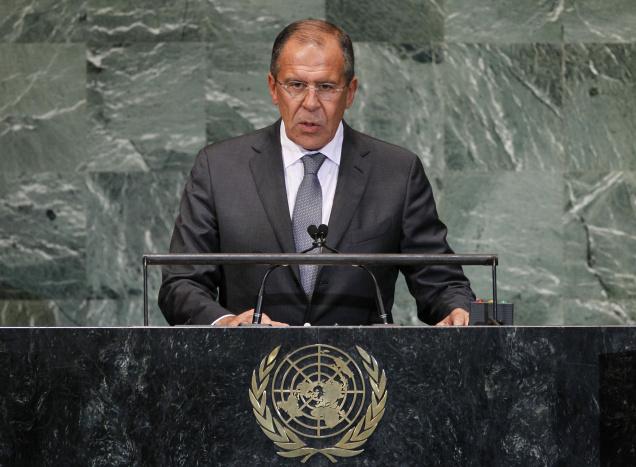
Lavrov

Dubai, September 30: With a little bit of help from Russia, the Americans and the Syrians have established contact with each other, sending shockwaves in Turkey, which has blamed Moscow and Beijing for the continuation of strife in Syria.

Addressing the American media on Thursday, Russian Foreign Minister, Sergei Lavrov dropped a bombshell. He said that Moscow had helped the American experts to establish contact with the Syrians on the subject of chemical weapons. “I hope I won't disclose any big secret, but we have helped American experts establish contact with the Syrians on this issue, and we have received explanations and assurances that the Syrian government is guarding these facilities in the best possible way,” said Mr. Lavrov, as reported by Russia Today.

He also added that Russia was not considering granting asylum to Syrian President Bashar Al Assad, in case he decided to quit office.

“No, we won't grant him asylum,” Mr. Lavrov said, pointing out that the Syrian President “was a friend of other countries northwest of Syria.”

Lebanon's Al Manar television website quoted its Arab sources in France as confirming that the U.S. delegation at the U.N. General Assembly annual session wanted to discuss with Syria, the issue of chemical weapons. The Syrian side pledged “with a Russian guarantee” that it would not use these weapons “inside Syria during the conflict between the government and the militant opposition”. However, the Syrian delegation was emphatic in stating that in case Syria was subjected to a foreign attack, in that case countries involved in inciting and participating in that attack would be legitimate targets “for the Syrian rockets… loaded with chemical warheads, including countries neighbouring Syria”.

Coinciding with the Mr. Lavrov's announcement of opening a U.S.-Syria dialogue track on chemical weapons, Turkish Prime Minister, Recep Tayyip Erdogan went uncharacteristically ballistic—blaming both Russia and China of siding with Syria. His outburst against Moscow and Beijing was aired live on NTV, a leading Turkish television station.

“The main source of disappointment is Russia. Let alone raising its voice against Syria, it stands by the massacre,” said Mr. Erdogan as reported by Reuters.

“China stands by Russia, and although [Chinese President] Hu Jintao had told me they wouldn't veto the plan [for a safe zone] for a third time, they did at the U.N. vote.” Mr. Erdogan described the position of Iran, a staunch Syria ally, as “impossible to understand”.

Turkey has emerged as a frontline state against the Assad government, with Saudi Arabia, Qatar and the United States as allies.

The bitter acrimony that this has caused between one time allies — Turkey and Syria — is climbing to new heights. Syria is now seriously considering arming Kurdish fighters for combat against


Turkey, Al Manar said. Citing its “Kurdish sources,” close to the Kurdistan Workers' Party (PKK) and the Kurdish Democratic Union Party in Syria, the website said that the Assad government “had sent a letter to Turkey saying that the Turkish interference in Syria would prompt Damascus to arm every Kurdish man in both Turkey and Syria”.

The Syrian government is apparently considering supplying the Kurds advanced weaponry including the anti-tank Kornet rockets, as it considers playing its “Kurdish card”.

Adding psychological warfare to its arsenal, the Syrian army has been sending cellphone text messages nationwide to the armed opposition stating: “Game Over”. These messages have also said that the countdown to evict the foreign fighters from Syria had begun, Associated Press reported.



Comments

Add new comment

  • Coastaldigest.com reserves the right to delete or block any comments.
  • Coastaldigset.com is not responsible for its readers’ comments.
  • Comments that are abusive, incendiary or irrelevant are strictly prohibited.
  • Please use a genuine email ID and provide your name to avoid reject.
News Network
June 18,2020

Washington, Jun 18: US Defence officials are concerned over China's use of COVID-19 situation to gain stakes in strategically important companies of United States as the impact of novel coronavirus has left several companies in dire need of capital.

Amid the pandemic, it getting hard for the defence department to keep an eye on national security and help protect smaller companies down the chain, CNN reported.

"We are paying close attention to any indicators that China is leveraging Covid-19 to take advantage of a situation where defence companies need capital more than ever," a defence official told CNN.

In April, Ellen Lord, undersecretary of defence for acquisition and sustainment said it is paying close attention to 'adversaries' against the 'economic warfare' with the United States.

"We have to be very, very careful about the focused efforts some of our adversaries have to really undergo sort of economic warfare with us, which has been going on for some time," Ellen Lord, undersecretary of defence for acquisition and sustainment was quoted as saying by CNN.

US Committee on Foreign Investment protects its interest against hostile countries gaining ownership in strategically important companies. But the pandemic is changing the definition of national security concerns to include drugs, protective gear and medical supplies.

"These are now national security needs and we probably should have been thinking about it a long time ago in terms of biowarfare that we should have a trusted industrial base or a set of trusted allies -- the UK, or NATO allies or Japan or Korea -- who are trusted in that regard," Bill Greenwalt, a former Pentagon official.

Give the threat posed by foreign acquisition, Pentagon has been offering tools to help small US businesses defend themselves against adversarial investment and conducting background checks with other government agencies to ensure transparency.

US President Donald Trump's trade adviser Peter Navarro recently told CNN if Trump wins reelection, Washington DC will likely take offshore supply chains as national security priorities.

"If we fail to do that in the face of this crisis, we will have failed this country and all future generations of Americans," Navarro said.

The US State Department has also warned US allies to "avoid economic overreliance on China" and "guard their critical infrastructure" from China's influence.

Chad P Bown, a senior fellow at the Peterson Institute for International Economics, pointed to recent China's economic coercion of Australia on the political matter saying, "this is how China operates and everybody knows it."

Comments

Add new comment

  • Coastaldigest.com reserves the right to delete or block any comments.
  • Coastaldigset.com is not responsible for its readers’ comments.
  • Comments that are abusive, incendiary or irrelevant are strictly prohibited.
  • Please use a genuine email ID and provide your name to avoid reject.
News Network
January 20,2020

Langkawi, Jan 20: Malaysia will not take retaliatory trade action against India over its boycott of palm oil purchases amid a political row between the two countries, Prime Minister Mahathir Mohamad said on Monday.

India, the world’s largest edible oil buyer, this month effectively halted imports from its largest supplier and the world’s second-biggest producer in response to comments from Mahathir attacking India’s domestic policies.

“We are too small to take retaliatory action,” Mahathir told reporters in Langkawi, a resort island off the western coast of Malaysia. “We have to find ways and means to overcome that,” he added.

The 94-year-old premier of Muslim-majority Malaysia has criticised New Delhi’s new religion-based citizenship law and also accused India of invading the disputed region of Kashmir.

Mahathir again criticised India’s citizenship law on Monday, saying he believed it was “grossly unfair”.

India has been Malaysia’s largest palm oil market for the past five years, presenting the Southeast Asian country with a major challenge in finding new buyers for its palm oil.

Benchmark Malaysian palm futures fell nearly 10% last week, their biggest weekly decline in more than 11 years.

New Delhi is also unhappy with Malaysia’s refusal to revoke permanent resident status for controversial Indian Islamic preacher Zakir Naik, who has lived in Malaysia for about three years and faces charges of money laundering and hate speech in India.

Mahathir said even if the Indian government guarantees a fair trial, Naik faces the real threat of vigilante action and that Malaysia will only relocate the preacher if it can find a third country where he would be safe.

“If we can find a place for him, we will send him out.”

Comments

Add new comment

  • Coastaldigest.com reserves the right to delete or block any comments.
  • Coastaldigset.com is not responsible for its readers’ comments.
  • Comments that are abusive, incendiary or irrelevant are strictly prohibited.
  • Please use a genuine email ID and provide your name to avoid reject.
News Network
April 26,2020

Apr 26: The remarkable story of an airman who overcame prejudice to become one of only a handful of Indian fighter pilots in the First World War has emerged in newly-released archive files by the UK's Commonwealth War Graves Commission (CWGC).

Lieutenant Shri Krishna Chanda Welinkar is one of the thousands of moving stories from the war preserved in family correspondence and being brought alive as part of a digitisation project.

The never-before-published files contain thousands of letters, pictures and other papers sent between the Commission and the next of the kin of First World War dead.

Among them is the story of Welinkar, who hailed from Bombay in colonial India. After much hardship and discrimination, he eventually became a pilot and went missing while on patrol over the skies above the Western Front in June 1918.

His family had to wait nearly three years before they finally knew for certain that he had died, and his grave was located.

“For everyone who died in the First World War, there was inevitably a partner, parent or child back home who had questions. The heartbreaking letters in CWGC's archive give us an insight into what it was like for those families trying to come to terms with their loss,” said Andrew Fetherston, chief archivist for CWGC.

“They are stories that show desperate searches for closure, former enemies uniting and, on many occasions, the sad realisation that a missing loved one would always remain so. We are pleased to be able to make this invaluable piece of World War history accessible to a new generation and help deepen our understanding of how the First World War impacted those who were left behind,” he said.

Welinkar was one of the 1.3 million Indians who answered the call to fight for the British Empire. Nearly 74,000 never saw their homeland again and are remembered today in cemeteries and memorials throughout the world, including France, Belgium, the Middle East and Africa.

Welinkar was a well-educated man studying at Cambridge University. He trained to become an aviator in Middlesex and wished to join the Royal Flying Corps, later known as the Royal Air Force.

Upon attempting to enlist, Welinkar encountered the same prejudices as his other fellow Indian airmen and was encouraged to become an air mechanic instead.

He was eventually given a commission in the Royal Flying Corps as an Officer. In 1918, he was posted to France and patrolled the skies above the Western Front.

In June 1918, Lieutenant Welinkar embarked on what would be his final patrol; he did not return and was reported missing. His fate remained unknown for many months afterwards.

The newly-released e-files chronicle the remarkable discovery of Welinkar and his final resting place long after the war had ended. Colonel Barton, who knew Welinkar, acted on behalf of his mother and helped find her missing son. They spoke to former enemies and honed their search to the grave of an unidentified man, buried by the Germans as “Oberleutnant S.C. Wumkar” in a grave in Rouvroy, Belgium.

The body was later moved and reinterred in Hangard Communal Cemetery Extension but it wasn't until the vital clue, found in the original German burial records in February 1921, that it was confirmed beyond doubt this grave was of Welinkar's.

In May 1921, Colonel Barton, on behalf of Welinkar's mother, requested that a Commission headstone be placed on the grave with the following personal inscription: “To the Honoured Memory of One of the Empire's Bravest Sons”.

This records – known as Enquiry Files – are part of a collection of nearly 3,000 files which have never been made available to the public before. Nearly half have been digitised so far, alongside a previously unreleased collection of more than 16,000 photographs held in negatives in the Commission's archive.

The files, internally referred to simply as E-Files, contain correspondence between the CWGC and the next of kin of the war dead. They often contain letters, typed memos between Commission staff and on occasion photos, maps and diagrams.

CWGC only holds an enquiry file for a small proportion of the 1.7 million people it commemorates from the Commonwealth. Today it is only possible to release those surviving records from the First World War because correspondence with families of Second World War casualties often involves people still alive today and cannot be made public for many years, due to the UK's data protection rules.

To date, more than 1,300 of the surviving 3,000 First World War enquiry files have been digitised.

The CWGC commemorates the 1.7 million Commonwealth servicemen and women who died during the two World Wars. It also holds and updates an extensive and accessible records archive, while operating over 23,000 locations in more than 150 countries and territories.

Comments

Add new comment

  • Coastaldigest.com reserves the right to delete or block any comments.
  • Coastaldigset.com is not responsible for its readers’ comments.
  • Comments that are abusive, incendiary or irrelevant are strictly prohibited.
  • Please use a genuine email ID and provide your name to avoid reject.