Two Americans killed in confused Afghan shootout

October 1, 2012

American_killed

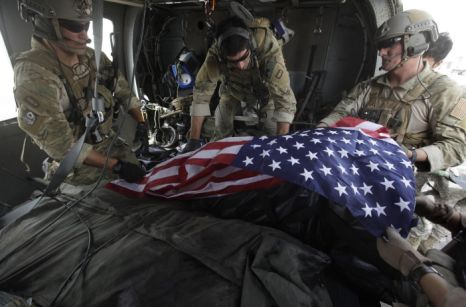
Kabul, October 1: Two Americans were killed in Afghanistan during an exchange of fire between NATO-led forces and the Afghan army that may have been the result of a misunderstanding, as the death toll of US military and civilian personnel passed 2,000.

A US official, who asked not to be identified, said on Sunday that an American soldier and a civilian contractor had been killed in the incident in eastern Afghanistan, the circumstances of which remain unclear.

The coalition initially said the incident may have been the result of an “insider attack” and another example of a member of the Afghan national security force turning on coalition troops in a war that began in 2001.

But it later said that nearby insurgent gunfire may have led to a misunderstanding.

“The circumstances were somewhat confused … There was a report of insurgent firing taking place in this incident which we believe may have been a factor,” Lt. General Adrian Bradshaw, deputy commander of the NATO-led coalition, said.

It was the latest setback for the coalition after the United States said joint operations with Afghan forces were returning to normal.

Joint operations were halted two weeks ago after a surge of attacks on the NATO-led International Security Assistance Force (ISAF) by its Afghan allies. At least 52 ISAF service members have been killed this year in so-called “green-on-blue” attacks.

The suspension of joint operations was a blow for NATO which wants to train the 350,000 members of the Afghan security forces so that they can try to ensure stability after coalition forces withdraw.

Pentagon data listing the number of U.S. troops and U.S. contractors killed in Afghanistan since combat began 11 years ago showed the two new deaths pushed the total combined number of U.S. personnel killed past the 2,000 mark.

The attack took place in the Sayed Abad district of the Wardak province, according to local police sources, who said a gun battle had broken out between coalition soldiers and Afghans when an Afghan National Army member opened fire on American troops.

Three members of the Afghan National Army were also killed in the firefight, while three other U.S. citizens and one Afghan were wounded, police spokesman Wali Mohammad said on Sunday.

“We appreciate the sacrifice of our fallen heroes, every death is tragic and important – none more than any other,” ISAF said in a statement after the incident on Saturday.

Tension between coalition forces and their Afghan allies has been rising due to an escalation of so-called “insider” attacks, but Bradshaw denied the incident was a reflection of growing mistrust between Afghan and coalition forces.

“There is a very strong relationship between ISAF (the International Security Assistance Force) and our Afghan colleagues,” Bradshaw told a press conference late on Sunday.

Separately on Saturday, police in eastern Kunar province said they had found the beheaded bodies of three male civilians in a forest.

The Taliban had kidnapped the men three days ago for allegedly spying for the government and NATO forces, Kunar police chief Shirwah Sameen said.


Comments

Add new comment

  • Coastaldigest.com reserves the right to delete or block any comments.
  • Coastaldigset.com is not responsible for its readers’ comments.
  • Comments that are abusive, incendiary or irrelevant are strictly prohibited.
  • Please use a genuine email ID and provide your name to avoid reject.
News Network
February 9,2020

Wuhan, Feb 9: President Xi Jinping strode onstage before an adoring audience in the Great Hall of the People in Beijing less than three weeks ago, trumpeting his successes in steering China through a tumultuous year and promising "landmark" progress in 2020.

"Every single Chinese person, every member of the Chinese nation, should feel proud to live in this great era," he declared to applause on the day before the Lunar New Year holiday. "Our progress will not be halted by any storms and tempests."

Xi made no mention of a dangerous new coronavirus that had already taken tenacious hold in the country. As he spoke, the government was locking down Wuhan, a city of 11 million people, in a frantic attempt to stop the virus spreading from its epicenter.

The coronavirus epidemic, which has killed more than 800 people in China as of Sunday and sickened tens of thousands, comes as Xi has struggled with a host of other challenges: a slowing economy, huge protests in Hong Kong, an election in Taiwan that rebuffed Beijing and a protracted trade war with the United States.

Now Xi faces an accelerating health crisis that is also a political one: a profound test of the authoritarian system he has built around himself over the past seven years. As the Chinese government struggles to contain the virus amid rising public discontent with its performance, the changes that Xi has ushered in could make it difficult for him to escape blame.

"It’s a big shock to the legitimacy of the ruling party. I think it could be only second to the June 4 incident of 1989. It’s that big," said Rong Jian, a writer about politics in Beijing, referring to the armed crackdown on Tiananmen Square protesters that year.

"There’s no doubt about his control over power," he added, "but the manner of control and its consequences have hurt his legitimacy and reputation."

Xi himself has recognized what is at stake, calling the outbreak "a major test of China’s system and capacity for governance."

Yet as China’s battle with the coronavirus intensified, Xi put the country’s No. 2 leader, Li Keqiang, in charge of a leadership group handling the emergency, effectively turning him into the public face of the government’s response. It was Li Keqiang who traveled to Wuhan to visit doctors.

Xi, by contrast, receded from public view for several days. That was not without precedent, though it stood out in this crisis, after previous Chinese leaders had used times of disaster to try to show a more common touch. State television and newspapers almost always lead with fawning coverage of Xi’s every move.

That retreat from the spotlight, some analysts said, signaled an effort by Xi to insulate himself from a campaign that may falter and draw public ire. Yet Xi has consolidated power, sidelining or eliminating rivals, so there are few people left to blame when something goes wrong.

"Politically, I think he is discovering that having total dictatorial power has a downside, which is that when things go wrong or have a high risk of going wrong, then you also have to bear all the responsibility," said Victor Shih, an associate professor at the University of California San Diego who studies Chinese politics.

Much of the country’s population has been told to stay at home, factories remain closed, and airlines have cut service. Experts warn that the coronavirus could slam the economy if not swiftly contained.

The government is also having trouble controlling the narrative. Xi now faces unusually sharp public discontent that even China’s rigorous censorship apparatus has been unable to stifle entirely.

The death of an ophthalmologist in Wuhan, Dr. Li Wenliang, who was censured for warning his medical school classmates of the spread of a dangerous new disease in December, has unleashed a torrent of pent-up public grief and rage over the government’s handling of the crisis. Chinese academics have launched at least two petitions in the wake of Li’s death, each calling for freedom of speech.

State media still portray Xi as ultimately in control, and there’s no sign that he faces a serious challenge from within the party leadership. The crisis, though, has already tainted China’s image as an emerging superpower — efficient, stable and strong — that could eventually rival the United States.

How much the crisis might erode Xi’s political standing remains to be seen, but it could weaken his position in the long run as he prepares to take a likely third term as Communist Party general secretary in 2022.

In 2018, Xi won approval to remove the constitutional limits on his term as the country’s president, making his plan for another five-year term seem all but certain.

If Xi comes out of this crisis politically insecure, the consequences are unpredictable. He may become more open to compromise within the party elite. Or he may double down on the imperious ways that have made him China’s most powerful leader in generations.

"Xi’s grip on power is not light," said Jude Blanchette, the Freeman Chair in China Studies at the Center for Strategic and International Studies.

"While the ham-fisted response to this crisis undoubtedly adds a further blemish to Xi’s tenure in office," Blanchette added, "the logistics of organizing a leadership challenge against him remain formidable."

In recent days, despite a dearth of public appearances, state media have portrayed Xi as a tireless commander-in-chief. This week they began calling the government’s fight against the virus the "people’s war," a phrase used in the official readout of Xi’s telephone call with President Donald Trump on Friday.

There are increasing signs that the propaganda this time is proving less than persuasive.

The Lunar New Year reception in Beijing where Xi spoke became a source of popular anger, a symbol of a government slow to respond to the suffering in Wuhan. Xi and other leaders appear to have been caught off guard by the ferocity of the epidemic.

Senior officials would almost certainly have been informed of the emerging crisis by the time national health authorities told the World Health Organization on Dec. 31, but neither Xi nor other officials in Beijing informed the public.

Xi’s first acknowledgment of the epidemic came Jan. 20, when brief instructions were issued under his name. His first public appearance after the lockdown of Wuhan on Jan. 23 came two days later, when he presided over a meeting of the Communist Party’s top body, the Politburo Standing Committee, which was shown at length on Chinese television. "We’re sure to be able to win in this battle," he proclaimed.

Back then, the death toll was 106. As it rose, Xi allowed other officials to take on more visible roles. Xi’s only appearances have been meeting foreign visitors in the Great Hall of the People or presiding over Communist Party meetings.

On Jan. 28, Xi met with the executive director of the World Health Organization, Dr. Tedros Adhanom Ghebreyesus, and told Tedros that he "personally directed" the government’s response. Later reports in state media omitted the phrase, saying instead that Xi’s government was "collectively directing" the response.

Since nothing about how Xi is portrayed in state media happens by accident, the tweak suggested a deliberate effort to emphasize shared responsibility.

Xi did not appear on official broadcasts again for a week — until a highly scripted meeting Wednesday with the authoritarian leader of Cambodia, Hun Sen.

There is little evidence that Xi has given up power behind the scenes. Li Keqiang, the premier in formal charge of the leadership group for the crisis, and other officials have said that they take their orders from Xi. The group is filled with officials who work closely under Xi, and its directives emphasize his authority.

"The way the epidemic is being handled now from the top just doesn’t fit with the argument that there’s been a clear shift toward more collective, consultative leadership," said Holly Snape, a British Academy Fellow at the University of Glasgow who studies Chinese politics.

The scale of discontent and the potential challenges for Xi could be measured by repeated references online to the nuclear accident at Chernobyl. Many of them came under the guise of viewer reviews of the popular television miniseries of the same name, which is still available for streaming inside China.

"In any era, any country, it’s the same. Cover everything up," one reviewer wrote.

The Soviet Union of 1986, however, was a different country than China in 2020.

The Soviet state was foundering when Chernobyl happened, said Sergey Radchenko, a professor of international relations at Cardiff University in Wales who has written extensively on Soviet and Chinese politics.

"The Chinese authorities, by contrast, are demonstrating an ability to cope, a willingness to take unprecedented measures — logistical feats that may actually increase the regime’s legitimacy," he added.

Radchenko compared Xi’s actions to those of previous leaders in moments of crisis: Mao Zedong after the Cultural Revolution or Deng Xiaoping after the Tiananmen Square crackdown.

"He’s doing what Mao and Deng would have done in similar circumstances: stepping back into the shadows while remaining firmly in charge."


Comments

Add new comment

  • Coastaldigest.com reserves the right to delete or block any comments.
  • Coastaldigset.com is not responsible for its readers’ comments.
  • Comments that are abusive, incendiary or irrelevant are strictly prohibited.
  • Please use a genuine email ID and provide your name to avoid reject.
News Network
January 6,2020

Sydney, Jan 6: Reserve troops fanned out across fire-ravaged regions in three Australian states on Monday after a horror weekend, as the government pledged $1.4 billion over two years to help recover from the devastating months-long crisis.

Catastrophic bushfires have turned swathes of land into smouldering, blackened hellscapes and destroyed an area about the size of the island of Ireland, according to official figures, with authorities warning the disaster still has weeks or months to run.

Prime Minister Scott Morrison, whose government has been criticised for its slow response to the emergency, pledged Australian $2 billion ($1.4 billion) of taxpayer money for a national recovery fund.

"It's a long road ahead and we will be with these communities every step of the way as they rebuild," Morrison said.

Firefighters joined by fresh teams from the US and Canada were taking advantage of rainy and cooler conditions to tackle out-of-control blazes ahead of rising temperatures forecast later this week.

In the biggest-ever call up of reserves, military teams were deployed across eastern Australia to help emergency services assess the damage, restore power and deliver supplies of food, water and fuel to cut-off communities.

For the first time in Australian history the government also deployed its medical assistance team, normally sent to other nations to lend support in the aftermath of their disasters to help evacuees.

"There is no room for complacency, especially as we have over 130 fires burning across (New South Wales) state still," Premier of New South Wales state Gladys Berejiklian said on Monday.

New normal

Almost five million hectares (50,000 square kilometres) have been razed across New South Wales and more than 1.2 million hectares in Victoria since late September, officials said.

That took the total amount of land burnt close to eight million hectares, around the size of the island of Ireland or South Carolina.

Twenty-four people have lost their lives so far, with over 1,800 homes damaged.

Two people are missing in New South Wales, the nation's most populous state.

In Victoria, Premier Daniel Andrews established a bushfire recovery agency to help devastated towns. It will be a permanent body, he said, as intense fires will become commonplace.

"We should just be honest about the fact that we're going to see more and more fires, more and more damage as each fire season comes... this is the new normal," Andrews told reporters.

The chair of the newly established Victoria state's bushfire appeal fund, Pat McNamara, added that this year's summer bushfire season was a "creeping disaster".

"We're still not even into what we would regard as the peak of the fire season," McNamara told national broadcaster ABC.

In the usually picturesque southeastern town of Eden, Holly Spence said she spent more than 12 hours defending her family's farm on Saturday, less than a week after saving it on New Year's Eve.

"We don't want to go through this for a third time," the 28-year-old told AFP.

Fiona Kennelly, 50, who evacuated with 24 members of her extended family to a motel outside Eden, said she was relieved the easing conditions allowed them to get some respite from the crisis.

"It's good to see daylight at the right time again," she told AFP, adding that the skies had been turning pitch-black in the afternoons.

Public anger

The impact of the bushfires has spread beyond affected communities, with heavy smoke engulfing the country's second-largest city Melbourne and the national capital Canberra.

Some government departments were shut in Canberra as the city's air quality was once-again ranked the world's poorest, according to independent online air-quality index monitor Air Visual.

The disaster has sparked growing public anger with Morrison. Rallies are planned on Friday to call on his government to step up efforts to tackle climate change, which experts say have helped fuel the fires.

In Los Angeles, Hollywood superstar Russell Crowe said he was back home fighting the fires and that the disaster was "climate change-based".

"We need to act on science, move our global workforce to renewable energy and respect our planet for the unique and amazing place it is. That way, we all have a future," he said in a message read out by Jennifer Aniston.

Australian actress Cate Blanchett praised the volunteer firefighters battling the blazes, adding: "When one country faces a climate disaster, we all face a climate disaster. We're in it together."

Comments

Add new comment

  • Coastaldigest.com reserves the right to delete or block any comments.
  • Coastaldigset.com is not responsible for its readers’ comments.
  • Comments that are abusive, incendiary or irrelevant are strictly prohibited.
  • Please use a genuine email ID and provide your name to avoid reject.
News Network
February 18,2020

Beijing, Feb 18: A hospital director at the epicentre of China's virus epidemic died on Tuesday, state media said, the latest medical worker to fall victim to the new coronavirus spreading across the country.

The COVID-19 virus, which is believed to have originated in Wuhan late last year, has infected more than 72,000 people and killed nearly 1,900.

Liu Zhiming, the director of Wuchang Hospital in Wuhan, died Tuesday morning after "all-out rescue efforts failed," state broadcaster CCTV reported.

China said last week that six medical workers had died from the virus, while 1,716 have been infected.

Liu's death was initially reported by Chinese media and bloggers shortly after midnight on Tuesday -- but the stories were later deleted and replaced with reports that doctors were still trying to save him.

After initial reports of his death were denied, the hospital told AFP on Tuesday morning that doctors were giving him life-saving treatment.

Liu's death has echoes of that of Wuhan ophthalmologist Li Wenliang, who had been punished by authorities for sounding the alarm about the virus in late December.

Li's death prompted a national outpouring of grief as well as anger against the authorities, who were accused of mishandling the crisis.

People took to social media to mourn Liu on Tuesday, with many users on the Twitter-like Weibo platform drawing critical comparisons between Liu's death and Li's.

In both cases their deaths were initially reported in state media posts -- later deleted -- and their deaths denied, before being finally confirmed again.

"Has everyone forgotten what happened to Li Wenliang? They forcefully attempted resuscitation after he died," one Weibo commenter wrote.

Another commenter said, Liu "already died last night, (but) some people are addicted to torturing corpses".

A hashtag about Liu's death had 29 million views by Tuesday afternoon.

Doctors in Wuhan face shortages of masks and protective bodysuits, with some even wearing makeshift hazmat suits and continuing to work despite showing respiratory symptoms, health workers have told AFP.

Hubei province and its capital Wuhan have been the hardest hit by the virus, accounting for nearly 1,800 of the deaths from the virus so far.

Comments

Add new comment

  • Coastaldigest.com reserves the right to delete or block any comments.
  • Coastaldigset.com is not responsible for its readers’ comments.
  • Comments that are abusive, incendiary or irrelevant are strictly prohibited.
  • Please use a genuine email ID and provide your name to avoid reject.