



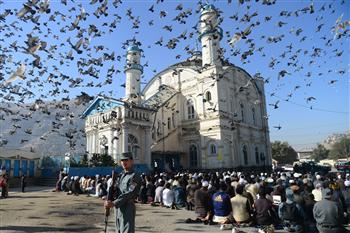
Suicide bomber kills 41 in Afghan mosque: official

October 26, 2012

Kabul_suicide_bomber

Kabul, October 26: A suicide bomber killed at least 41 people, including five children, when he struck at a mosque in northern Afghanistan after Eid al-Adha prayers on Friday, officials said. Dozens more were wounded as the bomb ripped through the crowd of worshippers in Maymana city in Faryab province and there were fears the death toll could rise.

There was no immediate claim of responsibility, but suicide bombings are a favourite weapon of Taliban Islamists trying to topple the Western-backed government of President Hamid Karzai.

The attacker was wearing a police uniform when he blew himself up at the entrance to the city's packed Eid Gah mosque, deputy provincial governor Abdul Satar Barez told AFP.

"Our latest death toll shows 41 deaths, and that might rise," he said.

"Nineteen were members of the security forces, including police, army and intelligence agents. Seventeen were civilians and five children are also among the dead."

Barez, like many other provincial officials, was at the scene at the time of the bombing and described the horror of the blast in the midst of a religious celebration.

"We had just finished Eid al-Adha prayers and we were congratulating and hugging each other," Barez said.

"Suddenly a big explosion took place and the area was full of dust and smoke and body parts of police and civilians were all over the place. It was a very powerful explosion."

One eyewitness, Sayed Moqeed, described the bomber as appearing to be in his early teens.

"Suddenly I heard a very big explosion," he said. "Everywhere were pieces of bodies, hands and limbs. The suicide attacker was in police uniform, he looked to be around 14 or 15 years old."

The four-day Eid al-Adha holiday is a celebration in which Muslims slaughter animals for feasts and distribute a portion of the meat among the poor, and the first day draws large crowds to mosques around the Islamic world.

Karzai strongly condemned the attack, calling the perpetrators "the enemies of Islam and humanity".

"Those who take the happiness of Muslims during Eid days cannot be called human and Muslim," he said.

Northern Afghanistan is relatively peaceful, with the Taliban, who were ousted from power in a US-led invasion in 2001, concentrating their operations in the south and east of the country.

But they have recently stepped up their activities in the north, despite the presence of more than 100,000 NATO troops in the country.

Last week, a huge roadside bomb ripped through a minibus carrying guests to a wedding party in the northern province of Balkh, near Faryab, killing 19 people and wounding 16 others.

The United Nations says 1,145 civilians were killed in the war in the first six months of this year, blaming 80 percent of the deaths on insurgents.

Last year as a whole, a record 3,021 civilians died in the war, according to UN figures.

But Afghan police and government officials have increasingly become targets as local forces take on more responsibility for the fight against the insurgents as NATO prepares to pull out.

The foreign combat troops are due to withdraw by the end of 2014 and there are fears that the Taliban will extend their activities across wider swathes of the country against ill-prepared Afghan forces.



Comments

Add new comment

  • Coastaldigest.com reserves the right to delete or block any comments.
  • Coastaldigset.com is not responsible for its readers’ comments.
  • Comments that are abusive, incendiary or irrelevant are strictly prohibited.
  • Please use a genuine email ID and provide your name to avoid reject.
News Network
June 1,2020

Jun 1: The new coronavirus is losing its potency and has become much less lethal, a senior Italian doctor said on Sunday.

"In reality, the virus clinically no longer exists in Italy," said Alberto Zangrillo, the head of the San Raffaele Hospital in Milan in the northern region of Lombardy, which has borne the brunt of Italy's coronavirus contagion.

"The swabs that were performed over the last 10 days showed a viral load in quantitative terms that was absolutely infinitesimal compared to the ones carried out a month or two months ago," he told RAI television.

Italy has the third-highest death toll in the world from COVID-19, with 33,415 people dying since the outbreak came to light on Feb. 21. It has the sixth-highest global tally of cases at 233,019.

However new infections and fatalities have fallen steadily in May and the country is unwinding some of the most rigid lockdown restrictions introduced anywhere on the continent.

Zangrillo said some experts were too alarmist about the prospect of a second wave of infections and politicians needed to take into account the new reality.

"We've got to get back to being a normal country," he said. "Someone has to take responsibility for terrorizing the country."

The government urged caution, saying it was far too soon to claim victory.

"Pending scientific evidence to support the thesis that the virus has disappeared ... I would invite those who say they are sure of it not to confuse Italians," Sandra Zampa, an undersecretary at the health ministry, said in a statement.

"We should instead invite Italians to maintain the maximum caution, maintain physical distancing, avoid large groups, to frequently wash their hands and to wear masks."

A second doctor from northern Italy told the national ANSA news agency that he was also seeing the coronavirus weaken. "The strength the virus had two months ago is not the same strength it has today," said Matteo Bassetti, head of the infectious diseases clinic at the San Martino hospital in the city of Genoa.

"It is clear that today the COVID-19 disease is different."

Comments

Add new comment

  • Coastaldigest.com reserves the right to delete or block any comments.
  • Coastaldigset.com is not responsible for its readers’ comments.
  • Comments that are abusive, incendiary or irrelevant are strictly prohibited.
  • Please use a genuine email ID and provide your name to avoid reject.
News Network
April 28,2020

Washington, Apr 28: After nearly three weeks in an intensive care unit in Los Angeles, doctors treating 41-year-old Broadway actor Nick Cordero for COVID-19 were forced to amputate his right leg.

The flow of blood had been impeded by a blood clot: yet another dangerous complication of the disease that has been bubbling up in frontline reports from China, Europe and the United States.

To be sure, so-called "thrombotic events" occur for a variety of reasons among intensive care patients, but the rates among COVID-19 patients are far higher than would be otherwise expected.

"I have had 40-year-olds in my ICU who have clots in their fingers that look like they'll lose the finger, but there's no other reason to lose the finger than the virus," Shari Brosnahan, a critical care doctor at NYU Langone said.

One of these patients is suffering from a lack of blood flow to both feet and both hands, and she predicts an amputation may be necessary, or the blood vessels may get so damaged that an extremity could drop off by itself.

Blood clots aren't just dangerous for our limbs, but can make their way to the lungs, heart or brain, where they may cause lethal pulmonary embolisms, heart attacks, and strokes.

A recent paper from the Netherlands in the journal Thrombosis Research found that 31 percent of 184 patients suffered thrombotic complications, a figure that the researchers called "remarkably high" -- even if extreme consequences like amputation are rare.

Behnood Bikdeli, a doctor at New York-Presbyterian Hospital, assembled an international consortium of experts to study the issue. Their findings were published in the Journal of The American College of Cardiology.

The experts found the risks were so great that COVID-19 patients "may need to receive blood thinners, preventively, prophylactically," even before imaging tests are ordered, said Bikdeli.

What exactly is causing it? The reasons aren't fully understood, but he offered several possible explanations.

People with severe forms of COVID-19 often have underlying medical conditions like heart or lung disease -- which are themselves linked to higher rates of clotting.

Next, being in intensive care makes a person likelier to develop a clot because they are staying still for so long. That's why for example people are encouraged to stretch and move around on long haul flights.

It's also now clear the COVID-19 illness is associated with an abnormal immune reaction called "cytokine storm" -- and some research has indicated this too is linked to higher rates of clotting.

There could also be something about the virus itself that is causing coagulation, which has some precedent in other viral illnesses.

A paper in the journal The Lancet last week showed that the virus can infect the inner cell layer of organs and of blood vessels, called the endothelium. This, in theory, could interfere with the clotting process.

According to Brosnahan, while thinners like Heparin are effective in some patients, they don't work for all patients because the clots are at times too small.

"There are too many microclots," she said. "We're not sure exactly where they are."

Autopsies have in fact shown some people's lungs filled with hundreds of microclots.

The arrival of a new mystery however helps solve a slightly older one.

Cecilia Mirant-Borde, an intensive care doctor at a military veterans hospital in Manhattan, told AFP that lungs filled with microclots helped explain why ventilators work poorly for patients with low blood oxygen.

Earlier in the pandemic doctors were treating these patients according to protocols developed for acute respiratory distress syndrome, sometimes known as "wet lung."

But in some cases, "it's not because the lungs are occupied with water" -- rather, it's that the microclotting is blocking circulation and blood is leaving the lungs with less oxygen than it should.

It has just been a little under five months since the virus emerged in Wuhan, China, and researchers are learning more about its impact every day.

"While we react surprised, we shouldn't be as surprised as we were. Viruses tend to do weird things," said Brosnahan.

While the dizzying array of complications may seem daunting, "it's possible there'll be one or a couple of unifying mechanisms that describe how this damage happens," she said.

"It's possible it's all the same thing, and that there'll be the same solution."

Comments

Add new comment

  • Coastaldigest.com reserves the right to delete or block any comments.
  • Coastaldigset.com is not responsible for its readers’ comments.
  • Comments that are abusive, incendiary or irrelevant are strictly prohibited.
  • Please use a genuine email ID and provide your name to avoid reject.
News Network
April 12,2020

London, Apr 12: British Prime Minister Boris Johnson has thanked the medics and staff of the state-funded National Health Service (NHS) for saving his life after he tested positive for the coronavirus, saying he owed them his life.

In his first public statement since being moved out of the intensive care at St. Thomas’ Hospital in London on Saturday, the 55-year-old Johnson said, “I can't thank them enough, I owe them my life.”

Downing Street has said that Johnson, who completes a week in hospital on Sunday after being shifted there with persistent COVID-19 symptoms, continues to make “very good progress” while on the ward.

Coronavirus India update: State-wise total number of confirmed cases, deaths on April 12

He has been able to take short walks as his doctors monitor his recovery after being moved out of the intensive care and has been watching films and doing puzzles in his hospital bed.

Johnson's fiancee Carrie Symonds, who is pregnant with their first child, is said to have sent him letters and baby scans to lift his spirits during his time in the hospital.

Thousands of get-well-soon cards have also poured in for the prime minister since he went into self-isolation after testing positive for coronavirus over two weeks ago.

Asked about plans for his return to work, UK Home Secretary Priti Patel said on Saturday that the UK PM needed "time and space to rest, recuperate and recover".

The Indian-origin Cabinet minister, who led the daily Downing Street update on the pandemic on Saturday, revealed that the UK had recorded 917 new coronavirus deaths, taking the total deaths in the country to 9,875.

According to the Johns Hopkins University data, the country has nearly 80,000 coronavirus cases.

Patel urged people to stay at home over the Easter weekend to curb the spread of the virus, despite warm and sunny weather across parts of the UK.

“We have given the police powers to enforce the necessary measures we have put in place, including through enforcement fines," said Patel.

"If you don't play your part... our selfless police will be unafraid to act. You will be endangering the lives of your own family, friends and loved ones," she said.

Meanwhile, an Easter message posted on the official 10 Downing Street Twitter account on behalf of the prime minister also urged people to stay at home to save lives.

It read: “Wishing everyone a very happy Easter from Downing Street.

“This year across the country churches will remain closed, and families will spend the day apart. But by staying home, remember, you are protecting the NHS and saving lives.” 

Comments

Add new comment

  • Coastaldigest.com reserves the right to delete or block any comments.
  • Coastaldigset.com is not responsible for its readers’ comments.
  • Comments that are abusive, incendiary or irrelevant are strictly prohibited.
  • Please use a genuine email ID and provide your name to avoid reject.