



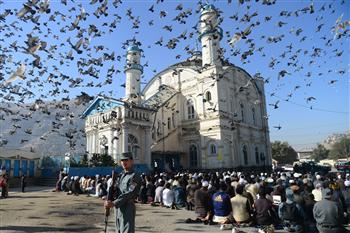
Suicide bomber kills 41 in Afghan mosque: official

October 26, 2012

Kabul_suicide_bomber

Kabul, October 26: A suicide bomber killed at least 41 people, including five children, when he struck at a mosque in northern Afghanistan after Eid al-Adha prayers on Friday, officials said. Dozens more were wounded as the bomb ripped through the crowd of worshippers in Maymana city in Faryab province and there were fears the death toll could rise.

There was no immediate claim of responsibility, but suicide bombings are a favourite weapon of Taliban Islamists trying to topple the Western-backed government of President Hamid Karzai.

The attacker was wearing a police uniform when he blew himself up at the entrance to the city's packed Eid Gah mosque, deputy provincial governor Abdul Satar Barez told AFP.

"Our latest death toll shows 41 deaths, and that might rise," he said.

"Nineteen were members of the security forces, including police, army and intelligence agents. Seventeen were civilians and five children are also among the dead."

Barez, like many other provincial officials, was at the scene at the time of the bombing and described the horror of the blast in the midst of a religious celebration.

"We had just finished Eid al-Adha prayers and we were congratulating and hugging each other," Barez said.

"Suddenly a big explosion took place and the area was full of dust and smoke and body parts of police and civilians were all over the place. It was a very powerful explosion."

One eyewitness, Sayed Moqeed, described the bomber as appearing to be in his early teens.

"Suddenly I heard a very big explosion," he said. "Everywhere were pieces of bodies, hands and limbs. The suicide attacker was in police uniform, he looked to be around 14 or 15 years old."

The four-day Eid al-Adha holiday is a celebration in which Muslims slaughter animals for feasts and distribute a portion of the meat among the poor, and the first day draws large crowds to mosques around the Islamic world.

Karzai strongly condemned the attack, calling the perpetrators "the enemies of Islam and humanity".

"Those who take the happiness of Muslims during Eid days cannot be called human and Muslim," he said.

Northern Afghanistan is relatively peaceful, with the Taliban, who were ousted from power in a US-led invasion in 2001, concentrating their operations in the south and east of the country.

But they have recently stepped up their activities in the north, despite the presence of more than 100,000 NATO troops in the country.

Last week, a huge roadside bomb ripped through a minibus carrying guests to a wedding party in the northern province of Balkh, near Faryab, killing 19 people and wounding 16 others.

The United Nations says 1,145 civilians were killed in the war in the first six months of this year, blaming 80 percent of the deaths on insurgents.

Last year as a whole, a record 3,021 civilians died in the war, according to UN figures.

But Afghan police and government officials have increasingly become targets as local forces take on more responsibility for the fight against the insurgents as NATO prepares to pull out.

The foreign combat troops are due to withdraw by the end of 2014 and there are fears that the Taliban will extend their activities across wider swathes of the country against ill-prepared Afghan forces.



Comments

Add new comment

  • Coastaldigest.com reserves the right to delete or block any comments.
  • Coastaldigset.com is not responsible for its readers’ comments.
  • Comments that are abusive, incendiary or irrelevant are strictly prohibited.
  • Please use a genuine email ID and provide your name to avoid reject.
News Network
February 13,2020

Feb 13: Two Indian crew on board a cruise ship off the Japanese coast have tested positive for the novel coronavirus, the Indian Embassy in Japan said on Wednesday as authorities confirmed that 174 people have been infected with the deadly disease.

The cruise ship Diamond Princess with 3,711 people on board arrived at the Japanese coast early last week and was quarantined after a passenger who de-boarded last month in Hong Kong was found to be the carrier of the novel virus on the ship.

A total of 138 Indians, including passengers and crew, were on board the ship.

“Due to the suspicion of novel coronavirus (nCoV) infection, the ship has been quarantined by the Japanese authorities till February 19, 2020,” the embassy said in a statement.

“Altogether 174 people have been tested positive for nCoV, including two Indian crew members,” it said.

All the infected people have been taken to hospitals for adequate treatment, including further quarantine, in accordance with the Japanese health protocol, it said.

Comments

Add new comment

  • Coastaldigest.com reserves the right to delete or block any comments.
  • Coastaldigset.com is not responsible for its readers’ comments.
  • Comments that are abusive, incendiary or irrelevant are strictly prohibited.
  • Please use a genuine email ID and provide your name to avoid reject.
Agencies
June 7,2020

Moscow, Jun 7: OPEC, Russia and allies agreed on Saturday to extend record oil production cuts until the end of July, prolonging a deal that has helped crude prices double in the past two months by withdrawing almost 10% of global supplies from the market.

The group, known as OPEC+, also demanded countries such as Nigeria and Iraq, which exceeded production quotas in May and June, compensate with extra cuts in July to September.

OPEC+ had initially agreed in April that it would cut supply by 9.7 million barrels per day (bpd) during May-June to prop up prices that collapsed due to the coronavirus crisis. Those cuts were due to taper to 7.7 million bpd from July to December.

“Demand is returning as big oil-consuming economies emerge from pandemic lockdown. But we are not out of the woods yet and challenges ahead remain,” Saudi Energy Minister Prince Abdulaziz bin Salman told the video conference of OPEC+ ministers.

Benchmark Brent crude climbed to a three-month high on Friday above $42 a barrel, after diving below $20 in April. Prices still remain a third lower than at the end of 2019.

“Prices can be expected to be strong from Monday, keeping their $40 plus levels,” said Bjornar Tonhaugen from Rystad Energy.

Saudi Arabia, OPEC’s de facto leader, and Russia have to perform a balancing act of pushing up oil prices to meet their budget needs while not driving them much above $50 a barrel to avoid encouraging a resurgence of rival U.S. shale production.

It was not immediately clear whether Saudi Arabia, the United Arab Emirates and Kuwait would extend beyond June their additional, voluntary cuts of 1.18 million bpd, which are not part of the deal.

BULGING INVENTORIES

The April deal was agreed under pressure from U.S. President Donald Trump, who wants to avoid U.S. oil industry bankruptcies.

Trump, who previously threatened to pull U.S. troops out of Saudi Arabia if Riyadh did not act, spoke to the Russian and Saudi leaders before Saturday’s talks, saying he was happy with the price recovery.

While oil prices have partially recovered, they are still well below the costs of most U.S. shale producers. Shutdowns, layoffs and cost cutting continue across the United States.

“I applaud OPEC-plus for reaching an important agreement today which comes at a pivotal time as oil demand continues to recover and economies reopen around the world,” U.S. Energy Secretary Dan Brouillette wrote on Twitter after the extension.

As global lockdowns ease, oil demand is expected to exceed supply sometime in July but OPEC has yet to clear 1 billion barrels of excess oil inventories accumulated since March.

Rystad’s Tonhaugen said Saturday’s decisions would help OPEC reduce inventories at a rate of 3 million to 4 million bpd in July-August. “The quicker stocks fall, the higher prices will get,” he said.

Nigeria’s petroleum ministry said Abuja backed the idea of compensating for its excessive output in May and June.

Iraq, with one of the worst compliance rates in May, agreed to extra cuts although it was not clear how Baghdad would reach agreement with oil majors on curbing Iraqi output.

Iraq produced 520,000 bpd above its quota in May, while overproduction by Nigeria was 120,000 bpd, Angola’s was 130,000 bpd, Kazakhstan’s was 180,000 bpd and Russia’s was 100,000 bpd, OPEC+ data showed.

OPEC+’s joint ministerial monitoring committee, known as the JMMC, will meet monthly until December to review the market, compliance and recommend levels of cuts. JMMC’s next meeting is scheduled for June 18.

OPEC and OPEC+ will hold their next scheduled meetings on Nov. 30-Dec. 1.

Comments

Add new comment

  • Coastaldigest.com reserves the right to delete or block any comments.
  • Coastaldigset.com is not responsible for its readers’ comments.
  • Comments that are abusive, incendiary or irrelevant are strictly prohibited.
  • Please use a genuine email ID and provide your name to avoid reject.
News Network
June 30,2020

Six months since the new coronavirus outbreak, the pandemic is still far from over, the World Health Organization said Monday, warning that "the worst is yet to come".

Reaching the half-year milestone just as the death toll surpassed 500,000 and the number of confirmed infections topped 10 million, the WHO said it was a moment to recommit to the fight to save lives.

"Six months ago, none of us could have imagined how our world -- and our lives -- would be thrown into turmoil by this new virus," WHO chief Tedros Adhanom Ghebreyesus told a virtual briefing.

"We all want this to be over. We all want to get on with our lives. But the hard reality is this is not even close to being over.

"Although many countries have made some progress, globally the pandemic is actually speeding up.

"We're all in this together, and we're all in this for the long haul.

"We will need even greater stores of resilience, patience, humility and generosity in the months ahead.

"We have already lost so much -- but we cannot lose hope."

Tedros also said that the pandemic had brought out the best and worst humanity, citing acts of kindness and solidarity, but also misinformation and the politicisation of the virus.

In an atmosphere of global political division and fractures on a national level, "the worst is yet to come. I'm sorry to say that," he said.

"With this kind of environment and condition, we fear the worst."

Comments

Add new comment

  • Coastaldigest.com reserves the right to delete or block any comments.
  • Coastaldigset.com is not responsible for its readers’ comments.
  • Comments that are abusive, incendiary or irrelevant are strictly prohibited.
  • Please use a genuine email ID and provide your name to avoid reject.