


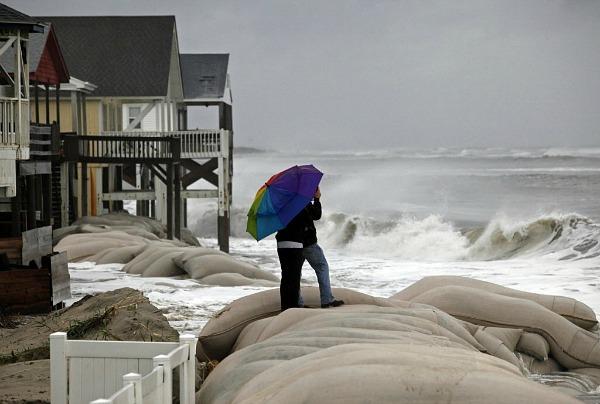
Hurricane Sandy: Emergency declared in New York

[email protected] (New York Times)
October 29, 2012

hurricane-sandy

New York, October 29: Hurricane Sandy, a menacing monster of a storm that forecasters said would bring "life-threatening" flooding, churned toward some of the nation's most densely populated areas on Sunday, prompting widespread evacuations and the shutdown of the New York City transit system.

Officials warned that the hurricane, pushing north from the Caribbean after leaving more than 60 people dead in its wake, could disrupt life in the Northeast for days.

New York went into emergency mode, ordering the evacuations of more than 370,000 people in low-lying communities from Coney Island in Brooklyn to Battery Park City in Manhattan and giving 1.1 million schoolchildren a day off on Monday. The city opened evacuation shelters at 76 public schools.


The National Hurricane Center said it expected the storm to swing inland, probably on Monday evening. The hurricane center reported that the storm had sustained winds of almost 75 miles an hour.

"We're going to have a lot of impact, starting with the storm surge," said Craig Fugate, the administrator of the Federal Emergency Management Agency. "Think, 'Big.' "


The subway closing began at 7 p.m. to darken every one of the city's 468 stations for the second time in 14 months, as officials encouraged the public to stay indoors and worked to prevent a storm surge from damaging tracks and signal equipment in the tunnels. A suspension of bus service was ordered for 9 p.m.

The closing this year seemed more ominous. The shutdown before Tropical Storm Irene last year began at noon on a Saturday, and service resumed before the workweek started on Monday. This time, officials warned, it might be Wednesday before trains were running again.

Another fear in the Northeast was that winds from the storm might knock down power lines, and that surging waters could flood utility companies' generators and other equipment.

Forecasters said the hurricane was a strikingly powerful storm that could reach far inland. Hurricane-force winds from the storm stretched 175 miles from the center, an unusually wide span, and tropical storm winds extended outward 520 miles. Forecasters said they expected high-altitude winds to whip every state east of the Mississippi River.

President Obama, who attended a briefing with officials from FEMA in Washington called Hurricane Sandy "a big and serious storm." He said federal officials were "making sure that we've got the best possible response to what is going to be a big and messy system."

"My main message to everybody involved is that we have to take this seriously," the president said.

The hurricane center said through the day on Sunday that Hurricane Sandy was "expected to bring life-threatening storm surge flooding to the mid-Atlantic Coast, including Long Island Sound and New York Harbor."

The storm preparations and cancellations were not confined to New York.

Amtrak said it would cancel most trains on the Eastern Seaboard, and Philadelphia shut down its mass transit system.

In the New York area, the Metropolitan Transportation Authority's commuter rail lines, which suffered the heaviest damage during Tropical Storm Irene, were suspended beginning at 7 p.m. on Sunday.

New Jersey Transit began rolling back service gradually at 4 p.m., with a full shutdown expected by 2 a.m.

The Staten Island Ferry was scheduled to stop running by 8:30 p.m., PATH trains at midnight.

The nation's major airlines canceled thousands of flights in the Northeast. The Port Authority of New York and New Jersey, which operates the three major airports in the New York City area, said it expected major carriers to cease operations entirely by Sunday evening. The Coast Guard closed New York Harbor - cruise ships were told to go elsewhere - and the Northeast faced the possibility of being all but shut down on Monday.


Federal offices in the Washington area will be closed; only emergency employees will be on the job. The Washington transit system - its Metrorail subway and its buses - will also be shut down.

The United Nations canceled all meetings at its headquarters in Manhattan.

Broadway shows were canceled on Sunday and Monday, as were performances at Carnegie Hall.

Schools in Baltimore, Boston and Washington called off classes for Monday.

Many public libraries said their reading rooms would be closed for the day, and parks department workers in Central Park told people to leave on Sunday and to stay away until the storm passed.

The New York Stock Exchange, which initially said its trading floor would be open on Monday, decided to close the floor and handle trading electronically. The closing was the first caused by bad weather since Hurricane Gloria in 1985, although the opening bell has been delayed a number of times - once during a blizzard in January 1996 - and the exchange was closed for three days after the Sept. 11 attacks. The Nasdaq exchange, which has long relied on electronic trading, said it would open as usual on Monday.

The hurricane center said the surges could reach 11 feet in New York Harbor, Long Island Sound and Raritan Bay in New Jersey - significantly higher than previous forecasts and significantly above the levels recorded during the tropical storm last year.

Forecasters said the water could top 8 feet from Ocean City, Md., to the border between Connecticut and Rhode Island. They predicted the waves would rise to 6 feet on the south shore of Cape Cod.

Hour after hour on Sunday, long before high tide, high waves pounded the dunes that protect the boardwalk in Rehoboth Beach, Del.

And in East Hampton, N.Y., where Mabel Harmon and her neighbors had spent the day tying down patio furniture, the wind was already "blowing like crazy," she said Sunday afternoon.

Forecasters also warned that rain could saturate the ground and that trees could tumble across roads or onto power lines.

From North Carolina to Connecticut, officials declared emergencies and directed residents to leave areas near the shore.

Delaware ordered coastal communities evacuated by 8 p.m. Sunday.

In New Jersey, gamblers scrambled to play a few last rounds of blackjack before leaving the Atlantic City casinos under orders from Gov. Chris Christie.

He also ordered residents to leave barrier islands from Sandy Hook to Cape May.

In beachfront towns from North Carolina to New Jersey, the surf was spitting, and crews were rushing to build sand walls in places where the beaches had been rebuilt after 2011, when many places were hit by what was still Hurricane Irene.

In Red Hook, Brooklyn, many residents along the streets closest to New York Harbor were in their basements checking sump pumps.

Gino Vitale, a builder and landlord there, was delivering sandbags piled high in the back of his white Ford pickup truck to tenants along Conover Street, a block from New York Bay.

"We dodged most of it with Irene," he said, referring to the storm that flooded basements in Red Hook but not much else. "I'm hoping we can do that again."

For the most part, residents appeared to follow officials' advice to stock up on bottled water, canned food and flashlights - so much so that stores ran low on batteries. Some gas stations in Connecticut had little gasoline left - no regular, and not much premium.

In a flood-prone neighborhood in Philadelphia, Michael Dornblum did something he did not do during Tropical Storm Irene or earlier storms that brought high water - he put 80-pound sandbags outside his family's furniture store. In the past, he has lined them up only inside. He put the additional protection in place as employees prepared to lift carpets and sofas off the showroom floor. Some went to a storage area on the second floor.

Con Edison did not provide an estimate of how long customers in the New York City area might be without power if the storm played havoc with its network; by contrast, the parent company of Jersey Central Power and Light warned as long ago as Friday that repairs could take 10 days after the storm passed through. Another utility in New Jersey, the Public Service Electric and Gas Company, said that restoring power could take a week.

Forecasters said Hurricane Sandy could deliver something besides wind and rain: snow. That is because a system known as a midlatitude trough - which often causes severe winter storms - was moving across the country from the west. It was expected to draw in Hurricane Sandy, giving it added energy.


A blast of arctic air is expected to sweep down through the Canadian Plains just as the two storms converge. That could lead to several feet of heavy, wet snow in West Virginia and lighter amounts in Pennsylvania and Ohio that could bring down trees and power lines if already chilly temperatures drop below freezing.

The full moon on Monday could cause even greater flooding, because tides will be at their peak.

The possibility of a higher surge was one reason that Mayor Michael R. Bloomberg of New York ordered mandatory evacuations in low-lying areas, just as he did before Tropical Storm Irene. One city official said there was particular concern about Con Edison's Lower Manhattan infrastructure, noting that if the storm surge washed over the bulkheads, it could damage the utility's electrical and steam networks. If the surge runs as high as forecast, Con Ed will shut off two electrical networks in Lower Manhattan,

As for the subway shutdown, Mr. Bloomberg said that if the Metropolitan Transportation Authority had not suspended service, but instead had left itself vulnerable to the storm, the city would have risked being without its mass transit network for even longer.

"They do have to make sure that their equipment doesn't get damaged," Mr. Bloomberg said. "Otherwise we would not have subway trains when this is over or buses when it's over."

Joseph J. Lhota, the chairman of the authority, said he expected the transit systems to restore at least some service about 12 hours after the storm ended. But he warned that the city could be without mass transit for as many as two full work days. "I do think Monday and Tuesday are going to be difficult days," Mr. Lhota said.

But while the mayor said schoolchildren could take Monday off, city workers could not: He said that city offices would be open for business.



Comments

Add new comment

  • Coastaldigest.com reserves the right to delete or block any comments.
  • Coastaldigset.com is not responsible for its readers’ comments.
  • Comments that are abusive, incendiary or irrelevant are strictly prohibited.
  • Please use a genuine email ID and provide your name to avoid reject.
Agencies
July 15,2020

Washington, Jul 15: The Trump administration has agreed to rescind its July 6 rule, which temporarily barred international students from staying in the United States unless they attend at least one in-person course, a federal district court judge said on Tuesday.

The U-turn by the Trump administration comes following a nationwide outrage against its July 6 order and a series of lawsuits filed by a large number of educational institutions, led by the prestigious Harvard University and Massachusetts Institute of Technology (MIT), seeking a permanent injunctive relief to bar the Department of Homeland Security (DHS) and the US Immigration and Customs Enforcement (ICE) from enforcing the federal guidelines barring international students attending colleges and universities offering only online courses from staying in the country.

As many as 17 US states and the District of Columbia, along with top American IT companies such as Google, Facebook and Microsoft, joined MIT and Harvard in the US District Court in Massachusetts against the DHS and the ICE in seeking an injunction to stop the entire rule from going into effect.

"I have been informed by the parties that they have come to a resolution. They will return to the status quo," Judge Allison Burroughs, the federal district judge in Boston, said in a surprise statement at the top of the hearing on the lawsuit.

The announcement comes as a big relief to international students, including those from India. In the 2018-2019 academic year, there were over 10 lakh international students in the US. According to a recent report of the Student and Exchange Visitor Program (SEVP), 1,94,556 Indian students were enrolled in various academic institutions in the US in January.

Judge Burroughs said the policy would apply nationwide.

"Both the policy directive and the frequently asked questions would not be enforced anyplace," she said, referring to the agreement between the US government and MIT and Harvard.

Congressman Brad Scneider said this is a great win for international students, colleges and common sense.

"The Administration needs to give us a plan to tackle our public health crisis - it can't be recklessly creating rules one day and rescinding them the next," he said in a tweet.

Last week, more than 136 Congressmen and 30 senators wrote to the Trump administration to rescind its order on international students.

"This is a major victory for the students, organisers and institutions of higher education in the #MA7 and all across the country that stood up and fought back against this racist and xenophobic rule," said Congresswoman Ayanna Pressley.

"Taking online classes shouldn't force international students out of our country," Congressman Mikie Sherrill said in a tweet.

In its July 6 notice, the ICE had said all student visa holders, whose university curricula were only offered online, "must depart the country or take other measures, such as transferring to a school with in-person instruction to remain in lawful status".

"If not, they may face immigration consequences, including but not limited to the initiation of removal proceedings," it had said.

In their lawsuit, the 17 states and the District of Columbia said for many international students, remote learning in the countries and communities they come from would impede their studies or be simply impossible.

The lawsuit alleged that the new rule imposes a significant economic harm by precluding thousands of international students from coming to and residing in the US and finding employment in fields such as science, technology, biotechnology, healthcare, business and finance, and education, and contributing to the overall economy.

In a separate filing, companies like Google, Facebook and Microsoft, along with the US Chamber of Commerce and other IT advocacy groups, asserted that the July 6 ICE directive will disrupt their recruiting plans, making it impossible to bring on board international students that businesses, including the amici, had planned to hire, and disturb the recruiting process on which the firms have relied on to identify and train their future employees.

The July 6 directive will make it impossible for a large number of international students to participate in the CPT and OPT programmes. The US will "nonsensically be sending...these graduates away to work for our global competitors and compete against us...instead of capitalising on the investment in their education here in the US", they said.

Comments

Add new comment

  • Coastaldigest.com reserves the right to delete or block any comments.
  • Coastaldigset.com is not responsible for its readers’ comments.
  • Comments that are abusive, incendiary or irrelevant are strictly prohibited.
  • Please use a genuine email ID and provide your name to avoid reject.
News Network
May 21,2020

Canberra, May 21: Australian Prime Minister Scott Morrison and his Indian counterpart, Narendra Modi, are looking forward to deepening the countries' strategic relationship, with both sides expected to sign a range of pacts from defence to trade in strategic sectors amid heightened tensions with China over Beijing's response to coronavirus pandemic.

During a virtual summit, scheduled to take place on June 4, both leaders are expected to ramp up efforts to diversify Australia's export markets and find trusted suppliers of vital products and components, a local newspaper, The Australian reported on Tuesday.

The new agreements will focus on reliable supply chains in key strategic sectors, including medical goods, technology and critical minerals, amid heightened tensions with China over Beijing's response to coronavirus pandemic.

The leaders will seal a new defence agreement allowing reciprocal access to bases and co-operation on military technology projects, while a new education partnership will be on the table to help overcome Australian university reliance on Chinese students.

The talks in terms of strategic convergence, now have greater significance as COVID-19 exacerbates the strategic contest between the US and China, and forces like-minded countries to seek out reliable partners.

Australian farmers could also benefit, with talks underway on expanding agricultural exports to India, including barley, as China throws up new trade barriers, media reports stated.

The virtual summit follows the cancellation of Morrison's planned state visit to India in January due to the bushfires.

Morrison said last year, ahead of his planned visit, that India was "a natural partner for Australia", referring to the countries' "shared values" -- a point of differentiation with China.

Former Department of Foreign Affairs and Trade secretary Peter Varghese, who wrote a landmark report on the bilateral relationship in 2018, was quoted by the newspaper as saying that India would be even more important to Australia in the post-COVID world. "If one of the lessons from COVID is that countries need to spread their risk, then finding new markets or building up existing markets is a crucial part of that," he added.

Varghese noted that India, a member of the Quadrilateral Security Dialogue along with Australia, Japan and the US, was a vital strategic partner to Australia in helping "constrain China's ambitions to be the predominant power".

"That shared objective between Australia and India of not wanting to see the region dominated by China is a key component of building up our geopolitical relationship," he told The Australian.

The summit also follows recent talks between Australian Foreign Minister Marise Payne and Indian counterpart Subrahmanyam Jaishankar on the pandemic response and Australia's call for an independent inquiry, which was overwhelmingly backed at the World Health Assembly on Tuesday.

Australia wants to support India to develop a domestic critical minerals processing industry, which would provide Western nations with an alternative to sourcing the materials from China.

Meanwhile, India has strong expertise as a manufacturer of drugs and medical equipment, while Australia is a centre of biomedical research, opening the possibility for closer co-operation in the key sector, the media reported further.

Comments

Add new comment

  • Coastaldigest.com reserves the right to delete or block any comments.
  • Coastaldigset.com is not responsible for its readers’ comments.
  • Comments that are abusive, incendiary or irrelevant are strictly prohibited.
  • Please use a genuine email ID and provide your name to avoid reject.
News Network
January 23,2020

Jan 23: Hundreds of Central Americans trying to reach the United States were stuck at the Mexico-Guatemala border on Wednesday after the Mexican government beefed up security to meet US demands to contain migrant flows.

Under sustained pressure from President Donald Trump, Mexico's government has adopted tougher measures to reduce the number of people heading towards the U.S. border.

Migrants in Tecun Uman, on the Guatemalan side of the border, were taken by surprise.

"We thought we'd be allowed through just like with the October caravan when they reached Tijuana," said Honduran migrant Ritzy Anabel, who did not give her surname.

"People from Mexico and Guatemala treated them well. But now it's changed because Mexicans don't want (us) to enter."

Many Central Americans migrants heading north are fleeing economic hardship and violence at home. A large caravan of migrants crossed into Mexico and went north in October 2018. Migrants crossing into Mexico earlier this week faced tear gas from security forces, who delivered a firmer response than in previous mass movements at the border.

Even so, about 1,000 migrants, most of them from Honduras, managed to reach Mexican soil on Tuesday. Mexican Foreign Minister Marcelo Ebrard said several hundred of the new arrivals were immediately deported on planes and buses.

On Wednesday, Mexican authorities said that 460 Honduran migrants were deported throughout the day. Other migrants from the group, including families traveling with children, were pondering their next moves.

Honduran Carlos Amador said that while some of his compatriots were returning home, others were hoping for positive news.

Trump has repeatedly threatened to punish Mexico and Central American countries if they fail to clamp down on the migrant flows. That has resulted in a series of agreements aimed at delivering on Trump's campaign promises to curb immigration.

Department of Homeland Security Acting Secretary Chad Wolf called the measures put in place by the Mexican National Guard "effective", adding that dozens of his personnel was on the ground in Central America assisting local immigration and security officials. Trump tweeted: "Sorry, if you come you will be immediately sent back!"

Comments

Add new comment

  • Coastaldigest.com reserves the right to delete or block any comments.
  • Coastaldigset.com is not responsible for its readers’ comments.
  • Comments that are abusive, incendiary or irrelevant are strictly prohibited.
  • Please use a genuine email ID and provide your name to avoid reject.