


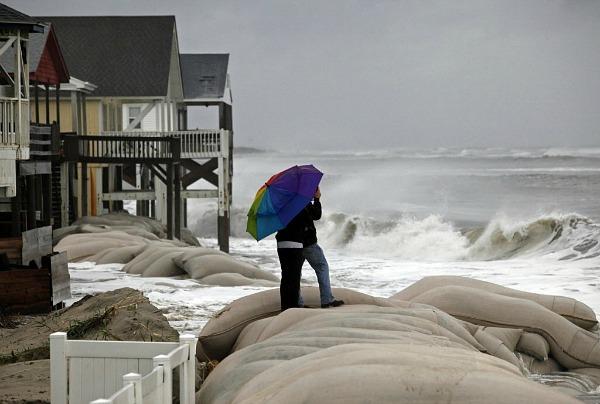
Hurricane Sandy: Emergency declared in New York

[email protected] (New York Times)
October 29, 2012

hurricane-sandy

New York, October 29: Hurricane Sandy, a menacing monster of a storm that forecasters said would bring "life-threatening" flooding, churned toward some of the nation's most densely populated areas on Sunday, prompting widespread evacuations and the shutdown of the New York City transit system.

Officials warned that the hurricane, pushing north from the Caribbean after leaving more than 60 people dead in its wake, could disrupt life in the Northeast for days.

New York went into emergency mode, ordering the evacuations of more than 370,000 people in low-lying communities from Coney Island in Brooklyn to Battery Park City in Manhattan and giving 1.1 million schoolchildren a day off on Monday. The city opened evacuation shelters at 76 public schools.


The National Hurricane Center said it expected the storm to swing inland, probably on Monday evening. The hurricane center reported that the storm had sustained winds of almost 75 miles an hour.

"We're going to have a lot of impact, starting with the storm surge," said Craig Fugate, the administrator of the Federal Emergency Management Agency. "Think, 'Big.' "


The subway closing began at 7 p.m. to darken every one of the city's 468 stations for the second time in 14 months, as officials encouraged the public to stay indoors and worked to prevent a storm surge from damaging tracks and signal equipment in the tunnels. A suspension of bus service was ordered for 9 p.m.

The closing this year seemed more ominous. The shutdown before Tropical Storm Irene last year began at noon on a Saturday, and service resumed before the workweek started on Monday. This time, officials warned, it might be Wednesday before trains were running again.

Another fear in the Northeast was that winds from the storm might knock down power lines, and that surging waters could flood utility companies' generators and other equipment.

Forecasters said the hurricane was a strikingly powerful storm that could reach far inland. Hurricane-force winds from the storm stretched 175 miles from the center, an unusually wide span, and tropical storm winds extended outward 520 miles. Forecasters said they expected high-altitude winds to whip every state east of the Mississippi River.

President Obama, who attended a briefing with officials from FEMA in Washington called Hurricane Sandy "a big and serious storm." He said federal officials were "making sure that we've got the best possible response to what is going to be a big and messy system."

"My main message to everybody involved is that we have to take this seriously," the president said.

The hurricane center said through the day on Sunday that Hurricane Sandy was "expected to bring life-threatening storm surge flooding to the mid-Atlantic Coast, including Long Island Sound and New York Harbor."

The storm preparations and cancellations were not confined to New York.

Amtrak said it would cancel most trains on the Eastern Seaboard, and Philadelphia shut down its mass transit system.

In the New York area, the Metropolitan Transportation Authority's commuter rail lines, which suffered the heaviest damage during Tropical Storm Irene, were suspended beginning at 7 p.m. on Sunday.

New Jersey Transit began rolling back service gradually at 4 p.m., with a full shutdown expected by 2 a.m.

The Staten Island Ferry was scheduled to stop running by 8:30 p.m., PATH trains at midnight.

The nation's major airlines canceled thousands of flights in the Northeast. The Port Authority of New York and New Jersey, which operates the three major airports in the New York City area, said it expected major carriers to cease operations entirely by Sunday evening. The Coast Guard closed New York Harbor - cruise ships were told to go elsewhere - and the Northeast faced the possibility of being all but shut down on Monday.


Federal offices in the Washington area will be closed; only emergency employees will be on the job. The Washington transit system - its Metrorail subway and its buses - will also be shut down.

The United Nations canceled all meetings at its headquarters in Manhattan.

Broadway shows were canceled on Sunday and Monday, as were performances at Carnegie Hall.

Schools in Baltimore, Boston and Washington called off classes for Monday.

Many public libraries said their reading rooms would be closed for the day, and parks department workers in Central Park told people to leave on Sunday and to stay away until the storm passed.

The New York Stock Exchange, which initially said its trading floor would be open on Monday, decided to close the floor and handle trading electronically. The closing was the first caused by bad weather since Hurricane Gloria in 1985, although the opening bell has been delayed a number of times - once during a blizzard in January 1996 - and the exchange was closed for three days after the Sept. 11 attacks. The Nasdaq exchange, which has long relied on electronic trading, said it would open as usual on Monday.

The hurricane center said the surges could reach 11 feet in New York Harbor, Long Island Sound and Raritan Bay in New Jersey - significantly higher than previous forecasts and significantly above the levels recorded during the tropical storm last year.

Forecasters said the water could top 8 feet from Ocean City, Md., to the border between Connecticut and Rhode Island. They predicted the waves would rise to 6 feet on the south shore of Cape Cod.

Hour after hour on Sunday, long before high tide, high waves pounded the dunes that protect the boardwalk in Rehoboth Beach, Del.

And in East Hampton, N.Y., where Mabel Harmon and her neighbors had spent the day tying down patio furniture, the wind was already "blowing like crazy," she said Sunday afternoon.

Forecasters also warned that rain could saturate the ground and that trees could tumble across roads or onto power lines.

From North Carolina to Connecticut, officials declared emergencies and directed residents to leave areas near the shore.

Delaware ordered coastal communities evacuated by 8 p.m. Sunday.

In New Jersey, gamblers scrambled to play a few last rounds of blackjack before leaving the Atlantic City casinos under orders from Gov. Chris Christie.

He also ordered residents to leave barrier islands from Sandy Hook to Cape May.

In beachfront towns from North Carolina to New Jersey, the surf was spitting, and crews were rushing to build sand walls in places where the beaches had been rebuilt after 2011, when many places were hit by what was still Hurricane Irene.

In Red Hook, Brooklyn, many residents along the streets closest to New York Harbor were in their basements checking sump pumps.

Gino Vitale, a builder and landlord there, was delivering sandbags piled high in the back of his white Ford pickup truck to tenants along Conover Street, a block from New York Bay.

"We dodged most of it with Irene," he said, referring to the storm that flooded basements in Red Hook but not much else. "I'm hoping we can do that again."

For the most part, residents appeared to follow officials' advice to stock up on bottled water, canned food and flashlights - so much so that stores ran low on batteries. Some gas stations in Connecticut had little gasoline left - no regular, and not much premium.

In a flood-prone neighborhood in Philadelphia, Michael Dornblum did something he did not do during Tropical Storm Irene or earlier storms that brought high water - he put 80-pound sandbags outside his family's furniture store. In the past, he has lined them up only inside. He put the additional protection in place as employees prepared to lift carpets and sofas off the showroom floor. Some went to a storage area on the second floor.

Con Edison did not provide an estimate of how long customers in the New York City area might be without power if the storm played havoc with its network; by contrast, the parent company of Jersey Central Power and Light warned as long ago as Friday that repairs could take 10 days after the storm passed through. Another utility in New Jersey, the Public Service Electric and Gas Company, said that restoring power could take a week.

Forecasters said Hurricane Sandy could deliver something besides wind and rain: snow. That is because a system known as a midlatitude trough - which often causes severe winter storms - was moving across the country from the west. It was expected to draw in Hurricane Sandy, giving it added energy.


A blast of arctic air is expected to sweep down through the Canadian Plains just as the two storms converge. That could lead to several feet of heavy, wet snow in West Virginia and lighter amounts in Pennsylvania and Ohio that could bring down trees and power lines if already chilly temperatures drop below freezing.

The full moon on Monday could cause even greater flooding, because tides will be at their peak.

The possibility of a higher surge was one reason that Mayor Michael R. Bloomberg of New York ordered mandatory evacuations in low-lying areas, just as he did before Tropical Storm Irene. One city official said there was particular concern about Con Edison's Lower Manhattan infrastructure, noting that if the storm surge washed over the bulkheads, it could damage the utility's electrical and steam networks. If the surge runs as high as forecast, Con Ed will shut off two electrical networks in Lower Manhattan,

As for the subway shutdown, Mr. Bloomberg said that if the Metropolitan Transportation Authority had not suspended service, but instead had left itself vulnerable to the storm, the city would have risked being without its mass transit network for even longer.

"They do have to make sure that their equipment doesn't get damaged," Mr. Bloomberg said. "Otherwise we would not have subway trains when this is over or buses when it's over."

Joseph J. Lhota, the chairman of the authority, said he expected the transit systems to restore at least some service about 12 hours after the storm ended. But he warned that the city could be without mass transit for as many as two full work days. "I do think Monday and Tuesday are going to be difficult days," Mr. Lhota said.

But while the mayor said schoolchildren could take Monday off, city workers could not: He said that city offices would be open for business.



Comments

Add new comment

  • Coastaldigest.com reserves the right to delete or block any comments.
  • Coastaldigset.com is not responsible for its readers’ comments.
  • Comments that are abusive, incendiary or irrelevant are strictly prohibited.
  • Please use a genuine email ID and provide your name to avoid reject.
News Network
March 4,2020

London, Mar 4: The UK government has reiterated its concern over the potential impact of the Citizenship Amendment Act (CAA) and said it is continuing to follow the events in India closely.

In response to an urgent question on “Recent Violence in India” tabled by Pakistani-origin Opposition Labour Party MP Khalid Mahmood in the House of Commons on Tuesday, UK’s Minister of State in the Foreign and Commonwealth Office (FCO) Nigel Adams said the UK engages with India at all levels, including on human rights, and also referred to the country's "proud history" of inclusive government and religious tolerance.

"The UK government also have concerns about the potential impact of the legislation (CAA),” said Adams, the Minister for Asia who was standing in for UK Foreign Secretary Dominic Raab, who is on a visit to Turkey.

"It is because of our close relationship with the government of India that we are able to discuss difficult issues with them and make clear our concerns where we have them, including on the rights of minorities. We will continue to follow events closely and to raise our concerns when we have with them,” said the minister.

While Mahmood, who had tabled the urgent question for an FCO statement, described the government response as “facile”, another Pakistani-origin MP Nusrat Ghani called on the government to relay the UK Parliament's concerns to the Indian authorities.

British Sikh Labour MP Tanmanjeet Singh Dhesi said the violence had brought back “painful personal memories” from the 1984 Sikh riots while he was studying in India and fellow Sikh MP Preet Kaur Gill also referenced 1984 in her intervention.

Other MPs sought to highlight the steps taken by the Indian authorities to restore “peace and tranquillity” in Delhi.

“He will be aware that it is not just Muslims who have been killed; Hindus have also been killed as part of the riots,” said Conservative Party MP Bob Blackman.

Scottish National Party (SNP) MP Alyn Smith sought the UK government’s intervention to share best practice around countering the online disinformation campaign being used in India to “inflame tensions”.

“We are in constant contact on these issues, and we know how important this is to Members of Parliament and their constituents, who may have family in the area,” said Adams, in his response.

Comments

Add new comment

  • Coastaldigest.com reserves the right to delete or block any comments.
  • Coastaldigset.com is not responsible for its readers’ comments.
  • Comments that are abusive, incendiary or irrelevant are strictly prohibited.
  • Please use a genuine email ID and provide your name to avoid reject.
News Network
February 26,2020

Feb 26: China’s massive travel restrictions, house-to-house checks, huge isolation wards and lockdowns of entire cities bought the world valuable time to prepare for the global spread of the new virus.

But with troubling outbreaks now emerging in Italy, South Korea and Iran, and U.S. health officials warning Tuesday it’s inevitable it will spread more widely in America, the question is: Did the world use that time wisely and is it ready for a potential pandemic?

“It’s not so much a question of if this will happen anymore, but rather more a question of exactly when this will happen — and how many people in this country will have severe illness,” said Dr. Nancy Messonnier of the U.S. Centers for Disease Control and Prevention.

Some countries are putting price caps on face masks to combat price gouging, while others are using loudspeakers on trucks to keep residents informed. In the United States and many other nations, public health officials are turning to guidelines written for pandemic flu and discussing the possibility of school closures, telecommuting and canceling events.

Countries could be doing even more: training hundreds of workers to trace the virus’ spread from person to person and planning to commandeer entire hospital wards or even entire hospitals, said Dr. Bruce Aylward, the World Health Organization’s envoy to China, briefing reporters Tuesday about lessons learned by the recently returned team of international scientists he led.

“Time is everything in this disease,” Aylward said. “Days make a difference with a disease like this.”

The U.S. National Institutes of Health’s infectious disease chief, Dr. Anthony Fauci, said the world is “teetering very, very close” to a pandemic. He credits China’s response for giving other nations some breathing room.

China locked down tens of millions of its citizens and other nations imposed travel restrictions, reducing the number of people who needed health checks or quarantines outside the Asian country.

It “gave us time to really brush off our pandemic preparedness plans and get ready for the kinds of things we have to do,” Fauci said. “And we’ve actually been quite successful because the travel-related cases, we’ve been able to identify, to isolate” and to track down those they came in contact with.

With no vaccine or medicine available yet, preparations are focused on what’s called “social distancing” — limiting opportunities for people to gather and spread the virus.

That played out in Italy this week. With cases climbing, authorities cut short the popular Venice Carnival and closed down Milan’s La Scala opera house. In Japan, Prime Minister Shinzo Abe called on companies to allow employees to work from home, while the Tokyo Marathon has been restricted to elite runners and other public events have been canceled.

Is the rest of the world ready?

In Africa, three-quarters of countries have a flu pandemic plan, but most are outdated, according to authors of a modeling study published last week in The Lancet medical journal. The slightly better news is that the African nations most connected to China by air travel — Egypt, Algeria and South Africa — also have the most prepared health systems on the continent.

Elsewhere, Thailand said it would establish special clinics to examine people with flu-like symptoms to detect infections early. Sri Lanka and Laos imposed price ceilings for face masks, while India restricted the export of personal protective equipment.

India’s health ministry has been framing step-by-step instructions to deal with sustained transmissions that will be circulated to the 250,000 village councils that are the most basic unit of the country’s sprawling administration.

Vietnam is using music videos on social media to reach the public. In Malaysia, loudspeakers on trucks blare information through the streets.

In Europe, portable pods set up at United Kingdom hospitals will be used to assess people suspected of infection while keeping them apart from others. France developed a quick test for the virus and has shared it with poorer nations. German authorities are stressing “sneezing etiquette” and Russia is screening people at airports, railway stations and those riding public transportation.

In the U.S., hospitals and emergency workers for years have practiced for a possible deadly, fast-spreading flu. Those drills helped the first hospitals to treat U.S. patients suffering from COVID-19, the disease caused by the virus.

Other hospitals are paying attention. The CDC has been talking to the American Hospital Association, which in turn communicates coronavirus news daily to its nearly 5,000 member hospitals. Hospitals are reviewing infection control measures, considering using telemedicine to keep potentially infectious patients from making unnecessary trips to the hospital and conserving dwindling supplies of masks and gloves.

What’s more, the CDC has held 17 different calls reaching more than 11,000 companies and organizations, including stadiums, universities, faith leaders, retailers and large corporations. U.S. health authorities are talking to city, county and state health departments about being ready to cancel mass gathering events, close schools and take other steps.

The CDC’s Messonnier said Tuesday she had contacted her children’s school district to ask about plans for using internet-based education should schools need to close temporarily, as some did in 2009 during an outbreak of H1N1 flu. She encouraged American parents to do the same, and to ask their employers whether they’ll be able to work from home.

“We want to make sure the American public is prepared,” Messonnier said.

How prepared are U.S. hospitals?

“It depends on caseload and location. I would suspect most hospitals are prepared to handle one to two cases, but if there is ongoing local transmission with many cases, most are likely not prepared just yet for a surge of patients and the ‘worried well,’” Dr. Jennifer Lighter, a pediatric infectious diseases specialist at NYU Langone in New York, said in an email.

In the U.S., a vaccine candidate is inching closer to first-step safety studies in people, as Moderna Inc. has delivered test doses to Fauci’s NIH institute. Some other companies say they have candidates that could begin testing in a few months. Still, even if those first safety studies show no red flags, specialists believe it would take at least a year to have something ready for widespread use. That’s longer than it took in 2009, during the H1N1 flu pandemic — because that time around, scientists only had to adjust regular flu vaccines, not start from scratch.

The head of the World Health Organization, Tedros Adhanom Ghebreyesus, said the U.N. health agency’s team in China found the fatality rate between 2% and 4% in the hard-hit city of Wuhan, the virus’ epicenter, and 0.7% elsewhere.

The world is “simply not ready,” said the WHO’s Aylward. “It can get ready very fast, but the big shift has to be in the mindset.”

Aylward advised other countries to do “really practical things” now to get ready.

Among them: Do you have hundreds of workers lined up and trained to trace the contacts of infected patients, or will you be training them after a cluster pops up?

Can you take over entire hospital wards, or even entire hospitals, to isolate patients?

Are hospitals buying ventilators and checking oxygen supplies?

Countries must improve testing capacity — and instructions so health workers know which travelers should be tested as the number of affected countries rises, said Johns Hopkins University emergency response specialist Lauren Sauer. She pointed to how Canada diagnosed the first traveler from Iran arriving there with COVID-19, before many other countries even considered adding Iran to the at-risk list.

If the disease does spread globally, everyone is likely to feel it, said Nancy Foster, a vice president of the American Hospital Association. Even those who aren’t ill may need to help friends and family in isolation or have their own health appointments delayed.

“There will be a lot of people affected even if they never become ill themselves,” she said.

Comments

Add new comment

  • Coastaldigest.com reserves the right to delete or block any comments.
  • Coastaldigset.com is not responsible for its readers’ comments.
  • Comments that are abusive, incendiary or irrelevant are strictly prohibited.
  • Please use a genuine email ID and provide your name to avoid reject.
News Network
May 30,2020

Washington, May 30: The United States will end its relationship with the World Health Organization over the body’s handling of the coronavirus pandemic, U.S. President Donald Trump said on Friday, accusing the U.N. agency of becoming a puppet of China.

The move to quit the Geneva-based body, which the United States formally joined in 1948, comes amid growing tensions between Washington and Beijing over the coronavirus outbreak. The virus first emerged in China’s Wuhan city late last year.

Speaking in the White House Rose Garden, Trump said Chinese officials “ignored their reporting obligations” to the WHO about the virus - that has killed hundreds of thousands of people globally - and pressured the agency to “mislead the world.”

“China has total control over the World Health Organization despite only paying $40 million per year compared to what the United States has been paying which is approximately $450 million a year,” he said.

Trump’s decision follows a pledge last week by Chinese President Xi Jinping to give $2 billion to the WHO over the next two years to help combat the coronavirus. The amount almost matches the WHO’s entire annual program budget for last year.

Trump last month halted funding for the 194-member organization, then in a May 18 letter gave the WHO 30 days to commit to reforms.

“Because they have failed to make the requested and greatly needed reforms, we will be today terminating our relationship with the World Health Organization and redirecting those funds to other worldwide and deserving urgent global public health needs,” Trump said on Friday.

It was not immediately clear when his decision would come into effect. A 1948 joint resolution of Congress on U.S. membership of the WHO said the country “reserves its right to withdraw from the organization on a one-year notice.”

The World Health Organization did not immediately respond to a request for comment on Trump’s announcement. It has previously denied Trump’s assertions that it promoted Chinese “disinformation” about the virus.

“It’s important to remember that the WHO is a platform for cooperation among countries,” said Donna McKay, executive director of Physicians for Human Rights. “Walking away from this critical institution in the midst of an historic pandemic will hurt people both in the United States and around the world.”

‘ABSOLUTELY CRITICAL’

The United States currently owes the WHO more than $200 million in assessed contributions, according to the WHO website. Washington also gives several hundred million dollars annually in voluntary funding tied to specific WHO programs such as polio eradication, HIV, hepatitis and tuberculosis.

Amesh A. Adalja, a senior scholar at Johns Hopkins Center for Health Security, said that in practice Trump’s decision was unlikely to change the operations of the WHO.

“From a symbolic or moral standpoint it’s the wrong type of action to be taking in the middle of a pandemic and seems to deflect responsibility for what we in the U.S. failed to do and blame the WHO,” said Adalja.

When Trump halted funding to the WHO last month, two Western diplomats said the U.S. suspension was more harmful politically to the WHO than to the agency’s current programs, which are funded for now.

The WHO is an independent international body that works with the United Nations. U.N. Secretary-General Antonio Guterres said last month that the WHO is “absolutely critical to the world’s efforts to win the war against COVID-19.”

When asked about Trump’s decision, a U.N. spokesman said: “We have consistently called for all states to support WHO.”

Trump has long scorned multilateralism as he focuses on an “America First” agenda. Since taking office, he has quit the U.N. Human Rights Council, the U.N. cultural agency, a global accord to tackle climate change and the Iran nuclear deal. He has also cut funding for the U.N. population fund and the U.N. agency that aids Palestinian refugees.

“The WHO is the world’s early warning system for infectious diseases,” said U.S. Representative Nita Lowey, a Democrat who chairs the House Committee on Appropriations. “Now, during a global pandemic that has cost over 100,000 American lives, is not the time to put the country further at risk.”

Comments

Add new comment

  • Coastaldigest.com reserves the right to delete or block any comments.
  • Coastaldigset.com is not responsible for its readers’ comments.
  • Comments that are abusive, incendiary or irrelevant are strictly prohibited.
  • Please use a genuine email ID and provide your name to avoid reject.