


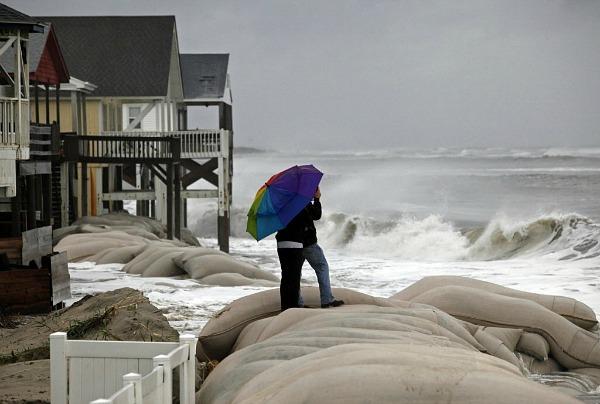
Hurricane Sandy: Emergency declared in New York

[email protected] (New York Times)
October 29, 2012

hurricane-sandy

New York, October 29: Hurricane Sandy, a menacing monster of a storm that forecasters said would bring "life-threatening" flooding, churned toward some of the nation's most densely populated areas on Sunday, prompting widespread evacuations and the shutdown of the New York City transit system.

Officials warned that the hurricane, pushing north from the Caribbean after leaving more than 60 people dead in its wake, could disrupt life in the Northeast for days.

New York went into emergency mode, ordering the evacuations of more than 370,000 people in low-lying communities from Coney Island in Brooklyn to Battery Park City in Manhattan and giving 1.1 million schoolchildren a day off on Monday. The city opened evacuation shelters at 76 public schools.


The National Hurricane Center said it expected the storm to swing inland, probably on Monday evening. The hurricane center reported that the storm had sustained winds of almost 75 miles an hour.

"We're going to have a lot of impact, starting with the storm surge," said Craig Fugate, the administrator of the Federal Emergency Management Agency. "Think, 'Big.' "


The subway closing began at 7 p.m. to darken every one of the city's 468 stations for the second time in 14 months, as officials encouraged the public to stay indoors and worked to prevent a storm surge from damaging tracks and signal equipment in the tunnels. A suspension of bus service was ordered for 9 p.m.

The closing this year seemed more ominous. The shutdown before Tropical Storm Irene last year began at noon on a Saturday, and service resumed before the workweek started on Monday. This time, officials warned, it might be Wednesday before trains were running again.

Another fear in the Northeast was that winds from the storm might knock down power lines, and that surging waters could flood utility companies' generators and other equipment.

Forecasters said the hurricane was a strikingly powerful storm that could reach far inland. Hurricane-force winds from the storm stretched 175 miles from the center, an unusually wide span, and tropical storm winds extended outward 520 miles. Forecasters said they expected high-altitude winds to whip every state east of the Mississippi River.

President Obama, who attended a briefing with officials from FEMA in Washington called Hurricane Sandy "a big and serious storm." He said federal officials were "making sure that we've got the best possible response to what is going to be a big and messy system."

"My main message to everybody involved is that we have to take this seriously," the president said.

The hurricane center said through the day on Sunday that Hurricane Sandy was "expected to bring life-threatening storm surge flooding to the mid-Atlantic Coast, including Long Island Sound and New York Harbor."

The storm preparations and cancellations were not confined to New York.

Amtrak said it would cancel most trains on the Eastern Seaboard, and Philadelphia shut down its mass transit system.

In the New York area, the Metropolitan Transportation Authority's commuter rail lines, which suffered the heaviest damage during Tropical Storm Irene, were suspended beginning at 7 p.m. on Sunday.

New Jersey Transit began rolling back service gradually at 4 p.m., with a full shutdown expected by 2 a.m.

The Staten Island Ferry was scheduled to stop running by 8:30 p.m., PATH trains at midnight.

The nation's major airlines canceled thousands of flights in the Northeast. The Port Authority of New York and New Jersey, which operates the three major airports in the New York City area, said it expected major carriers to cease operations entirely by Sunday evening. The Coast Guard closed New York Harbor - cruise ships were told to go elsewhere - and the Northeast faced the possibility of being all but shut down on Monday.


Federal offices in the Washington area will be closed; only emergency employees will be on the job. The Washington transit system - its Metrorail subway and its buses - will also be shut down.

The United Nations canceled all meetings at its headquarters in Manhattan.

Broadway shows were canceled on Sunday and Monday, as were performances at Carnegie Hall.

Schools in Baltimore, Boston and Washington called off classes for Monday.

Many public libraries said their reading rooms would be closed for the day, and parks department workers in Central Park told people to leave on Sunday and to stay away until the storm passed.

The New York Stock Exchange, which initially said its trading floor would be open on Monday, decided to close the floor and handle trading electronically. The closing was the first caused by bad weather since Hurricane Gloria in 1985, although the opening bell has been delayed a number of times - once during a blizzard in January 1996 - and the exchange was closed for three days after the Sept. 11 attacks. The Nasdaq exchange, which has long relied on electronic trading, said it would open as usual on Monday.

The hurricane center said the surges could reach 11 feet in New York Harbor, Long Island Sound and Raritan Bay in New Jersey - significantly higher than previous forecasts and significantly above the levels recorded during the tropical storm last year.

Forecasters said the water could top 8 feet from Ocean City, Md., to the border between Connecticut and Rhode Island. They predicted the waves would rise to 6 feet on the south shore of Cape Cod.

Hour after hour on Sunday, long before high tide, high waves pounded the dunes that protect the boardwalk in Rehoboth Beach, Del.

And in East Hampton, N.Y., where Mabel Harmon and her neighbors had spent the day tying down patio furniture, the wind was already "blowing like crazy," she said Sunday afternoon.

Forecasters also warned that rain could saturate the ground and that trees could tumble across roads or onto power lines.

From North Carolina to Connecticut, officials declared emergencies and directed residents to leave areas near the shore.

Delaware ordered coastal communities evacuated by 8 p.m. Sunday.

In New Jersey, gamblers scrambled to play a few last rounds of blackjack before leaving the Atlantic City casinos under orders from Gov. Chris Christie.

He also ordered residents to leave barrier islands from Sandy Hook to Cape May.

In beachfront towns from North Carolina to New Jersey, the surf was spitting, and crews were rushing to build sand walls in places where the beaches had been rebuilt after 2011, when many places were hit by what was still Hurricane Irene.

In Red Hook, Brooklyn, many residents along the streets closest to New York Harbor were in their basements checking sump pumps.

Gino Vitale, a builder and landlord there, was delivering sandbags piled high in the back of his white Ford pickup truck to tenants along Conover Street, a block from New York Bay.

"We dodged most of it with Irene," he said, referring to the storm that flooded basements in Red Hook but not much else. "I'm hoping we can do that again."

For the most part, residents appeared to follow officials' advice to stock up on bottled water, canned food and flashlights - so much so that stores ran low on batteries. Some gas stations in Connecticut had little gasoline left - no regular, and not much premium.

In a flood-prone neighborhood in Philadelphia, Michael Dornblum did something he did not do during Tropical Storm Irene or earlier storms that brought high water - he put 80-pound sandbags outside his family's furniture store. In the past, he has lined them up only inside. He put the additional protection in place as employees prepared to lift carpets and sofas off the showroom floor. Some went to a storage area on the second floor.

Con Edison did not provide an estimate of how long customers in the New York City area might be without power if the storm played havoc with its network; by contrast, the parent company of Jersey Central Power and Light warned as long ago as Friday that repairs could take 10 days after the storm passed through. Another utility in New Jersey, the Public Service Electric and Gas Company, said that restoring power could take a week.

Forecasters said Hurricane Sandy could deliver something besides wind and rain: snow. That is because a system known as a midlatitude trough - which often causes severe winter storms - was moving across the country from the west. It was expected to draw in Hurricane Sandy, giving it added energy.


A blast of arctic air is expected to sweep down through the Canadian Plains just as the two storms converge. That could lead to several feet of heavy, wet snow in West Virginia and lighter amounts in Pennsylvania and Ohio that could bring down trees and power lines if already chilly temperatures drop below freezing.

The full moon on Monday could cause even greater flooding, because tides will be at their peak.

The possibility of a higher surge was one reason that Mayor Michael R. Bloomberg of New York ordered mandatory evacuations in low-lying areas, just as he did before Tropical Storm Irene. One city official said there was particular concern about Con Edison's Lower Manhattan infrastructure, noting that if the storm surge washed over the bulkheads, it could damage the utility's electrical and steam networks. If the surge runs as high as forecast, Con Ed will shut off two electrical networks in Lower Manhattan,

As for the subway shutdown, Mr. Bloomberg said that if the Metropolitan Transportation Authority had not suspended service, but instead had left itself vulnerable to the storm, the city would have risked being without its mass transit network for even longer.

"They do have to make sure that their equipment doesn't get damaged," Mr. Bloomberg said. "Otherwise we would not have subway trains when this is over or buses when it's over."

Joseph J. Lhota, the chairman of the authority, said he expected the transit systems to restore at least some service about 12 hours after the storm ended. But he warned that the city could be without mass transit for as many as two full work days. "I do think Monday and Tuesday are going to be difficult days," Mr. Lhota said.

But while the mayor said schoolchildren could take Monday off, city workers could not: He said that city offices would be open for business.



Comments

Add new comment

  • Coastaldigest.com reserves the right to delete or block any comments.
  • Coastaldigset.com is not responsible for its readers’ comments.
  • Comments that are abusive, incendiary or irrelevant are strictly prohibited.
  • Please use a genuine email ID and provide your name to avoid reject.
Agencies
June 9,2020

Wuhan, Jun 9: China on Tuesday dismissed as "incredibly ridiculous" a Harvard study, which pointed to a surge in traffic outside Wuhan hospitals from August 2019 suggesting that the coronavirus hit the area far earlier than reported.

A whitepaper on coronavirus released by China on Sunday said the virus was first noticed on December 17 and Chinese virologists confirmed human-to-human transmission on January 19, prompting authorities to impose lockdown of Wuhan from January 23.

US President Donald Trump and leaders of several countries have accused China of not being transparent in reporting the deadly disease, leading to huge human casualties and economic crisis across the world.

The new study by Harvard researchers says satellite images show an increase in traffic outside five hospitals in Wuhan from late August to December.

The traffic spike coincided with a rise in online searches for information on symptoms like "cough" and "diarrhoea".

China said the study was "ridiculous" and based on "superficial" information, BBC reported.

It is believed that the virus first appeared in China some time in November. Authorities reported a cluster of pneumonia cases with an unknown cause to the World Health Organization (WHO) on December 31.

"Clearly, there was some level of social disruption taking place well before what was previously identified as the start of the novel coronavirus pandemic," Dr John Brownstein, who led the research, told ABC news.

The study has not been peer-reviewed.

The researchers examined commercial satellite data from outside five Wuhan hospitals, comparing data from late summer and autumn 2018 to the same time period in 2019.

In one case, researchers counted 171 cars parked at one of Wuhan''s largest hospitals, Tianyou Hospital, in October 2018.

Satellite data from the same time in 2019 showed 285 vehicles in the same place, an increase of 67 per cent.

A surge in online searches for words associated with the symptoms of coronavirus on the Chinese search engine Baidu seemed to emerge at the same time.

"This is all about a growing body of information pointing to something taking place in Wuhan at the time," Dr Brownstein said.

"Many studies are still needed to fully uncover what took place and for people to really learn about how these disease outbreaks unfold and emerge in populations. So this is just another point of evidence," he said.

Asked for her reaction at the media briefing, Chinese Foreign Ministry spokeswoman Hua Chunying dismissed the findings as "incredibly ridiculous".

"I think it is ridiculous, incredibly ridiculous, to come up with this conclusion based on superficial observations such as traffic volume," she said.

"(I have) Not seen the research you mentioned. If the conclusion is drawn based on traffic volumes (and) other superficial observations, it won’t be a sound conclusion," she said and referred to the allegations about the COVID-19 originating from the Wuhan Institute of Virology (WIV) by Trump.

"That allegation was proved to be wrong," she said.

When pointed out that China says it respects science based inquiry and Harvard is one of the top universities in the world, Hua said, "on the origin of virus there are lot of conspiracy theories against China”.

"That is very unfair. At the moment, the pressing task is to enhance coordination to contain the spread of the virus. Someday, I am sure the truth will be out. China deserves a fair and objective evaluation," she said and referred to the whitepaper released by the Chinese government detailing evolution of coronavirus in Wuhan and how Beijing handled the situation.

Recently, the World Health Assembly (WHA), the decision-making body of Geneva-based World Health Organization (WHO), passed a resolution to probe the origin of the virus. China also backed the resolution.

As of Monday, the overall confirmed cases on the mainland had reached 83,043, including 58 patients who were still being treated, with no one in severe condition, China’s National Health Commission, (NHC) said.

Altogether 78,351 people had been discharged after recovery and 4,634 people had died of the disease, it said.

Comments

Add new comment

  • Coastaldigest.com reserves the right to delete or block any comments.
  • Coastaldigset.com is not responsible for its readers’ comments.
  • Comments that are abusive, incendiary or irrelevant are strictly prohibited.
  • Please use a genuine email ID and provide your name to avoid reject.
Agencies
March 26,2020

Madrid, Mar 26: More than three billion people around the world were living under lockdown on Wednesday as governments stepped up their efforts against the coronavirus pandemic which has left more than 20,000 people dead.

As the number of confirmed cases worldwide soared past 450,000, UN Secretary General Antonio Guterres warned that only a concerted global effort could stop the spread of the virus.

In Spain, the number of fatalities surpassed those of China, where the novel coronavirus first emerged three months ago, making it the hardest-hit nation after Italy.

A total of more than 20,800 deaths have now been reported in 182 countries and territories, according to an AFP tally.

Stock markets rebounded after the US Congress moved closer to passing a $2.2 trillion relief package to prop up a teetering US economy.

In Washington, President Donald Trump said New York, the epicenter of the US outbreak with over 30,000 cases, likely has a few "tough weeks" ahead but he would decide soon whether unaffected parts of the country can get back to work.

"We want to get our country going again," Trump said. "I'm not going to do anything rash or hastily.

"By Easter we'll have a recommendation and maybe before Easter," said Trump, who had been touting a strong US economy as he faces an election in November.

UN chief Guterres said the world needs to ban together to stem the pandemic.

"COVID-19 is threatening the whole of humanity -- and the whole of humanity must fight back," Guterres said, launching an appeal for $2 billion to help the world's poor.

"Global action and solidarity are crucial," he said. "Individual country responses are not going to be enough."

India's stay-at-home order for its 1.3 billion people is now the biggest, taking the total number of individuals facing restrictions on their daily lives to more than three billion.

Anxious Indians raced for supplies after the world's second-biggest population was ordered not to leave their houses for three weeks.

Russia, which announced the death of two patients who tested positive for coronavirus on Wednesday, is expected to follow suit.

President Vladimir Putin declared next week a public holiday and postponed a public vote on controversial constitutional reforms, urging people to follow instructions given by authorities.

In Britain, heir to the throne Prince Charles became the latest high-profile figure to be infected, though he has suffered only mild symptoms.

The G20 major economies will hold an emergency videoconference on Thursday to discuss a global response to the crisis, as will the 27 leaders of the European Union, the outbreak's new epicenter.

China has begun to relax its own draconian restrictions on free movement in the province of Hubei -- where the outbreak began in December -- after the country reported no new cases.

Crowds jammed trains and buses in the province as people took their first opportunity to travel.

But Spain saw the number of deaths surge to more than 3,400 after 738 people died in the past 24 hours and the government announced a 432-million-euro ($467 million) deal to buy medical supplies from Beijing.

The death toll in Italy jumped in 24 hours by 683 to 7,503 -- by far the highest of any country.

The number of French deaths was up by 231 on Wednesday to more than 1,330, and metro and rail services in Paris were cut to a minimum.

Spain and Italy were joined by France and six more EU countries in urging Germany and the Netherlands to allow the issue of joint European bonds to cut borrowing costs and stabilise the eurozone economy.

The call is likely to fall on deaf ears when EU leaders talk on Thursday -- with northern members wary of pooling debt with big spenders -- but they will sign off on an "unprecedented" recovery plan.

At La Paz University Hospital in Madrid, nurse Guillen del Barrio sounded bereft as he related what happened overnight.

"It is really hard, we had feverish people for many hours in the waiting room," the 30-year-old told AFP.

"Many of my colleagues were crying because there were people who are dying alone, without seeing their family for the last time."

Coronavirus cases are also spreading in the Middle East, where Iran's death toll topped 2,000, and in Africa, where Mali declared its first case and several nations announced states of emergency.

In Japan, which has postponed this year's Olympic Games, Tokyo's governor urged residents to stay home this weekend, warning of a possible "explosion" of the coronavirus.

Jerusalem's Church of the Holy Sepulchre, believed by Christians to house Christ's tomb, was shut as Israel tightened movement restrictions.

The impact of the pandemic is also hitting European football, with leagues and tournaments cancelled, while the fate of the Wimbledon tennis tournament could be decided next week.

The economic damage of the virus -- and the lockdowns -- could also be devastating, with fears of a worldwide recession worse than the financial meltdown more than a decade ago.

But financial markets rose after US leaders reached agreement on a stimulus package worth roughly 10 percent of the US economy, an injection Senate Majority Leader Mitch McConnell said represented a "wartime level of investment."

Meanwhile, more than half of all Americans have been told to stay at home, including residents of the largest state, California.

The United States has at least 65,700 cases and 942 people have died.

Comments

Add new comment

  • Coastaldigest.com reserves the right to delete or block any comments.
  • Coastaldigset.com is not responsible for its readers’ comments.
  • Comments that are abusive, incendiary or irrelevant are strictly prohibited.
  • Please use a genuine email ID and provide your name to avoid reject.
Agencies
July 13,2020

New Delhi, Jul 13: Google CEO Sundar Pichai on Monday announced an investment of Rs 75,000 crore or approximately US$10 billion into India over the next five to seven years through 'Google for India Digistation Fund'.

This move is significant as it comes in the middle of the COVID-19 pandemic and as multinational companies across the world look at alternative investment destinations.

"Excited to announce Google for India Digitisation Fund. Through it, we will invest Rs 75,000 crore or approx US$10 Billon into India over the next 5-7 yrs. We'll do this through a mix of equity investments, partnerships and operational infrastructure in ecosystem investments," said Pichai.

Pichai along with Union Minister Ravi Shankar Prasad virtually attended the sixth annual edition of Google for India.

"This is a reflection of our confidence in the future of India and its digital economy," said Pichai.
He added that the investments will focus on four areas important to India's digitisation.

Listing out the areas, Pichai elaborated, "First enabling affordable access and information to every Indian in their own language. Second, building new products and services that are deeply relevant to India's unique needs. Third, empowering businesses as they continue or embark on the digital transformation. Fourth, leveraging technology in AI for social good in areas like health, education and agriculture."

"When I was young, every piece of technology brought new opportunities to learn and grow but I always had to wait for it to arrive from some places. Today people in India no more have to wait for technology to come to you. A whole new generation of technologies is happening in India first," said Pichai.

Earlier today Prime Minister Narendra Modi interacted with Pichai and discussed a range of subjects like a new work culture in coronavirus times, data security and cyber safety.

Comments

Add new comment

  • Coastaldigest.com reserves the right to delete or block any comments.
  • Coastaldigset.com is not responsible for its readers’ comments.
  • Comments that are abusive, incendiary or irrelevant are strictly prohibited.
  • Please use a genuine email ID and provide your name to avoid reject.