


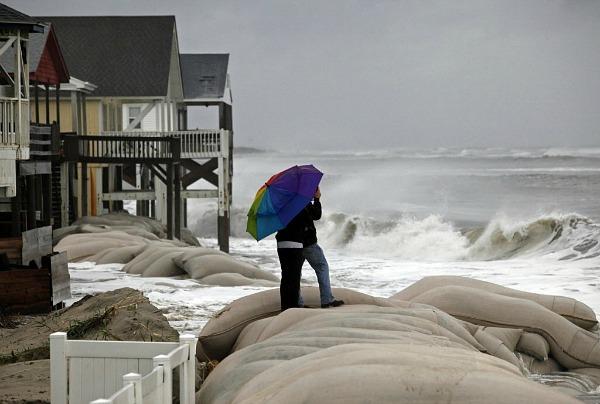
New York, October 29: Hurricane Sandy, a menacing monster of a storm that forecasters said would bring "life-threatening" flooding, churned toward some of the nation's most densely populated areas on Sunday, prompting widespread evacuations and the shutdown of the New York City transit system.
Officials warned that the hurricane, pushing north from the Caribbean after leaving more than 60 people dead in its wake, could disrupt life in the Northeast for days.
New York went into emergency mode, ordering the evacuations of more than 370,000 people in low-lying communities from Coney Island in Brooklyn to Battery Park City in Manhattan and giving 1.1 million schoolchildren a day off on Monday. The city opened evacuation shelters at 76 public schools.
The National Hurricane Center said it expected the storm to swing inland, probably on Monday evening. The hurricane center reported that the storm had sustained winds of almost 75 miles an hour.
"We're going to have a lot of impact, starting with the storm surge," said Craig Fugate, the administrator of the Federal Emergency Management Agency. "Think, 'Big.' "
The subway closing began at 7 p.m. to darken every one of the city's 468 stations for the second time in 14 months, as officials encouraged the public to stay indoors and worked to prevent a storm surge from damaging tracks and signal equipment in the tunnels. A suspension of bus service was ordered for 9 p.m.
The closing this year seemed more ominous. The shutdown before Tropical Storm Irene last year began at noon on a Saturday, and service resumed before the workweek started on Monday. This time, officials warned, it might be Wednesday before trains were running again.
Another fear in the Northeast was that winds from the storm might knock down power lines, and that surging waters could flood utility companies' generators and other equipment.
Forecasters said the hurricane was a strikingly powerful storm that could reach far inland. Hurricane-force winds from the storm stretched 175 miles from the center, an unusually wide span, and tropical storm winds extended outward 520 miles. Forecasters said they expected high-altitude winds to whip every state east of the Mississippi River.
President Obama, who attended a briefing with officials from FEMA in Washington called Hurricane Sandy "a big and serious storm." He said federal officials were "making sure that we've got the best possible response to what is going to be a big and messy system."
"My main message to everybody involved is that we have to take this seriously," the president said.
The hurricane center said through the day on Sunday that Hurricane Sandy was "expected to bring life-threatening storm surge flooding to the mid-Atlantic Coast, including Long Island Sound and New York Harbor."
The storm preparations and cancellations were not confined to New York.
Amtrak said it would cancel most trains on the Eastern Seaboard, and Philadelphia shut down its mass transit system.
In the New York area, the Metropolitan Transportation Authority's commuter rail lines, which suffered the heaviest damage during Tropical Storm Irene, were suspended beginning at 7 p.m. on Sunday.
New Jersey Transit began rolling back service gradually at 4 p.m., with a full shutdown expected by 2 a.m.
The Staten Island Ferry was scheduled to stop running by 8:30 p.m., PATH trains at midnight.
The nation's major airlines canceled thousands of flights in the Northeast. The Port Authority of New York and New Jersey, which operates the three major airports in the New York City area, said it expected major carriers to cease operations entirely by Sunday evening. The Coast Guard closed New York Harbor - cruise ships were told to go elsewhere - and the Northeast faced the possibility of being all but shut down on Monday.
Federal offices in the Washington area will be closed; only emergency employees will be on the job. The Washington transit system - its Metrorail subway and its buses - will also be shut down.
The United Nations canceled all meetings at its headquarters in Manhattan.
Broadway shows were canceled on Sunday and Monday, as were performances at Carnegie Hall.
Schools in Baltimore, Boston and Washington called off classes for Monday.
Many public libraries said their reading rooms would be closed for the day, and parks department workers in Central Park told people to leave on Sunday and to stay away until the storm passed.
The New York Stock Exchange, which initially said its trading floor would be open on Monday, decided to close the floor and handle trading electronically. The closing was the first caused by bad weather since Hurricane Gloria in 1985, although the opening bell has been delayed a number of times - once during a blizzard in January 1996 - and the exchange was closed for three days after the Sept. 11 attacks. The Nasdaq exchange, which has long relied on electronic trading, said it would open as usual on Monday.
The hurricane center said the surges could reach 11 feet in New York Harbor, Long Island Sound and Raritan Bay in New Jersey - significantly higher than previous forecasts and significantly above the levels recorded during the tropical storm last year.
Forecasters said the water could top 8 feet from Ocean City, Md., to the border between Connecticut and Rhode Island. They predicted the waves would rise to 6 feet on the south shore of Cape Cod.
Hour after hour on Sunday, long before high tide, high waves pounded the dunes that protect the boardwalk in Rehoboth Beach, Del.
And in East Hampton, N.Y., where Mabel Harmon and her neighbors had spent the day tying down patio furniture, the wind was already "blowing like crazy," she said Sunday afternoon.
Forecasters also warned that rain could saturate the ground and that trees could tumble across roads or onto power lines.
From North Carolina to Connecticut, officials declared emergencies and directed residents to leave areas near the shore.
Delaware ordered coastal communities evacuated by 8 p.m. Sunday.
In New Jersey, gamblers scrambled to play a few last rounds of blackjack before leaving the Atlantic City casinos under orders from Gov. Chris Christie.
He also ordered residents to leave barrier islands from Sandy Hook to Cape May.
In beachfront towns from North Carolina to New Jersey, the surf was spitting, and crews were rushing to build sand walls in places where the beaches had been rebuilt after 2011, when many places were hit by what was still Hurricane Irene.
In Red Hook, Brooklyn, many residents along the streets closest to New York Harbor were in their basements checking sump pumps.
Gino Vitale, a builder and landlord there, was delivering sandbags piled high in the back of his white Ford pickup truck to tenants along Conover Street, a block from New York Bay.
"We dodged most of it with Irene," he said, referring to the storm that flooded basements in Red Hook but not much else. "I'm hoping we can do that again."
For the most part, residents appeared to follow officials' advice to stock up on bottled water, canned food and flashlights - so much so that stores ran low on batteries. Some gas stations in Connecticut had little gasoline left - no regular, and not much premium.
In a flood-prone neighborhood in Philadelphia, Michael Dornblum did something he did not do during Tropical Storm Irene or earlier storms that brought high water - he put 80-pound sandbags outside his family's furniture store. In the past, he has lined them up only inside. He put the additional protection in place as employees prepared to lift carpets and sofas off the showroom floor. Some went to a storage area on the second floor.
Con Edison did not provide an estimate of how long customers in the New York City area might be without power if the storm played havoc with its network; by contrast, the parent company of Jersey Central Power and Light warned as long ago as Friday that repairs could take 10 days after the storm passed through. Another utility in New Jersey, the Public Service Electric and Gas Company, said that restoring power could take a week.
Forecasters said Hurricane Sandy could deliver something besides wind and rain: snow. That is because a system known as a midlatitude trough - which often causes severe winter storms - was moving across the country from the west. It was expected to draw in Hurricane Sandy, giving it added energy.
A blast of arctic air is expected to sweep down through the Canadian Plains just as the two storms converge. That could lead to several feet of heavy, wet snow in West Virginia and lighter amounts in Pennsylvania and Ohio that could bring down trees and power lines if already chilly temperatures drop below freezing.
The full moon on Monday could cause even greater flooding, because tides will be at their peak.
The possibility of a higher surge was one reason that Mayor Michael R. Bloomberg of New York ordered mandatory evacuations in low-lying areas, just as he did before Tropical Storm Irene. One city official said there was particular concern about Con Edison's Lower Manhattan infrastructure, noting that if the storm surge washed over the bulkheads, it could damage the utility's electrical and steam networks. If the surge runs as high as forecast, Con Ed will shut off two electrical networks in Lower Manhattan,
As for the subway shutdown, Mr. Bloomberg said that if the Metropolitan Transportation Authority had not suspended service, but instead had left itself vulnerable to the storm, the city would have risked being without its mass transit network for even longer.
"They do have to make sure that their equipment doesn't get damaged," Mr. Bloomberg said. "Otherwise we would not have subway trains when this is over or buses when it's over."
Joseph J. Lhota, the chairman of the authority, said he expected the transit systems to restore at least some service about 12 hours after the storm ended. But he warned that the city could be without mass transit for as many as two full work days. "I do think Monday and Tuesday are going to be difficult days," Mr. Lhota said.
But while the mayor said schoolchildren could take Monday off, city workers could not: He said that city offices would be open for business.


Comments
Add new comment