Japan airport reopens with WWII bomb still there

October 31, 2012
sandai_airport

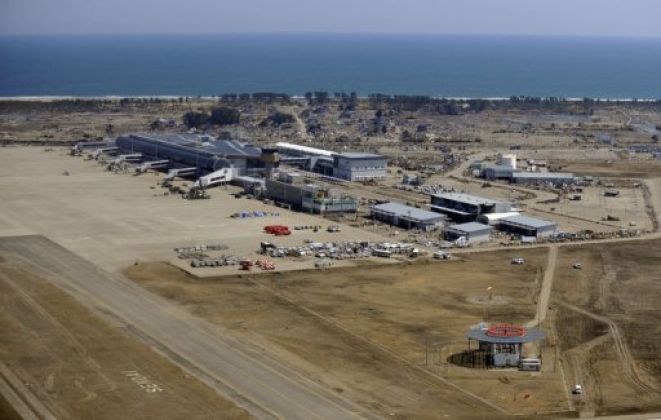
Tokyo, October 31: A huge World War II bomb uncovered near a busy runway was underneath a shield of concrete and sandbags today as flights resumed at an airport in northern Japan, a government official said.

A worker rebuilding drainage systems at Sendai Airport -- which was swamped by last year's tsunami -- on Monday uncovered the 500-pound bomb, believed to have been dropped by US forces.

Bomb disposal experts ordered the construction of three-metre-high concrete walls, supported by soil up to the same height, to protect the bomb.

Crews piled some 300 sandbags, each weighing a tonne, on top of the mound to construct a casing that stands six metres high.

The 110 centimetres long bomb is now sitting at the bottom of the structure, waiting for military experts to defuse and remove it once legal and logistical details are worked out, the transport ministry official said.

"The work to defuse it will start after we discuss the matter with local municipalities and residents," he said.

Troops believe the bomb is unlikely to explode unless unusually strong force is applied, according to local media.

The airport resumed operations, using one of its two runways, after having cancelled all 92 domestic and international flights yesterday.

"We are using our main 3,000-metre runway. So far we are not experiencing any delay to our flight schedule," the land ministry official said around midday.

Nearly 70 years after the war ended, unexploded bombs and shells are still occasionally found in Japan, particularly on the southern island of Okinawa, the site of an extremely bloody battle towards the end of World War II.

Less than two weeks ago, Japanese troops defused a similar 500-pound WWII bomb found in a busy business district of Tokyo.

Sendai Airport was devastated in the quake-triggered tsunami that hit Japan in March 2011. Footage posted on YouTube of waves covering the runway has been seen by more than 20 million people.


Comments

Add new comment

  • Coastaldigest.com reserves the right to delete or block any comments.
  • Coastaldigset.com is not responsible for its readers’ comments.
  • Comments that are abusive, incendiary or irrelevant are strictly prohibited.
  • Please use a genuine email ID and provide your name to avoid reject.
News Network
April 12,2020

Apr 12: India and other South Asian countries are likely to record their worst growth performance in four decades this year due to the coronavirus outbreak, the World Bank said on Sunday.

The South Asian region, comprising eight countries, is likely to show economic growth of 1.8 per cent to 2.8 per cent this year, the World Bank said in its South Asia Economic Focus report, well down from the 6.3 per cent it projected six months ago.

India's economy, the region's biggest, is expected to grow 1.5 per cent to 2.8 per cent in the fiscal year that started on April 1. The World Bank has estimated it will grow 4.8 per cent to 5 per cent in the fiscal year that ended on March 31.

"The green shoots of a rebound that were observable at the end of 2019 have been overtaken by the negative impacts of the global crisis," the World Bank report said.

Other than India, the World Bank forecast that Sri Lanka, Nepal, Bhutan and Bangladesh will also see sharp falls in economic growth.

Three other countries - Pakistan, Afghanistan and the Maldives - are expected to fall into recession, the World Bank said in the report, which was based on country-level data available as of April 7.

Measures taken to counter the coronavirus have disrupted supply chains across South Asia, which has recorded more than 13,000 cases so far - still lower than many parts of the world.

India's lockdown of 1.3 billion people has also left millions out of work, disrupted big and small businesses and forced an exodus of migrant workers from the cities to their homes in villages.

In the event of prolonged and broad national lockdowns, the report warned of a worst-case scenario in which the entire region would experience an economic contraction this year.

To minimize short-term economic pain, the Bank called for countries in the region to announce more fiscal and monetary steps to support unemployed migrant workers, as well as debt relief for businesses and individuals.

India has so far unveiled a $23 billion economic plan to offer direct cash transfers to millions of poor people hit by its lockdown. In neighbouring Pakistan, the government has announced a $6 billion plan to support the economy.

"The priority for all South Asian governments is to contain the virus spread and protect their people, especially the poorest who face considerable worse health and economic outcomes," said senior World Bank official Hartwig Schafer.

Comments

Add new comment

  • Coastaldigest.com reserves the right to delete or block any comments.
  • Coastaldigset.com is not responsible for its readers’ comments.
  • Comments that are abusive, incendiary or irrelevant are strictly prohibited.
  • Please use a genuine email ID and provide your name to avoid reject.
News Network
June 1,2020

New Delhi, Jun 1: Actor Kendrick Sampson, who stars in HBO series Insecure, was struck by rubber bullets as Los Angeles police officers tried to disperse a crowd protesting George Floyd”s death in Minneapolis.

Floyd, a black man, died last Monday in Minneapolis, Minnesota after a white police officer pressed his knee on his neck for more than eight minutes. The officer was arrested on Friday and charged with third-degree murder.

The actor went live via Instagram on Saturday to show his view of events, but he could be also be seen on a CNN broadcast simultaneously, with viewers watching him get hit by a police baton on TV.

Sampson posted several videos on his page of a large demonstration at Pan Pacific Park near the city”s Fairfax District, where violent clashes took place throughout the day outside the Grove shopping center.

In one video, LAPD officers can be seen firing rubber bullets to try and regain control at the park.

“They shot me four times already. I already got hurt and I got hit with a baton,” Sampson said in the video on Instagram.

Another clip showed him moving away from the police, as he appeared to be hit by an officer”s baton.

“Y”all ain”t see no police f*****g up white folks when they took guns to the statehouse,” he said, referring to an incident in Michigan over coronavirus restrictions, not in California. “Y”all didn”t see police attacking white folks, beating em up with batons, shooting them with rubber bullets when they brought guns to f*****g state houses. We came up here with no weapons, with masks.… And we”re the ones who are not peaceful,” Sampson alleged.

Protests turned violent over Floyd”s death and other police killings of black people spread Saturday in dozens of US cities, with police cars set ablaze, reports of injuries mounting on all sides, shops and showrooms vandalised amid the lockdown.

Comments

Add new comment

  • Coastaldigest.com reserves the right to delete or block any comments.
  • Coastaldigset.com is not responsible for its readers’ comments.
  • Comments that are abusive, incendiary or irrelevant are strictly prohibited.
  • Please use a genuine email ID and provide your name to avoid reject.
Agencies
August 7,2020

Russia boasts that it's about to become the first country to approve a Covid-19 vaccine, with mass vaccinations planned as early as October using shots that are yet to complete clinical trials -- and scientists worldwide are sounding the alarm that the headlong rush could backfire.

Moscow sees a Sputnik-like propaganda victory, recalling the Soviet Union's launch of the world's first satellite in 1957.

But the experimental Covid-19 shots began first-in-human testing on a few dozen people less than two months ago, and there's no published scientific evidence yet backing Russia's late entry to the global vaccine race, much less explaining why it should be considered a front-runner.

“I'm worried that Russia is cutting corners so that the vaccine that will come out may be not just ineffective, but also unsafe,” said Lawrence Gostin, a global public health law expert at Georgetown University. “It doesn't work that way... Trials come first. That's really important.”

According to Kirill Dmitriev, head of Russia's Direct Investment Fund that bankrolled the effort, a vaccine developed by the Gamaleya research institute in Moscow may be approved in days, before scientists complete what's called a Phase 3 study.

That final-stage study, usually involving tens of thousands of people, is the only way to prove if an experimental vaccine is safe and really works.

Health Minister Mikhail Murashko said members of “risk groups,” such as medical workers, may be offered the vaccine this month.

He didn't clarify whether they would be part of the Phase 3 study that is said to be completed after the vaccine receives “conditional approval.”

Deputy Prime Minister Tatyana Golikova promised to start “industrial production” in September, and Murashko said mass vaccination may begin as early as October.

Dr Anthony Fauci, the top US infectious disease specialist, questioned the fast-track approach last week.

“I do hope that the Chinese and the Russians are actually testing a vaccine before they are administering the vaccine to anyone, because claims of having a vaccine ready to distribute before you do testing I think is problematic at best," he said.

Questions about this vaccine candidate come after the US, Britain and Canada last month accused Russia of using hackers to steal vaccine research from Western labs.

Delivering a vaccine first is a matter of national prestige for the Kremlin as it tries to assert the image of Russia as a global power capable of competing with the US and China.

The notion of being “the first in the world” dominated state news coverage of the effort, with government officials praising reports of the first-step testing.

In April, President Vladimir Putin ordered state officials to shorten the time of clinical trials for a variety of drugs, including potential coronavirus vaccines.

According to Russia's Association of Clinical Trials Organizations, the order set “an unattainable bar” for scientists who, as a result, "joined in on the mad race, hoping to please those at power.”

The association first raised concern in late May, when professor Alexander Gintsburg, head of the Gamaleya institute, said he and other researchers tried the vaccine on themselves.

The move was a “crude violation of the very foundations of clinical research, Russian law and universally accepted international regulations" the group said in an open letter to the government, urging scientists and health officials to adhere to clinical research standards.

But a month later, the Health Ministry authorized clinical trials of the Gamaleya product, with what appeared to be another ethical issue.

Human studies started June 17 among 76 volunteers. Half were injected with a vaccine in liquid form and the other half with a vaccine that came as soluble powder.

Some in the first half were recruited from the military, which raised concerns that servicemen may have been pressured to participate.

Some experts said their desire to perform well would affect the findings. “It's no coincidence media reports we see about the trials among the military said no one had any side effects, while the (other group) reported some," said Vasily Vlassov, a public health expert with Moscow's Higher School of Economics.

As the trials were declared completed and looming regulatory approval was announced last week, questions arose about the vaccine's safety and effectiveness.

Government assurances the drug produced the desired immune response and caused no significant side effects were hardly convincing without published scientific data describing the findings.

The World Health Organization said all vaccine candidates should go through full stages of testing before being rolled out.

“There are established practices and there are guidelines out,” WHO spokesman Christian Lindmeier said Tuesday.

“Between finding or having a clue of maybe having a vaccine that works, and having gone through all the stages, is a big difference.”

Offering an unsafe compound to medical workers on the front lines of the outbreak could make things worse, Georgetown's Gostin said, adding: “What if the vaccine started killing them or making them very ill?”

Vaccines that are not properly tested can cause harm in many ways — from a negative impact on health to creating a false sense of security or undermining trust in vaccinations, said Thomas Bollyky, director of the global health program at the Council on Foreign Relations. 

Comments

Add new comment

  • Coastaldigest.com reserves the right to delete or block any comments.
  • Coastaldigset.com is not responsible for its readers’ comments.
  • Comments that are abusive, incendiary or irrelevant are strictly prohibited.
  • Please use a genuine email ID and provide your name to avoid reject.