Japan airport reopens with WWII bomb still there

October 31, 2012
sandai_airport

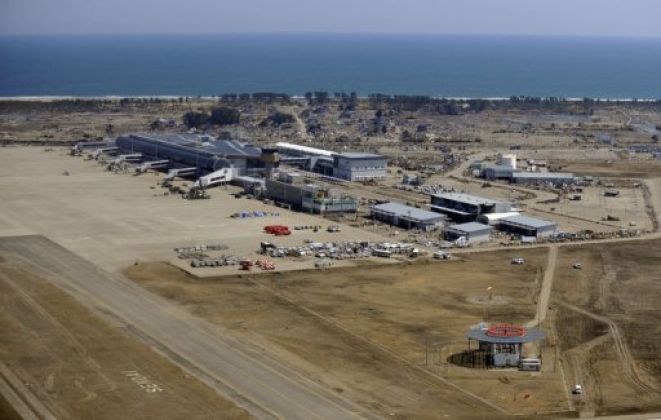
Tokyo, October 31: A huge World War II bomb uncovered near a busy runway was underneath a shield of concrete and sandbags today as flights resumed at an airport in northern Japan, a government official said.

A worker rebuilding drainage systems at Sendai Airport -- which was swamped by last year's tsunami -- on Monday uncovered the 500-pound bomb, believed to have been dropped by US forces.

Bomb disposal experts ordered the construction of three-metre-high concrete walls, supported by soil up to the same height, to protect the bomb.

Crews piled some 300 sandbags, each weighing a tonne, on top of the mound to construct a casing that stands six metres high.

The 110 centimetres long bomb is now sitting at the bottom of the structure, waiting for military experts to defuse and remove it once legal and logistical details are worked out, the transport ministry official said.

"The work to defuse it will start after we discuss the matter with local municipalities and residents," he said.

Troops believe the bomb is unlikely to explode unless unusually strong force is applied, according to local media.

The airport resumed operations, using one of its two runways, after having cancelled all 92 domestic and international flights yesterday.

"We are using our main 3,000-metre runway. So far we are not experiencing any delay to our flight schedule," the land ministry official said around midday.

Nearly 70 years after the war ended, unexploded bombs and shells are still occasionally found in Japan, particularly on the southern island of Okinawa, the site of an extremely bloody battle towards the end of World War II.

Less than two weeks ago, Japanese troops defused a similar 500-pound WWII bomb found in a busy business district of Tokyo.

Sendai Airport was devastated in the quake-triggered tsunami that hit Japan in March 2011. Footage posted on YouTube of waves covering the runway has been seen by more than 20 million people.


Comments

Add new comment

  • Coastaldigest.com reserves the right to delete or block any comments.
  • Coastaldigset.com is not responsible for its readers’ comments.
  • Comments that are abusive, incendiary or irrelevant are strictly prohibited.
  • Please use a genuine email ID and provide your name to avoid reject.
News Network
June 2,2020

London/Milan, Jun 2: World Health Organization experts and a range of other scientists said on Monday there was no evidence to support an assertion by a high profile Italian doctor that the coronavirus causing the COVID-19 pandemic has been losing potency.

Professor Alberto Zangrillo, head of intensive care at Italy's San Raffaele Hospital in Lombardy, which bore the brunt of Italy's COVID-19 epidemic, on Sunday told state television that the new coronavirus "clinically no longer exists".

But WHO epidemiologist Maria Van Kerkhove, as well as several other experts on viruses and infectious diseases, said Zangrillo's comments were not supported by scientific evidence.

There is no data to show the new coronavirus is changing significantly, either in its form of transmission or in the severity of the disease it causes, they said.

"In terms of transmissibility, that has not changed, in terms of severity, that has not changed," Van Kerkhove told reporters.

It is not unusual for viruses to mutate and adapt as they spread, and the debate on Monday highlights how scientists are monitoring and tracking the new virus. The COVID-19 pandemic has so far killed more than 370,000 people and infected more than 6 million.

Martin Hibberd, a professor of emerging infectious disease at the London School of Hygiene & Tropical Medicine, said major studies looking at genetic changes in the SARS-CoV-2 virus that causes COVID-19 did not support the idea that it was becoming less potent, or weakening in any way.

"With data from more than 35,000 whole virus genomes, there is currently no evidence that there is any significant difference relating to severity," he said in an emailed comment.

Zangrillo, well known in Italy as the personal doctor of former Prime Minister Silvio Berlusconi, said his comments were backed up by a study conducted by a fellow scientist, Massimo Clementi, which Zangrillo said would be published next week.

Zangrillo told Reuters: "We have never said that the virus has changed, we said that the interaction between the virus and the host has definitely changed."

He said this could be due either to different characteristics of the virus, which he said they had not yet identified, or different characteristics in those infected.

The study by Clementi, who is director of the microbiology and virology laboratory of San Raffaele, compared virus samples from COVID-19 patients at the Milan-based hospital in March with samples from patients with the disease in May.

"The result was unambiguous: an extremely significant difference between the viral load of patients admitted in March compared to" those admitted last month, Zangrillo said.

Oscar MacLean, an expert at the University of Glasgow's Centre for Virus Research, said suggestions that the virus was weakening were "not supported by anything in the scientific literature and also seem fairly implausible on genetic grounds."

Comments

Add new comment

  • Coastaldigest.com reserves the right to delete or block any comments.
  • Coastaldigset.com is not responsible for its readers’ comments.
  • Comments that are abusive, incendiary or irrelevant are strictly prohibited.
  • Please use a genuine email ID and provide your name to avoid reject.
News Network
January 3,2020

Islamabad, Jan 3: The United Arab Emirates has extended USD 200 million aid to Pakistan for the development of the small and medium-sized enterprises in the country, Finance Adviser to Prime Minister Imran Khan said.

The announcement came after Abu Dhabi Crown Prince Sheikh Mohamed Bin Zayed Al Nahyan concluded his one-day visit to the country on Thursday.

"The money will be spent on small business promotion and jobs. This support is testimony to the expanding economic relations and friendship between our countries," the adviser, Abdul Hafeez Shaikh, on Thursday said.

The Crown Prince directed the Khalifa Fund for Enterprise Development to allocate USD 200 million in order to assist the Pakistani government's efforts to create a stable and balanced national economy that will help achieve the country's sustainable development, Dawn News reported on Friday.

During the visit, the prince met Prime Minister Khan and held talks on bilateral, regional and international issues.

The UAE is Pakistan's largest trading partner in the Middle East and a major source of investments. The UAE is also among Pakistan's prime development partners in education, health and energy sectors.

It hosts more than 1.6 million expatriate Pakistani community, which contributes remittances of around USD 4.5 billion annually to the GDP.

This is the Crown Prince's second visit to Pakistan since Khan took office in August 2018. He had last visited Pakistan on January 6 last year, just weeks after his country offered USD 3 billion financial assistance to Pakistan to deal with its balance of payment crisis.

The Crown Prince's visit was considered by experts as an attempt to woo Pakistan against the backdrop of recent developments when Saudi Arabia and UAE apparently used pressure to stop Pakistan from attending the Kuala Lumpur summit held last month.

The summit from December 19-21 was seen by Saudis as an attempt to create a new bloc in the Muslim world that could become an alternative to the dysfunctional Organisation of Islamic Cooperation led by the Gulf Kingdom.

Comments

Add new comment

  • Coastaldigest.com reserves the right to delete or block any comments.
  • Coastaldigset.com is not responsible for its readers’ comments.
  • Comments that are abusive, incendiary or irrelevant are strictly prohibited.
  • Please use a genuine email ID and provide your name to avoid reject.
News Network
June 20,2020

Sao Paulo, June 20: Brazil’s government confirmed on Friday that the country has risen above 1 million confirmed coronavirus cases, second only to the United States.

The country’s health ministry said that the total now stood at 10,32,913, up more than 50,000 from Thursday. The ministry said the sharp increase was due to corrections of previous days’ underreported numbers.

Brazilian President Jair Bolsonaro still downplays the risks of the virus after nearly 50,000 deaths from COVID-19 in three months, saying the impact of social isolation measures on the economy could be worse than the disease itself.

Specialists believe the actual number of cases in Brazil could be up to seven times higher than the official statistic. Johns Hopkins University says Brazil is performing an average of 14 tests per 1,00,000 people each day, and health experts say that number is up to 20 times less than needed to track the virus.

Official data show a downward trend of the virus in Brazil’s north, including the hard-hit region of the Amazon, a plateau in cases and deaths in the countries’ biggest cities near the Atlantic coast, but a rising curve in the south.

In the Brazilian countryside, which is much less prepared to handle a crisis, the pandemic is clearly growing. Many smaller cities have weaker health care systems and basic sanitation that’s insufficient to prevent contagion.

“There is a lot of regional inequality in our public health system and a shortage of professionals in the interior,” said Miguel Lago, executive director of Brazil’s Institute for Health Policy Studies, which advises public health officials.

That creates many health care deserts, with people going long distances to get attention. When they leave the hospital, the virus can go with them.

The cattle-producing state of Mato Grosso was barely touched by the virus when it hit the nation’s biggest cities in March. Sitting far from the coast, between the Bolivian border and Brazil’s capital of Brasilia, its 33 lakh residents led a mostly normal life until May. But now its people live under lockdown and meat producers have dozens of infected workers.

In Tangará da Serra, a city of 1,03,000 people in Mato Grosso, the mayor decided Friday to forbid the sale of alcoholic drinks for two weeks as an incentive for people to stay home.

Fᢩo Junqueira said the measure was needed after a spike in COVID-19 cases that filled 80% of the city’s 54 intensive care beds. The city has had nearly 300 cases of the disease, plus three fatalities.

In Rondonópolis, only 300 miles away from Tangará da Serra and home to a thriving economy, health authorities closed the local meatpacking industry after 92 cases were confirmed there. The city of 1,44,000 inhabitants counted 21 deaths from the virus and more than 600 cases. The mayor has also decided to limit sales of alcoholic beverages.

Even regions once considered examples of successful efforts against the virus are now struggling.

Porto Alegre, home to about 14 lakh people, had success in slowing the virus’ spread over the last three months. But now its mayor is considering increasing social isolation measures after ICU occupancy in the city jumped to 80% this month.

We were already making projections for schools to come back, Mayor Nelson Marchezan Jr. told The Associated Press. Now the trend is to impose more restrictions. Outside Sao Paulo city, five regions of the state’s countryside will have to close shops starting Monday due to a rise in coronavirus cases. Governor João Doria announced the decision Friday.

Dr. Mike Ryan, the World Health Organization’s executive director, said at a news conference that Brazil needs to increase its efforts to stop the spread of infections.

“The epidemic is still quite severe in Brazil. I believe health workers are working extremely hard and under pressure to be able to deal with the number of cases that they see on a daily basis,” Dr. Ryan said.

“Certainly the rise is not as exponential as it was previously, so there are some signs that the situation is stabilising. But we’ve seen this before in other epidemics in other countries.”

Margareth Dalcolmo, a clinical researcher and professor of respiratory medicine at the state-funded Oswaldo Cruz Foundation in Rio de Janeiro, believes the reopening in major cities and the virus traveling by road into Brazil’s heartland will keep the pressure on the country’s health system.

“The risk in the interior now is very big,” she said. “Our health system just can’t solve the most serious cases of COVID in many places of the countryside.”


Comments

Add new comment

  • Coastaldigest.com reserves the right to delete or block any comments.
  • Coastaldigset.com is not responsible for its readers’ comments.
  • Comments that are abusive, incendiary or irrelevant are strictly prohibited.
  • Please use a genuine email ID and provide your name to avoid reject.