


Japan airport reopens with WWII bomb still there

October 31, 2012
sandai_airport

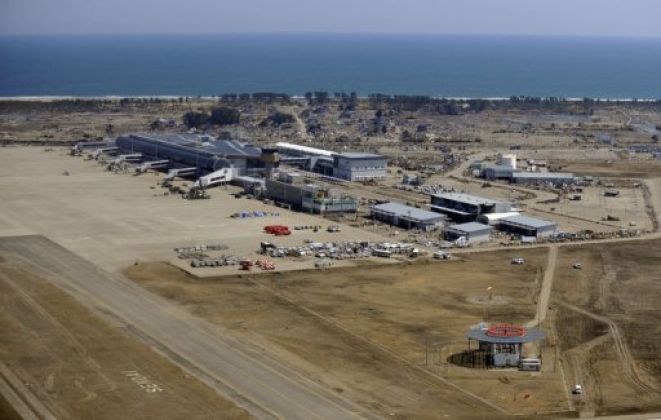
Tokyo, October 31: A huge World War II bomb uncovered near a busy runway was underneath a shield of concrete and sandbags today as flights resumed at an airport in northern Japan, a government official said.

A worker rebuilding drainage systems at Sendai Airport -- which was swamped by last year's tsunami -- on Monday uncovered the 500-pound bomb, believed to have been dropped by US forces.

Bomb disposal experts ordered the construction of three-metre-high concrete walls, supported by soil up to the same height, to protect the bomb.

Crews piled some 300 sandbags, each weighing a tonne, on top of the mound to construct a casing that stands six metres high.

The 110 centimetres long bomb is now sitting at the bottom of the structure, waiting for military experts to defuse and remove it once legal and logistical details are worked out, the transport ministry official said.

"The work to defuse it will start after we discuss the matter with local municipalities and residents," he said.

Troops believe the bomb is unlikely to explode unless unusually strong force is applied, according to local media.

The airport resumed operations, using one of its two runways, after having cancelled all 92 domestic and international flights yesterday.

"We are using our main 3,000-metre runway. So far we are not experiencing any delay to our flight schedule," the land ministry official said around midday.

Nearly 70 years after the war ended, unexploded bombs and shells are still occasionally found in Japan, particularly on the southern island of Okinawa, the site of an extremely bloody battle towards the end of World War II.

Less than two weeks ago, Japanese troops defused a similar 500-pound WWII bomb found in a busy business district of Tokyo.

Sendai Airport was devastated in the quake-triggered tsunami that hit Japan in March 2011. Footage posted on YouTube of waves covering the runway has been seen by more than 20 million people.


Comments

Add new comment

  • Coastaldigest.com reserves the right to delete or block any comments.
  • Coastaldigset.com is not responsible for its readers’ comments.
  • Comments that are abusive, incendiary or irrelevant are strictly prohibited.
  • Please use a genuine email ID and provide your name to avoid reject.
News Network
January 23,2020

Jan 23: Hundreds of Central Americans trying to reach the United States were stuck at the Mexico-Guatemala border on Wednesday after the Mexican government beefed up security to meet US demands to contain migrant flows.

Under sustained pressure from President Donald Trump, Mexico's government has adopted tougher measures to reduce the number of people heading towards the U.S. border.

Migrants in Tecun Uman, on the Guatemalan side of the border, were taken by surprise.

"We thought we'd be allowed through just like with the October caravan when they reached Tijuana," said Honduran migrant Ritzy Anabel, who did not give her surname.

"People from Mexico and Guatemala treated them well. But now it's changed because Mexicans don't want (us) to enter."

Many Central Americans migrants heading north are fleeing economic hardship and violence at home. A large caravan of migrants crossed into Mexico and went north in October 2018. Migrants crossing into Mexico earlier this week faced tear gas from security forces, who delivered a firmer response than in previous mass movements at the border.

Even so, about 1,000 migrants, most of them from Honduras, managed to reach Mexican soil on Tuesday. Mexican Foreign Minister Marcelo Ebrard said several hundred of the new arrivals were immediately deported on planes and buses.

On Wednesday, Mexican authorities said that 460 Honduran migrants were deported throughout the day. Other migrants from the group, including families traveling with children, were pondering their next moves.

Honduran Carlos Amador said that while some of his compatriots were returning home, others were hoping for positive news.

Trump has repeatedly threatened to punish Mexico and Central American countries if they fail to clamp down on the migrant flows. That has resulted in a series of agreements aimed at delivering on Trump's campaign promises to curb immigration.

Department of Homeland Security Acting Secretary Chad Wolf called the measures put in place by the Mexican National Guard "effective", adding that dozens of his personnel was on the ground in Central America assisting local immigration and security officials. Trump tweeted: "Sorry, if you come you will be immediately sent back!"

Comments

Add new comment

  • Coastaldigest.com reserves the right to delete or block any comments.
  • Coastaldigset.com is not responsible for its readers’ comments.
  • Comments that are abusive, incendiary or irrelevant are strictly prohibited.
  • Please use a genuine email ID and provide your name to avoid reject.
News Network
June 17,2020

Beijing, Jun 17: Beijing's airports cancelled more than 1,200 flights and schools in the Chinese capital were closed again on Wednesday as authorities rushed to contain a new coronavirus outbreak linked to a wholesale food market.

The city reported 31 new cases on Wednesday while officials urged residents not to leave Beijing, with fears growing about a second wave of infections in China, which had largely brought its outbreak under control.

Tens of thousands of people linked to the new Beijing virus cluster -- believed to have started in the sprawling Xinfadi wholesale food market -- are being tested, with almost 30 residential compounds in the city now under lockdown.

At least 1,255 scheduled flights were cancelled Wednesday morning, state-run People's Daily reported, nearly 70 percent of all trips to and from Beijing's main airports.

The outbreak had already forced authorities to announce a travel ban for residents of "medium- or high-risk" areas of the city, while requiring other residents to take nucleic acid tests in order to leave Beijing.

Meanwhile, several provinces were quarantining travellers from Beijing, where all schools -- which had mostly reopened -- have been ordered to close again and return to online classes.

"The epidemic situation in the capital is extremely severe," Beijing city spokesman Xu Hejian warned Tuesday.

Mass testing under way

Officials have closed 11 markets and disinfected thousands of food and beverage businesses in Beijing after the outbreak was detected.

The city has now reported 137 infections over the last six days, with six new asymptomatic cases and three suspected cases on Wednesday, according to the municipal health commission.

An additional two domestic cases, one in neighbouring Hebei province and another in Zhejiang, were reported by national authorities on Wednesday, while there were 11 imported cases.

Authorities have so far banned group sports, ordered people to wear masks in crowded enclosed spaces, and suspended inter-provincial group tours in response to the outbreak.

Officials said that since May 30, more than 200,000 people had visited Xinfadi market, which supplies more than 70 percent of Beijing's fruit and vegetables.

More than 8,000 workers there were tested and quarantined.

Until the new outbreak, most of China's recent cases were nationals returning from abroad as COVID-19 spread globally, and the government had all but declared victory against the disease.

China's Center for Disease Control and Prevention said Monday that the virus type found in the Beijing outbreak was a "major epidemic strain" in Europe.

Comments

Add new comment

  • Coastaldigest.com reserves the right to delete or block any comments.
  • Coastaldigset.com is not responsible for its readers’ comments.
  • Comments that are abusive, incendiary or irrelevant are strictly prohibited.
  • Please use a genuine email ID and provide your name to avoid reject.
Agencies
July 28,2020

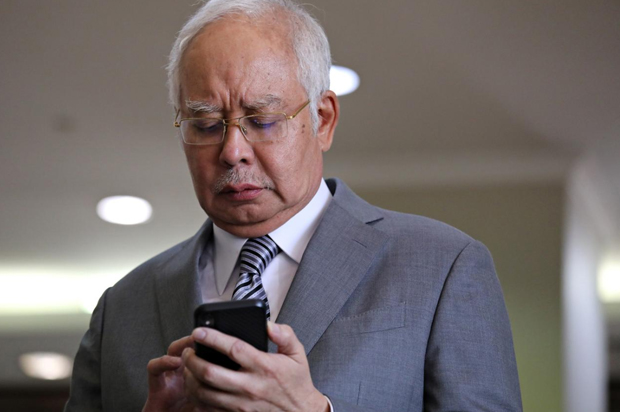
Kuala Lumpur, Jul 28: Malaysia's ex-leader Najib Razak was found guilty Tuesday in his first trial over the multi-billion-dollar 1MDB scandal, two years after the fraud contributed to the downfall of his long-ruling government.

The former prime minister could now face decades in jail after being convicted on all charges in the case related to the looting of sovereign wealth fund 1Malaysia Development Berhad.

Billions of dollars were stolen from the investment vehicle and spent on everything from high-end real estate to pricey art, while investment bank Goldman Sachs also became embroiled in the scandal.

Anger at the looting played a large part in the shock loss of Najib's long-ruling coalition in elections in 2018, and he was arrested and hit with dozens of charges following his defeat.

The verdict was a test of Malaysia's rule of law. It comes about five months after Najib's scandal-plagued party returned to power as part of a coalition, development observers had feared could affect the outcome of the case.

About 16 months after it began, the Kuala Lumpur High Court delivered the verdict in Najib's first trial, which centred on the transfer of 42 million ringgit ($9.9 million) from a former 1MDB unit, SRC International, into his accounts.

Najib had vehemently denied wrongdoing.

But Judge Mohamad Nazlan Mohamad Ghazali took apart all the arguments put forward by his defence, and found him guilty on the seven charges he faced.

"In conclusion, after considering all the evidence in this trial, I find the prosecution has successfully proven the case," the judge told the court.

The charges were one of abuse of power, three of criminal breach of trust and three of money-laundering.

The counts of abuse of power and criminal breach of trust are punishable by up to 20 years in jail each, while the money-laundering charges are punishable by up to 15 years each.

Sentencing was not handed down straight away. The 67-year-old will likely appeal and he may not be sent to jail immediately. If his conviction is upheld, he will also be barred from political office for several years.

Najib had insisted he was ignorant of the transactions.

The defence team portrayed Najib as a victim and instead sought to paint financier Low Taek Jho, a key figure in the scandal who has been charged in the US and Malaysia, as the mastermind.

Low, whose whereabouts are unknown, maintains his innocence.

Prosecutors insisted Najib was in control of the 1MDB unit, SRC International.

The return of Najib's party to power as part of a coalition in March followed the collapse of Mahathir Mohamad's reformist administration.

Since then, 1MDB-linked charges were unexpectedly dropped against the ex-leader's stepson Riza Aziz, a producer of Hollywood movie "The Wolf of Wall Street", in exchange for him agreeing to return assets to Malaysia.

Prosecutors also dropped dozens of charges against Najib ally Musa Aman, the former leader of Sabah state.

The amounts involved in Najib's first case are small compared to those in his second and most significant trial, which centres on allegations he illicitly obtained more than $500 million.

Malaysia had charged Goldman Sachs and some current and former staff, claiming large amounts were stolen when the bank arranged bond issues for 1MDB.

But the two sides agreed to a $3.9 billion settlement last week in exchange for charges being dropped.

Comments

Add new comment

  • Coastaldigest.com reserves the right to delete or block any comments.
  • Coastaldigset.com is not responsible for its readers’ comments.
  • Comments that are abusive, incendiary or irrelevant are strictly prohibited.
  • Please use a genuine email ID and provide your name to avoid reject.