Japan airport reopens with WWII bomb still there

October 31, 2012
sandai_airport

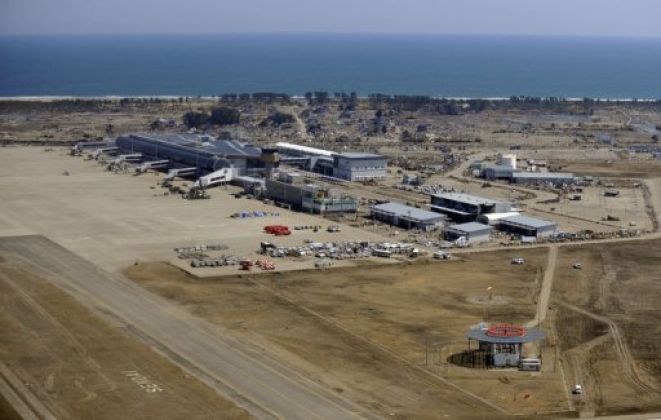
Tokyo, October 31: A huge World War II bomb uncovered near a busy runway was underneath a shield of concrete and sandbags today as flights resumed at an airport in northern Japan, a government official said.

A worker rebuilding drainage systems at Sendai Airport -- which was swamped by last year's tsunami -- on Monday uncovered the 500-pound bomb, believed to have been dropped by US forces.

Bomb disposal experts ordered the construction of three-metre-high concrete walls, supported by soil up to the same height, to protect the bomb.

Crews piled some 300 sandbags, each weighing a tonne, on top of the mound to construct a casing that stands six metres high.

The 110 centimetres long bomb is now sitting at the bottom of the structure, waiting for military experts to defuse and remove it once legal and logistical details are worked out, the transport ministry official said.

"The work to defuse it will start after we discuss the matter with local municipalities and residents," he said.

Troops believe the bomb is unlikely to explode unless unusually strong force is applied, according to local media.

The airport resumed operations, using one of its two runways, after having cancelled all 92 domestic and international flights yesterday.

"We are using our main 3,000-metre runway. So far we are not experiencing any delay to our flight schedule," the land ministry official said around midday.

Nearly 70 years after the war ended, unexploded bombs and shells are still occasionally found in Japan, particularly on the southern island of Okinawa, the site of an extremely bloody battle towards the end of World War II.

Less than two weeks ago, Japanese troops defused a similar 500-pound WWII bomb found in a busy business district of Tokyo.

Sendai Airport was devastated in the quake-triggered tsunami that hit Japan in March 2011. Footage posted on YouTube of waves covering the runway has been seen by more than 20 million people.


Comments

Add new comment

  • Coastaldigest.com reserves the right to delete or block any comments.
  • Coastaldigset.com is not responsible for its readers’ comments.
  • Comments that are abusive, incendiary or irrelevant are strictly prohibited.
  • Please use a genuine email ID and provide your name to avoid reject.
News Network
June 16,2020

Seoul, Jun 16: North Korea blew up an inter-Korean liaison office on its side of the border on Tuesday, the South's Unification Ministry said, after days of increasingly virulent rhetoric from Pyongyang.

"North Korea blows up Kaesong Liaison Office at 14:49," the ministry, which handles inter-Korean relations, said in a one-line alert sent to reporters.

The statement came minutes after an explosion was heard and smoke seen rising from the long-shuttered joint industrial zone in Kaesong where the liaison office was located, Yonhap news agency reported citing unspecified sources.

Its destruction came after Kim Yo Jong, the powerful sister of North Korean leader Kim Jong Un, said at the weekend: "Before long, a tragic scene of the useless north-south joint liaison office completely collapsed would be seen."

Since early June, North Korea has issued a series of vitriolic condemnations of the South over activists sending anti-Pyongyang leaflets over the border -- something defectors do on a regular basis.

Last week it announced it was severing all official communication links with South Korea.

The leaflets -- usually attached to hot air balloons or floated in bottles -- criticise North Korean leader Kim Jong Un for human rights abuses and his nuclear ambitions.

Analysts say Pyongyang may be seeking to manufacture a crisis to increase pressure on Seoul while nuclear negotiations with Washington are at a standstill.

Earlier Tuesday, North Korea's army said it was "fully ready" to take action against the South, included re-entering areas that had been demilitarised under an inter-Korean agreement.

"North Korea is frustrated that the South has failed to offer an alternative plan to revive the US-North talks, let alone create a right atmosphere for the revival," said Cheong Seong-chang, a director of the Sejong Institute's Center for North Korean Studies.

"It has concluded the South has failed as a mediator in the process."

Comments

Add new comment

  • Coastaldigest.com reserves the right to delete or block any comments.
  • Coastaldigset.com is not responsible for its readers’ comments.
  • Comments that are abusive, incendiary or irrelevant are strictly prohibited.
  • Please use a genuine email ID and provide your name to avoid reject.
News Network
May 19,2020

May 19: A Chinese laboratory has been developing a drug it believes has the power to bring the coronavirus pandemic to a halt.

The outbreak first emerged in China late last year before spreading across the world, prompting an international race to find treatments and vaccines.

A drug being tested by scientists at China's prestigious Peking University could not only shorten the recovery time for those infected, but even offer short-term immunity from the virus, researchers say.

Sunney Xie, director of the university's Beijing Advanced Innovation Center for Genomics, told AFP that the drug has been successful at the animal testing stage.

"When we injected neutralising antibodies into infected mice, after five days the viral load was reduced by a factor of 2,500," said Xie.

"That means this potential drug has (a) therapeutic effect."

The drug uses neutralising antibodies -- produced by the human immune system to prevent the virus infecting cells -- which Xie's team isolated from the blood of 60 recovered patients.

A study on the team's research, published Sunday in the scientific journal Cell, suggests that using the antibodies provides a potential "cure" for the disease and shortens recovery time.

Xie said his team had been working "day and night" searching for the antibody.

"Our expertise is single-cell genomics rather than immunology or virology. When we realised that the single-cell genomic approach can effectively find the neutralising antibody we were thrilled."

He added that the drug should be ready for use later this year and in time for any potential winter outbreak of the virus, which has infected 4.8 million people around the world and killed more than 315,000.

"Planning for the clinical trial is underway," said Xie, adding it will be carried out in Australia and other countries since cases have dwindled in China, offering fewer human guinea pigs for testing.

"The hope is these neutralised antibodies can become a specialised drug that would stop the pandemic," he said.

China already has five potential coronavirus vaccines at the human trial stage, a health official said last week.

But the World Health Organization has warned that developing a vaccine could take 12 to 18 months.

Scientists have also pointed to the potential benefits of plasma -- a blood fluid -- from recovered individuals who have developed antibodies to the virus enabling the body's defences to attack it.

More than 700 patients have received plasma therapy in China, a process which authorities said showed "very good therapeutic effects".

"However, it (plasma) is limited in supply," Xie said, noting that the 14 neutralising antibodies used in their drug could be put into mass production quickly.

Using antibodies in drug treatments is not a new approach, and it has been successful in treating several other viruses such as HIV, Ebola and Middle East Respiratory Syndrome (MERS).

Xie said his researchers had "an early start" since the outbreak started in China before spreading to other countries.

Ebola drug Remdesivir was considered a hopeful early treatment for COVID-19 -- clinical trials in the US showed it shortened the recovery time in some patients by a third -- but the difference in mortality rate was not significant.

The new drug could even offer short-term protection against the virus.

The study showed that if the neutralising antibody was injected before the mice were infected with the virus, the mice stayed free of infection and no virus was detected.

This may offer temporary protection for medical workers for a few weeks, which Xie said they are hoping to "extend to a few months".

More than 100 vaccines for COVID-19 are in the works globally, but as the process of vaccine development is more demanding, Xie is hoping that the new drug could be a faster and more efficient way to stop the global march of the coronavirus.

"We would be able to stop the pandemic with an effective drug, even without a vaccine," he said.

Comments

Add new comment

  • Coastaldigest.com reserves the right to delete or block any comments.
  • Coastaldigset.com is not responsible for its readers’ comments.
  • Comments that are abusive, incendiary or irrelevant are strictly prohibited.
  • Please use a genuine email ID and provide your name to avoid reject.
Agencies
August 4,2020

Washington, Aug 4: US President Donald Trump gave popular Chinese-owned video app TikTok six weeks to sell its US operations to an American company, saying Monday it would be "out of business" otherwise, and that the government wanted a financial benefit from the deal.

"It's got to be an American company... it's got to be owned here," Trump said. "We don't want to have any problem with security."

Trump said that Microsoft was in talks to buy TikTok, which has as many as one billion worldwide users who make quirky 60-second videos with its smartphone app.

But US officials say the app constitutes a national security risk because it could share millions of Americans' personal data with Chinese intelligence.

Trump gave the company's Chinese parent ByteDance until mid-September to strike a deal.

"I set a date of around September 15, at which point it's going to be out of business in the United States," he said.

Whatever the price is, he said, "the United States should get a very large percentage of that price because we're making it possible."

Trump compared the demand for a piece of the pie to a landlord demanding under-the-table "key money" from a new tenant, a practice widely illegal including in New York, where the billionaire president built his real estate empire.

"TikTok is a big success, but a big portion of it is in the country," he said. "I think it's very fair."

But Trump also threw a surprise new condition in any deal, saying the sale of TikTok's US business would have to result in a significant payout to the US Treasury for initiating it.

"A very substantial portion of that price is going to have to come into the Treasury of the United States, because we're making it possible for this deal to happen," Trump told reporters.

"They don't have any rights unless we give it to them," he said.

Sell or shut down

The pressure for a sale of TikTok's US and international business, based in Los Angeles, left the company and ByteDance facing tough decisions.

Trump has made TikTok the latest front in the ongoing political and trade battles between Washington and Beijing.

The app has been under formal investigation on US national security grounds because it collects large amounts of personal data on all its users and is legally bound to share that with authorities in Beijing if they demand it.

Both its huge user base and its algorithm for collecting data make it hugely valuable.

But being forced by the US government to sell at least its US business or be shut down -- and to then split the sale price with the US Treasury as Trump is demanding -- was an almost unheard-of tactic.

Shutting down could force users to switch to competitors, and many content creators are already encouraging followers to follow them on other social media platforms.

"The most obvious beneficiaries are Snapchat, Facebook and Twitter, with Snapchat likely being the biggest beneficiary," said investment analysts at Lightshed Partners.

Earlier Monday, ByteDance founder Zhang Yiming acknowledged the hefty pressure and said in a letter to staff, reported by Chinese media, that they were working around-the-clock "for the best outcome."

"We have always been committed to ensuring user data security, as well as the platform neutrality and transparency," Zhang said.

However, he said, the company faces "mounting complexities across the geopolitical landscape and significant external pressure."

He said the company must confront the challenge from the United States, though "without giving up exploring any possibilities."

According to Britain's The Sun newspaper Monday, as a possible consequence of the pressure, ByteDance is planning to relocate TikTok's global operations to Britain.

Pushing back

China's foreign ministry pushed back Monday, calling Washington hypocritical for demanding TikTok be sold.

"The US is using an abused concept of national security and, without providing any evidence, is making presumptions of guilt and issuing threats to relevant companies," said spokesman Wang Wenbin.

"This goes against the principle of market economy and exposes the hypocrisy and typical double standards of the US in upholding so-called fairness and freedom," he added.

stm88 info live rtp slot

slot auto scatter hitam

Comments

Add new comment

  • Coastaldigest.com reserves the right to delete or block any comments.
  • Coastaldigset.com is not responsible for its readers’ comments.
  • Comments that are abusive, incendiary or irrelevant are strictly prohibited.
  • Please use a genuine email ID and provide your name to avoid reject.