


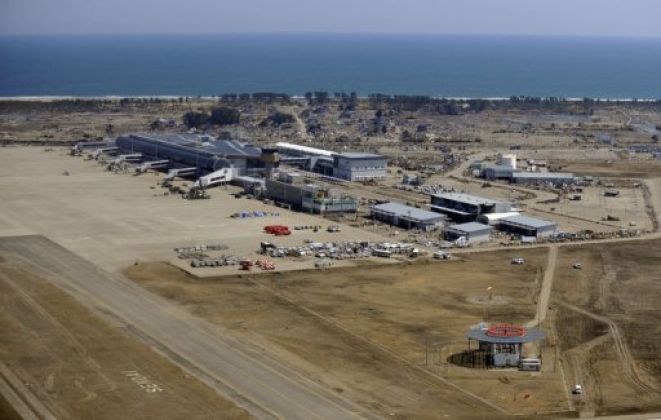
Japan airport reopens with WWII bomb still there

October 31, 2012
sandai_airport

Tokyo, October 31: A huge World War II bomb uncovered near a busy runway was underneath a shield of concrete and sandbags today as flights resumed at an airport in northern Japan, a government official said.

A worker rebuilding drainage systems at Sendai Airport -- which was swamped by last year's tsunami -- on Monday uncovered the 500-pound bomb, believed to have been dropped by US forces.

Bomb disposal experts ordered the construction of three-metre-high concrete walls, supported by soil up to the same height, to protect the bomb.

Crews piled some 300 sandbags, each weighing a tonne, on top of the mound to construct a casing that stands six metres high.

The 110 centimetres long bomb is now sitting at the bottom of the structure, waiting for military experts to defuse and remove it once legal and logistical details are worked out, the transport ministry official said.

"The work to defuse it will start after we discuss the matter with local municipalities and residents," he said.

Troops believe the bomb is unlikely to explode unless unusually strong force is applied, according to local media.

The airport resumed operations, using one of its two runways, after having cancelled all 92 domestic and international flights yesterday.

"We are using our main 3,000-metre runway. So far we are not experiencing any delay to our flight schedule," the land ministry official said around midday.

Nearly 70 years after the war ended, unexploded bombs and shells are still occasionally found in Japan, particularly on the southern island of Okinawa, the site of an extremely bloody battle towards the end of World War II.

Less than two weeks ago, Japanese troops defused a similar 500-pound WWII bomb found in a busy business district of Tokyo.

Sendai Airport was devastated in the quake-triggered tsunami that hit Japan in March 2011. Footage posted on YouTube of waves covering the runway has been seen by more than 20 million people.



Comments

Add new comment

  • Coastaldigest.com reserves the right to delete or block any comments.
  • Coastaldigset.com is not responsible for its readers’ comments.
  • Comments that are abusive, incendiary or irrelevant are strictly prohibited.
  • Please use a genuine email ID and provide your name to avoid reject.
Agencies
June 16,2020

India continues to remain ranked 43rd on an annual World Competitiveness Index compiled by Institute for Management Development (IMD) with some traditional weaknesses like poor infrastructure and insufficient education investment keeping its ranking low, the international business school said on Tuesday.

Singapore has retained its top position on the 63-nation list.

Denmark has moved up to the second position (from 8th last year), Switzerland has gained one place to rank 3rd, the Netherlands has retained its 4th place and Hong Kong has slipped to the fifth place (from 2nd in 2019).

The US has moved down to 10th place (from 3rd last year), while China has also slipped from 14th to 20th place. Among the BRICS nations, India is ranked second after China, followed by Russia (50th), Brazil (56th) and South Africa (59th).

India was ranked 41st on the IMD World Competitiveness Ranking, being produced by the business school based in Switzerland and Singapore every year since 1989, but had slipped to 45th in 2017 before improving to 44th in 2018 and then to 43rd in 2019.

While its overall position has remained unchanged in the 2020 list, it has recorded improvements in areas like long-term employment growth, current account balance, high-tech exports, foreign currency reserves, public expenditure on education, political stability and overall productivity, the IMD said.

However, it has moved down in areas like exchange rate stability, real GDP growth, competition legislation and taxes.

Arturo Bris, Head of Competitiveness Center at IMD Business School, said India continues to struggle on the list and the recent country rating downgrade by Moody’s reflects the uncertainties regarding the economy’s future.

"In our ranking this year, we again emphasize the traditional weaknesses of India -- poor infrastructure, an important deficit in education investment, and a health system that does not reach everybody. For India to follow the path of China, it must stress its intangible infrastructure," Bris said.

"In a less global world, with China, USA, and Europe looking inwards, currencies like the rupee (and the Brazilian real for instance) are going to suffer and display high volatilities.

"Moody’s has threatened the country with a downgrade to junk and that would put India in a terrible position to attract foreign capital. So the urgency for the government should be to fix the short-term problems—and this requires to improve the credibility of the government itself," Bris added.

With the exception of Singapore, the Philippines, Taiwan and the Korean Republic, most Asian economies dropped in rankings this year, the IMD said.

The reason for the Asian economies’ less stellar performance as a region, this year is partly the result of the trade frictions between China and the US, particularly because these economies are highly dependent on trade with China.

About Singapore, which moved to the top rank last year, the IMD said its position is largely driven by the relative ease of setting up business, availability of skilled labour and its cutting-edge technological infrastructure.

The IMD said the impact of COVID-19 on the competitiveness ranking has partially been captured by executives’ opinions about the effectiveness of the different health systems.

In the ASEAN countries included in the survey, only Singapore and Thailand have a positive performance in the effectiveness of the health infrastructure.

Comments

Add new comment

  • Coastaldigest.com reserves the right to delete or block any comments.
  • Coastaldigset.com is not responsible for its readers’ comments.
  • Comments that are abusive, incendiary or irrelevant are strictly prohibited.
  • Please use a genuine email ID and provide your name to avoid reject.
Agencies
February 29,2020

Islamabad, Feb 29: A coalition comprising digital media giants Facebook, Google and Twitter (among others) have spoken out against the new regulations approved by the Pakistani government for social media, threatening to suspend services in the country if the rules were not revised, it was reported.

In a letter to Prime Minster Imran Khan earlier this month, the Asia Internet Coalition (AIC) called on his government to revise the new sets of rules and regulations for social media, The News International reported on Friday.

"The rules as currently written would make it extremely difficult for AIC Members to make their services available to Pakistani users and businesses," reads the letter, referring to the Citizens Protection Rules (Against Online Harm).

The new set of regulations makes it compulsory for social media companies to open offices in Islamabad, build data servers to store information and take down content upon identification by authorities.

Failure to comply with the authorities in Pakistan will result in heavy fines and possible termination of services.

It said that the regulations were causing "international companies to re-evaluate their view of the regulatory environment in Pakistan, and their willingness to operate in the country".

Referring to the rules as "vague and arbitrary in nature", the AIC said that it was forcing them to go against established norms of user privacy and freedom of expression.

"We are not against regulation of social media, and we acknowledge that Pakistan already has an extensive legislative framework governing online content. However, these Rules fail to address crucial issues such as internationally recognized rights to individual expression and privacy," The News International quoted the letter as saying.

According to the law, authorities will be able to take action against Pakistanis found guilty of targeting state institutions at home and abroad on social media.

The law will also help the law enforcement authorities obtain access to data of accounts found involved in suspicious activities.

It would be the said authority's prerogative to identify objectionable content to the social media platforms to be taken down.

In case of failure to comply within 15 days, it would have the power to suspend their services or impose a fine worth up to 500 million Pakistani rupees ($3 million).

Comments

Add new comment

  • Coastaldigest.com reserves the right to delete or block any comments.
  • Coastaldigset.com is not responsible for its readers’ comments.
  • Comments that are abusive, incendiary or irrelevant are strictly prohibited.
  • Please use a genuine email ID and provide your name to avoid reject.
News Network
June 15,2020

Dubai, Jun 15: The global tally of Covid-19 coronavirus infections crossed the 8 million mark on Monday, with recoveries at 4.13 million, and deaths at nearly 436,000.

As of 11.40am UAE time, there were 3.43 active Covid-19 cases globally, of which 54,460 were serious or critical.

The United States still leads the charts with 2.16 million cases and 117,858 deaths. Behind US, at a distant No 2, is Brazil with 867,882 cases and 43,389 deaths.

Russia, India, the UK, Spain, Italy, Peru, Germany and Iran complete the top 10.

Comments

Add new comment

  • Coastaldigest.com reserves the right to delete or block any comments.
  • Coastaldigset.com is not responsible for its readers’ comments.
  • Comments that are abusive, incendiary or irrelevant are strictly prohibited.
  • Please use a genuine email ID and provide your name to avoid reject.