



Hindu-American Tulsi Gabbard elected to US Congress

November 7, 2012

TULSI-GABBARD-CONGRESS

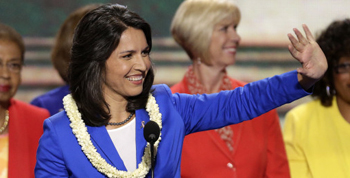
Washington, November 7: Tulsi Gabbard today created history by becoming the first Hindu-American to be elected to the the US House of Representatives, winning her Hawaii seat by trouncing her Republican rival in a one-sided contest.

An Iraq war veteran, 31-year-old Gabbard defeated K Crowley of the Republican Party with a handsome margin. Her victory has been cheered by the Hindu-American community across the country.

Though just 50 per cent of the votes had been counted when reports came in, Gabbard had taken a massive unassailable lead of 120,000 votes over her Republican rival in her bid to represent Hawaii's 2nd Congressional District in the US House.

She is also the first female combat veteran to serve in the Congress.

"Although there are not very many Hindus in Hawaii, I never felt discriminated against. I never really gave it a second thought growing up that any other reality existed, or that it was not the same everywhere," Tulsi said in a statement, soon after she took an inaccessible lead over her Republican challenger.

"On my last trip to the mainland I met a man who told me that his teenage daughter felt embarrassed about her faith, but after meeting me, she's no longer feeling that way. He was so happy that my being elected to Congress would give hope to hundreds and thousands of young Hindus in America, that they can be open about their faith, and even run for office, without fear of being discriminated against or attacked because of their religion," Gabbard said.

She was endorsed by US President Barack Obama, during the election campaign.

Proud of her Hindu religion, she is not Indian or of Indian heritage. Her father Mike Gabbard, is currently Hawaii State Senator and mother Carol Porter Gabbard is an educator and business owner.

At 21, she became the youngest person elected to the Hawaii Legislature. At 23, she was the state's first elected official to voluntarily resign to go to war. At 28, she was the first woman to be presented with an award by the Kuwait Army National Guard.

Early during the Democratic National Convention, Gabbard spoke from stage along with Nancy Pelosi, the Democratic Party leader in the US House of Representatives.

"Aloha! I'm Tulsi Gabbard, candidate for Congress in Hawaii and a captain in the Army National Guard," she had said, amidst rounds of applause and cheer from the audience.

Currently a Company Commander with the Hawaii Army National Guard, who has volunteered to serve on two deployments to the Middle East, Gabbard served as Hawaii's youngest state representative in 2002 and is the youngest woman in the US to be elected into such a position.

Having never visited India so far, Tulsi says she is looking to make her first trip to India as an elected member of the House of Representatives.

"As a Vaishnava, I especially look forward to visiting the holy sites of Vrindavan," she said in an earlier interview.

Notably Hawaii is comprised of a majority of Christians with a significant number of Buddhists (10-15 percent of the population).

The number of Hindus living in Hawaii is relatively small, with only two Hindu temples in the entire state, the Iskcon Temple on Oahu and the Aadheenam Temple on Kauai.

Her religion, Tulsi said is not an issue for the election, neither it has been a negative factor in her electoral campaign, she noted.

Tulsi was born in 1981 in Leloaloa, American Samoa, the fourth of five children born to a Hindu mother and a Christian (Catholic) father.

At the age of two, the family moved to Hawaii, the 50th state of the US, also known as the "Aloha State"; which is also the birth place of Obama.

Comments

Add new comment

  • Coastaldigest.com reserves the right to delete or block any comments.
  • Coastaldigset.com is not responsible for its readers’ comments.
  • Comments that are abusive, incendiary or irrelevant are strictly prohibited.
  • Please use a genuine email ID and provide your name to avoid reject.
News Network
June 4,2020

Jun 4: Mahatma Gandhi’s statue outside the Indian Embassy in Washington DC was vandalised with graffiti and spray painting by unknown persons allegedly involved in the ongoing protests in the US against the custodial killing of African-American George Floyd.

This has prompted the mission officials to register a complaint with the local law enforcement agencies.

The incident is reported to have taken place on the intervening night of June 2 and 3 in Washington DC.

The Indian embassy has informed the State Department and registered a complaint with local law enforcement agencies, which are now conducting an investigation into the incident.

On Wednesday, a team of officials from Metropolitan Police in consultation with the Diplomatic Security Service and National Park Police visited the site and are conducting inquiries.

Efforts are on to clean up the site at the earliest.

Vandalism of the statue of the apostle of peace comes during the week of nationwide protests against the custodial killing of African-American George Floyd in Minneapolis on May 25.

Several of these protests have turned violent which many times has resulted in damage of some of the most prestigious and sacred American monuments.

In Washington DC, protestors this week burnt a historic church and damaged some of the prime properties and historic places like the national monument and Lincoln Memorial.

One of the few statues of a foreign leader on a federal land in Washington DC, the statue of Mahatma Gandhi was dedicated by the then Prime Minister Atal Bihari Vajpayee, in the presence of the then US president Bill Clinton on September 16, 2000, during his state visit to the US.

In October 1998, the US Congress had authorised the government of India to establish and maintain a memorial “to honour Mahatma Gandhi on Federal land in the District of Columbia."

According to the Indian Embassy website, the sculpture of Mahatma Gandhi is cast in bronze as a statue to a height of 8 feet 8 inches. It shows Gandhi in stride, as a leader and man of action evoking memories of his 1930 protest march against salt-tax, and the many padyatras (long marches) he undertook throughout the length and breadth of the Indian sub-continent.

The statue, the design of which was created by Gautam Pal, is a gift from the Indian Council for Cultural Relations (ICCR). The pedestal for the statue of Mahatma Gandhi is a block of new Imperial Red also known as Ruby Red a block originally weighing 25 tonnes reduced to a size of 9'x7'x3'4". It now weighs 16 tonnes.

Comments

Add new comment

  • Coastaldigest.com reserves the right to delete or block any comments.
  • Coastaldigset.com is not responsible for its readers’ comments.
  • Comments that are abusive, incendiary or irrelevant are strictly prohibited.
  • Please use a genuine email ID and provide your name to avoid reject.
Agencies
July 28,2020

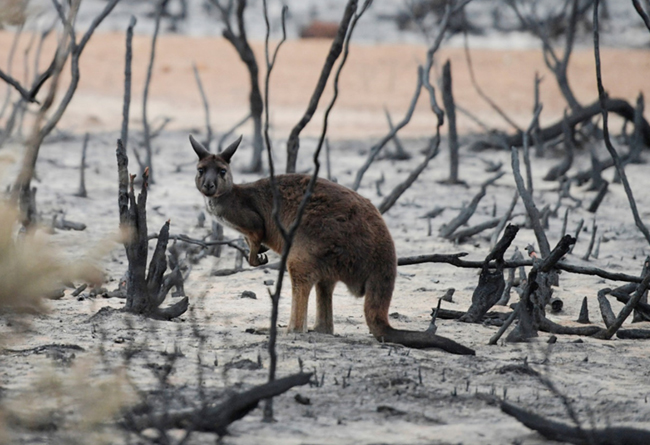
Sydney, Jul 28: Nearly 3 billion koalas, kangaroos and other native Australian animals were killed or displaced by bushfires in 2019 and 2020, a study by the World Wide Fund for Nature (WWF) said on Tuesday, triple the group's earlier estimates.

Some 143 million mammals, 2.46 billion reptiles, 180 million birds and 51 million frogs were impacted by the country's worst bushfires in decades, the WWF said.

When the fires were still blazing, the WWF estimated the number of affected animals at 1.25 billion. The fires destroyed more than 11 million hectares (37 million acres) across the Australian southeast, equal to about half the area of the United Kingdom.

"This ranks as one of the worst wildlife disasters in modern history," said WWF-Australia Chief Executive Officer Dermot O'Gorman in a statement.

The project leader Lily Van Eeden, from the University of Sydney, said the research was the first continent-wide analysis of animals impacted by the bushfires, and "other nations can build upon this research to improve understanding of bushfire impacts everywhere".

The total number included animals which were displaced because of destroyed habitats and now faced lack of food and shelter or the prospect of moving to habitat that was already occupied.

The main reason for raising the number of animal casualties was that researchers had now assessed the total affected area, rather than focusing on the most affected states, they said.

After years of drought made the Australian bush unusually dry, the country battled one of its worst bushfire seasons ever from September 2019 to March 2020, resulting in 34 human deaths and nearly 3,000 homes lost.

Comments

Add new comment

  • Coastaldigest.com reserves the right to delete or block any comments.
  • Coastaldigset.com is not responsible for its readers’ comments.
  • Comments that are abusive, incendiary or irrelevant are strictly prohibited.
  • Please use a genuine email ID and provide your name to avoid reject.
News Network
May 30,2020

May 30: Warning of the tightrope walk ahead as governments battle the coronavirus crisis, Nobel laureate Peter Charles Doherty has expressed concern about densely populated countries such as India relaxing lockdown norms while also describing a complete shutdown as “an economic and social impossibility”.

The Australian immunologist, who cautioned that the number of COVID-19 cases will rise in the coming days, said the earliest time frame for an effective vaccine “going into large numbers of people” is nine to 12 months.

"If all goes well with testing, we could know if some of the candidate vaccines are both safe and effective as early as September/October. Then, rolling a vaccine out will depend on the type of product and how quickly it can be made, put in vials and so forth," Doherty told PTI in an email interview from Melbourne.

The novel coronavirus, he added, does not change fast like influenza and, from what is known so far, “the same vaccine should work everywhere”.

Doherty, who is with the Department of Microbiology and Immunology at the Doherty Institute, University of Melbourne, won the Nobel Prize for Medicine in 1996 for his discovery of how the body’s immune system distinguishes virus-infected cells from normal ones.

Discussing the lockdown, he said, "If it was purely a matter of hard science, everywhere should stay locked down. But that’s pretty much an economic and social impossibility.”

The expectation, he said, is the numbers will rise and limiting spread will depend on people acting responsibly and the capacity for rapid response and extensive contact testing.

“And in a densely populated country like India I think that it will be very difficult," the scientist said.

Several countries, including India, began relaxing lockdown norms in mid-May despite the WHO’s warning about a second wave. India’s lockdown began on March 25 and has since been extended. The fourth phase ends on Sunday.

Asked whether there are any alternatives to a lockdown, the 79-year-old said, "There is no other option other than closing borders. South Korea, for example, conducted massive, intensive testing and contact tracing in a wealthy country with a very disciplined population. Otherwise, not till we have effective vaccines."

He added that he personally doesn’t see the point of closing borders for people coming in if there’s already a high incidence of disease in the community, “unless it’s to avoid the need to care for them and use scarce hospital beds".

According to Doherty, the coronavirus "is a new virus which has come straight out of nature".

“It (the virus) has moved so rapidly across the world because of people travelling on international planes as well as tourist ships," he added.

The immunologist also warned against the use of hydroxychloroquine to treat COVID-19, and said current and planned trials of the anti-malaria drug should be stopped.

“My understanding is that the use of the drug in severe disease is definitely contra-indicated, but it’s not yet clear whether, if taken under medical supervision, it could have some useful effect if taken early on, or as a preventive. Those trials just haven’t been done properly," Doherty noted.

The Indian Council of Medical Research (ICMR) has backed the use of hydroxychloroquine as a preventive against COVID-19 even after the WHO suspended clinical trials of the drug citing safety concerns.

Asked whether plasma therapy can be an effective treatment for COVID-19, Doherty said, "We lack good properly controlled trials but, especially if the plasma has been tested for antibody levels and there’s evidence of good activity, it could be helpful. If I had the disease and was offered plasma therapy I would certainly accept, but I would not take hydroxychloroquine."

Doherty is also very optimistic about herd immunity developing against the SARS-CoV-2 infection.

"We think that (herd immunity) will cut in and have an obvious effect when, say, 60 per cent of people have been infected. Best hope is to boost herd immunity with a vaccine," he stated.

Herd immunity is a form of indirect protection from infectious disease that occurs when a large percentage of a population has become immune to an infection, whether through vaccination or previous infections.

The number of COVID-19 cases have crossed 5.9 million and the fatalities 3,65,000, according to the Johns Hopkins University on Saturday. 

In India, the death toll has risen to 4,971 and the number of cases to 1,73,763, according to the Union Health Ministry on Saturday.

Several states, including Bihar, Uttar Pradesh, Madhya Pradesh, Jharkhand and Chhattisgarh, have reported a rise in number since lockdown norms were relaxed in early May and migrant workers reached home.

In Uttar Pradesh, for instance, the number of infections rose from around 3,000 on May 4 to 6,532 on May 26. Similarly, Bihar’s numbers increased from around 500 to over 2,700 in the period.

Comments

Add new comment

  • Coastaldigest.com reserves the right to delete or block any comments.
  • Coastaldigset.com is not responsible for its readers’ comments.
  • Comments that are abusive, incendiary or irrelevant are strictly prohibited.
  • Please use a genuine email ID and provide your name to avoid reject.