



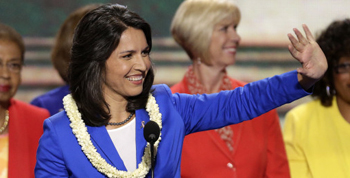
Hindu-American Tulsi Gabbard elected to US Congress

November 7, 2012

TULSI-GABBARD-CONGRESS

Washington, November 7: Tulsi Gabbard today created history by becoming the first Hindu-American to be elected to the the US House of Representatives, winning her Hawaii seat by trouncing her Republican rival in a one-sided contest.

An Iraq war veteran, 31-year-old Gabbard defeated K Crowley of the Republican Party with a handsome margin. Her victory has been cheered by the Hindu-American community across the country.

Though just 50 per cent of the votes had been counted when reports came in, Gabbard had taken a massive unassailable lead of 120,000 votes over her Republican rival in her bid to represent Hawaii's 2nd Congressional District in the US House.

She is also the first female combat veteran to serve in the Congress.

"Although there are not very many Hindus in Hawaii, I never felt discriminated against. I never really gave it a second thought growing up that any other reality existed, or that it was not the same everywhere," Tulsi said in a statement, soon after she took an inaccessible lead over her Republican challenger.

"On my last trip to the mainland I met a man who told me that his teenage daughter felt embarrassed about her faith, but after meeting me, she's no longer feeling that way. He was so happy that my being elected to Congress would give hope to hundreds and thousands of young Hindus in America, that they can be open about their faith, and even run for office, without fear of being discriminated against or attacked because of their religion," Gabbard said.

She was endorsed by US President Barack Obama, during the election campaign.

Proud of her Hindu religion, she is not Indian or of Indian heritage. Her father Mike Gabbard, is currently Hawaii State Senator and mother Carol Porter Gabbard is an educator and business owner.

At 21, she became the youngest person elected to the Hawaii Legislature. At 23, she was the state's first elected official to voluntarily resign to go to war. At 28, she was the first woman to be presented with an award by the Kuwait Army National Guard.

Early during the Democratic National Convention, Gabbard spoke from stage along with Nancy Pelosi, the Democratic Party leader in the US House of Representatives.

"Aloha! I'm Tulsi Gabbard, candidate for Congress in Hawaii and a captain in the Army National Guard," she had said, amidst rounds of applause and cheer from the audience.

Currently a Company Commander with the Hawaii Army National Guard, who has volunteered to serve on two deployments to the Middle East, Gabbard served as Hawaii's youngest state representative in 2002 and is the youngest woman in the US to be elected into such a position.

Having never visited India so far, Tulsi says she is looking to make her first trip to India as an elected member of the House of Representatives.

"As a Vaishnava, I especially look forward to visiting the holy sites of Vrindavan," she said in an earlier interview.

Notably Hawaii is comprised of a majority of Christians with a significant number of Buddhists (10-15 percent of the population).

The number of Hindus living in Hawaii is relatively small, with only two Hindu temples in the entire state, the Iskcon Temple on Oahu and the Aadheenam Temple on Kauai.

Her religion, Tulsi said is not an issue for the election, neither it has been a negative factor in her electoral campaign, she noted.

Tulsi was born in 1981 in Leloaloa, American Samoa, the fourth of five children born to a Hindu mother and a Christian (Catholic) father.

At the age of two, the family moved to Hawaii, the 50th state of the US, also known as the "Aloha State"; which is also the birth place of Obama.

Comments

Add new comment

  • Coastaldigest.com reserves the right to delete or block any comments.
  • Coastaldigset.com is not responsible for its readers’ comments.
  • Comments that are abusive, incendiary or irrelevant are strictly prohibited.
  • Please use a genuine email ID and provide your name to avoid reject.
News Network
May 6,2020

Singapore, May 6: Oil prices slipped back Wednesday after two days of gains, although Brent crude remained above $30 a barrel, as renewed US-China tensions offset optimism about the easing of coronavirus lockdowns.

Brent, the international benchmark, fell 1.1 per cent to $30.63 a barrel in early Asian trade. On Tuesday, the contract surged 14 per cent and rose above $30 for the first time since mid-April.

US marker West Texas Intermediate slipped 1.9 per cent and was changing hands for $24.13 a barrel.

Oil markets have been battered as the virus strangled demand due to business closures and travel restrictions, with US crude falling into negative territory last month for the first time.

They started rallying strongly this week as countries from Europe to Asia ease curbs and economies start shuddering back to life.

But gains were capped Wednesday as dealers follow a brewing US-China row after Donald Trump hit out at Beijing over its handling of the outbreak, saying it began in a Wuhan lab, but so far offering no evidence.

"Traders are incredibly cautious this morning, weighing all the possible China responses," said Stephen Innes, chief global market strategist at AxiCorp.

"And the one that would hurt the most would be for China to reduce imports of US oil."

This week's rally was in part driven by a deal agreed between top producers to reduce output by almost 10 million barrels a day, which came into effect on May 1.

There have also been signs that the massive oversupply in the market is starting to ease as demand slowly comes back.

Energy data provider Genscape said earlier this week that stockpiles at the main US oil depot in Cushing, Oklahoma had increased by only 1.8 million barrels last week following weeks of major rises.

Comments

Add new comment

  • Coastaldigest.com reserves the right to delete or block any comments.
  • Coastaldigset.com is not responsible for its readers’ comments.
  • Comments that are abusive, incendiary or irrelevant are strictly prohibited.
  • Please use a genuine email ID and provide your name to avoid reject.
News Network
May 7,2020

United Nations, May 7: An average of 80,000 COVID-19 cases were reported each day in April to the World Health Organization, the top UN health agency has said, noting that South Asian nations like India and Bangladesh are seeing a spike in the infections while the numbers are declining in regions such as Western Europe.

WHO Director-General Tedros Adhanom Ghebreyesus said on Wednesday that countries must also be able to manage any risk of the disease being imported into their territories, and communities should be fully educated to adjust to what will be a "new norm".

He said as the countries press forward in the common fight against COVID-19, they should also lay the groundwork for resilient health systems globally.

"More than 3.5 million cases of COVID-19 and almost 250,000 deaths have now been reported to the WHO. Since the beginning of April, an average of around 80,000 new cases have been reported to the WHO every day," Ghebreyesus said in Geneva yesterday.

Asserting that the virus cases were not just numbers, he said: "every single case is a mother, a father, a son, a daughter, a brother, sister or friend".

He said while the numbers are declining in Western Europe, more cases are being reported every day from Eastern Europe, Africa, South-East Asia, the Eastern Mediterranean and the Americas. Even within regions and within countries, there are divergent trends, the agency added.

While some countries are reporting an increase in COVID-19 cases over time, many have seen caseloads rise because they have ramped up testing, the WHO official said.

"We've also seen in Europe and Western Europe a fundamental decrease in the number of cases, but we have seen an associated increase in the number of cases reported in places like the Russian Federation. Southeast, the Western Pacific areas are relatively on the downward trend like Korea and others, but then we do see in South Asia, in places like Bangladesh, in India, some trends towards increase.

"So it's very difficult to say that any particular region is improving or (not improving). There are individual countries within each region that are having difficulties getting on top of this disease and I am particularly concerned about those countries that have (an) ongoing humanitarian crisis," WHO's Executive Director Michael Ryan said.

The death toll due to COVID-19 in India rose to 1,783 while the number of cases climbed to 52,952 on Thursday, registering an increase of 89 deaths and 3,561 cases in the last 24 hours, the Union Health Ministry said.

The number of active COVID-19 cases stood at 35,902 while 15,266 people have recovered, it said.

Noting that while seeing an increase in the number of cases is not good in terms of transmission, WHO's Emerging Diseases and Zoonoses Unit head Maria Van Kerkhove said: "but I don't want to equate that with something (being) wrong".

"I want to equate that with countries are working very hard to increase their ability to find the virus, to find people with the virus, to have testing in place to identify who has COVID-19, and putting into place what they need to do to care for those patients," Kerkhove said.

With more countries considering easing restrictions implemented to curb the spread of the coronavirus, the WHO has again reminded the authorities of the need to maintain vigilance.

"The risk of returning to lockdown remains very real if countries do not manage the transition extremely carefully, and in a phased approach," Ghebreyesus said.

He urged countries to consider the UN agency's six criteria for lifting stay-at-home measures.

That advice includes ensuring surveillance is strong, cases are declining and transmission is controlled. Health systems also must be able to detect, isolate, test and treat cases, and to trace all contacts.

Additionally, the risk of outbreak in settings such as health facilities and nursing homes needs to be minimised, while schools, workplaces and other public locations should have preventive measures in place.

"The COVID-19 pandemic will eventually recede, but there can be no going back to business as usual. We cannot continue to rush to fund panic but let preparedness go by the wayside," he said.

He said the crisis has highlighted the importance of strong national health systems as the foundation of global health security: not only against pandemics but also against the multitude of health threats that people across the world face every day.

"If we learn anything from COVID-19, it must be that investing in health now will save lives later," Ghebreyesus said.

While the world currently spends around USD 7.5 trillion on health annually, the WHO believes the best investments are in promoting health and preventing disease.

"Prevention is not only better than cure, it's cheaper, and the smartest thing to do," he said.

The deadly coronavirus, which originated from the Chinese city of Wuhan in December last year, has infected over 3.7 million people and killed 263,831 people globally, according to a tally by Johns Hopkins University.

Comments

Add new comment

  • Coastaldigest.com reserves the right to delete or block any comments.
  • Coastaldigset.com is not responsible for its readers’ comments.
  • Comments that are abusive, incendiary or irrelevant are strictly prohibited.
  • Please use a genuine email ID and provide your name to avoid reject.
News Network
February 22,2020

Washington, Feb 22: US President Donald Trump will raise the issue of religious freedom with Prime Minister Narendra Modi during his visit to India next week, the White House said on Friday, noting that the US has great respect for India's democratic traditions and institutions.

"President Trump will talk about our shared tradition of democracy and religious freedom both in his public remarks and then certainly in private. He will raise these issues, particularly the religious freedom issue, which is extremely important to this administration," a senior official told reporters in a conference call.

The official was responding to a question on whether the president was planning to speak to Modi on the Citizenship (Amendment) Act or the National Register of Citizens.

"We do have this shared commitment to upholding our universal values, the rule of law. We have great respect for India's democratic traditions and institutions, and we will continue to encourage India to uphold those traditions," the official said, requesting anonymity.

"And we are concerned with some of the issues that you have raised," the senior administration official said, in response to the question on CAA and NRC.

"I think the President will talk about these issues in his meetings with Prime Minister Modi and note that the world is looking to India to continue to uphold its democratic traditions, respect for religious minorities," the official said.

"Of course, it's in the Indian constitution -- religious freedom, respect for religious minorities, and equal treatment of all religions. So this is something that is important to the president and I'm sure it will come up," said the official.

Pointing out that India has a strong democratic foundation, the official said India is a country rich in religious, linguistic, and cultural diversity.

"In fact, it's the birthplace of four major world religions," the official noted.

Comments

Add new comment

  • Coastaldigest.com reserves the right to delete or block any comments.
  • Coastaldigset.com is not responsible for its readers’ comments.
  • Comments that are abusive, incendiary or irrelevant are strictly prohibited.
  • Please use a genuine email ID and provide your name to avoid reject.