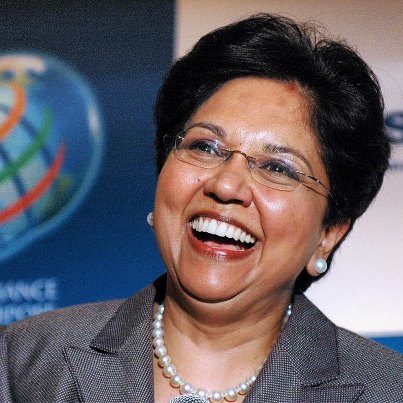
Obama invites Indra Nooyi for consultation on economy

November 14, 2012
indra
Washington, November 14: United States President Barack Obama has invited at least three Indian-Americans, including PepsiCo CEO Indra Nooyi, as part of his wider consultations with leaders from business, labour, civic community and Congress on the current economic crisis.

Neera Tandon, president of the Center for American Progress, an eminent U.S. think-tank based in Washington; and Deepak Bhargava from the Center for Community Change are the other Indian-Americans invited for consultations, said a White House official.


The President this week would meet leaders from the business, labour, progressive and civic communities, as well as congressional leadership, to have discussions on the best ways to move the economy forward and find a balanced approach to reduce deficit, he said.


“On Tuesday, Obama will attend a meeting with labour and progressive leaders….” Ms. Tandon and Mr. Bhargava have been invited to attend the White House meeting with Mr. Obama later on Tuesday.


Others attending the meeting are Kay Henry from the Service Employees International Union (SEIU); Lee Saunders from the American Federation of State, County and Municipal Employees (AFSCME); Dennis Van Roekel from the National Education Association (NEA); and Rich Trumka from the American Federation of Labour and Congress of Industrial Organisations (AFL-CIO).


Those invited for the meeting on Wednesday include Mark Bertolini (President, Chairman and CEO, Aetna); and Ursula Burns (Chairman and CEO, Xerox), Kenneth I.

Comments

Add new comment

  • Coastaldigest.com reserves the right to delete or block any comments.
  • Coastaldigset.com is not responsible for its readers’ comments.
  • Comments that are abusive, incendiary or irrelevant are strictly prohibited.
  • Please use a genuine email ID and provide your name to avoid reject.
News Network
May 21,2020

Washington, May 21: US President Donald Trump China is on a "massive disinformation" campaign and is desperately trying to deflect the "pain and carnage" that it spread throughout the world, US President Donald Trump has said, upping the ante on Beijing over its handling of the coronavirus outbreak.

Trump, who has expressed disappointment over China's handling of the COVID-19 pandemic, claimed that it was the "incompetence" of Beijing that led to the mass killing across the globe. 

"China is on a massive disinformation campaign because they are desperate to have Sleepy Joe Biden win the presidential race so they can continue to rip-off the United States, as they have done for decades, until I came along!" Trump said in a tweet on Wednesday.

"Spokesman speaks stupidly on behalf of China, trying desperately to deflect the pain and carnage that their country spread throughout the world. Its disinformation and propaganda attack on the United States and Europe is a disgrace… It all comes from the top. They could have easily stopped the plague, but they didn't," he said in a series of tweets.

Trump blamed China for spreading the coronavirus globally and accused it of being incompetent.
"Some wacko in China just released a statement blaming everybody other than China for the Virus which has now killed hundreds of thousands of people. Please explain to this dope that it was the 'incompetence of China', and nothing else, that did this mass Worldwide killing!" Trump said.

China has denied covering up the extent of its coronavirus outbreak and accused the US of attempting to divert public attention by insinuating that the virus originated from a virology laboratory in Wuhan.

"China was the first country to report the COVID-19 to the World Health Organisation (WHO), (and) that doesn't mean the virus originated from Wuhan... There has never been any concealment, and we'll never allow any concealment," Chinese Foreign Ministry spokesman Zhao Lijian said last month.

"A discerning person will understand at a glance that the purpose is to create confusion, divert public attention, and shirk their responsibility," he said.

The novel coronavirus which first originated in Wuhan in December last year has claimed 328,120 lives and infected nearly 5 million people globally. The Us is the worst affected country with 93,439 deaths and over 1.5 million infections, according to Johns Hopkins University data.

Meanwhile, the US Senate passed a bill boosting oversight of companies based in China and other nations that could lead to their removal from American stock exchanges.

The Holding Foreign Companies Accountable Act, proposes to increase oversight of Chinese and other foreign companies listed on American exchanges and delist and ban over-the-counter trading for firms that are out of compliance with US regulators for a period of three years.

In a related development, a group of top Republican Senators led by Marco Rubio sent a letter to Secretary of the Treasury Steven Mnuchin following disturbing reports that China's state-owned and-directed enterprises were looking to exploit the economic crisis by buying US and foreign companies.

As companies backed by the Chinese Communist Party (CCP) approach banks to identify the purchase of companies in the US and in Europe affected by the pandemic, the senators urged Mnuchin to protect against the China's and the CCP's predatory economic behaviour during the COVID-19 crisis.

"We write to express our concerns related to the People's Republic of China's (PRC) efforts to exploit the economic crisis wrought by the COVID-19 pandemic to gain control of distressed companies or shirking its international responsibilities amidst a worldwide crisis.

"In both Chinese Communist Party (CCP) and PRC policy documents, Beijing has made no secret of its intentions to dominate strategic industrial and emerging technology sectors as well as influence standards at the expense of liberal, rules-based governance," wrote the senators.

As the crisis reverberates across the globe, the PRC's predatory lending practices — including the use of non-disclosure agreements for bilateral loans — not only damage the fiscal situation of recipient countries but also undermine the international community's ability to respond effectively to the crisis, they said.

"Without US and international pressure for accountability and transparency, those countries that are in debt to the PRC will not have the political cover or protection to open their financial books. Such countries will face the risk of default or a currency crisis, leaving the International Monetary Fund (IMF), World Bank, and Western countries to clean up the PRC's mess," the senators said.

During a campaign round table Katrina Pierson, Senior Advisor to the Trump 2020 Campaign, said that only the US President will defeat the coronavirus, hold China accountable for their negligence, and defend the American people from socialism. 

Comments

Add new comment

  • Coastaldigest.com reserves the right to delete or block any comments.
  • Coastaldigset.com is not responsible for its readers’ comments.
  • Comments that are abusive, incendiary or irrelevant are strictly prohibited.
  • Please use a genuine email ID and provide your name to avoid reject.
Agencies
January 12,2020

Washington, Jan 12: The US State Department has described the recent visit of envoys of 15 countries to Jammu and Kashmir as an "important step" but expressed concern over the continued detention of political leaders and restrictions on internet in the region.

Alice Wells, the Acting Assistant Secretary of State for South Asia, tweeted on Saturday that she was "closely following" the visit of the envoys to Kashmir, describing it an "important step".

Wells, who will be visiting India this week, added: "We remain concerned by detention of political leaders and residents and Internet restrictions. We look forward to a return to normalcy."

The group of diplomats made a two-day visit to the Union Territory on Thursday and Friday to see the conditions thereafter Jammu and Kashmir's special constitutional status was removed last August.

While some US politicians and media have criticised the action by Prime Minister Narendra Modi's government, the US has officially appeared to support the abrogation of the Constitution's Article 370 on the special status.

Last October, Wells told the House of Representatives Subcommittee on Asia and the Pacific that the State Department supported the objectives behind it, while not directly mentioning the abrogation.

"The Indian government has argued that its decision on Article 370 was driven by a desire to increase economic development, reduce corruption, and uniformly apply all national laws in Jammu and Kashmir, particularly in regard to women and minorities.

"While we support these objectives, the Department remains concerned about the situation in the Kashmir Valley, where daily life for the nearly eight million residents has been severely impacted since August 5," she had said.

Washington has banked on India's democratic institutions - the judiciary and public debates - being able to steer the country.

Bearing this out, the Supreme Court last week ordered the government to review its decision to shut down the internet in Kashmir, which it declared was a fundamental right, thus taking a step to address Wells's concern.

Comments

Add new comment

  • Coastaldigest.com reserves the right to delete or block any comments.
  • Coastaldigset.com is not responsible for its readers’ comments.
  • Comments that are abusive, incendiary or irrelevant are strictly prohibited.
  • Please use a genuine email ID and provide your name to avoid reject.
News Network
June 4,2020

Jun 4: A malaria drug President Donald Trump took to try to prevent COVID-19 proved ineffective for that in the first large, high-quality study to test it in people in close contact with someone with the disease.

Results published Wednesday by the New England Journal of Medicine show that hydroxychloroquine was no better than placebo pills at preventing illness from the coronavirus.

The drug did not seem to cause serious harm, though -- about 40% on it had side effects, mostly mild stomach problems.

 “We were disappointed. We would have liked for this to work,” said the study leader, Dr. David Boulware, an infectious disease specialist at the University of Minnesota.

“But our objective was to answer the question and to conduct a high-quality study,” because the evidence on the drug so far has been inconclusive, he said.

Hydroxychloroquine and a similar drug, chloroquine, have been the subject of much debate since Trump started promoting them in March.

Hydroxychloroquine has long been used for malaria, lupus, and rheumatoid arthritis, but no large studies have shown it or chloroquine to be safe or effective for much sicker patients with coronavirus, and some studies have suggested the drugs may do harm.

Trump took a two-week course of hydroxychloroquine, along with zinc and Vitamin D, after two staffers tested positive for COVID-19, and had no ill effects, according to results of his latest physical released by his doctor Wednesday.

Federal regulators have warned against hydroxychloroquine's use except in hospitals and formal studies because of the risk of side effects, especially heart rhythm problems.

Boulware's study involved 821 people in the United States and Canada living with someone diagnosed with COVID-19 or at high risk of getting it because of their job -- doctors, nurses, ambulance workers who had significant exposure to a sick patient while not wearing full protective gear.

They were randomly assigned to get either the nutrient folate as a placebo or hydroxychloroquine for five days, starting within four days of their exposure. Neither they nor others involved in the research knew who was getting which pills.

After 14 days in the study, 12 per cent on the drug developed COVID-19 symptoms versus 14 per cent in the placebo group, but the difference is so small it could have occurred by chance, Boulware said.

“There's basically no effect. It does not prevent infection,” he said of the drug. Even if it were to give some slim advantage, “we'd want a much larger effect” to justify its use and risk of side effects for preventing illness, he said.

Results were no different among a subgroup of participants who were taking zinc or vitamin C, which some people believe might help make hydroxychloroquine more effective or fight the coronavirus.

There are some big caveats: The study enrolled people through the Internet and social media, relying on them to report their own symptoms rather than having them tracked in a formal way by doctors.

Participants were not all tested for the coronavirus but were diagnosed as COVID-19 cases based on symptoms in many cases. And not all took their medicines as directed.

The results “are more provocative than definitive,” and the drug may yet have prevention benefits if tried sooner or in a different way, Dr. Myron Cohen of the University of North Carolina at Chapel Hill wrote in a commentary in the journal.

Others were glad to see a study that had a comparison group and good scientific methods after so many weaker reports on hydroxychloroquine.

“This fits with everything else we've seen so far which suggests that it's not beneficial," said Dr. Peter Bach, director of a health policy center at Memorial Sloan Kettering Cancer Center in New York.

This study was in younger relatively healthy people, but the results “would make me very discouraged about trying to use this in older people” who are most vulnerable to serious illness from the coronavirus, Bach said.

“If it does work, it doesn't work very well.” Dr. Dan Culver, a lung specialist at the Cleveland Clinic, said there's still a chance that giving the drug sooner than four days after someone's exposure to the virus may help prevent illness.

But the study “takes 'home run' off the table” as far as hopes for the drug, he said.

The study was mostly funded by David Baszucki, founder of Roblox, a California-based game software company, and other private donors and the Minnesota university.

Boulware also is leading a study testing hydroxychloroquine for treating COVID-19. The study is finished and results are being analyzed now.

On Tuesday, the journal Lancet posted an “expression of concern” about a study it published earlier this month of nearly 15,000 COVID-19 patients on the malaria drugs that tied their use to a higher risk of dying in the hospital or developing a heartbeat problem.

Scientists have raised serious questions about the database used for that study, and its authors have launched an independent audit.

That work had a big impact: the World Health Organization suspended use of hydroxychloroquine in a study it is leading, and French officials stopped the drug's use in hospitals. On Wednesday, the WHO said experts who reviewed safety information decided that its study could resume.


Comments

Add new comment

  • Coastaldigest.com reserves the right to delete or block any comments.
  • Coastaldigset.com is not responsible for its readers’ comments.
  • Comments that are abusive, incendiary or irrelevant are strictly prohibited.
  • Please use a genuine email ID and provide your name to avoid reject.