



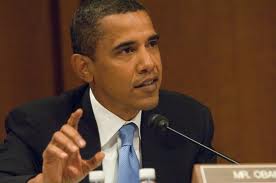
In first post-election news conference, Obama lays out second term

November 15, 2012

o1

Washington, November 15:President Obama said in his victory speech last week that “elections matter.” On Wednesday, he made clear how much the election matters to him — and to the way he intends to govern in his second term.


Appearing in his first post-victory news conference, the customarily cautious Obama spoke like a politician with nothing to lose after winning the last race of his life.

Over the course of an hour, he struck an unabashedly populist tone in characterizing his second-term “mandate” to help the poor and the middle class, and he warned his partisan rivals that voters had sided with his approach to the economy during the long campaign.


There was a confidence and ease in Obama's manner far removed from the listlessness of his first presidential debate in Denver six weeks ago. There also was a stridency that had been absent during key moments in his first term, much to the dismay of his supporters.

Displaying a rare flash of anger, Obama fiercely defended U.N. Ambassador Susan E. Rice, a leading candidate to be the next secretary of state, from Republican attempts to “besmirch her reputation.” He told GOP senators to “go after me” instead and, showing the potential risks of his approach,they soon did.


“As I said during the campaign, there are going to be times where there are fights, and I think those are fights that need to be had,” Obama said, sounding like someone eager to have them.


“But what I think the American people don't want to see is a focus on the next election, instead of a focus on them,” he continued. “And I don't have another election.”


Presidents often use their first post-election news conferences to set a tone and a direction for the second term, as George W. Bush famously attempted in 2004 when he declared that he would spend his “political capital” in the years ahead.


Obama proved no different in Wednesday's White House news conference, only the 20th of his presidency. His self-assurance on display in the East Room, despite a looming fiscal crisis and a widening scandal involving former CIA director David H. Petraeus, suggested he would take a far more combative approach with Congress than he did during his first term.


The event also reflected a sense that Obama understands the need for a fast start after a draining and negative campaign. Although his term will last another four years, a second-term president's power slips away sharply after about two.


“Even less really, because the congressional elections will be taking away attention before that,” said Robert Dallek, a presidential scholar. “This is when he has his authority and influence, and his political capital is right there to be spent. He doesn't need to wait until January.”


With that narrowing window in mind, Obama said Wednesday that he intends to be as ambitious as possible, while avoiding the second-term mistakes that have afflicted at least the past three two-term presidents.


“I'm more than familiar with all the literature about presidential overreach in second terms,” he said. “We are very cautious about that. On the other hand, I didn't get reelected just to bask in reelection.”

Comments

Add new comment

  • Coastaldigest.com reserves the right to delete or block any comments.
  • Coastaldigset.com is not responsible for its readers’ comments.
  • Comments that are abusive, incendiary or irrelevant are strictly prohibited.
  • Please use a genuine email ID and provide your name to avoid reject.
Agencies
March 15,2020

Houston, Mar 15: Researchers, studying the novel coronavirus, have found that the time between cases in a chain of transmission is less than a week, and over 10 per cent of patients are infected by someone who has the virus, but does not show symptoms yet, a finding that may help public health officials contain the pandemic.

The study, published in the journal Emerging Infectious Diseases, estimated what's called the serial interval of the coronavirus by measuring the time it takes for symptoms to appear in two people with the virus -- the person who infects another, and the infected second person.

According to the researchers, including those from the University of Texas at Austin, the average serial interval for the novel coronavirus in China was approximately four days.

They said the speed of an epidemic depends on two things -- how many people each case infects, and how long it takes cases to spread.

The first quantity, the scientists said, is called the reproduction number, and the second is the serial interval.

Due to the short serial interval of the disease caused by the coronavirus -- COVID-19 -- they said, emerging outbreaks will grow quickly, and could be difficult to stop.

“Ebola, with a serial interval of several weeks, is much easier to contain than influenza, with a serial interval of only a few days,” said Lauren Ancel Meyers, study co-author from UT Austin.

Meyers explained that public health responders to Ebola outbreaks have much more time to identify and isolate cases before they infect others.

“The data suggest that this coronavirus may spread like the flu. That means we need to move quickly and aggressively to curb the emerging threat,” Meyers added.

In the study, the scientists examined more than 450 infection case reports from 93 cities in China, and found the strongest evidence yet that people without symptoms must be transmitting the virus -- known as pre-symptomatic transmission.

More than one in ten infections were from people who had the virus but did not yet feel sick, the scientists said.

While researchers across the globe had some uncertainty until now about asymptomatic transmission with the coronavirus, the new evidence could provide guidance to public health officials on how to contain the spread of the disease.

“This provides evidence that extensive control measures including isolation, quarantine, school closures, travel restrictions and cancellation of mass gatherings may be warranted,” Meyers said.

The researchers cautioned that asymptomatic transmission makes containment more difficult.

With hundreds of new cases emerging around the world every day, the scientists said, the data may offer a different picture over time.

They said infection case reports are based on people's memories of where they went and whom they had contact with, and if health officials move quickly to isolate patients, that may also skew the data.

“Our findings are corroborated by instances of silent transmission and rising case counts in hundreds of cities worldwide. This tells us that COVID-19 outbreaks can be elusive and require extreme measures,” Meyers said.

Comments

Add new comment

  • Coastaldigest.com reserves the right to delete or block any comments.
  • Coastaldigset.com is not responsible for its readers’ comments.
  • Comments that are abusive, incendiary or irrelevant are strictly prohibited.
  • Please use a genuine email ID and provide your name to avoid reject.
News Network
March 28,2020

London: Italy on Friday recorded the most daily deaths of any country since the start of the coronavirus pandemic and Spain had its deadliest day, as British Prime Minister Boris Johnson became the first major world leader to test positive.

Italy reported 969 new deaths, Spain 769 and France 299 as Europe reeled from a crisis that has put millions at risk around the world and threatened a global economic meltdown.

In other grim milestones, AFP tallies showed a total of 300,000 cases now recorded in Europe with more than 26,000 deaths worldwide, and the United States overtook China as the country with the most infections.

Italy showed infection rates continuing a downward trend and Spain said its rate of new infections appeared to be slowing, but other countries were bracing to feel the full impact of the virus's spread.

The World Health Organization's regional director for Africa warned the continent faced a "dramatic evolution" of the pandemic, as South Africa became the latest nation to start life under lockdown and reported its first COVID-19 deaths.

Johnson, whose country has seen more than 14,000 declared coronavirus cases and 759 deaths, said he had developed mild symptoms over the previous 24 hours and was self-isolating after testing positive.

Britain's Health Secretary Matt Hancock also tested positive with mild symptoms.

Europe has suffered the brunt of the coronavirus crisis in recent weeks, with millions across the continent on lockdown and the streets of Paris, Rome and Madrid eerily empty.

In France — where nearly 2,000 people have died -- the government announced it was extending its stay-at-home order until at least April 15. While severe, the 299 new deaths it recorded on Friday was lower than the 365 reported the previous day.

The death of a 16-year-old girl from the virus has particularly shaken France, and shattered the belief of many young people that they are immune.

The girl's mother Sabine told AFP that Julie "just had a cough" at first but deteriorated quickly. She died on Wednesday, less than a week after showing her first symptoms.

"It's unbearable," Sabine said. "We were supposed to have a normal life."

Focus was also turning to the United States, where the number of known infections jumped by 18,000 on Friday, reaching more than 97,000 -- higher than both China and Italy. The US also recorded 345 deaths over the past 24 hours, with a total toll of 1,478.

In New York City, health workers are battling a surging toll of dead and infected at the US epicentre of the crisis, including an increasing number of younger patients.

"Now it's 50-year-olds, 40-year-olds, 30-year-olds," said one respiratory therapist at the Jewish Medical Center in Queens.

They "didn't listen about not going out or protecting themselves and washing their hands", he said.

- 'Afraid and lost' -

The coronavirus first emerged in China late last year before spreading globally, with more than half a million declared cases in 183 countries and territories.

Over the last six days, as many new cases have been diagnosed around the world as in the previous 80 days.

Beijing managed to contain its spread with lockdowns and quarantines and its epicentre Wuhan is in the process of easing severe movement restrictions in place for two months.

Three billion people around the world have been told to stay indoors.

In a historic first, Pope Francis performed the rarely recited "Urbi et Orbi" blessing to an empty Saint Peter's Square.

"Thick darkness has gathered over our squares, our streets and our cities; it has taken over our lives, filling everything with a deafening silence and a distressing void, that stops everything as it passes by," he said.

"We find ourselves afraid and lost," he said, describing the coronavirus as a "tempest".

Health care systems even in the most developed nations are stretched to breaking point and medical workers have been having to make difficult choices.

"If I've got five patients and only one bed, I have to choose who gets it," Sara Chinchilla, a paediatrician at a hospital near Madrid, told AFP.

The WHO's chief Tedros Adhanom Ghebreyesus said the dire lack of protective gear for frontline health workers was one of the most pressing problems in the fight to prevent deaths.

"The chronic global shortage of personal protective equipment is now one of the most urgent threats to our collective ability to save lives," he told a virtual news conference in Geneva.

Lockdowns and other measures are wreaking havoc on the global economy, with fears of a downturn worse than the Great Depression of the 1930s.

"It is clear that we have entered a recession" that will be worse than in 2009 following the global financial crisis, International Monetary Fund chief Kristalina Georgieva said Friday.

Unprecedented stimulus measures have helped markets bounce back after a brutal month, but people around the world are bracing for economic hardship.

The United States reported that 3.3 million people applied for unemployment benefits last week -- by far the highest number ever recorded.

Retail workers in particular have suffered as many countries shutter non-essential business, while airlines and the global tourism industry have been dealt devastating blows.

The fashion industry was the latest hit on Friday, with Paris men's fashion week and haute couture shows cancelled along with Milan men's fashion week.

- Armies of volunteers -

The World Tourism Organization said Friday it expected tourist arrivals to fall by 20-30 percent this year, with losses of $300 billion-450 billion in international tourism receipts.

But there have been rays of hope in the midst of the crisis.

Armed groups in Cameroon, the Philippines and Yemen have moved in recent days to reduce violence after UN Secretary General Antonio Guterres issued an appeal for ceasefires.

And armies of volunteers have emerged in many countries to bring help to the needy, with food deliveries for the elderly, free taxi rides, accommodation for health workers, and even home-sewn face masks.

Comments

Add new comment

  • Coastaldigest.com reserves the right to delete or block any comments.
  • Coastaldigset.com is not responsible for its readers’ comments.
  • Comments that are abusive, incendiary or irrelevant are strictly prohibited.
  • Please use a genuine email ID and provide your name to avoid reject.
News Network
January 7,2020

Dubai/Washington, Jan 7: Iran's Supreme Leader Ayatollah Ali Khamenei wept in grief with hundreds of thousands of mourners thronging Tehran's streets on Monday for the funeral of military commander Qassem Soleimani, killed by a U.S. drone on U.S. President Donald Trump's orders.

The coffins of General Qassem Soleimani and Iraqi militia leader Abu Mahdi al-Muhandis, who also died in Friday's attack in Baghdad, were draped in their national flags and passed from hand to hand over the heads of mourners in central Tehran.

Responding to Trump's threats to hit 52 Iranian sites if Tehran retaliates for the drone strike, Iran's President Hassan Rouhani pointedly wrote on Twitter: "Never threaten the Iranian nation." And Soleimani's successor vowed to expel U.S. forces from the Middle East in revenge.

Khamenei, 80, led prayers at the funeral, pausing as his voice cracked with emotion. Soleimani, 62, was a national hero in Iran, even to many who do not consider themselves supporters of Iran's clerical rulers.

Aerial footage showed people, many clad in black, packing thoroughfares and side streets in the Iranian capital, chanting "Death to America!" - a show of national unity after anti-government protests in November in which many demonstrators were killed.

The crowd, which state media said numbered in the millions, recalled the masses of people that gathered in 1989 for the funeral of the Islamic Republic's founder, Ayatollah Ruhollah Khomeini. Soleimani, architect of Iran's drive to extend its influence across the Middle East, was widely seen as Iran's second most powerful figure behind Khamenei.

His killing of Soleimani has prompted concern around the world that a broader regional conflict could flare.

Trump on Saturday vowed to strike 52 Iranian targets, including cultural sites, if Iran retaliates with attacks on Americans or U.S. assets, and stood by his threat on Sunday, though American officials sought to downplay his reference to cultural targets. The 52 figure, Trump noted, matched the number of U.S. Embassy hostages held for 444 days after the 1979 Iranian Revolution.

Rouhani, regarded as a moderate, responded to Trump on Twitter.

"Those who refer to the number 52 should also remember the number 290. #IR655," Rouhani wrote, referring to the 1988 shooting down of an Iranian airline by a U.S. warship in which 290 were killed.

Trump also took to Twitter to reiterate the White House stance that "Iran will never have a nuclear weapon" but gave no other details.

'ACTIONS WILL BE TAKEN'

General Esmail Ghaani, Soleimani's successor as commander of the Quds Force, the elite unit of Iran's Revolutionary Guards charged with overseas operations, promised to "continue martyr Soleimani's cause as firmly as before with the help of God, and in return for his martyrdom we aim to rid the region of America."

"God the Almighty has promised to take martyr Soleimani's revenge," he told state television. "Certainly, actions will be taken."

Other political and military leaders have made similar, unspecific threats. Iran, which lies at the mouth of the key Gulf oil shipping route, has a range of proxy forces in the region through which it could act.

Iran's demand for U.S. forces to withdraw from the region gained traction on Sunday when Iraq's parliament passed a resolution calling for all foreign troops to leave the country.

Iraqi caretaker Prime Minister Abdel Abdul Mahdi told the U.S. ambassador to Baghdad on Monday that both nations needed to implement the resolution, the premier's office said in a statement. It did not give a timeline.

The United States has about 5,000 troops in Iraq.

Soleimani built a network of proxy militia that formed a crescent of influence - and a direct challenge to the United States and its regional allies led by Saudi Arabia - stretching from Lebanon through Syria and Iraq to Iran. Outside the crescent, Iran nurtured allied Palestinian and Yemeni groups.

He notably mobilised Shi'ite Muslim militia forces in Iraq that helped to crush ISIS, the Sunni militant group that had seized control of swathes of Syria and Iraq in 2014.

Washington, however, blames Soleimani for attacks on U.S. forces and their allies.

The funeral moves to Soleimani's southern home city of Kerman on Tuesday. Zeinab Soleimani, his daughter, told mourners in Tehran that the United States would face a "dark day" for her father's death, adding, "Crazy Trump, don't think that everything is over with my father's martyrdom."

NUCLEAR DEAL

Iran stoked tensions on Sunday by dropping all limitations on its uranium enrichment, another step back from commitments under a landmark deal with major powers in 2015 to curtail its nuclear programme that Trump abandoned in 2018.

In response, European signatories may launch a dispute resolution process against Iran this week that could lead to a renewal of the United Nations sanctions that were lifted as part of the deal, European diplomats said on Monday.

Diplomats said France, Britain and Germany could make a decision ahead of an EU foreign ministers' meeting on Friday that would assess whether there were any ways to salvage the deal.

After quitting the deal, the United States imposed new sanctions on Iran, saying it wanted to halt Iranian oil exports, the main source of government revenues. Iran's economy has been in freefall as the currency has plunged.

Trump adviser Kellyanne Conway said on Monday that he was still confident he could renegotiate a new nuclear agreement "if Iran wants to start behaving like a normal country."

Tehran has said Washington must return to the existing nuclear pact and lift sanctions before any talks can take place.

The United States advised American citizens in Israel and the Palestinian territories to be vigilant, citing the risk of rocket fire amid heightened tensions. As a U.S. ally against Iran, Israel is concerned about possible rocket attacks from Gaza, ruled by Iranian-backed Palestinian Islamists, or major Iran proxy Hezbollah in Lebanon.

Democratic critics of Trump have said the Republican president was reckless in authorising the strike, with some saying his threat to hit cultural sites amounted to a vow to commit war crimes. Trump also threatened sanctions against Iraq and said Baghdad would have to pay Washington for an air base in Iraq if U.S. troops were required to leave.

Comments

Add new comment

  • Coastaldigest.com reserves the right to delete or block any comments.
  • Coastaldigset.com is not responsible for its readers’ comments.
  • Comments that are abusive, incendiary or irrelevant are strictly prohibited.
  • Please use a genuine email ID and provide your name to avoid reject.