



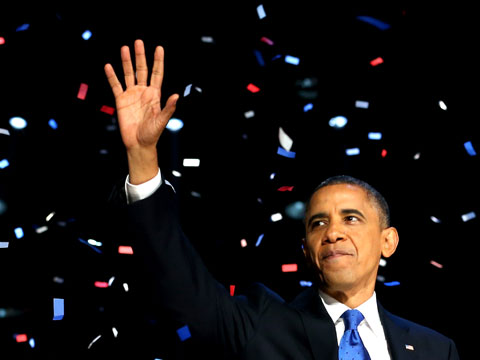
Obama inducts record number Indian-Americans into his administration

November 19, 2012

obama_inducts_indians

Washington, November 19: The small Indian-American community - constituting just about one per cent of the US population never had it so good as under the Obama administration, with a record number of community members being roped in to head top administrative positions.

President Barack Obama recognising the immense talent and potential of this community numbering about 3.1 million, not only appointed a record number of Indian-Americans to his administration, but also there is hardly any major wing of the US government ranging from his own White House to departments of State, Treasury, Defence and Commerce that some of the key positions are not being held by an Indian-American.

While there is no official or unofficial figure of the number of Indian-Americans appointed by Obama in his administration in the first four years of his Administration, it is estimated that the list could easily be at least a few dozens or even touch the 50.

This is a far cry from the Regan Administration when the first Indian Americans was appointed to a senior administration post to his administrations. In 1987, Regan appointed Joy Cherian to Equal Employment Opportunities Commission. He later on went on to become its Commissioner from 1990 to 1994. And in 1990, Sambhu Banik, a Bethesda psychologist, was appointed as executive director of the President's Committee on Mental Retardation.

Indian Americans have come a long way since them and have travelled quite a distance under the Obama Administration. Obama, who in four years ago became the first African American to have been elected as US President, appointed Raj Shah, as administrator of USAID the highest ranking Indian American in any administration.

Vinai Thummalapally, the US Ambassador to Belize, became the first Indian-American Ambassador in the US history. Highly talented, Vikram Singh in his capacity as the Deputy Assistant Secretary of Defence for South and Southeast Asia (SSEA) is the highest ranking Indian American official in the Pentagon.

The anti-terrorism and anti-Wall Street crusade of Preet Bharara, the US Attorney, who is another Obama appointee, is well known. Subra Suresh in his capacity as Director of the National Science Foundation, the agency responsible for promoting science and engineering through research programs and education projects, overseas billions of dollars in scientific research.

Towards the fag end of the first term of the Obama administration at least two dozen Indian Americans were working at senior positions in the Obama administration. While Nisha Biswal, is Assistant Administrator, Bureau for Asia, in the USAID; Islam Siddiqui having the rank of an Ambassador is Chief Agricultural Negotiator at the US Trade Representative (USTR); Priya Aiyar serves as the Deputy General Counsel for Environment and Nuclear Programs in the Department of Energy.

Among other Indian Americans currently holding important posts in the Obama Administration include Mythili Raman (Department of Justice), Subhasri Ramanathan, Counselor to the Secretary, Department of Homeland Security; Sri Srinivasan, Principal Deputy Solicitor General in Department of Justice; Kiran Ahuja, Executive Director of the White House Initiative on Asian Americans and Pacific Islanders (AAPI), Nealesh Kemkar, Deputy Counselor to the Secretary in the Department of Interior; and Lopa P Kolluri, who is Deputy Chief of Staff, Operations and Strategy in the Department of Housing and Urban Development.

Taara Rangarajan is Special Assistant to Susan Rice, the US Ambassador to the UN; Atman Trivedi serves as Senior Advisor in the Bureau of International Security and Non-Proliferation (ISN); Jeremy Bernton is Priority Placement Director; Rachana "Ruchi" Bhowmik is the Deputy Assistant to the US President and Deputy Cabinet Secretary in the White House Office of Cabinet Affairs.

A large number of the Indian Americans have made it to the White House in various capacities. While Shilpa Phadke is the White House Deputy Director Of Cabinet Affairs; Gautam Raghavan is Associate Director of Public Engagement at the White House and Aneesh Raman serves as the presidential speech writer at the White House. Rishi Sahgal is Deputy Associate Counsel at the White House; Kevin Samy has been appointed as the Special Assistant for Public Engagement at the White House Council on Environmental Quality; Kamala Vasagam, Special Assistant to the President, Office of Presidential Personnel, and Rohan Patel is Associate Director for Public Engagement, White House Council on Environmental Quality.

Puneet Talwar in his capacity as the Senior Director for the Gulf States, Iran and Iraq at the White House National Security Council, is playing a key role in driving the Administration's policies in the region at a critical time. Not to miss, the distinction to be the first White House official videographer has gone to an Indian American Arun Chaudhary. The Obama Administration has also banked heavily on Indian Americans when it comes to its outreach to the Muslim world. While Rashad Hussain, an attorney serves as the US Special Envoy to the Organisation of Islamic Cooperation (OIC), Farah Pandith was appointed Special Representative to Muslim Communities in June 2009.



Comments

Add new comment

  • Coastaldigest.com reserves the right to delete or block any comments.
  • Coastaldigset.com is not responsible for its readers’ comments.
  • Comments that are abusive, incendiary or irrelevant are strictly prohibited.
  • Please use a genuine email ID and provide your name to avoid reject.
News Network
February 26,2020

Feb 26: Looking out over the world’s largest cricket stadium, the seats jammed with more than 100,000 people, India’s prime minister heaped praise on his American visitor.

“The leadership of President Trump has served humanity,” Prime Minister Narendra Modi said Monday, highlighting Trump’s fight against terrorism and calling his 36-hour visit to India a watershed in India-U.S. relations.

The crowds cheered. Trump beamed.

“The ties between India and the U.S. are no longer just any other partnership,” Modi said. “It is a far greater and closer relationship.”

India, it seems, loves Donald Trump. It seemed obvious from the thousands who turned out to wave as his motorcade snaked through the city of Ahmedabad, and from the tens of thousands who filled the city’s new stadium. It seemed obvious from the hug that Modi gave Trump after he descended from Air Force One, and from the hundreds of billboards proclaiming Trump’s visit.

But it’s not so simple.

Because while Trump is genuinely popular in India, his clamorous and carefully choreographed welcome was also about Asian geopolitics, China’s growing power and a masterful Indian politician who gave his American visitor exactly what he wanted.

Modi “is doing this not necessarily because he loves Trump,” said Tanvi Madan, the director of the India Project at the Brookings Institution in Washington, D.C. “It’s very much about Trump as the leader of the U.S. and recognizing what it is that Trump himself likes.”

Trump likes crowds — big crowds — and the foot soldiers of India’s political parties have long known how to corral enough people to make any politician look popular. In a city like Ahmedabad, the capital of Modi’s home state of Gujarat and the center of his power base, it wouldn’t take much effort to fill a cavernous sports stadium. It was more surprising that a handful of seats remained empty, and that some in the stands had left even before Trump had finished his speech.

For India, good relations with the U.S. are deeply important: They signal that India is a serious global player, an issue that has long been important to New Delhi, and help cement an alliance that both nations see as a counterweight to China’s rise.

“For both countries, their biggest rival is China,” said John Echeverri-Gent, a professor at the University of Virginia whose research often focuses on India. “China is rapidly expanding its presence in the Indian Ocean, which India has long considered its backyard and its exclusive realm for security concerns.”

“It’s very clearly a major concern for both India and the United States,” he said.

Trump isn’t the first U.S. president that Modi has courted. In 2015, then-President Barack Obama was the first American chief guest at India’s Republic Day parade, a powerful symbolic gesture. Obama also got a Modi hug, and the media in both countries were soon writing about the two leaders’ “bromance.”

Trump is popular in India, even if some of that is simply because he’s the U.S. president. A 2019 Pew Research Center poll showed that 56% of Indians had confidence in Trump’s abilities in world affairs, one of only a handful of countries where he has that level of approval. But Obama was also popular: Before he left office, he had 58% approval in world affairs among Indians.

The Pew poll also indicated that Trump’s support was higher among supporters of Modi’s Hindu nationalist party.

That’s not surprising. Both men have fired up their nationalist bases with anti-Muslim rhetoric and government policies, from Trump’s travel bans to Modi’s crackdown in Kashmir, India’s only Muslim-majority state.

And Trump’s Indian support is far from universal. Protests against his trip roiled cities from New Delhi to Hyderabad to the far northeastern city of Gauhati, although those demonstrations were mostly overshadowed by protests over a new Indian citizenship law that Modi backs.

Modi, who is widely popular in India, has faced weeks of protests over the law, which provides fast track naturalization for some foreign-born religious minorities — but not Muslims. While Trump talked about ties with India on Tuesday, Hindus and Muslims fought in violent clashes that left at least 10 people dead over two days.

In some ways, Modi and Trump are powerful echoes of each other.

They have overlapping political styles. Both are populists who see themselves as brash, rule-breaking outsiders who disdain their countries’ traditional elites. Both are seen by their critics as having authoritarian leanings. Both surround themselves with officials who rarely question their decisions.

But are they friends?

Trump says yes. “Really, we feel very strongly about each other,” he said at a New Delhi press briefing.

But many observers aren’t so sure.

“The question is how much of this is real chemistry, as opposed to what I’d call planned chemistry” orchestrated for diplomatic reasons, said Madan. “It’s so hard to know if you’re not in the room.”

Certainly, Modi understands America’s importance to India. While the two countries continue to bicker about trade issues, the prime minister organized a welcome that impressed even India’s news media, which have watched countless choreographed mass political rallies.

“There is no other country for whose leader India would hold such an event, and for which an Indian prime minister would lavish such rhetoric,” the Hindustan Times said in an editorial.

“The spectacle and the sound were worth a thousand agreements.”

Comments

Add new comment

  • Coastaldigest.com reserves the right to delete or block any comments.
  • Coastaldigset.com is not responsible for its readers’ comments.
  • Comments that are abusive, incendiary or irrelevant are strictly prohibited.
  • Please use a genuine email ID and provide your name to avoid reject.
News Network
April 10,2020

Melbourne, Apr 10: Scientists have identified six drug candidates from more than 10,000 compounds that may help treat COVID-19.

The research, published in the journal Nature, tested the efficacy of approved drugs, drug candidates in clinical trials and other compounds.

"Currently there are no targeted therapeutics or effective treatment options for COVID-19," said Professor Luke Guddat from the University of Queensland in Australia.

"In order to rapidly discover lead compounds for clinical use, we initiated a programme of high-throughput drug screening, both in laboratories and also using the latest computer software to predict how different drugs bind to the virus," Guddat said.

The project targeted the main COVID-19 virus enzyme, known as the main protease or Mpro, which plays a pivotal role in mediating viral replication, the researchers said.

This makes it an attractive drug target for this virus, and as people don't naturally have this enzyme, compounds that target it are likely to have low toxicity, they said.

"We add the drugs directly to the enzyme or to cell cultures growing the virus and assess how much of each compound is required to stop the enzyme from working or to kill the virus. If the amount is small, then we have a promising compound for further studies," said Guddat.

After assaying thousands of drugs, researchers found of the six that appear to be effective in inhibiting the enzyme, one is of particular interest.

"We're particularly looking at several leads that have been subjected to clinical trials including for the prevention and treatment of various disorders such as cardiovascular diseases, arthritis, stroke, atherosclerosis and cancer," Guddat said.

Researchers said compounds that are already along the pipeline to drug discovery are preferred, as they can be further tested as antivirals at an accelerated rate compared to new drug leads that would have to go through this process from scratch.

"With continued and up-scaled efforts we are optimistic that new candidates can enter the COVID-19 drug discovery pipeline in the near future," Guddat said.

Comments

Add new comment

  • Coastaldigest.com reserves the right to delete or block any comments.
  • Coastaldigset.com is not responsible for its readers’ comments.
  • Comments that are abusive, incendiary or irrelevant are strictly prohibited.
  • Please use a genuine email ID and provide your name to avoid reject.
Agencies
May 31,2020

Washington, May 31: US President Donald Trump said Saturday he will delay the G7 summit scheduled to take place in June and invite other countries -- including India and Russia -- to join the meeting.

"I don't feel that as a G7 it properly represents what's going on in the world. It's a very outdated group of countries," Trump told reporters on Air Force One.

He said he would like to invite Russia, South Korea, Australia and India to join an expanded summit in the fall.

It could happen in September, either before or after the UN General Assembly, Trump said, adding that "maybe I'll do it after the election."

Americans head to the polls in early November to choose a new president, with Trump keen for a return to normalcy after the coronavirus pandemic and a healthy economy as voters cast their ballots.

Describing the event as a "G-10 or G-11", Trump said he had "roughly" broached the topic with leaders of the four other countries.

Leaders from the Group of Seven, which the United States heads this year, had been scheduled to meet by videoconference in late June after COVID-19 scuttled plans to gather in-person at Camp David, the US presidential retreat outside Washington.

Trump created suspense last week, however, when he announced that he might hold the huge gathering in-person after all, "primarily at the White House" but also potentially parts of it at Camp David.

German Chancellor Angela Merkel became the first leader to decline the in-person invitation outright.

"Considering the overall pandemic situation, she cannot agree to her personal participation, to a journey to Washington," her spokesman said Saturday.

Her response followed ambivalent to positive reactions to the invitation from Britain, Canada and France.

The 65-year-old chancellor is the oldest G7 leader after Trump, who is 73. Japan's Shinzo Abe, also 65, is several months younger than Merkel. Their age puts them at higher risk from the coronavirus.

The G7 major advanced countries -- Britain, Canada, France, Germany, Italy, Japan and the United States -- hold annual meetings to discuss international economic coordination.

Russia was thrown out of what was the G8 in 2014 after it seized Ukraine's Black Sea peninsula of Crimea, an annexation never recognized by the international community.

The work of the G7 is now more important than ever as countries struggle to repair coronavirus-inflicted damage.

The White House had previously said the huge diplomatic gathering would be a "show of strength" when world economies are gradually reemerging from shutdowns.

The United States is the worst-hit country for COVID-19 infections, recording more than 1.7 million cases and over 103,680 deaths.

Comments

Add new comment

  • Coastaldigest.com reserves the right to delete or block any comments.
  • Coastaldigset.com is not responsible for its readers’ comments.
  • Comments that are abusive, incendiary or irrelevant are strictly prohibited.
  • Please use a genuine email ID and provide your name to avoid reject.