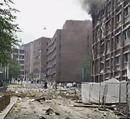
Blast kills 20 in Rawalpindi Shia procession

[email protected] (CD Network)
November 22, 2012

blast_copy

Islamabad, November 22: Twenty people have died in Pakistan's Rawalpindi city when a powerful explosion ripped through a Shia procession, police said Thursday.

The attack took place around 11.40 p.m. Wednesday when a suicide bomber blew himself up among a crowd of worshippers, Rawalpindi Deputy Commissioner Saqib Zaffar said.

Over 1,500 Shia Muslims took part in the procession. Nearly 50 others were injured.

The police said about five kilograms of explosives were used in the attack. Seven grenades were also recovered from the scene of the blast, Xinhua reported.

The injured were shifted to various hospitals. Officials said the toll could rise as some of the injured, including women and children, were in critical condition.

Wednesday's blast took place hours after a twin-bomb explosion in Karachi targeting Shia Muslims left at least two people dead and 15 others.

Interior Minister Rehman Malik has ordered the administration to beef up security.


Comments

Add new comment

  • Coastaldigest.com reserves the right to delete or block any comments.
  • Coastaldigset.com is not responsible for its readers’ comments.
  • Comments that are abusive, incendiary or irrelevant are strictly prohibited.
  • Please use a genuine email ID and provide your name to avoid reject.
News Network
June 2,2020

Minneapolis, Jun 2: An official autopsy released Monday ruled that George Floyd, the African-American man whose death at police hands set off unrest across the United States, died in a homicide involving "neck compression".

George, 46, died of "cardiopulmonary arrest complicating law enforcement subdual, restraint, and neck compression," and the manner of death was "homicide," the Hennepin County Medical Examiner in Minneapolis said in a statement.

Floyd's other significant health conditions were listed as "arteriosclerotic and hypertensive heart disease; fentanyl intoxication; recent methamphetamine use."

The statement added that the "manner of death is not a legal determination of culpability or intent."

It emphasized that under Minnesota state law "the Medical Examiner is a neutral and independent office and is separate and distinct from any prosecutorial authority or law enforcement agency."

Comments

Add new comment

  • Coastaldigest.com reserves the right to delete or block any comments.
  • Coastaldigset.com is not responsible for its readers’ comments.
  • Comments that are abusive, incendiary or irrelevant are strictly prohibited.
  • Please use a genuine email ID and provide your name to avoid reject.
Agencies
March 15,2020

Houston, Mar 15: Researchers, studying the novel coronavirus, have found that the time between cases in a chain of transmission is less than a week, and over 10 per cent of patients are infected by someone who has the virus, but does not show symptoms yet, a finding that may help public health officials contain the pandemic.

The study, published in the journal Emerging Infectious Diseases, estimated what's called the serial interval of the coronavirus by measuring the time it takes for symptoms to appear in two people with the virus -- the person who infects another, and the infected second person.

According to the researchers, including those from the University of Texas at Austin, the average serial interval for the novel coronavirus in China was approximately four days.

They said the speed of an epidemic depends on two things -- how many people each case infects, and how long it takes cases to spread.

The first quantity, the scientists said, is called the reproduction number, and the second is the serial interval.

Due to the short serial interval of the disease caused by the coronavirus -- COVID-19 -- they said, emerging outbreaks will grow quickly, and could be difficult to stop.

“Ebola, with a serial interval of several weeks, is much easier to contain than influenza, with a serial interval of only a few days,” said Lauren Ancel Meyers, study co-author from UT Austin.

Meyers explained that public health responders to Ebola outbreaks have much more time to identify and isolate cases before they infect others.

“The data suggest that this coronavirus may spread like the flu. That means we need to move quickly and aggressively to curb the emerging threat,” Meyers added.

In the study, the scientists examined more than 450 infection case reports from 93 cities in China, and found the strongest evidence yet that people without symptoms must be transmitting the virus -- known as pre-symptomatic transmission.

More than one in ten infections were from people who had the virus but did not yet feel sick, the scientists said.

While researchers across the globe had some uncertainty until now about asymptomatic transmission with the coronavirus, the new evidence could provide guidance to public health officials on how to contain the spread of the disease.

“This provides evidence that extensive control measures including isolation, quarantine, school closures, travel restrictions and cancellation of mass gatherings may be warranted,” Meyers said.

The researchers cautioned that asymptomatic transmission makes containment more difficult.

With hundreds of new cases emerging around the world every day, the scientists said, the data may offer a different picture over time.

They said infection case reports are based on people's memories of where they went and whom they had contact with, and if health officials move quickly to isolate patients, that may also skew the data.

“Our findings are corroborated by instances of silent transmission and rising case counts in hundreds of cities worldwide. This tells us that COVID-19 outbreaks can be elusive and require extreme measures,” Meyers said.


Comments

Add new comment

  • Coastaldigest.com reserves the right to delete or block any comments.
  • Coastaldigset.com is not responsible for its readers’ comments.
  • Comments that are abusive, incendiary or irrelevant are strictly prohibited.
  • Please use a genuine email ID and provide your name to avoid reject.
News Network
April 10,2020

Paris, Apr 10: French pharma major Sanofi said on Friday it has decided to donate 100 million doses of hydroxychloroquine, the anti-malaria drug which could be a potential weapon against novel coronavirus, across 50 countries.

The company has already doubled its incremental production capacity on top of the usual production for current indications across its eight hydroxychloroquine manufacturing sites worldwide and is on track to quadruple it by the summer.

"In this global health emergency, Sanofi stands ready to assist as many countries as possible, starting with countries where its medicine is registered for current approved indications as well as countries where there are no hydroxychloroquine suppliers or countries with underserved populations," it said in a statement.

Sanofi called for coordination among the entire hydroxychloroquine chain worldwide to ensure the continued supply of the medicine if proven to be a well-tolerated and effective treatment in COVID-19 patients.

"The COVID-19 pandemic is an unprecedented health and economic crisis which is shaking some of the very fundamentals of international solidarity and cooperation among countries," said Chief Executive Officer Paul Hudson. "This virus does not care about the concept of borders, so we should not either," he added.

"It is critical that international authorities, local governments, manufacturers and all other players involved in the hydroxychloroquine chain work together in a coordinated manner to ensure all patients who may benefit from this potential treatment can access it. If the trials prove positive, we hope our donation will play a critical role for patients," said Hudson.

While hydroxychloroquine is generating a lot of hope for patients around the world, said Sanofi, it should be remembered that there are no results from ongoing studies and the results may be positive or negative.

To date, there is insufficient clinical evidence to draw any conclusion over the safety and efficacy of hydroxychloroquine in the management of COVID-19 patients.

It is one of several medicines being investigated by the World Health Organisation (WHO) in its international clinical trial seeking a treatment solution for COVID-19. "Sanofi is supporting ongoing trials by providing the medicine to some participating investigator sites and other independent research centres," it said.

Comments

Add new comment

  • Coastaldigest.com reserves the right to delete or block any comments.
  • Coastaldigset.com is not responsible for its readers’ comments.
  • Comments that are abusive, incendiary or irrelevant are strictly prohibited.
  • Please use a genuine email ID and provide your name to avoid reject.