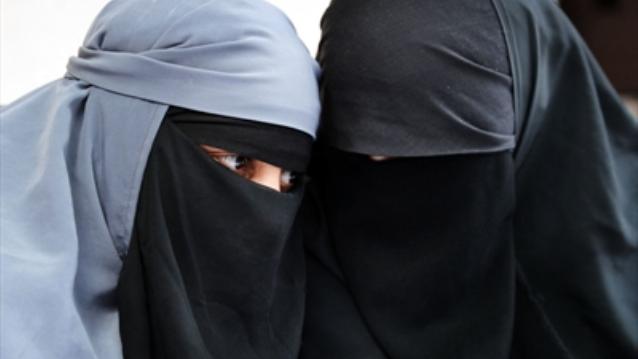
Hijab first in British parliament

November 24, 2012

Hijab_in_US_parliment

London, November 24: A 16-year-old girl is thought to have become the first person to speak from the House of Commons despatch box in the British parliament while wearing a hijab, The Times newspaper reported Saturday.

Sumaiya Karim a biology, chemistry, history and maths student, was speaking as the Youth Parliament held its annual session in the lower house's chamber, where Britain's MPs gather.

Karim, from Wokingham, west of London, said: "Wearing the hijab was my own choice."

The Muslim hijab scarf covers the head and neck but leaves the face exposed.

British ministers and opposition shadow ministers stand at the despatch boxes when they address the Commons.

The democratically elected Youth Parliament members, aged 11 to 18, are elected to represent the views of young people in their area to government.


Comments

Add new comment

  • Coastaldigest.com reserves the right to delete or block any comments.
  • Coastaldigset.com is not responsible for its readers’ comments.
  • Comments that are abusive, incendiary or irrelevant are strictly prohibited.
  • Please use a genuine email ID and provide your name to avoid reject.
Agencies
July 3,2020

The dollar's dominance will slowly melt away over the coming year on weakening global demand and a sombre U.S. economic outlook, according to a Reuters poll of currency forecasters whose views depend on there being no second coronavirus shock.

Despite fears a surge in new Covid-19 cases would delay economies reopening and stymie a tentative recovery, world stocks have rallied - with the S&P 500 finishing higher in June, marking its biggest quarterly percentage gain since the height of the technology boom in 1998.

Caught between bets in favour of riskier investments, weak U.S. economic prospects as well as an easing in the thirst for dollars after the Federal Reserve flooded markets with liquidity, the greenback fell nearly 1.0 per cent last month. It was its worst monthly performance since December.

While there was a dire prognosis from the top U.S. medical expert on the coronavirus' spread, the June 25-July 1 poll of over 70 analysts showed weak dollar projections as Fed Chair Jerome Powell on Monday reiterated the economic outlook for the world's largest economy was uncertain.

"The dollar rises in two instances: when you see risk off or when there is a situation where the U.S. is leading the global recovery, and we don't think that's going to be the case anytime soon," said Gavin Friend, senior FX strategist at NAB Group in London.

"The U.S. is playing fast and loose with the virus, and chronologically they're behind the rest of the world."

Currency speculators, who had built up trades against the dollar to the highest in two years during May, increased their out-of-favour dollar bets further last week, the latest positioning data showed.

About 80 per cent of analysts, 53 of 66, said the likely path for the dollar over the next six months was to trade around current levels, alternating between slight gains and losses in a range. That suggests the greenback may be at a crucial crossroad as more currency strategists have turned bearish.

But more than 90 per cent, or 63 of 68, said a second shock from the pandemic would push the dollar higher. Five said it would push the U.S. currency lower.

Much will also depend on debt servicing and repayments by Asian, European and other international borrowers in U.S. dollars.

While an early shortage of dollars in March from the pandemic's first shock pushed the Fed to open currency swap lines with major central banks, international funding strains have eased significantly since. In recent weeks, usage of the facility has reduced dramatically.

That trend is expected to continue over the next six months with major central banks' usage of swap lines to "stay around current levels", according to 32 of 46 analysts. While 13 predicted a sharp drop, only one respondent said use of them would "rise sharply".

The dollar index, which measures the greenback's strength against six other major currencies, has slipped over 5 per cent since touching a more than three-year high in March.

When asked which currencies would perform better against the dollar by end-December, a touch over half of 49 respondents said major developed market ones, with the remaining almost split between commodity-linked and emerging market currencies.

"The dollar is so overvalued, and has been overvalued for a long time, it's time now for it to come back down again, as we head towards the (U.S.) election," added NAB's Friend.

Over the last quarter, the euro has staged a 1.8 per cent comeback after falling by a similar margin during the first three months of the year. For the month of June, the euro was up 1.2 per cent against the dollar.

The single currency was now expected to gain about 2.5 per cent to trade at $1.15 in a year from around $1.12 on Wednesday, slightly stronger than $1.14 predicted last month. While those findings are similar to what analysts have been predicting for nearly two years, there was a clear shift in their outlook for the euro, with the range of forecasts showing higher highs and higher lows from last month.

"In comparison to even a month or two ago, the outlook in Europe has improved significantly," said Lee Hardman, currency strategist at MUFG.

"I think that makes the euro look relatively more attractive and cheap against the likes of the dollar. We're not arguing strongly for the euro to surge higher, we're just saying, after the weakness we have seen in recent years, there is the potential for that weakness to start to reverse."


Comments

Add new comment

  • Coastaldigest.com reserves the right to delete or block any comments.
  • Coastaldigset.com is not responsible for its readers’ comments.
  • Comments that are abusive, incendiary or irrelevant are strictly prohibited.
  • Please use a genuine email ID and provide your name to avoid reject.
Agencies
June 4,2020

Washington D.C, Jun 4: A lawsuit has been filed against US President Donald Trump for signing an executive order on preventing online censorship that seems to violate the freedom of speech of individuals on social media platforms.

On Tuesday, the Center for Democracy and Technology filed the lawsuit against Trump's "Executive Order on Preventing Online Censorship," which was signed May 28, 2020. The suit argues that the Executive Order violates the First Amendment by curtailing and chilling the constitutionally protected speech of online platforms and individuals.

"CDT filed suit today because the President's actions are a direct attack on the freedom of speech protected by the First Amendment. The government cannot and should not force online intermediaries into moderating speech according to the President's whims. Blocking this order is crucial for protecting freedom of speech and continuing important work to ensure the integrity of the 2020 election," said CDT President and CEO Alexandra Givens.

The executive order is designed to deter social media services from fighting misinformation, voter suppression, and the stoking of violence on their platforms, the digital rights group said.

"Access to accurate information about the voting process and the security of our elections infrastructure is the lifeblood of our democracy. The President has made clear that his goal is to use threats of retaliation and future regulation to intimidate intermediaries into changing how they moderate content, essentially ensuring that the dangers of voter suppression and disinformation will grow unchecked in an election year," Givens said.

The law firm of Mayer Brown is representing CDT in this action.

Comments

Add new comment

  • Coastaldigest.com reserves the right to delete or block any comments.
  • Coastaldigset.com is not responsible for its readers’ comments.
  • Comments that are abusive, incendiary or irrelevant are strictly prohibited.
  • Please use a genuine email ID and provide your name to avoid reject.
News Network
April 11,2020

Washington, Apr 11: China is considered a developing country, make the United States too a developing one, US President Donald Trump said on Friday, alleging that Beijing has taken advantage of his country.

"China has been unbelievably taken advantage of us and other countries. You know, for instance, they are considered a developing nation. I said well then make us a developing nation too,” Trump told reporters at his daily White House news conference on coronavirus.

The president was responding to a question on China.

“They get big advantages because they are a developing nation. India, a developing nation. The United States is a big developed nation. Well, we have plenty of development to do,” he said.

Reiterating that United States was taken advantage of by the World Trade Organization, Trump said the Chinese economy started booming after it joined WTO with the help of the US.

“If you look at the history of China, it was only since they went into the WTO that they became a rocket ship with their economy. They were flatlined for years and years,” he said.

“Frankly, for many, many decades. And it was only when they came into the WTO that they became a rocket ship because they took advantage of all -- I'm not even blaming them. I'm saying how stupid were the people that stood here and allowed it to happen,” he said.

For latest updates on coronavirus outbreak, click  here

The Trump Administration will now allow that to happen, he said.

“If they don't treat us fairly, will leave. But now we're starting to win cases,” he said.

Alleging that China has taken advantage of the United States for 30 years, he said, China has taken advantage of the US through WTO and using rules that are unfair to the United States.

"They should have never been allowed it, this should have never been allowed to happen", he added.

“When China joined and was allowed to join under those circumstances the WTO, that was a very bad day for the United States because they have rules and regulations that were far different and far easier than our rules and regulations,” he said.

“Plus. They took advantage of them down to the last. China took advantage of them like few people would even think to take advantage of them and again they are considered right a developing nation,” he added.

The United States, he rued, is not considered a developing nation.

“The were given advantages (for being a developing nation). For many years China has ripped off the United States. Then I came along and right now, as you know, China is paying 25 percent," said Trump, adding that the US is now gaining "billions and billions and billions of dollars in tariffs from China”.

The US is not paying, he asserted.

“Not every country is China but China would devalue their currency and they would also pour out money and they essentially were paying most of those tariffs not us,” he said.

Comments

Add new comment

  • Coastaldigest.com reserves the right to delete or block any comments.
  • Coastaldigset.com is not responsible for its readers’ comments.
  • Comments that are abusive, incendiary or irrelevant are strictly prohibited.
  • Please use a genuine email ID and provide your name to avoid reject.